Polk County stretches from the St. Croix River bluffs at Osceola and St. Croix Falls east to Amery and Clear Lake, with the county seat in the village of Balsam Lake. Criminal cases go to the two-branch Polk County Circuit Court in the Justice Center on West Main Street in Balsam Lake, while four municipal courts handle local ordinance tickets in Amery, Osceola, St. Croix Falls and Turtle Lake. State charges are brought by the elected Polk County District Attorney, whose office is in the same building. The Sheriff books and holds arrested adults at the Polk County Jail, also inside the Justice Center, which is where cash bail is paid.
- Polk County Circuit Court, Justice Center, 1005 West Main Street, Suite 300, Balsam Lake, WI 54810; Clerk of Circuit Court (715) 485-9299
- Polk County District Attorney, Justice Center, 1005 West Main Street, Suite 700, Balsam Lake, WI 54810, (715) 485-9231
- Polk County Sheriff's Office, Justice Center, 1005 West Main Street, Suite 900, Balsam Lake, WI 54810, (715) 485-8300
- Polk County Jail, Justice Center, 1005 West Main Street, Suite 900, Balsam Lake, WI 54810, (715) 485-8370
- Wisconsin State Public Defender, Hudson office (assigned to Polk County), 2100 O'Neil Road, Suite 400, Hudson, WI 54016, (715) 650-9777
- Polk County Human Services Department (juvenile intake), 100 Polk County Plaza, Suite 50, Balsam Lake, WI 54810, (715) 485-8400
Which court hears your case. A local ordinance violation or a first-offense OWI, which Wisconsin treats as a civil forfeiture unless a child under 16 was in the car, is heard by the municipal court serving the place where it happened: the Amery Area court for Amery, Clear Lake, Clayton and the town of Black Brook, the Osceola court for Osceola and Dresser, or the St. Croix Falls or Turtle Lake courts. In Balsam Lake, Luck, Frederic, Milltown, Centuria and the towns, such tickets are generally heard by the circuit court unless the community has a court of its own. Misdemeanors and criminal traffic offenses go to the Polk County Circuit Court, where two judges split the criminal calendar, and felonies are handled there from the first appearance and preliminary hearing to trial.
Where pretrial inmates are held. Every adult arrested by deputies, the State Patrol or the county's many village police departments is brought to the Sheriff's jail at the Justice Center in Balsam Lake. Sentenced inmates may be allowed out for work under Huber release. The jail line, (715) 485-8370, can tell relatives whether someone is in custody and how release can be arranged.
- Local courts in Polk County (circuit court and municipal courts)
- Misdemeanor (for example, theft, battery, disorderly conduct, a second OWI)
- Felony (for example, burglary, felony theft, drug possession with intent to deliver, substantial battery)
- Violent felony (for example, homicide, sexual assault, armed robbery)
- Juveniles (under 17) arrested in Polk County
- Federal cases (U.S. District Court) from Polk County
Local courts in Polk County (circuit court and municipal courts)
Two of Polk County's four municipal courts are joint courts that cover more than one community. All four are limited to ordinance cases, where the only penalty is a forfeiture and jail can follow only from a failure to pay. A defendant in some ordinance cases may be able to have the matter transferred to the circuit court, for example through a timely jury request; ask the municipal clerk about the rules for the specific ticket. The Turtle Lake court also serves the village and town of Almena in neighboring Barron County. Addresses below come from the state's 2021 municipal court directory, so confirm before going in person.
Circuit court
- Polk County Circuit Court, Justice Center, 1005 West Main Street, Suite 300, Balsam Lake, WI 54810. Branches 1 and 2; Clerk of Circuit Court (715) 485-9299
Municipal courts
- Amery Area Municipal Court (city of Amery, villages of Clear Lake and Clayton, and the town of Black Brook), 104 Maple Street West, Suite A, Amery, WI 54001, (715) 268-6567
- Osceola Municipal Court (villages of Osceola and Dresser), P.O. Box 217, Osceola, WI 54020, (715) 294-2090
- St. Croix Falls Municipal Court (city of St. Croix Falls), 710 Highway 35 South, St. Croix Falls, WI 54024, (715) 483-1533
- Turtle Lake Municipal Court (village of Turtle Lake, which straddles the Polk-Barron line, plus Almena), mailing address P.O. Box 11, Turtle Lake 54889, (715) 986-2241
Prosecution, defense, police and intake
- District Attorney, Justice Center, Suite 700, Balsam Lake, (715) 485-9231
- Appointed counsel: the Hudson trial office of the State Public Defender, Suite 400, 2100 O'Neil Road, (715) 650-9777
- Polk County Sheriff's Office, which runs the Polk County Jail, Justice Center, Suite 900, Balsam Lake, (715) 485-8300
- Amery Police Department, 104 Maple Street West, Suite C, Amery, WI 54001, (715) 268-7411
- Osceola Police Department, 310 Chieftain Street, Osceola, WI 54020, (715) 294-3628
- Balsam Lake-Centuria Police Department, 404 Main Street, Balsam Lake, WI 54810, (715) 485-3544
- Clear Lake Police Department, 350 Fourth Avenue, Clear Lake, WI 54005, (715) 263-2156
- Clayton Police Department, 133 Clayton Avenue East, Clayton, WI 54004, (715) 948-2121
- Dresser Police Department, 102 Main Street West, Dresser, WI 54009, (715) 755-2941
- Frederic Police Department, 110 Oak Street East, Frederic, WI 54837, (715) 327-8851
- Luck Police Department, 401 Main Street South, Luck, WI 54853, (715) 472-9191
- Milltown Police Department, 97 Main Street West, Milltown, WI 54858, (715) 825-3500
- St. Croix Falls Police Department, city of St. Croix Falls; reach it through the Sheriff's dispatch at (715) 485-8300
- Juvenile intake: Polk County Human Services, 100 Polk County Plaza, Suite 50, Balsam Lake, (715) 485-8400; after hours through the Sheriff's Office
Misdemeanor (for example, theft, battery, disorderly conduct, a second OWI)
In Polk County, with its dozens of lakes and summer cabin traffic, misdemeanor files tend to involve impaired driving on Highways 8, 35 and 46, boating and alcohol incidents, retail theft and household disputes.
What follows an arrest
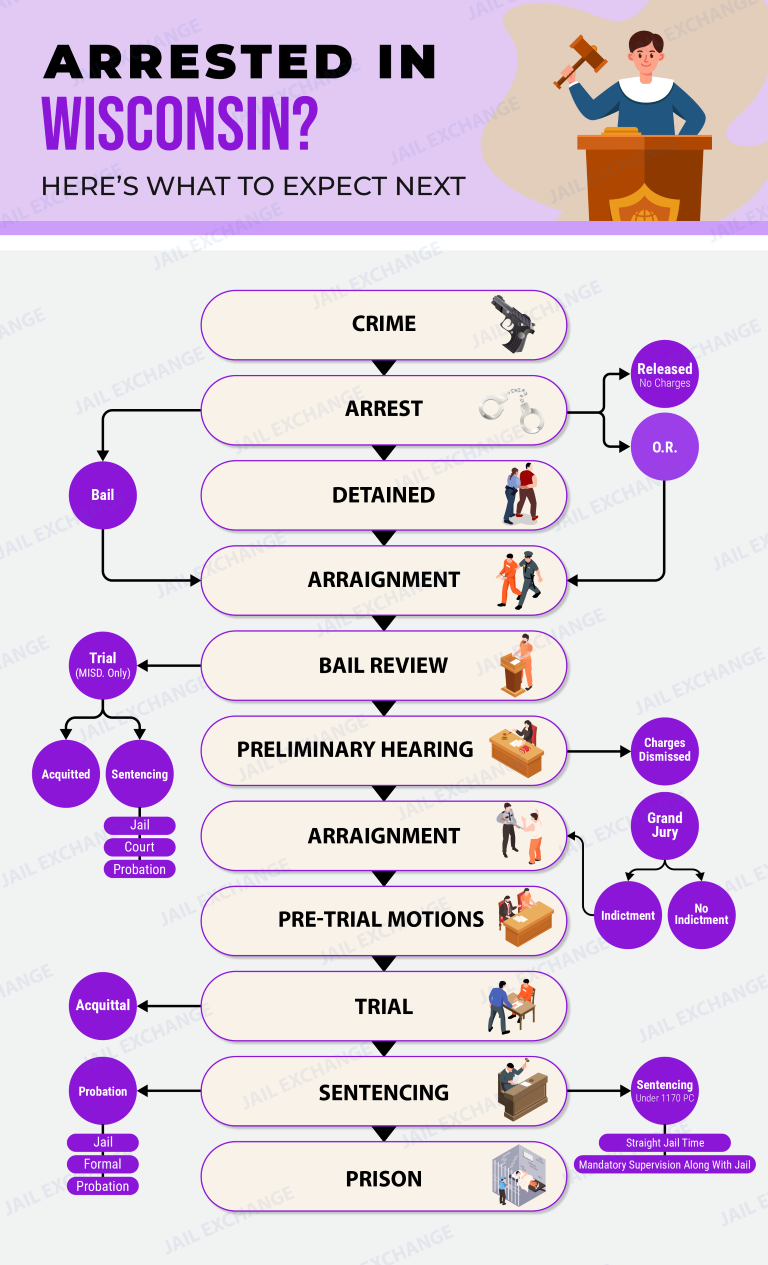
Village officers and deputies often release people on a citation for low-level offenses. Anyone arrested goes to the Polk County Jail in Balsam Lake to be booked. A signature bond is the usual release in misdemeanor cases: the person signs a promise to appear, and an amount may become payable if they do not. A cash amount, when the court requires one, is paid in full at the jail or the clerk's office by the defendant or relatives; Wisconsin bars commercial bonding companies. After a domestic abuse arrest in Polk County, the released person must avoid contact with the alleged victim for 72 hours, a rule the victim can waive in writing.
First appearance and counsel
A person who remains locked up typically sees a Polk County judge or court commissioner within about 48 hours, often by video from the jail, for the reading of the charges and release conditions. Applications for a public defender go to the State Public Defender's Hudson office, (715) 650-9777, and can be begun at the jail. Those who are over the state's tight income limit but still cannot hire a lawyer may ask the court about appointing counsel at county expense.
Maximum penalties for the examples
- Theft of no more than $2,500: Class A misdemeanor, up to 9 months in jail and a $10,000 fine in Balsam Lake.
- Battery: Class A; when charged as domestic abuse, it also brings a surcharge and a federal firearm prohibition.
- Disorderly conduct: Class B, with a limit of 90 days in jail and a $1,000 fine.
- Second OWI within 10 years: 5 days to 6 months of required jail time, a fine, revocation and an ignition interlock. A first OWI is a forfeiture of $150 to $300 plus costs, with 6 to 9 months of revocation, an alcohol and drug assessment and an interlock for a 0.15 or higher test or a refusal.
- Class C misdemeanors: up to 30 days and a fine of $500.
A misdemeanor may end in dismissal, deferred prosecution, a fine, probation or county jail with Huber release. A six-person jury decides any trial. Most cases take two to six months; a speedy trial demand generally obligates the court to start trial within 60 days.
Felony (for example, burglary, felony theft, drug possession with intent to deliver, substantial battery)
Methamphetamine distribution, burglaries of seasonal homes and lake cabins, and repeat drunk driving (a fourth OWI is generally a felony) make up much of the felony work in Polk County. The District Attorney's Office in the Justice Center reviews each referral before filing.
The felony track in Balsam Lake
- Complaint and initial appearance: the court reviews the complaint and sets a signature bond or cash bail with conditions. A 2023 amendment to the Wisconsin Constitution lets the judge consider the potential for serious harm when the charge is violent.
- Preliminary hearing: held within 10 days when the defendant is in custody and cannot post the amount set, or within 20 days otherwise. It tests only probable cause and is frequently waived.
- Information and arraignment: the DA files the information and the defendant enters a plea before Branch 1 or Branch 2.
- Resolution: most felonies end in plea agreements; a trial requires a unanimous jury of 12. After a speedy trial demand, trial should start within 90 days.
- Sentencing: often preceded by a presentence investigation report.
Example felony classes
- Burglary: Class F, which in Polk County carries up to 12.5 years in prison and up to $25,000 in fines.
- Felony theft: over $2,500 to $5,000 is Class I; over $5,000 to $10,000 is Class H; more than $10,000 is Class G (maximums of 3.5, 6 and 10 years).
- Possession with intent to deliver: the class depends on which controlled substance and how much.
- Substantial battery: Class I, with a maximum of 3.5 years and $10,000; aggravated battery is charged as Class H or E.
Under truth in sentencing, a prison term combines initial confinement with extended supervision, and parole does not exist for offenses committed after 1999. Anyone sentenced to a year or less serves that time in the county lockup in Balsam Lake. If the judge finds a defendant eligible, completing the Challenge Incarceration Program or Substance Abuse Program can shorten confinement. Felony cases in Polk County generally run six to twelve months.
Violent felony (for example, homicide, sexual assault, armed robbery)
The Sheriff's Office leads most major violent-crime investigations in rural Polk County, with village departments and state agents assisting when needed. Prosecutions are handled by the District Attorney in Balsam Lake.
Custody
People charged with homicide, sexual assault or armed robbery are usually held at the Polk County Jail through at least the initial appearance. A judge may set a high cash bail with strict conditions and, under the 2023 constitutional change, can weigh the risk that the defendant would cause serious bodily harm. The State Public Defender's Hudson office, (715) 650-9777, determines eligibility for an appointed lawyer.
Penalties
- First-degree intentional homicide: Class A with a mandatory life sentence; the Polk County judge sets a date for possible release to extended supervision or orders life without it.
- Second-degree intentional homicide and first-degree reckless homicide: both Class B felonies with 60-year maximum terms.
- First-degree sexual assault: Class B, up to 60 years, with mandatory minimums in some cases involving young children.
- Armed robbery: Class C, carrying up to 40 years and a $100,000 fine; robbery without a weapon is Class E.
Wisconsin ended the death penalty in 1853. Violent felony cases move through the same preliminary hearing and arraignment stages as other felonies, but forensic work and motions often push them to one or two years. Victims hold constitutional rights under Marsy's Law, approved by voters in 2020, including notice of proceedings and the chance to speak at sentencing. Appeals go to the Wisconsin Court of Appeals, with possible review by the Wisconsin Supreme Court.
Juveniles (under 17) arrested in Polk County
Polk County's circuit court also sits as the juvenile court for delinquency cases involving children ages 10 through 16. Once a person turns 17, Wisconsin prosecutes new crimes in adult court.
Juvenile intake
Officers who take a child into custody call the intake worker at Polk County Human Services in Balsam Lake, (715) 485-8400 during the day, or through the Sheriff's Office at night and on weekends. The worker can send the child home, close the referral, arrange a deferred prosecution agreement, or pass the case to the District Attorney to consider a delinquency petition. When intake keeps a youth in custody, the law calls for a custody hearing within 24 hours of that decision, with weekends and legal holidays excluded.
Secure detention
Polk County has no juvenile detention center. A youth who needs secure detention is usually transported to a facility in another county that holds Polk County youths under contract, such as the Northwest Regional Juvenile Detention Center in Eau Claire. Parents can learn the location from Human Services.
How juvenile cases are resolved
- A deferred prosecution agreement at intake or a consent decree in court.
- Supervision at home with conditions such as counseling, schooling, restitution and community service.
- Placement in a foster home, group home or residential treatment, or a Type 2 placement.
- Type 1 placement at Lincoln Hills School for boys or Copper Lake School for girls, or the Serious Juvenile Offender program, reserved for grave cases.
When a juvenile can face adult charges
The District Attorney may ask to waive a youth 14 or older into adult court for many offenses, and in limited cases a younger child can be waived. Adult court holds original jurisdiction over children 10 and older charged with attempted or completed first-degree intentional homicide, first-degree reckless homicide or felony murder, and over some youths with prior delinquency adjudications who are accused of certain additional crimes. The State Public Defender represents children in juvenile cases. Juvenile records are generally closed to the public.
Federal cases (U.S. District Court) from Polk County
Polk County falls within the Western District of Wisconsin. Federal charges arising in the county are filed and tried in Madison.
- Clerk's Office, Western District of Wisconsin, at 120 North Henry Street (Room 320) in Madison, (608) 264-5156
- U.S. Attorney's Office serving western Wisconsin, Suite 700, 222 West Washington Avenue, Madison, (608) 264-5158
- Federal Defender Services of Wisconsin (Madison), 22 East Mifflin Street, Suite 1000, Madison, WI 53703, (608) 260-9900; a private Criminal Justice Act panel lawyer is appointed when the office has a conflict
Federal jurisdiction in Polk County
Typical federal cases include drug trafficking conspiracies, gun possession by felons and other prohibited people, bank robbery, child exploitation and fraud. The headquarters of the St. Croix National Scenic Riverway is in St. Croix Falls, and the river along the county's western edge is federally managed, so crimes on Riverway land may be charged federally, though the state can also prosecute. Communities of the St. Croix Chippewa Indians of Wisconsin are in and near northern Polk County. Wisconsin is a Public Law 280 state, so the Polk County Circuit Court generally has criminal jurisdiction over tribal lands here, alongside the tribe's own court; the Menominee Reservation in the east of the state is the federal exception.
How federal prosecutions proceed
A defendant arrested on federal charges first goes before a U.S. magistrate judge, who goes over the accusations and names a lawyer for any defendant who meets the financial test. Instead of cash bail, the Bail Reform Act calls for release on conditions supervised by Pretrial Services or for detention, decided at a hearing usually held within three court days of the government's motion. An arrest on a complaint must be followed by a grand jury indictment within 30 days, and the Speedy Trial Act sets a 70-day limit for trial that is often extended.
Most federal defendants plead guilty; those who go to trial face 12 jurors, who must be unanimous. The judge sentences after a presentence report, using the advisory Sentencing Guidelines and any mandatory minimum term. Because federal parole was abolished, a prisoner serves roughly 85 percent of the term in the Bureau of Prisons before supervised release begins. Appeals go to the U.S. Court of Appeals for the Seventh Circuit.
Looking up a federal inmate
To learn where a federal prisoner from Polk County is held, try the Federal Bureau of Prisons inmate locator, which accepts a name or a register number. A detainee kept in a county jail for the Marshals before trial might also be listed on that jail's own roster. Juvenile cases are seldom brought in federal court.
The information on this page describes the general criminal process in Polk County, Wisconsin, and is not legal advice; procedures, offices and phone numbers can change. Speak with a criminal defense attorney licensed in Wisconsin about any particular case. Public defender applications are handled by the State Public Defender's Hudson office at (715) 650-9777; to ask whether someone is in custody, call the Polk County Jail at (715) 485-8370 or the Sheriff's Office at (715) 485-8300.