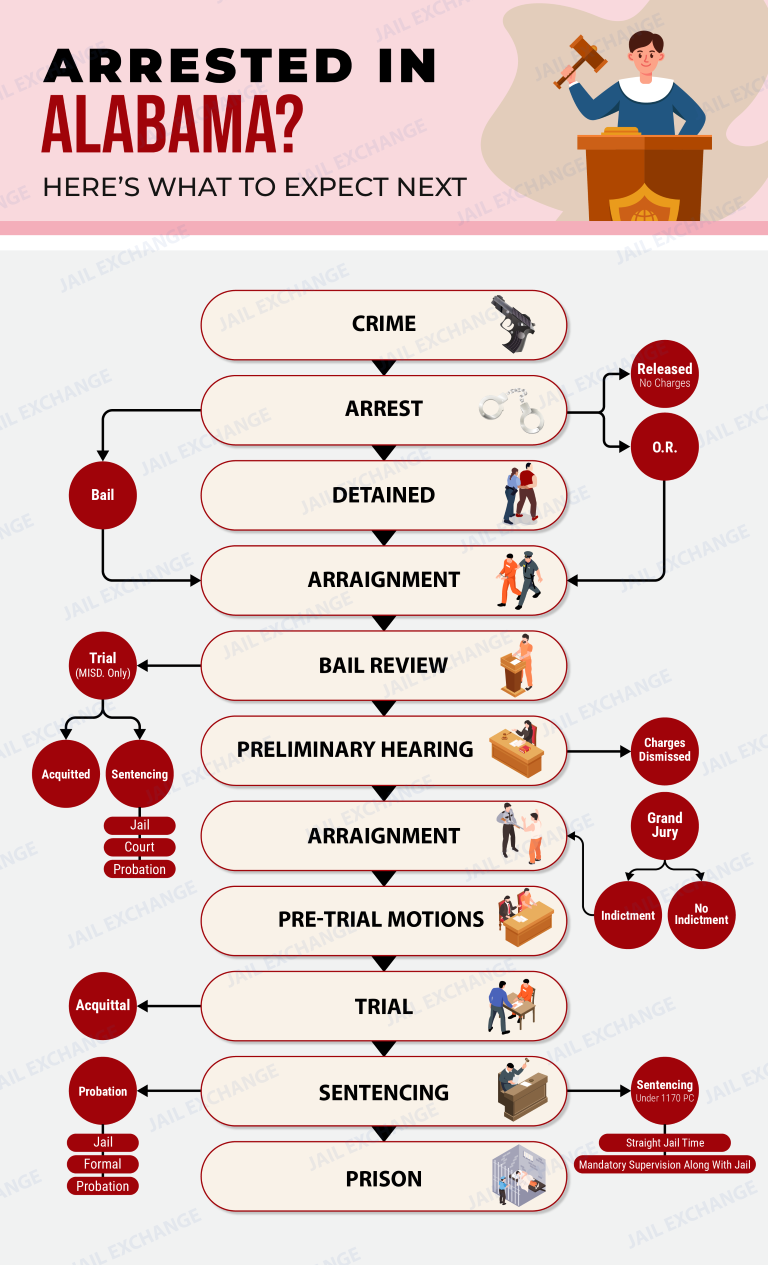
Conecuh County Jail Criminal Court Process
Criminal Court Process for Conecuh County Alabama
Conecuh County Criminal Court Guide
This guide shows how a Conecuh County criminal case moves from arrest to a plea, a trial or a dismissal. Every adult arrested in Evergreen, Castleberry, Repton or the rural parts of the county is booked into the Conecuh County Jail, 104 Liberty Street, Evergreen, AL 36401, and state cases go to the Government Center on Court Street.
Before a hearing, confirm custody in the official custody lookup. Current custody, fresh arrests, warrants, charges, mugshots and property pickup are all on our Inmate Search page.
The circuit clerk at 251-578-2066 is the best first call, weekdays from 8:00 a.m. until 5:00 p.m. Spell the legal name, then ask what the case number is and when and where the next setting will be. For bond and release, read our Conecuh County bail guide.
1. Which courts hear criminal cases in Conecuh County?
Conecuh and Monroe counties together make up the 35th Judicial Circuit. The charge and the agency that filed it decide where a case is heard:
- Circuit Court: indicted felonies, jury trials and appeals sent up by lower courts
- District Court: state misdemeanors, traffic tickets, plus felony first appearances and preliminary hearings
- Evergreen and Repton municipal courts: town ordinance charges filed by city officers
- Juvenile court: delinquency cases for anyone under 18, held at the same Evergreen building
Look at the ticket, warrant or complaint to see which court is named. The lower courts decide cases with a judge alone, so a jury trial can only happen in Circuit Court.
↑ Back to the question list2. Where do I find the Evergreen courthouse and clerk?
Both state trial courts work out of the county Government Center in Evergreen. The circuit clerk, who handles circuit and district files, is in Room 203: the county Government Center, 111 Court Street, Room 203, Evergreen, AL 36401, 251-578-2066. The counter is open Monday to Friday, 8:00 a.m. until 5:00 p.m.
Clerk staff can look up a case number, read you the next hearing date and print orders, like a bond order. For advice about the case itself, ask a lawyer instead. The county court website shows the office hours too. Carry a photo ID and leave time for the security line before court starts.
↑ Back to the question list3. Which town courts hear city charges in this county?
Arrests by town police generally lead to that town's court. Two Conecuh towns have one:
- Evergreen Municipal Court: 355 East Front Street, Evergreen, AL 36401, 251-578-1574
- Repton Municipal Court: Conaly Street in Repton, 251-248-2370
Castleberry cases normally land in District Court at the Evergreen courthouse, so start with the circuit clerk at 251-578-2066. State charges written by deputies or troopers go to District Court as well. A city charge carries a separate bond and court date, even when the person is held at the Liberty Street jail, so check with every court on the paperwork.
↑ Back to the question list4. What is said at the first hearing after arrest?
The initial appearance is quick. The judge reads the charge, reminds the person they can keep quiet and have a lawyer, and goes over the release conditions. No one is convicted at this point. For a felony complaint, the person also learns they can ask for a preliminary hearing.
Alabama Rule 4.3 puts a clock on this. Someone picked up with no warrant should have probable cause reviewed by a judge inside 48 hours. For a warrant arrest, when bond money is not there, the hearing comes within 72 hours. On domestic violence charges, release can wait as long as 24 hours while a judge writes conditions.
↑ Back to the question list5. How does a misdemeanor case usually go?
Misdemeanors, like fourth-degree theft, a first DUI on Interstate 65 or third-degree domestic violence, usually stay in a lower court:
- An opening date in District Court or a town court, where the person may request an appointed lawyer.
- Back-and-forth between defense and prosecution over the evidence and any offer.
- An ending by plea, diversion or a bench trial before the judge.
Alabama's top penalties: Class A can bring a year behind bars and a $6,000 fine, Class B half a year, and Class C three months. On a first DUI, jail can reach one year, with a fine between $600 and $2,100.
↑ Back to the question list6. What steps does a Conecuh felony case follow?
Felony cases, for example drug possession, third-degree burglary or a stolen pickup, move through two courts:
- First appearance in District Court, where an appointed lawyer can be assigned if money is short.
- A preliminary hearing, but only if asked for within 30 days of arrest, before any indictment.
- Grand jury. An indictment passes the file on to Circuit Court, unless the defendant gives up that step and pleads.
- Circuit Court arraignment, followed by a plea agreement or jury trial.
Six months to a year is common. Unless bond is posted or reduced, the person spends that time at the Liberty Street jail.
↑ Back to the question list7. How long can an Alabama felony sentence be?
Alabama law puts each felony in one of four classes. Prison ranges for each:
- Class A felony: life, or a term between 10 and 99 years
- Class B felony: from two years up to twenty
- Class C felony: from a year and a day up to a decade
- Class D felony: from 366 days up to five years
Simple drug possession is normally Class D, third-degree burglary is Class C and auto theft is Class B. Trafficking is Class A and carries mandatory minimums. Lower-level drug and property cases often point toward probation under the sentencing standards, while a record of prior felonies raises the possible sentence through the Habitual Felony Offender Act. For someone still under 21 when the crime took place, youthful offender status may be requested; that keeps the record private and limits prison time to three years at most.
↑ Back to the question list8. What happens in a Conecuh murder or assault case?
Violent felonies from Conecuh are tried in Evergreen, and defendants usually wait at the Liberty Street jail. Aniah's Law allows a judge, after a hearing, to deny bail for listed crimes like murder and first-degree robbery. Alabama voters expanded that list on May 19, 2026, to cover attempted murder and firing into an occupied vehicle or building. Our state bail rules page walks through the details.
- Murder or first-degree robbery: Class A, a decade to 99 years or life, and no less than 20 years when a gun or other deadly weapon was involved
- Second-degree assault: Class C, a year and a day up to a decade
- Capital murder: execution or life with no parole, where a death sentence takes the votes of at least 10 jurors out of 12
Expect a case like this to last a year or more.
↑ Back to the question list9. Which office prosecutes state charges here?
The District Attorney for the 35th Judicial Circuit brings state charges here and in Monroe County. That office works from Monroeville, takes mail at P.O. Box 397, Monroeville, and answers at 251-575-2067.
Prosecutors represent the State of Alabama. They do not speak for the defendant, so relatives should keep case details for the defense lawyer. Victims and witnesses may call the office about court dates and victim rights. Charges in Evergreen or Repton city court are argued by that town's prosecutor instead.
↑ Back to the question list10. Can the Evergreen court appoint a defense lawyer?
Anyone who cannot pay for a defense should tell the judge, usually at the first hearing. They will sign an affidavit about income, what they own, what they owe and who depends on them. Rule 6.3 lets the judge take a fresh look if money changes, and relatives chipping in on bond do not make the person ineligible.
Judges in this circuit pick private or contract attorneys, and the state covers the bill. Call the circuit clerk at 251-578-2066 to learn how the request works. Alabama's Office of Indigent Defense Services, which oversees that system, is at 100 North Union Street, Suite 680, Montgomery, AL 36104, 334-242-7059. Get a lawyer in place before agreeing to plead guilty.
↑ Back to the question list11. Can a District or town court verdict be appealed?
Yes. District Court and the Evergreen and Repton city courts hold bench trials only. Someone found guilty in one of them gets 14 days to appeal, and Circuit Court hears the whole case again with a jury.
Two weeks passes quickly, so call the defense lawyer the day of the verdict. Appeal papers go through the circuit clerk at the county Government Center, 111 Court Street, Room 203, Evergreen, AL 36401, 251-578-2066. A new bond may be needed for the appeal, and the person can stay in custody until it is posted. Convictions in Circuit Court go up to a higher Alabama court instead.
↑ Back to the question list12. How are juvenile cases handled in Conecuh County?
Juvenile probation screens each complaint against a child before it reaches juvenile court in Evergreen, and probation is reached by calling the circuit clerk at 251-578-2066. There is no bail in juvenile court. A child who is held must get a hearing inside 72 hours under Ala. Code § 12-15-207. When going home is not an option, the child usually goes to the Baldwin County Regional Juvenile Detention Center, 43405 Nicholsville Road, Bay Minette, AL 36507, 251-580-2540, or now and then the Strickland Youth Center, 2315 Costarides Street, Mobile, AL 36617, 251-574-1450.
Results range from an informal adjustment to probation to commitment with the Alabama Department of Youth Services. Under § 12-15-204, a 16- or 17-year-old facing the gravest felonies goes straight to adult court, and prosecutors may seek a transfer for any child 14 or older. If the parents have no money for counsel, the court assigns one.
↑ Back to the question list13. What changes when the charge is federal?
Cases brought by federal prosecutors, often drug seizures on I-65, firearms held by people with felony records, or fraud, are filed in Mobile at the federal courthouse for the Southern District's Southern Division, 155 St. Joseph Street, Mobile, AL 36602, 251-690-2371. The U.S. Marshals Service, 155 St. Joseph Street, Suite 201, Mobile, AL 36602, 251-499-6620, places federal prisoners in jails it contracts with, the Evergreen jail among them.
There is no money bail chart in federal court. After a first hearing before a magistrate judge, a Bail Reform Act hearing settles release or detention. Indictment is due in 30 days and trial in 70 under federal speedy-trial law, though extra time is routinely allowed. Since federal sentences carry no parole, about 85 percent of the time gets served. After sentencing, search the federal inmate locator.
↑ Back to the question list14. How does an ICE hold affect a criminal case?
The immigration hold and the criminal charges are separate. ICE files Form I-247A to ask the Evergreen jail for notice before release and for up to 48 extra hours of custody after that time. Guilt, sentencing and bond stay with the criminal court, and posting bond leaves the hold in force.
The ICE office responsible for Conecuh is the New Orleans Field Office, 181 James Drive W, St. Rose, LA 70087, 504-318-2360. Alabama short stays can include the Baldwin County Corrections Center, 200 Hand Avenue, Bay Minette, AL 36507, 251-937-0361. Once ICE moves the person, check the online detainee locator. Before any plea, a defense lawyer should explain the possible immigration consequences.
↑ Back to the question list15. How do I check for a Conecuh warrant or missed date?
Warrants are served by deputies out of the sheriff's office, 104 Liberty Street, Evergreen, AL 36401, 251-578-1260. Court filings appear on Alacourt Access at $9.99 per name search, while the county court website gives the clerk's hours and phone.
After a missed court date, ask the circuit clerk at the county Government Center, 111 Court Street, Room 203, Evergreen, AL 36401, 251-578-2066 for a new setting. Turning in by appointment, set up through counsel, tends to go smoother than getting picked up on the warrant.
↑ Back to the question list16. How do I find someone after sentencing?
After court, a person might stay local or be moved. Pick the search that fits:
- Still at the Liberty Street jail: the official custody lookup
- Sent to an Alabama prison: the state corrections inmate finder, using a name or AIS number
- Federal custody: the federal inmate locator after sentencing, or the U.S. Marshals at 251-499-6620 before then
- Custody alerts: VINELink, which can call or email you when the person is moved or released
State prisoners often sit in the county jail for weeks waiting on a ride. See our Inmate Search page for more.
↑ Back to the question list