
Dallas County Jail
Dallas County Jail
Jail Phone Number
334-690-1200Dallas County Inmate Search: Finding Someone After a Selma-Area Arrest
This page helps you find an adult arrested anywhere in Dallas County, from Selma to Orrville and Valley Grande. The old jail building on Selfield Road in Selma is closed after tornado damage, so the Dallas County Jail now runs from a temporary site at 4805 US Highway 80, Uniontown, AL 36786. Some people are also housed in jails in other counties.
Wondering if a friend or relative is behind bars? Type their last name into the official custody search. Check that the age and arrest date fit, then save any booking number on the record. A blank result can simply mean booking is still going on, or that the person was moved.
Next, call the Sheriff's Office at 334-874-2530. Ask two questions, with the name and birthday ready: which facility is holding them and how much the bond is. Our bail and bond page covers the release process, and the county court guide explains hearings, case files and court dates.
Read inmate search answers
 Read inmate search answers
1. How does the Dallas County custody search work?
Open the official custody search, pick Alabama if it asks, and enter the surname. Add a first name when too many matches come up. Look at the age and booking date on each result before you decide it is your person, because many families in Selma share last names. Save the booking number and the facility name the record shows.
The facility shown on the screen can lag behind a recent move between jails. Prior to any trip, phone the Sheriff's Office, 102 Church Street, Selma, AL 36702, at 334-874-2530. Ask staff to read you the person's current location, the charges and the bond. Write down the name of the jail they give you and the time you called.
↑ Back to the question list2. Why is the Selma jail on Selfield Road closed?
A tornado hit Selma on January 12, 2023, and damaged the county jail at 988 Selfield Road, Selma, AL 36703. The building has stayed closed since then while repair work goes on. Please do not drive there to visit, mail letters there, or try to drop off money or clothes there. Nobody will be there to take them.
For now the jail works out of a temporary facility at 4805 US Highway 80, Uniontown, AL 36786, 334-690-1200. Its office is open Monday through Friday from 8 a.m. to 5 p.m. Some people are kept in other counties' jails as well. Ask the Sheriff's Office at 334-874-2530 for the newest word on when the Selma building will open again.
↑ Back to the question list3. Where are adults arrested in Dallas County held now?
Most adults booked on county charges go to the county's temporary jail near Uniontown. The county website lists that site as the jail's current home. In 2026 the sheriff said others are being housed in jails in other counties, so the person could be some distance from Selma. These are the places to know:
- Temporary county jail: 4805 US Highway 80, Uniontown, AL 36786, 334-690-1200. Holds adults now.
- Old county jail: 988 Selfield Road, Selma, AL 36703. Closed since the 2023 tornado.
- Youth detention: Dallas County Juvenile Detention Center, 800 Selfield Road, Selma, AL 36703, 334-876-4809. Holds children under 18.
The Sheriff's Office at 334-874-2530 knows which jail holds each county prisoner, whichever agency made the arrest.
↑ Back to the question list4. Why is a new arrest not showing up?
An empty result rarely means the person has already gone home. Some common reasons a search comes up empty:
- Booking is slow. Prints, photos and forms often eat up several hours.
- The name was typed another way, or the person gave a middle name or a married name.
- Selma officers kept the person downtown for a short time before the move to a county jail.
- The person was moved to a jail in another county.
- The person got a ticket with a court date and was never booked.
Try other spellings first. Then call the Sheriff's Office, 102 Church Street, Selma, AL 36702, at 334-874-2530 with the full name, date of birth, and when and where the arrest happened. Staff can tell you if booking is finished.
↑ Back to the question list5. Could the police have ticketed the person instead?
Yes. For many minor offenses, an officer may simply write a citation that lists a hearing date, and no one goes to jail. Alabama's Rule 4.3 allows this kind of release in cases that qualify. That person never goes to a jail, so the custody search will not show them.
Where the case goes depends on who wrote the ticket. Tickets from Selma officers for city charges go to Selma Municipal Court at 1300 Alabama Avenue, Selma, AL 36703, 334-876-1299. Tickets from deputies, troopers and officers in the smaller towns are filed in District Court, which sits at the county courthouse, 105 Lauderdale Street, Selma, AL 36701, 334-874-2523. Keep the ticket somewhere safe. Missing that court date can lead a judge to issue a warrant.
↑ Back to the question list6. What are the time limits for a first hearing?
Alabama court rules set time limits for people who stay in jail after an arrest:
- No warrant at arrest: within 48 hours, a judge or magistrate decides if probable cause existed.
- Arrested on a warrant: someone who still cannot bond out sees a judge in 72 hours or less.
- Domestic violence: bond can be delayed for up to 24 hours.
These limits do not promise release when time runs out. They mean a judge has to look at the case. Because the county houses people in more than one place, the hearing can happen by video. For the time of that first appearance, call the circuit clerk at 105 Lauderdale Street, Selma, AL 36701, 334-874-2523, and give the name and birthday.
↑ Back to the question list7. How does bail work after a Dallas County booking?
Start by asking the Sheriff's Office at 334-874-2530 what bond each charge carries and where payment is accepted. The person may be sleeping in another county, so the place to pay may not be the place they are held. Bond in Alabama is usually one of these:
- Cash paid in full to the court
- A licensed bondsman, who keeps the fee they charge
- A pledge of land or a house in Alabama
- A signature bond, which costs nothing up front but requires a signed promise to return
Alabama also adds a 3.5% fee plus $35 to a bond. Our bond guide covers each step, and Alabama's bail laws explain the state rules.
↑ Back to the question list8. Where can I read the charges filed in Selma?
The charge on a booking record is the reason for the arrest. Prosecutors may later file a different or extra charge. To read what was actually filed, look at the court file. Felony charges can lead to prison for more than a year. Misdemeanors carry less than a year.
The circuit clerk keeps state case files at the county courthouse, 105 Lauderdale Street, Selma, AL 36701, 334-874-2523. You can read a file at the counter for free. Office hours run 8 a.m. to noon and 1 to 4:30 p.m., and the office is closed to the public on Wednesdays. You can also search state cases on Alacourt Access, where a $9.99 name search covers one case.
↑ Back to the question list9. Can an inmate get a lawyer at no cost?
Anyone without money for a lawyer should tell the judge at their earliest hearing. The judge will ask questions about money and have the person fill out a sworn form that lists income, bills, property and the people they support. Answer it honestly. When the judge finds the person qualifies, counsel is appointed with nothing to pay up front. Under Rule 6.3, eligibility can be revisited when finances change. Relatives who help with bond do not spoil the right to appointed counsel.
The state Office of Indigent Defense Services, 100 North Union Street, Suite 680, Montgomery, AL 36104, 334-242-7059, runs the appointed lawyer program. Calls from the jail are taped, so hold back case facts until you meet the lawyer in person.
↑ Back to the question list10. How do visits work for Dallas County inmates?
Visits for people held by the county are by video and last 20 minutes. Families may also be able to set up remote video visits from home. If the person is in another county's jail, that jail's visiting rules apply instead, so always ask where the person is before you plan anything.
Call the temporary jail at 4805 US Highway 80, Uniontown, AL 36786, 334-690-1200, on a weekday between 8 a.m. and 5 p.m. Ask how to sign up, what ID visitors need, whether children can join, and what any video visit costs. Our pages on how visits work and remote video visits explain the usual steps.
↑ Back to the question list11. How do families add commissary money?
Money for snacks, soap and other store items goes into a commissary account. That money is separate from bond. Putting money on an account will not get anyone out of jail.
Before you send anything, confirm the jail that houses them right now. If they are at the county's temporary jail, call 334-690-1200 and ask how deposits are made. If they are housed in another county, use that jail's own deposit method. Match the full name and booking number on every deposit and keep the receipt. Our commissary page explains what the account buys, and the money page covers deposits. Never send money through a link a stranger texts you.
↑ Back to the question list12. How can an inmate call my phone?
People in jail call out using prepaid phone accounts. To let someone call your number, set up an account through the phone service the housing jail uses and add money to it. The housing jail can explain the setup, because a jail in another county may use a different company.
The temporary county jail answers at 334-690-1200 on weekdays. Our jail phone page explains how accounts work, and the messaging page covers electronic notes where offered. Every call is recorded. Keep the arrest, the evidence and any witnesses off these calls. Save those things for the lawyer.
↑ Back to the question list13. Where should letters to an inmate go?
Never mail anything to the closed jail on Selfield Road in Selma. Letters sent there can be lost or sent back. Phone the Sheriff's Office at 334-874-2530 first and get the right mailing address for the jail where the person is held right now.
On the envelope, write the inmate's full legal name and booking number. Put your return address in the corner too, so a refused letter finds its way back. Send only plain letters and photos the jail allows. Do not send cash, stamps, medicine or anything glued or taped. Letters from an attorney are handled under separate rules. If the person is moved, ask again before you mail the next letter. Our jail mail guide explains the usual rules.
↑ Back to the question list14. How do I pick up property after a release?
Whatever was taken at booking, like a phone, keys or a wallet, stays at the jail that holds the person. When someone is released, they get their property back at that same jail. If the person stays in jail, they may be able to sign a form that lets another adult pick up certain items.
Call the jail first. For the county's temporary jail, use 334-690-1200 on a weekday. Ask what items are ready, what ID the jail wants to see, and what hours pickup runs. Things kept as evidence are handled separately and are not released with the person. A vehicle towed during the arrest goes through a different process. Keep every property receipt, and give questions about evidence to the defense lawyer.
↑ Back to the question list15. How do I tell the jail about medicine or an injury?
First find out where the person is held by calling the Sheriff's Office at 334-874-2530. Then call that jail and ask for the shift supervisor or the medical staff. For the temporary county jail, the number is 334-690-1200.
Start with the inmate's name and date of birth, then list each medicine and its dose, any allergies, and any health problem staff should watch for, such as diabetes, seizures or a mental health condition. Do not show up with medicine unless the staff request it. Injuries from the arrest should be photographed when possible, with notes on what happened, and shared with the lawyer. If the emergency is happening outside the jail, dial 911.
↑ Back to the question list16. Can I see mugshots after a Dallas County arrest?
The Sheriff's Office holds the mugshots taken when people are booked. Reporters may ask for a booking photo by calling 334-874-2530. A family member who needs a photo should call the same number and ask what the request process is. Share details like the birth date so staff pull the right person's record.
Federal mugshots work differently. The U.S. Marshals take those photos and share one only to help catch a wanted person or warn the public. ICE releases its own booking photos only after an approved online records request. A mugshot shows an arrest, not guilt. Do not pay a private site that promises to remove one.
↑ Back to the question list17. Does the person have a warrant in Dallas County?
For county warrants, call the Sheriff's Office at 334-874-2530 on weekdays from 8 a.m. to 4:30 p.m. The circuit clerk at 334-874-2523 can check court records. Selma police may hold city warrants. You can also look for related cases yourself:
- Alacourt Access, the state's paid case search
- The circuit clerk's website, with clerk contacts
Looking up a case does nothing to cancel a warrant. A lawyer can set up a calm surrender. Turn-ins are booked through the Sheriff's Office, 102 Church Street, Selma, AL 36702, once a bond plan is ready.
↑ Back to the question list18. Where does Dallas County hold a youth after arrest?
Anyone younger than 18 is held separately from adults and stays off the adult custody search. They are held at the Dallas County Juvenile Detention Center, 800 Selfield Road, Selma, AL 36703, 334-876-4809. The office is open weekdays from 8 a.m. to 5 p.m. Juvenile probation is on the courthouse's third floor, 105 Lauderdale Street, Selma, AL 36701, 334-874-2556, and can confirm a child's location and explain the next steps.
A judge must hold a detention hearing within 72 hours. There is no adult cash bond in juvenile court. Teens who are 16 or 17 may face adult court on the gravest felony charges. A youth found delinquent may be committed to the Alabama Department of Youth Services. Request a lawyer for your child as early as you can.
↑ Back to the question list19. How can I find a person facing federal charges?
Federal arrests in this area are made by agencies such as the U.S. Marshals Service or the Secret Service. Cases go to the Southern District of Alabama, Northern Division, which uses the federal courthouse at 908 Alabama Avenue, Selma, AL 36701. The clerk works out of Mobile, so call 251-690-2371 about filings and dates.
Before trial, the Marshals decide where federal prisoners stay, often in a county jail under contract. Their office is at 155 St. Joseph Street, Suite 201, Mobile, AL 36602, 251-499-6620. Ask them where the person is held. A judge decides release at a hearing under the Bail Reform Act, so there is no bond chart. After sentencing, the federal inmate locator can find the person by register number.
↑ Back to the question list20. My relative has an ICE hold. What happens now?
An ICE detainer, on Form I-247A, asks the jail to tell ICE before the person is released and to hold them a short time so officers can pick them up. Here is how it works:
- Fingerprints taken at booking are shared with Homeland Security.
- Paying the county bond does not remove the detainer.
- The detainer seeks no more than 48 extra hours of custody past the local release time.
- If ICE does not come, the jail should release the person on the local case.
- When ICE has the person, try the ICE detainee locator. An A-number plus birth country works, or else the name, birthday and home country.
The New Orleans field office covers this area: 181 James Drive W, St. Rose, LA 70087, 504-318-2360.
↑ Back to the question list21. How do I track a move from jail to state prison?
When a judge hands down more than 12 months, the time is usually served with the Alabama Department of Corrections. Before the transfer, many people sit in county custody waiting for a state bed. ADOC then takes them to an intake prison, where staff check health, mental health and security needs before choosing a long-term prison.
Use the ADOC inmate search to see where they are. The AIS number is a six-digit state ID and gives the best match. You can also search by name. Records under the Youthful Offender Act do not appear there. After the prison is known, check our state prison pages for Alabama about visits and mail.
↑ Back to the question list22. What if a caller wants money to free my relative?
Treat it as a scam. Real courts, jails and police do not call families and ask for money by gift card, money app or wire transfer to free someone. Scammers know that people are confused about which jail is holding county prisoners, and they may say the person was moved and needs a fee paid today.
Hang up. Do not give the caller any names, birth dates or card numbers. Then call the Sheriff's Office yourself at 334-874-2530, or the temporary jail at 334-690-1200, and ask for the jail name and the real bond amount. Pay a bond only at the place the sheriff or court clerk tells you. Keep a note of the scam caller's number.
↑ Back to the question list23. Who made the arrest, and where might the person be?
The arresting agency tells you a lot about where the person is and which court will hear the case. Selma is the county seat and its police make most arrests inside the city. Deputies cover Valley Grande, Orrville and the rural parts of the county, including the land along the Alabama River. State troopers patrol the highways.
- Selma Police Department: Public Safety Building, 1300 Alabama Avenue, Selma, AL 36703, non-emergency 334-876-1259
- Sheriff's deputies: Sheriff's Office, 102 Church Street, Selma, AL 36702, 334-874-2530
- Valley Grande: City Hall, 334-872-0104
- Orrville: Town Hall, 334-267-1859
After the arrest, the person may be held at the temporary jail at 4805 US Highway 80, Uniontown, AL 36786, 334-690-1200, or in a jail in another county.
↑ Back to the question listPosting Bond in Dallas County, Alabama
When someone is arrested in Dallas County, the family's first jobs are finding them, learning the bond figure and locating the office that takes payment. The jail building on Selfield Road in Selma is closed, so the Dallas County Jail runs from a temporary facility at 4805 US Highway 80, Uniontown, AL 36786. Some people are also housed in other counties' jails.
Begin with the county custody lookup and enter the last name. For more detail, our Inmate Search page has help on recent arrests, mugshots, property pickup, warrants and charges, and on checking who is in custody right now. A bond figure on a record can change, and it does not show every hold on the person.
Next, phone the Sheriff's Office at 334-874-2530 with three questions: what jail is holding your loved one, what bond each charge carries, and which office can accept it. A pen and paper help here. Our Dallas court guide sorts out which court owns the case and what later hearings look like.
1. Where is a person held after a Dallas County arrest?
Most adults go to the county's temporary jail at 4805 US Highway 80, Uniontown, AL 36786, 334-690-1200. Its office is open weekdays from 8 a.m. to 5 p.m. The old jail at 988 Selfield Road, Selma, AL 36703, has been closed since tornado damage, so do not go there to look for someone or to pay a bond.
Space is short, so some county prisoners are boarded in jails elsewhere in Alabama. That means the person may be farther away than you expect. Call the Sheriff's Office at 334-874-2530 and ask for the name and address of the jail before you travel or send anything. Write it down along with the booking number, because you will need both when you post bond.
↑ Back to the question list2. Who can tell me the bond amount in Dallas County?
Call the Sheriff's Office, 102 Church Street, Selma, AL 36702, at 334-874-2530. Ask the deputy to list each charge with its bond amount. A person with three charges may have three separate bonds, and all of them must be met before release. Also ask whether another agency, such as a second county, probation or a federal office, has placed a hold.
The judge's written order sits in the court file with the circuit clerk at 105 Lauderdale Street, Selma, AL 36701, 334-874-2523. If what the sheriff tells you and the court order do not match, the court's order controls. Write down the amounts, the case numbers and the name of the office you spoke with, so you have them when you pay.
↑ Back to the question list3. Where do I post bond in Dallas County now?
Start with the circuit clerk at the Dallas County Courthouse, 105 Lauderdale Street, Selma, AL 36701, 334-874-2523. The office is open 8 a.m. to noon and 1 to 4:30 p.m. It is closed to the public every Wednesday, so plan around that day.
For nights, weekends or Wednesdays, call the Sheriff's Office at 334-874-2530 and ask how a bond can be made at that time. Because the person may be held outside the county, ask exactly where the paperwork must go and who will send the release order to the jail. Never hand bond money to an officer on the street or to anyone who calls you. Get a receipt for every payment.
↑ Back to the question list4. What kinds of payment does the Selma clerk take?
Plan to pay with a money order, cashier's check or certified check. The clerk rarely takes personal checks. Whether a credit or debit card works depends on the court and the amount, so ask before you go.
A short call to the clerk at 334-874-2523 can save you a wasted drive to Selma. Ask who the check should be made out to, the exact total with any fees, and what ID the person paying must bring. Alabama adds a 3.5% fee plus $35 on top of a bond, so the total may be more than the bond figure. Bring the case number, plus the defendant's legal name and birthday. Keep the receipt with your other papers.
↑ Back to the question list5. Which types of bond can a judge allow?
The judge's order decides which ways a bond may be met. In Alabama the usual choices are:
- Cash bond: the court holds the full sum, and that money can be returned after the case closes.
- Bail bond company: a licensed company guarantees the full bond for a fee that is not refunded.
- Property bond: land or a house in Alabama is pledged to cover the amount.
- Signature bond: no money changes hands at first; the defendant signs a pledge to appear at each hearing.
Every bond comes with rules, like coming to every hearing and staying away from certain people. Breaking a rule can send the person back to jail. Call the clerk at 334-874-2523 to ask which options the order allows.
↑ Back to the question list6. Will a Selma judge take property for bond?
A judge here may allow a property bond. Under Alabama law, the owner has to be a state resident whose land or home is also in this state. The value left over after any loans must cover the full bond. Every owner named on the deed normally has to sign.
Expect extra forms and a slower process than with cash. You will likely need a copy of the deed and proof of what the property is worth. If the person misses court, the property can be at risk. Call the circuit clerk at 105 Lauderdale Street, Selma, AL 36701, 334-874-2523, and ask which papers the judge wants before you gather anything.
↑ Back to the question list7. Will a bondsman help if the jail is far away?
Yes, as long as the company is licensed and writes bonds in this county. A bondsman can often file the bond with the clerk in Selma, so you may not have to drive to the jail holding the person. That helps when someone is housed in another county.
The company charges a fee for its promise, and the company keeps that fee even when the charges later go away. It may also ask for collateral, like a car title, and a co-signer who will owe money if the person misses court. Ask for the fee, any collateral and what happens after a no-show, all on paper, before you sign. Keep a copy of the contract and every receipt.
↑ Back to the question list8. How are bond amounts chosen in Dallas County?
Selma judges and magistrates weigh the offense, past convictions, and ties to family and work. Rule 7.2 sets out guideline ranges by charge level, and a judge is free to set an amount outside them:
- City ordinance case: $300 to $1,000
- Class C misdemeanor: $300 to $1,000
- Class B misdemeanor: $300 to $3,000
- Class A misdemeanor: $300 to $6,000
- DUI: $1,000 to $7,500
- Class D felony: $1,000 to $10,000
- Class C felony: $2,500 to $15,000
- Class B felony: $5,000 to $30,000
- Class A felony: $10,000 to $60,000
- Drug trafficking: $5,000 to $1,500,000
The Rule 7.2 bail schedule has the full chart.
↑ Back to the question list9. How long does release take after bond is posted?
Once the bond is accepted, the jail must get the release paperwork before anyone can walk out. That step can take a few hours. Expect more delay when the person is boarded in another county, since papers must travel between offices.
Ask the Sheriff's Office at 334-874-2530 three things: where the release will happen, about when, and how the person will get home. Someone released from a jail far from Selma may need a ride, so plan for that. If another case or hold is on file, the person stays in jail until that is handled too. Keep your bond receipt with you until the person is actually out.
↑ Back to the question list10. When can a judge refuse bail in Alabama?
Most people have a right to bail, but not everyone. Someone facing a capital murder charge may be refused bail when the state's evidence is strong. Aniah's Law also allows the state to seek a no-bail order on listed violent offenses, among them kidnapping, murder, and the first-degree forms of burglary and robbery. A hearing must be held first, and the defense can argue for release.
On May 19, 2026, Alabama voters made the list longer, covering attempted murder, conspiring or soliciting to murder, and firing a gun into a home, building or vehicle where people are. Separate holds can block release too, such as a probation order, a federal detainer or a warrant from another county. Read Alabama's bail laws for more.
↑ Back to the question list11. Can a high bond be lowered?
Yes. The defense can ask, by motion, for a lower amount or an easier condition. Under Rule 7.4, the judge can change the terms for good cause after both sides have a chance to respond. The strongest requests show the defendant will return for hearings and poses no threat to anyone.
Pay stubs, a lease, notes from local relatives and school or medical papers all help, so gather them for the lawyer. The rule also has the circuit court revisit release terms once a defendant has waited in jail longer than 90 days for trial. Even then, the judge may leave the bond as it is. To find the case file and the judge's name, call the circuit clerk at 105 Lauderdale Street, Selma, AL 36701, 334-874-2523.
↑ Back to the question list12. What if Selma police made the arrest?
City misdemeanors and ordinance cases inside Selma go through Selma Municipal Court. Felony charges from the same event may go to the county courts instead. A municipal judge or magistrate can set bond on a city warrant. Even after a city arrest, the person may end up in a jail away from Selma, because the old county jail is closed.
Call the Selma Police Department at the Public Safety Building, 1300 Alabama Avenue, Selma, AL 36703, 334-876-1259, and ask which jail received the person. For a city bond or court date, call Selma Municipal Court at the same building, 334-876-1299. For the county charges, call the circuit clerk at 334-874-2523.
↑ Back to the question list13. What happens after a missed Selma court date?
Skipping a hearing in Selma often brings a fresh warrant, and the bond can be forfeited. Forfeiture means the court may keep the cash or property that secured the release. Rule 7.6 says notice comes first, followed by an opportunity to answer it. Hand any forfeiture letter to the lawyer as soon as you get it.
If a hearing was missed because a distant jail did not bring the person to court, tell the clerk and the lawyer at once. Call the clerk at 105 Lauderdale Street, Selma, AL 36701, 334-874-2523, to ask about a new date. A bail bond company may also look for a client who misses court, and the co-signer can owe the full bond.
↑ Back to the question list14. How do I get cash bond money back?
Money posted as a cash bond is normally returned after the case closes, as long as the defendant made every court date. Under Rule 7.6(e), the judge discharges the bond when the case no longer requires it. The clerk often takes out fines, court costs and money owed to a victim before sending the rest back. A fee paid to a bail bond company stays with the company.
Store the bond receipt with the case number in one safe spot. If you move, give the clerk your new mailing address so the check finds you. Before you pay a bond, ask the clerk at 334-874-2523 for a written total and whose name the refund will go to. Refund checks go to the name printed on that receipt.
↑ Back to the question list15. How can a defendant qualify for a free lawyer?
When a private lawyer is too expensive, the defendant should say so at the earliest hearing. Expect questions about pay and bills, and a sworn form to sign a sworn form that lists money, property and family members they support. If the judge agrees, the court names a lawyer. Under Rule 6.3, the judge can look at the question again if money problems change. Relatives covering the bond do not make the defendant ineligible.
The state Office of Indigent Defense Services, 100 North Union Street, Suite 680, Montgomery, AL 36104, 334-242-7059, oversees the appointed lawyer program. The court file is with the clerk at 334-874-2523. Get that lawyer in place before any plea deal is discussed.
↑ Back to the question list16. How is bond handled when the person is under 18?
Children under 18 go through juvenile court, and adult cash bond does not apply. They do not appear on the adult custody search. Call the Dallas County Juvenile Detention Center, 800 Selfield Road, Selma, AL 36703, 334-876-4809, on weekdays from 8 a.m. to 5 p.m., to ask where the youth was placed.
The juvenile probation office sits on the courthouse's third floor at 105 Lauderdale Street, Selma, AL 36701, 334-874-2556, reviews each complaint and can explain what comes next. A detention hearing follows within 72 hours, and the judge then decides whether going home is allowed. Older teens, 16 and 17, facing the gravest felonies can be charged as adults, and then adult bond rules apply. Ask for a lawyer for the child.
↑ Back to the question list17. Does a state bond help with a federal charge?
No. Federal cases use their own rules and the state bond chart plays no part. Federal cases from here belong to the federal court for Alabama's Southern District. Court is held at the federal courthouse at 908 Alabama Avenue, Selma, AL 36701, and the clerk's work is done in Mobile at 251-690-2371. The usual path:
- Federal agents make the arrest, sometimes picking the person up from a county jail.
- A magistrate judge runs the opening hearing.
- A pretrial officer checks the person's history and ties to the community.
- The government may argue the defendant should stay detained.
- When release is allowed, it rests on conditions, not money.
The U.S. Marshals, 155 St. Joseph Street, Suite 201, Mobile, AL 36602, 251-499-6620, hold the person during the case.
↑ Back to the question list18. Does a Dallas bond clear an immigration hold?
No. An immigration detainer stays in place after the local bond is paid. Using Form I-247A, immigration agents request a warning from the jail before letting the person go, then keep them as long as 48 hours more while officers travel there. The county bond still has to be met first for the local case.
For brief holds in Alabama, ICE uses Baldwin County Correctional Center in Bay Minette, Etowah County Jail in Gadsden and Pickens County Detention Center in Carrollton. Many longer cases are sent out of state. Once ICE has the person, the ICE detainee locator works best with the A-number and birth nation. Questions go to ICE's New Orleans field office, 181 James Drive W, St. Rose, LA 70087, 504-318-2360.
↑ Back to the question list19. How do I check state and federal prisons?
If the person has already been sentenced, or the case is federal, these free searches can help:
- Alabama prisons: the ADOC inmate search finds people in state prisons by AIS number, a six-digit code, or by name.
- Federal Bureau of Prisons: the federal inmate locator shows people serving federal sentences. Before sentencing, ask the U.S. Marshals at 251-499-6620.
- County custody: the official custody search shows people held on county charges.
A missing result does not prove someone is free. Youthful offender records are left out of the ADOC search. Our inmate search page covers each lookup in more detail.
↑ Back to the question list20. Which offices handle Dallas County bond questions?
With the Selma jail closed, bond questions can go to several offices. Call ahead, since hours differ:
- Circuit and District Court clerk: 105 Lauderdale Street, Selma, AL 36701, 334-874-2523. Closed to the public on Wednesdays.
- Sheriff's Office: 102 Church Street, Selma, AL 36702, 334-874-2530. Location and bond on file.
- Temporary county jail: 4805 US Highway 80, Uniontown, AL 36786, 334-690-1200. Weekdays 8 to 5.
- Selma Municipal Court: 1300 Alabama Avenue, Selma, AL 36703, 334-876-1299. City cases.
- Selma Police Department: same building, 334-876-1259. Arrests by city officers.
- Valley Grande City Hall: 334-872-0104.
- Orrville Town Hall: 334-267-1859.
For a town case, ask the circuit clerk where the charge was filed.
↑ Back to the question list21. How can I avoid bond scams?
With prisoners spread across more than one jail, scammers may call and say the person was moved and a fee must be paid right now. Real courts and jails do not ask for bond by gift card, money app or wire transfer from a phone call. A surprise call demanding payment is a warning sign by itself.
End the call, then dial the Sheriff's Office at 334-874-2530 or the temporary jail at 334-690-1200 yourself. Ask for the jail name and the true bond amount, then pay only at the place the clerk or sheriff names. If a bondsman contacts you, check the company's license before you sign anything, and get every promise in writing.
↑ Back to the question listVisiting someone held by Dallas County Jail
First make sure you know where the person is being held. Dallas County lists its temporary jail at 4805 US Highway 80, Uniontown, AL 36786. Use the confirmed visit location in your booking rather than traveling to the former Selma address.
Book at-home or on-site video
- Open Inmate Sales, sign in or create a visitor account, and select Dallas County Alabama.
- Find the person you want to see. Choose Video Visit (Remote) to join from home or Video Visit (Onsite) to request a terminal appointment. Follow any visitor approval instructions.
- Select a time the account offers for that person. Review the session length and any charge before you book, then save your confirmation.
For a remote appointment on a phone or tablet, open Remote Video Visitation in the Inmate Sales app at the scheduled time. It opens InmateSales-View for the visit. The vendor’s app instructions explain how to connect.
If your appointment is onsite
Follow the location and check-in directions in your confirmation. A video terminal is provided for the appointment. Bring only your ID and keys unless staff tell you otherwise. Keep weapons, illegal drugs, and other contraband off the grounds, including out of any car parked there.
If the confirmation does not give a clear location, the person doesn’t appear in the scheduler, or you need a non-contact visit through a partition, call 334-690-1200. Ask where the person is held, which visit format is available there, and how to reserve or check in. Have their full legal name, date of birth, and arrest or booking date if known. If they’re housed elsewhere, follow that facility’s visiting instructions.
Attorney visits
Call the jail at 334-690-1200 to arrange a confidential legal visit. Confirm your client’s location, how to book the visit, and what professional credentials to bring.

Inmate Sales Video Visitation provides a secure online platform that enables families and loved ones to conduct scheduled face-to-face video visits with incarcerated individuals from home. Using an internet-connected smartphone, tablet, or personal computer equipped with a webcam, visitors connect directly through housing-unit video stations or tablets without traveling to the facility.
Important: Advance Registration and Visitor Clearance Required
Detention centers do not permit unscheduled or unverified video sessions. Correctional facilities require prospective visitors to submit government-issued photo identification and receive administrative clearance before booking an appointment, an approval process that can take up to 48 hours depending on facility staffing. You should verify your visitor approval status with the facility prior to scheduling. If you do not register well in advance, you will miss your loved one's scheduled visiting window for the week.
Step-by-Step Instructions to Register and Schedule a Video Visit
- Visit www.inmatesales.com or launch the Inmate Sales mobile app.
- Register your visitor profile and upload a clear photograph of your government-issued ID for background review.
- Wait for email notification confirming facility visitor approval.
- Select Schedule Video Visit, choose the detention facility, and select the inmate.
- Browse the available schedule calendar, select an open time slot, and pay the visitation fee using a credit or debit card.
- Log into the website or mobile app 10 minutes prior to the start time on a device with a functioning camera, microphone, and stable high-speed internet connection.
What the Inmate Needs to Do
The inmate receives a visitation notification on their housing unit video kiosk or tablet. At the appointed time, they log in with their PIN and sit before the terminal. Inmates and visitors must strictly observe jail dress and conduct rules; sessions are monitored by staff and will terminate immediately upon any violation.
Official Provider: Inmate Sales Official Website
Customer Service Telephone: 1-877-998-5678 or 1-702-829-3001
Support Hours: Monday – Friday, 8:00 AM – 11:00 PM EST; Saturday, 9:00 AM – 5:00 PM EST
Supported Languages: English and Spanish
Other Services Provided by Inmate Sales (CPC)
In addition to Remote Video Visitation, Inmate Sales provides calling, messaging, and commissary options:
- Prepaid Phone Calling Accounts: Prepay for phone calling credits so your loved one can call your telephone directly.
• Learn more on our website: Prepaid Calling Accounts Guide | • Visit official vendor page: Inmate Sales Calling - Two-Way Texting & Messaging: Send digital text messages and photos directly to an inmate's device.
• Learn more on our website: Digital Messaging Guide | • Visit official vendor page: Inmate Sales Messaging - Inmate Tablets & Digital Media: Discover educational programs, phone access, and entertainment offered on facility tablets.
• Learn more on our website: Tablet Programs Guide | • Visit official vendor page: Inmate Sales Tablets - Commissary & Care Packages: Order pre-approved snack boxes, food packages, and clothing directly to the jail.
• Learn more on our website: Commissary Orders Guide | • Visit official vendor page: Inmate Sales Commissary
Dallas County Criminal Court Guide
Every Dallas County criminal case, from the first hearing through sentencing, is covered here. State charges are tried in Selma at the county courthouse. Adults waiting on bond or trial are held by the Dallas County Jail, which now uses a temporary facility at 4805 US Highway 80, Uniontown, AL 36786 because the Selfield Road building is closed. Some are housed in other counties.
Before you head to court, check the official custody search for your loved one's name. Our Inmate Search page walks through mugshots, warrants, charges, recent arrests, property pickup and seeing who is in custody today.
For the next court date, phone the circuit clerk at 334-874-2523 with the full name and case number. Ask for the date, time and courtroom. The office is closed to the public on Wednesdays. Still waiting on bond? Our Dallas bail guide explains how to pay it and what happens after release.
1. Which Dallas County court will hear the case?
Which courtroom gets the case turns on the type of charge and the arresting agency:
- Selma Municipal Court: city ordinance, traffic and misdemeanor cases from Selma police.
- District Court: misdemeanors charged by deputies, troopers or officers in the smaller towns, plus the early hearings in every felony case.
- Circuit Court: felony cases after a grand jury indictment, and appeals from the lower courts.
- Juvenile court: children under 18.
Anyone found guilty in a city court or in District Court can appeal to Circuit Court within 14 days. The case is then tried over fresh, and a jury can hear it on request. Both state courts share the courthouse at 105 Lauderdale Street, Selma, AL 36701, 334-874-2523.
↑ Back to the question list2. Where is the Dallas County Courthouse?
The Circuit and District Courts meet at the Dallas County Courthouse, 105 Lauderdale Street, Selma, AL 36701. The circuit clerk keeps the files for both courts and answers at 334-874-2523. Office hours are 8 a.m. to noon and 1 to 4:30 p.m. The office is closed to the public every Wednesday, so plan visits for other days.
At the clerk's counter you can read a case file for free, ask about court dates, and get copies. Have the defendant's full name and birthday handy, plus the case number when you know it. Juvenile probation works upstairs, on the building's third floor. Arrive early on a hearing day so there is time to find the right courtroom.
↑ Back to the question list3. Which city and town courts serve Selma and nearby towns?
Selma Municipal Court is at the Public Safety Building, 1300 Alabama Avenue, Selma, AL 36703, 334-876-1299. It handles city ordinance, traffic and misdemeanor cases. A municipal judge or magistrate can set bond on a city warrant. A defendant who could get jail time and cannot pay a lawyer can ask for one there.
For a charge from the smaller towns, call the town first and then the circuit clerk to learn where the case was filed:
- Valley Grande: City Hall, 334-872-0104
- Orrville: Town Hall on Main Street, 334-267-1859
Cases from unincorporated places such as Plantersville, Sardis and Safford go to District Court.
↑ Back to the question list4. Who prosecutes state criminal cases here?
State charges here are brought by the 4th Judicial Circuit District Attorney's office. It is based in Selma and also serves Bibb, Hale, Perry and Wilcox counties. Its number is 334-874-2540. Prosecutors decide which charges to file, present felony cases to the grand jury and make plea offers.
Prosecutors represent the State of Alabama, not the accused or the accused person's relatives. A defendant needs a separate defense lawyer. Families of a defendant should send questions about the case through the defense lawyer, not straight to the prosecutor.
↑ Back to the question list5. What happens at a first appearance in Selma?
During this first court appearance, the judge or magistrate reads out the charges and explains the defendant's rights, such as staying silent and getting counsel. The judge also reviews bond and release rules. This hearing does not decide guilt.
Alabama sets time limits for people still in jail:
- No warrant: a judge checks for probable cause within two days, 48 hours at most.
- Arrest on a warrant: anyone still unable to bond out goes before a judge by the 72-hour mark.
- Domestic violence: bond may wait as long as 24 hours.
Because the county houses people in several jails, a hearing may happen by video. Ask the clerk at 334-874-2523 for the time.
↑ Back to the question list6. What happens in a Selma misdemeanor case?
Arraignment is the first court date in city or District Court, and it is the place to ask for a free lawyer. A judge, not a jury, decides guilt. Common results include a dismissal, a diversion program, fines and costs, up to two years of probation, or a jail term that is suspended. A first DUI conviction carries a fine of $600 to $2,100 and a license suspension that an ignition interlock can shorten. Alabama's top penalties are:
- Class A, such as third-degree assault or DUI: up to one year and $6,000
- Class B: up to six months and $3,000
- Class C, such as harassment: up to 90 days and $500
- Violation: up to 30 days and $200
7. What steps lead a Selma felony to trial?
Felony cases start in District Court, where the judge explains the charge at the first appearance, sets release terms and can appoint counsel. The usual path after that:
- A District Court preliminary hearing, available when the defense demands it within 30 days after the arrest and no indictment has come yet.
- A grand jury review, where prosecutors present the case, unless the defendant gives up the right to an indictment.
- Arraignment in Circuit Court in Selma, followed by sharing of evidence and motions.
- A plea deal, a jury trial or a dismissal.
- Sentencing if the person is found guilty.
An indictment only means grand jurors saw enough evidence to charge; it is no conviction. The clerk at 334-874-2523 can tell you which step a case has reached.
↑ Back to the question list8. What prison time can Alabama felonies bring?
Alabama sorts felonies into classes, each with a set prison range:
- Class A (murder, first-degree robbery): at least 10 years, up to 99 or life
- Class B (shooting into an occupied car): from 2 years to 20
- Class C (third-degree burglary, second-degree theft): over a year, capped at 10
- Class D (drug possession): over a year, capped at 5
When a Class C or D crime involved no violence, the state's guidelines usually favor probation or a community corrections program. Earlier felonies can raise a sentence under the Habitual Felony Offender Act. Using a gun can bring a 20-year minimum on a Class A crime. A defendant under age 21 on the day of the crime can seek youthful offender status from the judge. That keeps the record sealed and limits any sentence to 3 years.
↑ Back to the question list9. What changes for violent charges?
Aniah's Law lets prosecutors ask for a no-bail hold on certain charges. Examples are kidnapping, murder, first-degree burglary and first-degree robbery. On May 19, 2026, Alabama voters widened that list to cover murder attempts, murder conspiracies or solicitations, and gunfire aimed into occupied buildings or vehicles. A detention hearing decides. When a judge does allow release, the bond tends to be steep, often with no-contact orders or monitoring.
A capital murder conviction means life without parole or death. Ten of the 12 jurors must agree for a death sentence, and Alabama uses lethal injection or nitrogen hypoxia. Serious cases like these often wait more than a year for trial, and appointed lawyers must meet extra experience standards.
↑ Back to the question list10. Can a defendant get a lawyer for free?
Speak up at the earliest hearing and tell the judge the family cannot afford a defense lawyer. The person signs a sworn form that lists income, bills, property and family members they support, so fill it out honestly. The judge decides and, if the person qualifies, names a lawyer. Under Rule 6.3, the judge can look at the question again if money problems change. Relatives chipping in for bond is a separate matter and does not cancel eligibility.
The state Office of Indigent Defense Services, 100 North Union Street, Suite 680, Montgomery, AL 36104, 334-242-7059, supports appointed lawyers across Alabama. Calling that office does not appoint a lawyer by itself; the request must go to the judge in Selma.
↑ Back to the question list11. Is there an open warrant in Dallas County?
The Sheriff's Office handles county warrants. Call 334-874-2530 or go in person to 102 Church Street, Selma, AL 36702, with a photo ID. Selma police may hold city warrants. To look for a related case:
- Alacourt Access, which charges $9.99 for a name search
- The circuit clerk's website for court schedules and contacts
Finding a case online is not the same as clearing a warrant. Talk with a lawyer about a planned surrender, which is calmer than an arrest on the roadside. For a missed hearing, the clerk at 334-874-2523 can explain how to get back on the calendar.
↑ Back to the question list12. When is the next Selma court date?
The next court date lives in the court file, not on the jail record. Call the circuit clerk at 105 Lauderdale Street, Selma, AL 36701, 334-874-2523. Give the clerk the defendant's name, birthday and case number. Ask about the hearing's day and time, its courtroom and its purpose. Remember the office is closed to the public on Wednesdays.
You can also check state cases on Alacourt Access for a fee. A Selma city case keeps its own calendar, so call Selma Municipal Court at 334-876-1299 for those dates. If the person is held in a jail outside the county, ask the lawyer how they will be brought to court or joined by video.
↑ Back to the question list13. Where do Dallas County juvenile cases go?
Children under 18 go to juvenile court. A detained youth is held at the Dallas County Juvenile Detention Center, 800 Selfield Road, Selma, AL 36703, 334-876-4809. Juvenile probation, at 334-874-2556 on the third floor of the courthouse, reviews each complaint and may settle small matters without court.
Detained youths must have a hearing inside 72 hours, and Saturdays and Sundays count. The public cannot sit in on juvenile hearings. If the family cannot pay a lawyer, the court provides one. Outcomes can include an informal agreement, probation or a commitment to the Alabama Department of Youth Services. Sixteen- and seventeen-year-olds are sent to adult court automatically for a capital crime, any Class A felony, trafficking, or certain weapon felonies. Prosecutors can also ask to move a case for any child 14 or older.
↑ Back to the question list14. How do federal cases from Dallas County work?
Federal court in Selma is home to the Southern District's Northern Division. The federal courthouse is at 908 Alabama Avenue, Selma, AL 36701. Filings go through the clerk in Mobile at 251-690-2371. Common federal charges include drug sales, felons with guns, program fraud and crimes on federal land, such as sites on the Selma to Montgomery National Historic Trail.
A magistrate judge holds the first hearing. If the two sides disagree on release, the judge usually holds a Bail Reform Act detention hearing three to five days later. Prosecutors get 30 days to bring an indictment. Trial should begin within 70 days, leaving out delays the law allows. Since federal parole is gone, most people serve close to 85 percent of their time. Appeals from Selma's federal court are heard in Atlanta by the Eleventh Circuit.
↑ Back to the question list15. Where is a federal defendant held before trial?
Until trial, a federal defendant's jail is chosen by the U.S. Marshals. They often use county jails under contract, and the person may show on that jail's roster. Call the Marshals at 155 St. Joseph Street, Suite 201, Mobile, AL 36602, 251-499-6620, to learn the location.
A federal judge, not a bond chart, decides release. A pretrial officer gathers facts about the person's history and ties, and prosecutors can ask for detention. If release is allowed, it comes with conditions instead of a dollar amount. After sentencing, the defendant is moved to a Bureau of Prisons site. To find them, search the federal inmate locator with the BOP register number. A missing result does not prove release.
↑ Back to the question list16. Does an immigration hold change the Selma case?
An immigration hold and the Selma criminal case move separately. A detainer, on Form I-247A, asks the jail to tell ICE before release and hold the person up to 48 hours so officers can take custody. It does not end the state case or prove anyone guilty.
- Field office: ICE New Orleans, 181 James Drive W, St. Rose, LA 70087, 504-318-2360
- Short-stay Alabama jails: Baldwin County Correctional Center in Bay Minette, Etowah County Jail in Gadsden and Pickens County Detention Center in Carrollton
- Locator: the ICE detainee locator, searchable by A-number and birth country
Ask the defense lawyer to review any detainer before the person agrees to a plea.
↑ Back to the question list17. What happens after a state prison sentence?
A sentence to state prison sends the person into Alabama Department of Corrections custody. Until ADOC has a bed, they can remain in county custody. ADOC then moves them to an intake prison for health and security checks before choosing a long-term prison. The sentence date alone does not tell you the transfer date.
Use the ADOC inmate search to follow the move. Enter the six-digit AIS number if you have it, or search by name and check the birth date. That database skips youthful offender cases. Our Alabama state prison pages explain mail and visits once you know the prison.
↑ Back to the question list18. Where is the defendant held while the case is open?
An adult who cannot make bond stays in county custody until the case ends or bond is paid. While the old Selfield Road building is closed, the county uses its temporary jail at 4805 US Highway 80, Uniontown, AL 36786, 334-690-1200, and some people are kept in other counties' jails. Defendants may wait a year or more for trial on serious charges.
Call the Sheriff's Office at 334-874-2530 to learn where a relative is housed. The lawyer needs that location to set up visits and arrange transport to Selma for hearings. Our Inmate Search page explains visits, phone calls, mail and money for someone in custody.
↑ Back to the question list19. What rules come with release on bond?
Each release order has standard terms: attend each hearing, break no laws, report any new address to the court, and stay in Alabama unless the judge says otherwise. Judges may tack on extra terms, like a curfew, staying away from named people or living at an approved address.
Starting October 1, 2026, amended Rule 7.3 adds a request for the defendant's email and cell phone so the court can send reminders, except when the defendant lacks one or release terms forbid using it. Report changes right away. If a text reminder never arrives, the hearing still goes on, so keep the paper notice too. Breaking any rule risks a new arrest and forfeiture of the bond. Read Alabama's bail laws for more.
↑ Back to the question list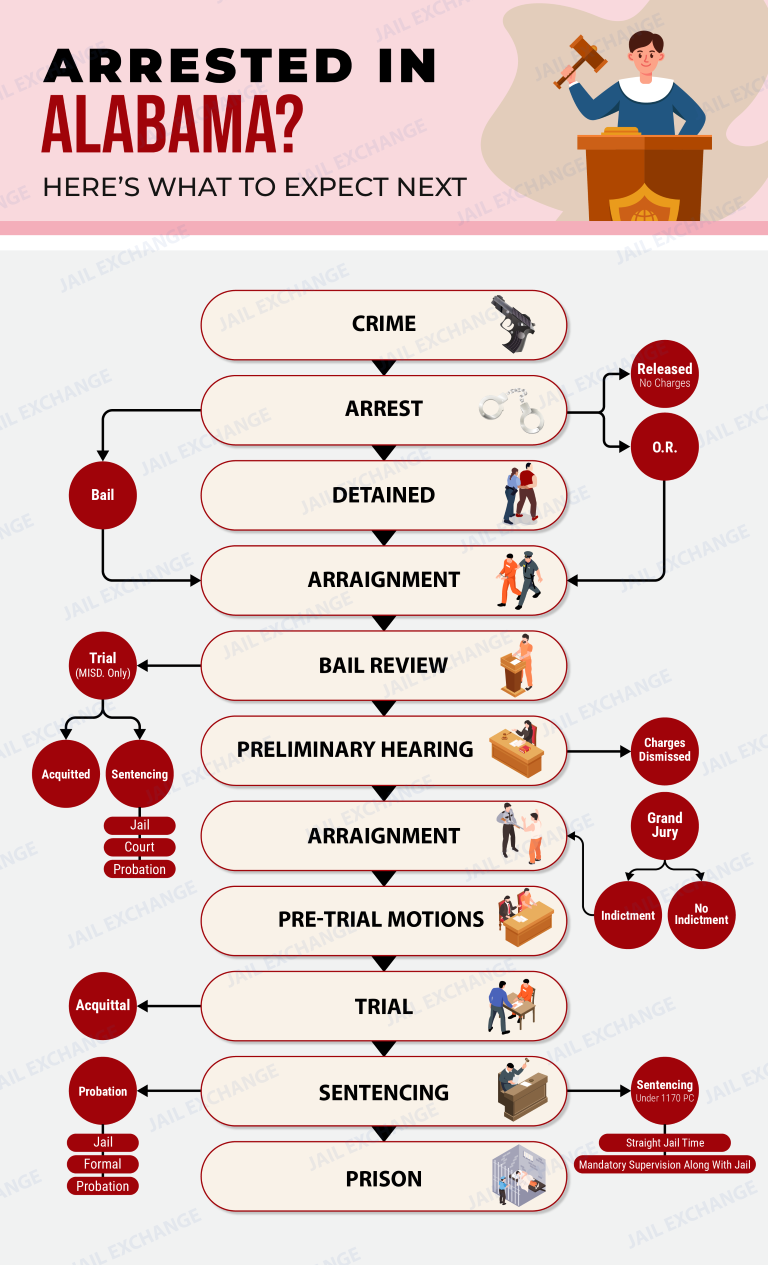
Information for this service is currently unavailable.

Inmate Canteen Trust & Phone Deposits allow friends and family members to transfer money directly into an incarcerated person's jail trust account or telephone calling balance using a credit or debit card. Deposited funds give your loved one the financial balance needed to buy personal care goods, over-the-counter medication, snacks, and phone talk time from the facility canteen.
Important: Facility Banking Policies Vary Across Jails
Once a person is booked and moved to a cell, facilities do not always allow cash drop-offs or phone payments directly to the jail window. Some might and you should confirm this by calling the facility and asking. But if you do not register online and fund your loved one's trust account immediately, they may be forced to wait days or weeks for standard paper processing, leaving them without essential soap, clean undergarments, basic medical sundries or snacks.
Step-by-Step Instructions to Register and Deposit Funds
- Confirm the inmate's legal first and last name, date of birth, and assigned booking or inmate ID number.
- Navigate to www.inmatecanteen.com on your computer or mobile device.
- Click on Deposit Funds and select whether to fund the Trust Account (for commissary) or Phone Account (for talk time).
- Select the state and facility where the inmate is currently housed.
- Search for the inmate to confirm their active housing record matches the facility roster.
- Enter your deposit dollar amount, review convenience fees, and enter your debit or credit card billing details.
- Submit payment and save the digital confirmation receipt for your financial records.
What the Inmate Needs to Do
The inmate does not need an internet connection to receive trust funds. Once payment clears, the balance posts directly to their accounting profile in the jail's internal system. The inmate can review their updated balance at the pod kiosk terminal and place their regular weekly commissary order or make outbound phone calls.
Official Provider: Inmate Canteen Official Website
Customer Service Telephone: 1-715-690-2965
Support Hours: Monday – Friday, 8:00 AM – 5:00 PM CST
Supported Languages: English and Spanish
Other Services Provided by Inmate Canteen (TurnKey Corrections)
In addition to Trust & Phone Deposits, Inmate Canteen provides several other communication, financial, and commissary services at participating correctional facilities:
- Commissary & Snack Packs: Order pre-approved snack boxes, food packages, and clothing directly to the jail.
• Learn more on our website: Commissary Orders Guide | • Visit official vendor page: Inmate Canteen Commissary - Remote Video Visitation: Schedule and join live face-to-face video visits from your computer or smartphone.
• Learn more on our website: Video Visitation Guide | • Visit official vendor page: Inmate Canteen Video Visits - Digital Messaging & Chirp Texts: Send electronic messages and photos directly to housing pod kiosks and handheld devices.
• Learn more on our website: Digital Messaging Guide | • Visit official vendor page: Inmate Canteen Messaging
Deposit Money for an Inmate in the Dallas County Jail
A tornado badly damaged the jail in Selma in January 2023, so the Dallas County Jail now runs from a temporary site at 4805 US-80, ZIP 36786, near Uniontown. Commissary money is still sent online.
- Online: Sign up or log in at Inmate Canteen, choose Alabama, then Dallas County Jail and the person, and pick Purchase Items.
- Questions: The jail line is 334-690-1200, Monday through Friday, 8 a.m. to 5 p.m.
Online money may only work for local commissary buys, and each person can spend up to $125.
For now, Dallas County inmates are not at the jail building on Selfield Road in Selma. While that jail is closed, the county rents space at the Perry County Correctional PREP Center on U.S. Highway 80 East in Uniontown and holds its inmates there. Every piece of mail is opened by staff and checked for items that aren't allowed. Letters, legal mail and publications all share one address.
Letters, legal mail and publications:
Inmate's Full Name & Inmate ID #
Dallas County Jail
4805 US Highway 80
Uniontown, AL 36786
- Who may write: Family and friends may write. Co-defendants, other inmates and anyone under a no-contact order may not.
- Reading material: Books, magazines and newspapers must be new and come directly from the publisher, and hardcovers are not allowed. Staff throw out very violent, sexual or obscene books and take any magazine with profanity, weapons or adult content.
- Return address: In the top left corner, write your name and mailing address. A letter without one most likely won't be delivered.
- Money: Money can be deposited online.
- Cards: Send plain greeting cards, not musical ones.
- Pen: Only blue or black ink will do, with no felt markers or crayons.
- Just the letter: Don't put glitter, confetti or other items inside, and don't draw on the envelope or postcard.
Family can also trade text messages with inmates, which is quicker than mail.
Inmate Sales (Combined Public Communications - CPC) provides telecommunications services that allow incarcerated individuals to place outbound voice calls from dayroom telephones or handheld tablets to family and friends. Because correctional facilities do not permit incoming calls, funding an Inmate Sales prepaid account links calling credits directly to your phone number so calls connect without carrier restrictions.
Important: Mobile Phones Automatically Block Inmate Collect Calls
Cellular phone carriers automatically reject standard collect calls originating from jail phone systems. While some residential landlines might permit direct monthly billing, mobile devices and internet-based telephone lines require an active prepaid calling balance, which you can verify by checking with your provider. If you do not register online and fund an Inmate Sales account right away, your loved one will receive an automated disconnect announcement when attempting to call your number.
Step-by-Step Instructions to Register and Fund a Phone Account
- Visit www.inmatesales.com or call customer care at 1-877-998-5678.
- Click New User and register using the primary 10-digit telephone number where you want to receive calls.
- Select the state and facility where the inmate is currently detained.
- Link the inmate to your profile using their full legal name and booking ID number.
- Select Prepaid Collect Phone or Direct Inmate PIN Debit.
- Select your deposit dollar amount and enter your debit or credit card billing details.
- Submit payment, record your confirmation number, and confirm that your mobile phone allows calls from automated or unknown correctional numbers.
What the Inmate Needs to Do
The inmate dials your 10-digit telephone number from any dayroom telephone or tablet and keys in their assigned PIN. The automated system verifies that your phone number has an active prepaid balance and connects the call once you accept the automated prompt. All personal telephone conversations are recorded and monitored by facility staff.
Official Provider: Inmate Sales Official Website
Customer Service Telephone: 1-877-998-5678 or 1-702-829-3001
Support Hours: Monday – Friday, 8:00 AM – 11:00 PM EST; Saturday, 9:00 AM – 5:00 PM EST
Supported Languages: English and Spanish
Other Services Provided by Inmate Sales (CPC)
In addition to Phone Calling Accounts, Inmate Sales provides several other communication and visitation channels:
- Inmate Tablets & Digital Media: Discover educational programs, phone access, and entertainment offered on facility tablets.
• Learn more on our website: Tablet Programs Guide | • Visit official vendor page: Inmate Sales Tablets - Two-Way Texting & Messaging: Send digital text messages and photos directly to an inmate's device.
• Learn more on our website: Digital Messaging Guide | • Visit official vendor page: Inmate Sales Messaging - Remote Video Visitation: Schedule and join live video visits from home using your computer or smartphone.
• Learn more on our website: Video Visitation Guide | • Visit official vendor page: Inmate Sales Video Visits - Commissary & Care Packages: Order pre-approved snack boxes, food packages, and clothing directly to the jail.
• Learn more on our website: Commissary Orders Guide | • Visit official vendor page: Inmate Sales Commissary
Inmate Sales Two-Way Texting allows friends and family members to exchange electronic text messages and digital photo attachments directly with an incarcerated loved one. Messages are delivered electronically to housing unit kiosks and handheld tablets within hours, avoiding the lengthy transit times associated with physical postal mail.
Important: Electronic Messaging Screening Rules Differ
Inmates cannot receive incoming phone calls, and traditional postal mail rules differ across correctional agencies. While some facilities still allow regular handwritten letters, many jails have transitioned to digital-only mail scanning or restrict postal delivery, which you can verify by checking facility rules. If you do not register online and purchase messaging credits immediately, your loved one may face lengthy periods without direct written contact from family.
Step-by-Step Instructions to Register and Send Text Messages
- Go to www.inmatesales.com or launch the Inmate Sales mobile app.
- Register your account using your 10-digit telephone number and email address.
- Select Text Messaging / Chirp from your service options.
- Select your state and detention center, then search for the inmate using their full legal name or booking ID.
- Purchase a messaging credit bundle using a debit or credit card.
- Type your message in the composition window and attach approved JPEG photos if permitted by the facility.
- Submit your message to the facility's screening queue.
What the Inmate Needs to Do
All electronic correspondence is screened by facility staff before delivery. Once approved, messages appear in the inmate's inbox on their housing unit terminal or tablet. The inmate opens the message, reads your note, and types an electronic reply using their available credits.
Official Provider: Inmate Sales Official Website
Customer Service Telephone: 1-877-998-5678 or 1-702-829-3001
Support Hours: Monday – Friday, 8:00 AM – 11:00 PM EST; Saturday, 9:00 AM – 5:00 PM EST
Supported Languages: English and Spanish
Other Services Provided by Inmate Sales (CPC)
In addition to Two-Way Texting, Inmate Sales provides several communication, commissary, and visitation options:
- Remote Video Visitation: Schedule and join live video visits from home using your computer or smartphone.
• Learn more on our website: Video Visitation Guide | • Visit official vendor page: Inmate Sales Video Visits - Prepaid Phone Calling Accounts: Prepay for phone calling credits so your loved one can call your telephone directly.
• Learn more on our website: Prepaid Calling Accounts Guide | • Visit official vendor page: Inmate Sales Calling - Inmate Tablets & Digital Media: Discover educational programs, phone access, and entertainment offered on facility tablets.
• Learn more on our website: Tablet Programs Guide | • Visit official vendor page: Inmate Sales Tablets - Commissary & Care Packages: Order pre-approved snack boxes, food packages, and clothing directly to the jail.
• Learn more on our website: Commissary Orders Guide | • Visit official vendor page: Inmate Sales Commissary
Inmate Sales (CPC) provides corrections-grade handheld wireless tablets to incarcerated individuals in county detention centers. Operating on a secure internal network, these devices allow inmates to conduct remote video visits, make voice telephone calls, send and receive text messages, stream approved music, read digital books, and access self-help legal resources directly from their living areas.
Important: Tablet Hardware Deployment and Rental Rules Vary
Detention centers do not manage tablet distribution identically. While some agencies issue individual personal tablets to every detainee at booking, others utilize shared pod docking stations or restrict tablet use to specific dayroom hours, which you should confirm with the facility directly. Although core educational and legal resources are generally provided free of charge, sending messages, listening to music, or making phone calls from the tablet requires an active balance funded by outside contacts.
Step-by-Step Instructions to Support and Fund Tablet Use
- Verify that Inmate Sales / CPC tablets are deployed at your loved one's specific detention facility.
- Navigate to www.inmatesales.com or launch the Inmate Sales mobile app.
- Sign into your verified user profile and link the inmate's legal name and booking ID number.
- Select Tablet / Chirp Funds or Inmate PIN Debit to add funds to their available balance.
- Specify your deposit amount, review convenience fees, and enter your credit or debit card billing details.
- Submit payment, save your confirmation receipt, and notify your loved one that their device balance is available.
What the Inmate Needs to Do
The inmate unlocks their assigned tablet using their PIN or biometric scan. Their available balance appears on the screen, allowing them to download songs, read digital books, write messages, and communicate with approved family members. Devices are docked during quiet hours and shift changes for secure recharging and data synchronization.
Official Provider: Inmate Sales Official Website
Customer Service Telephone: 1-877-998-5678 or 1-702-829-3001
Support Hours: Monday – Friday, 8:00 AM – 11:00 PM EST; Saturday, 9:00 AM – 5:00 PM EST
Supported Languages: English and Spanish
Other Services Provided by Inmate Sales (CPC)
In addition to Tablet Services, Inmate Sales provides several core communication channels:
- Two-Way Texting & Messaging: Send digital text messages and photos directly to an inmate's device.
• Learn more on our website: Digital Messaging Guide | • Visit official vendor page: Inmate Sales Messaging - Remote Video Visitation: Schedule and join live video visits from home using your computer or smartphone.
• Learn more on our website: Video Visitation Guide | • Visit official vendor page: Inmate Sales Video Visits - Prepaid Phone Calling Accounts: Prepay for phone calling credits so your loved one can call your telephone directly.
• Learn more on our website: Prepaid Calling Accounts Guide | • Visit official vendor page: Inmate Sales Calling - Commissary & Care Packages: Order pre-approved snack boxes, food packages, and clothing directly to the jail.
• Learn more on our website: Commissary Orders Guide | • Visit official vendor page: Inmate Sales Commissary
Dallas County County Jails
Dallas County Juvenile Facilities
Nearby counties
- Jail (Main): 334-690-1200
- Juvenile: 334-876-4809
- Sheriff: 334-874-2530
The Dallas County Jail serves the following cities and towns of Dallas County: Orrville, Plantersville and Selma.