
Montgomery Correctional Center
Montgomery Correctional Center
Physical Address
4727 Lannie Rd.Jacksonville, FL 32218
Jail Phone Number
904-630-8800Duval County arrests: the Pre-Trial Detention Facility downtown
Jacksonville and Duval County share one consolidated government, so the Jacksonville Sheriff's Office runs the county's jails.
Adults are booked at the John E. Goode Pre-Trial Detention Facility on East Adams Street. Search Duval County Inmate Search or call 904-630-5760.
Our criminal court page has more.
Read inmate search answers
 Read inmate search answers
1. Where is the Duval jail?
New arrests go to the John E. Goode Pre-Trial Detention Facility, 500 East Adams Street, Jacksonville, FL 32202, a few blocks from the Duval County Courthouse. Jail phone: 904-630-5760. Jacksonville Sheriff's Office main line: 904-630-0500.
↑ Back to the question list2. Searching the Duval roster
Duval County Inmate Search shows location, charges and bond. Sentenced or longer-stay inmates may be moved to another JSO facility, so check the housing field. VINELink can alert you to a move or release. The JSO site may be down now and then; if it won't load, look the person up on VINELink instead.
↑ Back to the question list3. First appearance and bond in Jacksonville
Duval is the Fourth Judicial Circuit. Each arrestee sees a judge within 24 hours, usually over video from the jail.
- ROR, where the signature is the only promise required.
- Cash, the entire bond, returned through the clerk after the case minus costs.
- Surety, through a bondsman whose 10 percent fee, $100 minimum per charge, stays with them.
A Nassau, St. Johns or Georgia warrant, or a probation hold, can keep someone in after bond. Missing court means a warrant. See our Duval bail guide.
↑ Back to the question list4. Is someone from the Beaches or Baldwin held on Adams Street on a warrant?
Probably. The downtown Pretrial Detention Facility is where JSO books warrant pickups from the Beaches, Baldwin and every neighborhood in between. The jail line, 904-630-0500, confirms custody. Any capias is visible in the clerk's CORE docket. FDLE's statewide wanted persons roster lists warrants released elsewhere. When the warrant is yours, a defense attorney can arrange a surrender on a set day, often with a bond motion already filed. The Sheriff's Office posts visiting rules and inmate lookups on its site to help families plan.
↑ Back to the question list5. Public defender in Duval
The Fourth Circuit Public Defender represents Duval clients a judge declares indigent. Florida's $50 application fee may be waived.
↑ Back to the question list6. Visiting the downtown jail
Visits are scheduled and largely by video. Confirm details at 904-630-5760. See visitation rules and remote visits.
↑ Back to the question list7. Phone calls and messages
Inmates can only call out, billed to a family's prepaid account. Read phones, messaging and tablets.
↑ Back to the question list8. Money for commissary
A deposit pays for snacks, hygiene goods and stationery. Use only JSO-approved methods. See deposits and commissary.
↑ Back to the question list9. Mailing a Duval inmate
Include full name and jail number, using the address for the facility on the roster. No stickers, perfume or tape. Our mail guide has more.
↑ Back to the question list10. Duval juvenile arrests
Under-18 cases go to juvenile court. Jacksonville youth ordered detained are taken to the Duval Regional Juvenile Detention Center, 904-798-4820, and see a judge within 24 hours. Parents can call JSO at 904-630-0500.
↑ Back to the question list11. Health and medications
Call 904-630-5760 about insulin, HIV drugs, seizures, mental health or suicide risk.
↑ Back to the question list12. Federal cases in Jacksonville
The U.S. District Court, Middle District of Florida, hears Duval federal cases at its Jacksonville courthouse, 300 N. Hogan St., Jacksonville, FL 32202.
On Hogan Street, a magistrate takes the first hearing; release is fought over at a later detention hearing. The U.S. Marshals (904-301-6670) can rent Jacksonville jail beds for its prisoners. Post-sentence locations appear on the BOP finder.
↑ Back to the question list13. ICE detainers at the Duval jail
- JSO runs a 287(g) Jail Enforcement Model, so ICE-trained officers screen immigration status at booking.
- An I-247A detainer may follow.
- The Pretrial Detention Facility may hold the person awaiting federal transfer up to 48 hours after they would otherwise be released (8 CFR 287.7(d)).
- F.S. 908.105: the bond judge is told, the detainer is filed in the case, and prosecutors are notified.
- F.S. 907.041: JSO can't let a forcible-felony suspect without lawful status out before first appearance, and the judge begins by presuming detention, which the defense can challenge.
- F.S. 908.11: 287(g) is required for jail sheriffs; JSO also has the Task Force Model.
- To locate a Jacksonville relative, use ICE's detainee search or call the Miami field office, 2805 SW 145th Ave., Miramar, FL 33027, 954-843-5800.
14. Transfer to state prison
A prison sentence in Duval is followed by a stay in a JSO jail until a Corrections bus arrives. Classification at a reception center comes next. Track progress on FDC's website, and find prison addresses here.
↑ Back to the question list15. Duval mugshots
Request booking photos from the Jacksonville Sheriff's Office, 904-630-0500. Florida treats most as public; F.S. 119.071 exempts some.
Photos ICE took come through its FOIA office. The federal government keeps its own booking pictures closed, though the Marshals sometimes post a wanted fugitive's.
↑ Back to the question list16. Duval police numbers
- Jacksonville Sheriff's Office: 904-630-0500
- Jacksonville Beach Police Department: 904-270-1661
- Atlantic Beach Police Department: 904-247-5859
- Neptune Beach Police Department: 904-270-2413
Dial 911 in an emergency.
↑ Back to the question listDuval County contacts
- Inmate search
- Duval County Inmate Search
- Jail
- John E. Goode Pre-Trial Detention Facility, 500 East Adams Street, Jacksonville, FL 32202, 904-630-5760
- Sheriff
- 904-630-0500
- Clerk
- 904-255-2000
- Backup search
- VINELink
Duval County bail and bond: Jacksonville's jail and the amounts judges start from
In Duval County the Jacksonville Sheriff's Office runs the county jails, and new arrests are processed at the John E. Goode Pre-Trial Detention Facility, 500 East Adams Street, Jacksonville.
Use Duval County Inmate Search to check for your relative, the listed counts, and any bail. The jail information line is 904-630-5760.
Duval and Jacksonville share one government, so there is one sheriff, one large jail, and a busy court. Read the bail steps below before you spend money.
1. Is my relative at the Pre-Trial Detention Facility downtown?
Look the name up on Duval County Inmate Search. Duval books hundreds of people, so a fresh booking may take hours to show. Duval's detention facility line, 904-630-5760, covers gaps in the search. Give the full name and birth date.
2. Why are there several Duval jails?
The Sheriff runs the downtown Pretrial Detention Facility, the Community Transition Center at 451 Catherine Street, and the Montgomery Correctional Center at 4727 Lannie Road. Sentenced inmates held at Montgomery are brought to the downtown jail for release. If the search shows another building, ask the corrections staff at 904-630-5760 why.
3. What does the Sheriff accept for bond?
For a cash bond, the Sheriff says to bring the full amount to the public reception area of the jail. It takes cash, a certified or cashier's check drawn on a local bank (subject to verification), or a U.S. Postal money order made out to the Office of the Sheriff. For a surety bond, you contact a bonding agency, which arranges the release. Officers may not tell you which agency to pick. Posting hours are not published, so call 904-630-5760. In Duval, inmate account money is not bail.
4. How much is bail for a first drunk-driving charge?
For Duval DUIs, the 2026 Supreme Court schedule (AOSC25-69) sets $500 for a first offense filed as second-degree and $1,000 for first-degree. A second offense charged at the lower misdemeanor level is $750. The Fourth Judicial Circuit may post a higher local schedule, and the judge at first appearance may choose any amount.
5. What are bail amounts for other charges?
Under that order, a first-degree misdemeanor in Duval is $500 without force and $1,000 with force or a threat. A second-degree misdemeanor is $150, or $250 with force. A Duval third-degree felony is $2,500 without force and $5,000 with it. Charges for the most serious offenses carry no bond until a judge acts. Each charge has its own bond.
6. Who decides whether bail is allowed at all?
A judge does. Article I, section 14 of the Florida Constitution gives most Duval defendants a right to reasonable pretrial release; exceptions are capital or life cases with strong proof, and cases where release would be unsafe. Section 903.011 holds back more groups, including people arrested for a new felony while on probation, those charged with violating a protective injunction, and drug trafficking suspects.
7. What happens at first appearance in Jacksonville?
Rule 3.130 requires it within 24 hours. The Duval judge states the charge, decides on a free lawyer, and sets conditions. The Video Visitation Center entrance on the west side of the Pretrial Detention Facility is the same entrance as first appearance court. After the hearing, look at Duval County Inmate Search for the bond. The judge may continue, raise, lower, or end the bail.
8. Is a bondsman cheaper than paying cash?
Jacksonville agents charge what the state's financial services department lists, 10 percent of bail, so a $1,500 bail costs $150. That fee is earned when your relative is released and is not given back. If no release happens, the premium comes back to you. Any security you left should come back within 21 days of the court's discharge. Cash costs more up front but is refundable later, while the agent's fee is gone. In Duval, get the terms on paper and check the agent's license with the department.
9. Can real estate in Duval County secure a bond?
Duval's bond webpage lists just cash and surety bonds; ask the Clerk and an agent about property. Duval private sureties have to reside in Florida or own Florida land (section 903.05). A Duval no-show records the forfeiture as a two-year land lien (section 903.26). Confirm what documents the court wants before anyone signs.
10. Do the beach cities or other police departments run their own cells?
Duval is consolidated, so most arrests are processed by the Sheriff's Office downtown. If a different Duval agency arrested, ask it where the person is, then recheck Duval County Inmate Search. Whether any agency keeps a short-term cell is something the arresting agency can answer.
11. Where does Duval send a detained teenager?
Duval Regional Juvenile Detention Center, 1241 East 8th Street, Jacksonville, 904-798-4820, holds youth whom a judge orders detained. Duval juvenile files are private, so a child won't be in the adult search. Ask the center or the court for the hearing time.
12. Who is the free lawyer for adult cases?
The Fourth Circuit Public Defender serves Duval County at 904-255-HOPE (4673). In Duval, tell the first appearance judge you can't afford counsel. A Duval lawyer can ask the judge to cut the bond or release with no money.
13. What if someone skips a court date?
In Duval, a missed court date means forfeiture; the Clerk has five days to send notice, and the bond must be paid in 60 days (section 903.26). Turning in the defendant soon may return part of it (section 903.28). Contact a lawyer and the bond agent today.
14. When can I ask for my cash back?
Once the case closes and the bond is released. The Clerk's Misdemeanor Department says refunds are generally issued within 10 to 14 working days after final disposition, and you can call 904-255-2000 after 14 working days with the case number. Fines, court costs, or restitution may be taken out first. For Duval cash posted by a non-agent, the Clerk deducts unpaid fines, fees, and costs first (section 903.286). A bond expires 36 months after it was posted (section 903.31). Save every receipt.
15. Which payment demands should I ignore?
Any text or call asking for gift cards, a cash app, or crypto "to release him." Hang up and call 904-630-5760 yourself.
16. Can ICE keep someone in the Duval jail after bond is posted?
- With Form I-247A, ICE can ask the Duval jail to keep a person.
- That extra hold in Duval lasts up to 48 hours.
- The Duval clock keeps running on weekends and holidays.
- Paying a Duval bond will not lift the detainer.
- The Duval judge who sets bond learns of it (F.S. 908.105).
- The Duval prosecutor is told too.
- Every Florida jail sheriff, Duval included, must join 287(g) (F.S. 908.11).
- ICE's official 287(g) list shows these models for Duval:
- Jail Enforcement Model
- Task Force Model
- If ICE takes someone from Duval, search the ICE detainee locator.
Duval County bail contacts
- County jails
- Duval County jails: John E. Goode Pre-Trial Detention Facility, 500 East Adams Street, Jacksonville, FL 32202, 904-630-5760; also Montgomery Correctional Center and Jacksonville Community Transition Center
- Bond guide
- Duval bail and bond pages
- Custody lookup
- Duval County Inmate Search
- Clerk, misdemeanor
- 501 West Adams Street, Room 1223, Jacksonville, FL 32202; 904-255-2000; Monday to Friday, 8 a.m. to 5 p.m.
- Sheriff's Office
- Jacksonville Sheriff's Office, 904-630-0500
- Judicial circuit
- Fourth Judicial Circuit of Florida
- Public defender
- 904-255-4673 (255-HOPE)
- Youth detention
- Duval Regional Juvenile Detention Center, 1241 East 8th Street, Jacksonville, FL 32206; 904-798-4820
- Bail agents
- Florida Department of Financial Services
Jacksonville jail steps, bonds, and phones can change, and a judge may set another figure. Confirm with the Sheriff's corrections staff before you pay. This Duval page explains the steps in general and is not legal advice.
Instructions on How to Post Bond Online in Duval County

CASH BOND ONLINE provides a secure, 24/7 web portal that allows families to post full cash appearance bonds online using a debit or credit card, avoiding the delay of traveling to a courthouse or jail booking window with large amounts of cash.
Important: Verify Magistration and Bond Eligibility First
Not every facility accepts cash bonds through an online portal around the clock, and court hours vary. Call the booking desk to verify that intake is completed, that the magistrate has officially set the bail amount, and that the person has no additional hold orders before paying. Once an electronic bond is processed, administrative transaction fees cannot be refunded.
Step-by-Step Instructions to Register and Access Service
- Contact the jail booking desk to confirm the defendant is cleared for bond release and obtain the exact dollar amount required.
- Open your web browser and navigate to www.cashbondonline.com.
- Select the participating state, county, or municipality.
- Type in the defendant's full legal name, date of birth, and booking or case number.
- Enter your debit or credit card payment information, review the processing charge, and authorize the transaction.
- Print the electronic confirmation receipt and notify the booking desk with your confirmation number.
What the Inmate Needs to Do
The booking officer receives the electronic payment confirmation, prepares the release paperwork, and has the defendant sign the court appearance bond agreement before initiating their discharge.
Official Provider: CASH BOND ONLINE Official Website
Customer Service Telephone: 1-888-474-0610
Support Hours: 24/7/365
Supported Languages: English and Spanish
Other Services Provided by CASH BOND ONLINE
In addition to CASH BOND ONLINE Bail Services, CASH BOND ONLINE provides several other communication, financial, and visitation services at participating correctional facilities:
- Inmate Trust Money Deposits: Deposit funds into an inmate's personal trust account for canteen and phone usage.
• Learn more on our website: Inmate Trust Money Deposits Guide | • Visit official vendor page: CASH BOND ONLINE Inmate Trust Money Deposits
Montgomery Correctional Center at-the-jail Inmate Video Visitation Schedule, Policies & Guidelines
All on-site visits are done at the Vistation Center
500 E. Adams St.
Jacksonville, FL 32202
(enter on the Westside of the Pretrial Detention Facility, same entrance for 1st Appearance court)
- First, you must register to visit (and schedule) with gettingout/ViaPath

- All visits must be scheduled at least 24 hours in advance. No exceptions.
- There is no cost for on site video visits.
- Each inmate can receive one visitor per week.
- Visitation center visits are a maximum of two hours.
- Inmates have the option to initiate visits with Friends and Family who signed up to allow the visit remotely from home. (see the second schedule below).
- Inmate workers will not be allowed visitation during their assigned work hours.
- Juveniles will not be allowed visitation during school hours.
- Dress Code: Always dress appropriately... as if you were meeting someone's grandmother for the first time.
- No cameras, phones, sexual acts, etc. Violators will be suspended from having future vists... or be prosecuted.
| DAY | HOURS |
| SUNDAY | 9:00AM - 7:00PM |
| MONDAY | 9:00AM - 7:00PM |
| TUESDAY | 9:00AM - 7:00PM |
| WEDNESDAY | 9:00AM - 7:00PM |
| THURSDAY | 9:00AM - 7:00PM |
| FRIDAY | 9:00AM - 7:00PM |
| SATURDAY | 9:00AM - 7:00PM |
Montgomery Correctional Center REMOTE Inmate Video Visitation Schedule, Registration & Cost
- First, you must register to visit (and schedule) with gettingout/ViaPath
- All visits must be scheduled at least 24 hours in advance. No exceptions.
- Visits cost $0.25 per minute.
| DAY | HOURS |
| SUNDAY | 9:00AM - 7:00PM |
| MONDAY | 9:00AM - 7:00PM |
| TUESDAY | 9:00AM - 7:00PM |
| WEDNESDAY | 9:00AM - 7:00PM |
| THURSDAY | 9:00AM - 7:00PM |
| FRIDAY | 9:00AM - 7:00PM |
| SATURDAY | 9:00AM - 7:00PM |
GettingOut / ViaPath Remote Video Visits
Provider: GettingOut (Telmate) • Rebranding as ViaPath Technologies (myViaPath Visits)

GettingOut Video Visitation allows friends and family members to conduct live, face-to-face video visits with incarcerated loved ones using a personal computer, laptop webcam, or the mobile application. Telmate and GTL operate under ViaPath Technologies, and the visiting service is transitioning from GettingOut Visits to myViaPath Visits; users may encounter either brand name depending on whether their county jail has completed the platform update.
Important: Advance Background Clearance Required
Detention centers do not permit unapproved drop-in video visitation. All visitors must submit valid government photo identification and pass administrative screening before an appointment can be booked, a review that can take up to 48 hours depending on facility staffing. You should verify your visitor approval status with the facility in advance. If you do not register ahead of time, you will miss your loved one's scheduled visiting slots for the week.
Step-by-Step Instructions to Schedule a Video Visit
- Open the GettingOut / myViaPath Visits app or go to www.gettingout.com / my.viapath.com.
- Register your profile and upload clear photographs of your government ID and a verification photo.
- Wait for the facility to issue visitor approval (you will receive an email confirmation).
- Select Schedule Visit, pick your detention facility, and select the inmate.
- Choose an available 25- or 30-minute time slot from the calendar and pay the visitation fee using a credit or debit card.
- Sign into the app or website 10 minutes prior to the start time on a device with a functioning camera, microphone, and stable internet connection.
What the Inmate Needs to Do
The inmate receives a schedule alert on their housing unit video kiosk or personal tablet. At the appointed time, they log in with their PIN and sit in front of the terminal. Inmates must follow institutional dress and conduct rules; corrections staff actively monitor sessions and will terminate any call immediately if rules are broken.
Official Providers: GettingOut Visits | myViaPath Visits
Customer Service Telephone: 1-866-516-0115 (GettingOut) • 1-877-650-4249 (ViaPath)
Support Hours: Monday – Friday, 7:00 AM – 11:00 PM CST; Saturday – Sunday, 8:00 AM – 7:00 PM CST
Supported Languages: English and Spanish
Other Services Provided by GettingOut / ViaPath
In addition to Remote Video Visits, GettingOut and ViaPath provide several other communication and financial options:
- Two-Way Text Messaging: Send electronic messages and photos straight to the inmate's screen.
• Learn more on our website: Two-Way Text Messaging Guide | • Visit official vendor page: GettingOut Messaging - Inmate Tablet Rentals & Content: Provide funds for educational modules, music streaming, and news.
• Learn more on our website: Tablet Rentals & Content Guide | • Visit official vendor page: GettingOut Tablets - AdvancePay Phone Calling: Keep a funded prepaid balance to receive calls directly on your phone.
• Learn more on our website: AdvancePay Phone Calling Guide | • Visit official vendor page: ViaPath ConnectNetwork Calling - Inmate Trust Deposits: Transfer money directly into their jail trust account for canteen goods.
• Learn more on our website: Inmate Trust Deposits Guide | • Visit official vendor page: ViaPath Trust Deposits
Duval County and Jacksonville: How a Criminal Case Moves Through Court
Jacksonville and Duval County merged their governments back in 1968, so here the city and the county are nearly the same thing. In the court system, Duval anchors Florida’s Fourth Judicial Circuit, which also takes in Clay and Nassau counties. There are two kinds of trial court. On the lower rung, Duval County Court sorts out misdemeanors, ordinance cases and criminal traffic charges (a Jacksonville DUI, say, or a fender-bender hit-and-run). On the upper rung, Duval Circuit Court tries felonies, and a juvenile division inside it handles Jacksonville kids under 18. Our bail guide and inmate search cover the other steps.
Most criminal hearings take place in the big Duval County Courthouse, 501 W. Adams Street, Jacksonville, FL 32202, in downtown Jacksonville. The Duval Clerk of Courts’ main line is (904) 255-2000, and staff there can connect you to the criminal departments. Adults arrested by the Jacksonville Sheriff’s Office or by the beach-city and Baldwin police go to the sheriff’s John E. Goode Pre-Trial Detention Facility, 500 E. Adams Street, a short walk from the courthouse.
Free case lookup: The Duval Clerk’s online records system is called CORE. Anybody can search it free by a name or a case number. Without an account, you can view public filings in cases that aren’t confidential. A free registered account adds features like requesting documents. Juvenile cases and other confidential records aren’t open to the public, and documents marked “Unavailable” aren’t posted online.
1. Jacksonville misdemeanors: DUI, shoplifting, domestic battery, resisting an officer without violence
In Duval, misdemeanors make up the giant share of criminal cases. A JSO officer can skip the jail trip and issue a notice to appear, naming the date to report to 501 W. Adams. People taken to the Pre-Trial Detention Facility instead see a judge at first appearance within 24 hours, often on video from the jail. That judge goes over the charge and sets the conditions of pretrial release, which are the rules you follow while your case is open. Since January 1, 2026, every Florida jail, Jacksonville’s included, has followed one Supreme Court bond schedule with minimum amounts for anyone released before that hearing. For some offenses, domestic violence included, release waits on the judge. A bondsman’s premium runs 10% of the bond amount in Florida, with $100 as the floor.
What’s the most you can get? A first-degree misdemeanor can cost a year in a Duval jail and a $1,000 fine. With second degree, Jacksonville judges are held to two months (60 days) and $500. The State Attorney for the Fourth Circuit, an elected official, runs the prosecutor’s office on Bay Street. A judge can appoint the elected Fourth Circuit Public Defender for someone who can’t pay a lawyer. When that office has a conflict, Regional Conflict Counsel can step in. Florida law also permits a fee for a public defender, which can become a lien if left unpaid.
Fourth Circuit prosecutors offer pretrial diversion to some Jacksonville first-timers; finishing it wipes out the charge. If your misdemeanor goes to trial, the speedy-trial rule sets 90 days from formal charging unless waived, and a six-member jury of Duval residents hears it.
Under 18: When a Jacksonville teen is accused of a misdemeanor, Circuit Court’s juvenile division takes it. Instead of arresting a first offender, JSO can often issue a civil citation (Florida Statute 985.12), and the kid then makes up for it through counseling or service hours, leaving no arrest on file. Locked-up youth must get a detention hearing inside 24 hours. Jacksonville’s state-run juvenile lockup, the Duval Regional Juvenile Detention Center, is where they wait.
2. Duval felony court: car break-ins, fentanyl trafficking, felon with a gun, grand theft
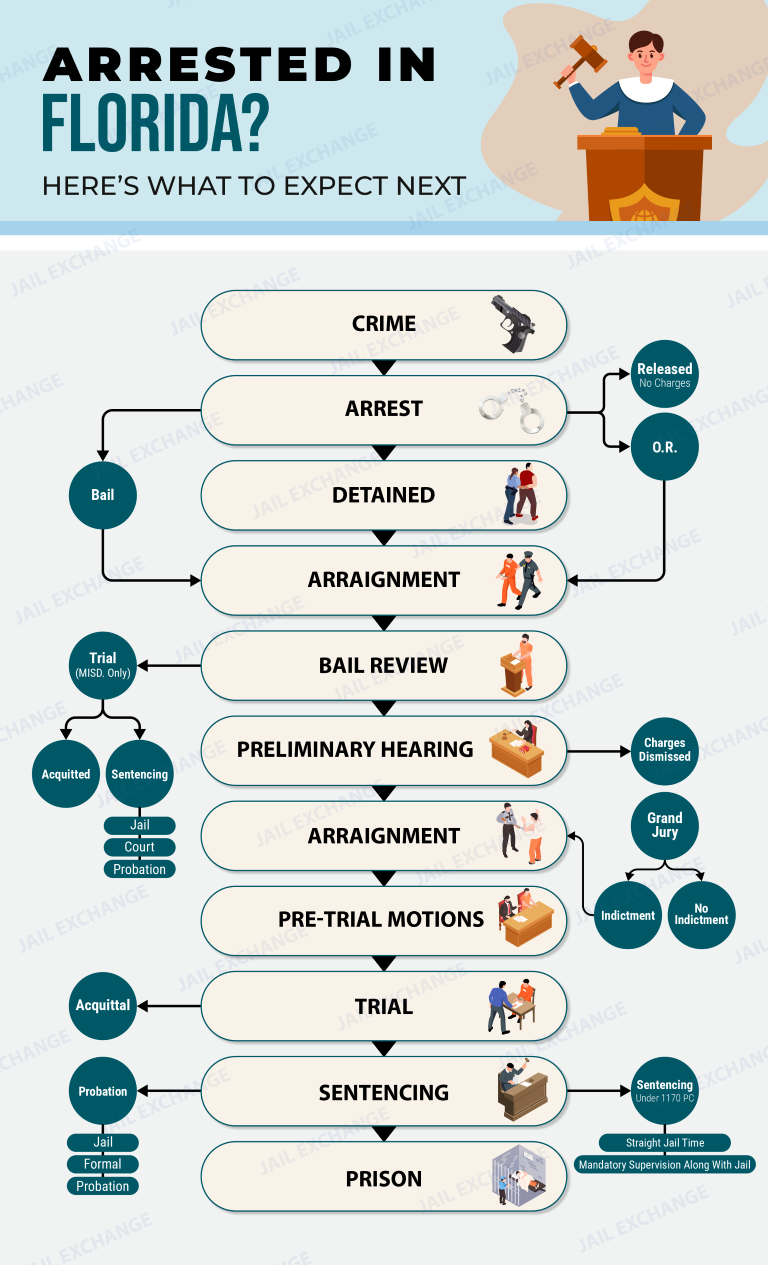
A felony can put someone in a Florida prison. Every Duval felony starts with first appearance. After that, a Fourth Circuit prosecutor looks over the evidence and decides whether to file formal charges in an information. The defendant is then arraigned, which means formally told the charges and asked to plead. Months of discovery, motions and plea talks follow. Most felony cases at 501 W. Adams Street end in a plea, not a trial.
Florida felonies come in degrees. Third-degree felonies can mean as much as 5 years in prison. Second-degree felonies can mean 15. First-degree felonies can mean 30. Life felonies and capital felonies are at the top. Sentencing at the Adams Street courthouse relies on Florida’s Criminal Punishment Code scoresheet, which piles up points for the offense, the harm and prior record, and the score sets a floor. Florida’s 85% rule then keeps prisoners inside for nearly the whole term. A felon caught with a gun faces a second-degree felony and, in some cases, a 3-year minimum.
Duval felony defendants can demand trial by day 175 after formal charges are filed, a right most of them waive. Juries for Jacksonville felony trials hold six people; only capital trials use twelve.
Under 18: Most juvenile felony cases stay in the juvenile division, where judges can choose probation, treatment or a commitment program. The State Attorney can also “direct file” adult charges. Jacksonville prosecutors may do that for nearly any felony when the teen is 16 or 17. Younger teens, 14 or 15, qualify only for crimes listed in Florida Statute 985.557, carjacking, robbery and home burglary among them.
3. Jacksonville violent felony cases: murder, shootings, carjacking, sexual battery
Violent felony cases in Duval go through the same steps, but the penalties can be enormous. Someone judged dangerous at a pretrial detention hearing stays at the Adams Street jail, bond denied. In carjackings, robberies and similar crimes, Florida’s 10-20-Life law stacks on mandatory prison: possession of a gun, 10 years; a shot fired, 20; a death or great bodily harm, 25 years or more, possibly life. Sexual battery (Florida’s legal word for rape) can carry life in prison.
Duval first-degree murder cases start with a grand jury indictment; a conviction brings death or life without parole. Florida passed a law in 2023 letting a jury recommend death if 8 of the 12 jurors agree. About an hour southwest of Jacksonville, Union Correctional Institution in Raiford holds the state’s male death row; the women’s is at Lowell Correctional Institution.
Marsy's Law, a Florida constitutional amendment, gives Jacksonville victims notice of each hearing, a seat in court, and a chance to speak before sentencing. In a city with many shooting cases, the Fourth Circuit prosecutor’s victim advocates stay busy helping families.
Under 18: Violent crimes are where Duval teens are most likely to be charged as adults. Even at 14 or 15, a Duval teen accused of carjacking or armed robbery can be direct filed. Under Florida Statute 985.56, a Duval grand jury may also indict a child of any age if death or life is a possible penalty. A death sentence itself remains impossible for anyone who was a minor on the day of the crime.
4. How does Jacksonville handle warrant checks?
JSO, the consolidated Sheriff's Office, holds the Fourth Circuit warrant file; call (904) 630-0500, and its warrants unit needs a birth date to confirm a name. The clerk's CORE system lists each case and any capias. With an attorney, a person can self-surrender at the Pretrial Detention Facility on East Adams Street, a block from the courthouse. Room 2350 of the courthouse on West Adams is where the clerk sets new dates. For warrants from other agencies, FDLE runs a statewide wanted persons search.
Federal court: Duval is the home base of the Middle District of Florida’s Jacksonville Division, whose judges sit downtown on North Hogan Street (No. 300), inside the Bryan Simpson U.S. Courthouse. A case becomes federal if it breaks a federal law or happens on federal property, and Jacksonville has a lot of it. NAS Jacksonville, Naval Station Mayport and the Marine Corps’ Blount Island Command are all in Duval. So are the Timucuan Ecological and Historic Preserve and Fort Caroline National Memorial, run by the National Park Service. JAXPORT’s cargo docks bring smuggling and customs cases, and the Coast Guard at Mayport stops drugs coming by sea. Crimes on airplanes landing at Jacksonville International are federal too. Duval has no tribal land. Pick a section to read.
Immigration holds. If ICE lodges a Duval detainer on someone:
- F.S. 908.105 requires telling the Duval bond judge
- the Duval prosecutor gets notice
- Duval bond can still be granted
- the jail may hold them 48 more hours for ICE
- those hours in Duval include weekends and holidays
- F.S. 907.041: in Duval, an unauthorized alien facing a Duval forcible felony charge stays in the Duval jail until first appearance
- then the Duval court presumes detention, and the Duval defense can push back
Town courts. Duval has no city or town courts. The 1972 Article V reform phased them out. In Duval, a city ordinance case goes to Duval County Court, which also hears misdemeanors.
For Jacksonville readers, this Duval County overview is general background, not legal advice. Each case is different, so talk with a lawyer, or call the Duval Clerk of Courts at (904) 255-2000.

Access Securepak is an authorized correctional commissary care-package program that allows families to purchase customized food, snack, hygiene, apparel, and electronics packages sent directly to an incarcerated loved one. Every package is custom-packed to meet the strict security regulations of the specific jail or state prison.
Important: Delivery Schedules and Package Quotas
Jail package guidelines are not uniform across detention centers. Some facilities permit orders year-round, while others restrict deliveries to quarterly cycles or strict weekly deadlines that you should confirm with the facility directly. If you delay setting up your account, you risk missing the upcoming delivery cutoff, leaving your loved one waiting an extra cycle for fresh food, warm thermals, or personal toiletries.
Step-by-Step Instructions to Register and Access Service
- Visit the official Access Securepak online store at www.accesscatalog.com.
- Select the state and the specific jail or correctional institution from the dropdown menu.
- Enter the inmate's legal last name and inmate ID to verify their active housing and package eligibility.
- Browse the catalog of approved meats, cheeses, ramen soups, cookies, toiletries, and clothing.
- Add items to your cart up to the facility's maximum weight or dollar limit (usually $50 to $125 per order).
- Check out using your debit or credit card and save the order confirmation tracking number.
What the Inmate Needs to Do
The inmate does not need to order anything themselves. Securepak ships the sealed package directly to the correctional facility's commissary warehouse. Jail staff inspect the box and deliver it to the inmate during regular pod commissary distribution, where the inmate signs for the package.
Official Provider: Access Corrections / Keefe Group Official Website
Customer Service Telephone: 1-800-546-6283
Support Hours: Monday – Friday, 8:30 AM – 11:30 PM EST; Saturday, 11:00 AM – 5:00 PM EST
Supported Languages: English and Spanish
Other Services Provided by Access Corrections / Keefe Group
In addition to Access Securepak (Commissary & Gift Packages), Access Corrections / Keefe Group provides several other communication, financial, and visitation services at participating correctional facilities:
- Inmate Trust Money Deposits: Send cash directly to their personal account so they can buy items independently.
• Learn more on our website: Inmate Trust Money Deposits Guide | • Visit official vendor page: Access Corrections / Keefe Group Inmate Trust Money Deposits - Digital Messaging & Photos: Send fast electronic letters and digital pictures to their tablet.
• Learn more on our website: Digital Messaging & Photos Guide | • Visit official vendor page: Access Corrections / Keefe Group Digital Messaging & Photos
Buy Commissary for an Inmate in the Montgomery Correctional Center
Montgomery Correctional Center Inmate Commissary - Sending Money or Purchasing Commissary for an Inmate
Montgomery Correctional Center allows inmates to purchase commissary. Ask the jail what its commissary sells; snacks and hygiene items are common.
You can buy commissary for an inmate using an online service called Access Securepak.

Call the facility at 904-630-8800 to ask whether there is a limit on how much an inmate can spend on commissary.
Access Securepak's site shows whether friends and family can order commissary for an inmate at this jail.
Scroll down for information on the Montgomery Correctional Center's service they use for you being able to purchase commissary items online and have them shipped directly to the inmate.
You can also go to our Inmate Money page for information on how to send money to an inmate.
Access Secure Deposits (Smart Deposit) allows families and friends to securely transfer money directly into an incarcerated person's jail trust account using a debit or credit card. Deposited funds become immediately available for your loved one to purchase essential hygiene goods, over-the-counter medication, food items, and writing materials from the facility commissary.
Important: Inmate Banking Policies Vary by Facility
Once a person is booked and moved to a cell, facilities do not always allow cash drop-offs or phone payments directly to the jail. Some might and you should confirm this by calling the facility and asking. But if you do not register online and fund your loved one's trust account immediately, they may be forced to wait days or weeks for standard paper processing, leaving them without essential soap, clean undergarments, basic medical sundries or snacks.
Step-by-Step Instructions to Register and Access Service
- Obtain the inmate's legal first and last name, date of birth, and official six- to ten-digit Booking or Inmate ID number.
- Visit the official Access Corrections portal at www.accesscorrections.com or download the Access Corrections mobile app.
- Select the state and the exact detention facility or county jail where the inmate is currently housed.
- Add the inmate as a contact and confirm their identity from the facility roster.
- Enter your debit or credit card billing information, choose your deposit amount, review the facility processing fee, and submit your payment.
- Save and print your transaction confirmation number for verification.
What the Inmate Needs to Do
The inmate does not need internet access to receive your deposit. Once approved, the funds post directly to their facility account balance. The inmate can verify their balance at the dayroom kiosk or on their trust statement and start ordering items on the next designated commissary day.
Official Provider: Access Corrections / Keefe Group Official Website
Customer Service Telephone: 1-866-345-1884
Support Hours: 24/7/365
Supported Languages: English and Spanish
Other Services Provided by Access Corrections / Keefe Group
In addition to Access Secure Deposits (Trust Money), Access Corrections / Keefe Group provides several other communication, financial, and visitation services at participating correctional facilities:
- Digital Messaging & Photos: Send digital letters and pictures straight to the inmate's kiosk or tablet.
• Learn more on our website: Digital Messaging & Photos Guide | • Visit official vendor page: Access Corrections / Keefe Group Digital Messaging & Photos - Commissary Care Packages: Order pre-approved food boxes, thermal clothes, and snack bundles directly to the jail.
• Learn more on our website: Commissary Care Packages Guide | • Visit official vendor page: Access Corrections / Keefe Group Commissary Care Packages
Deposit Money for an Inmate in the Montgomery Correctional Center
Need to help someone at the Montgomery Correctional Center on Lannie Road? The Jacksonville Sheriff's Office lets you add money in three ways, and all three use the same deposit system.
- Cash at the kiosk: The lobby of the Montgomery Correctional Center, 4727 Lannie Road, Jacksonville, has a kiosk that takes cash.
- Card by phone: Dial 866-345-1884, open 24 hours, 7 days a week. Have your Visa or MasterCard ready and write down the confirmation number they give you.
- Card on the web: Set up a private login at Access Secure Deposits. Your deposit history and receipts stay in your account, and money posts within minutes.
Money orders, cashier's checks and cash sent by mail or handed in at the desk are refused. Money on the account is used for commissary. Anyone who owes the facility for hygiene or writing supplies will have that debt taken out of new deposits, even on a later stay of up to three years. Call 904-630-8800 with questions.
Montgomery Correctional Center on Lannie Road is the Jacksonville Sheriff's Office prison for men and women serving county sentences, along with some state-sentenced inmates. It uses the same mail system as every Jacksonville jail. Family letters go to a central processing center, where they are scanned and sent to the inmate's tablet as a digital file. Paper laced with drugs is the reason for the change. Only legal mail and approved reading material should be mailed to Lannie Road.
Personal mail (central scanning center):
Inmate's Full Name & 10-digit Booking #
Jacksonville Sheriff's Office - Duval, FL
P.O. Box 247
Phoenix, MD 21131
Legal mail and publications (to Montgomery):
Inmate's Full Name & 10-digit Booking #
Montgomery Correctional Center
4727 Lannie Road
Jacksonville, FL 32218
- How to address it: Write the inmate's name and 10-digit booking number on the front, and your name and mailing address too. You can get that number from the sheriff's inmate search.
- What you can send: Personal letters, postcards and reading material. Mail packed in a box is turned away.
- Size limit: Envelopes can't be larger than letter size, 8½ x 11 inches. A changed or altered envelope goes back to you.
- Photos and printouts: Don't send them. Pictures, faxes and pages printed off the internet are taken no matter what they show.
- Reading material: Magazines and newspapers arrive only by subscription in the inmate's name. Paperback books must ship from a bookseller the sheriff approves. No hardback books, and an inmate may hold four periodicals and two paperbacks.
- Clothing and store items: Inmates are issued uniforms, so personal clothing is not accepted, and neither is anything sold in the commissary.
- Putting money on an account: Money orders, cashier's checks and cash are not accepted by mail. Deposits are made online, by phone, or with cash at the kiosk in the Montgomery lobby.
Inmates can also get electronic messages on their tablets.
ViaPath AdvancePay Phone Calling Accounts
Provider: ViaPath Technologies • Formerly ConnectNetwork / Global Tel*Link (GTL)
AdvancePay is the primary prepaid telecommunications service operated by Global Tel*Link (GTL) and ConnectNetwork, which have unified under the corporate identity of ViaPath Technologies (and the myViaPath platform). By funding an AdvancePay account, telephone charges are deducted per minute whenever an incarcerated loved one calls your specific telephone number, preventing calls from being rejected by cellular carriers.
Important: Cell Carriers Automatically Block Jail Collect Calls
Inmate telephone networks do not permit incoming calls, and wireless cell providers automatically block traditional collect billing by default. While select traditional landlines may support operator billing, cell phones and internet-based lines require an active AdvancePay balance, which you can verify with your carrier. If you do not register your number online and add funds immediately, your loved one will hear an automated operator announcement stating your line is blocked from receiving correctional calls.
Step-by-Step Instructions to Open and Fund AdvancePay
- Visit web.connectnetwork.com or the updated my.viapath.com portal, or launch the ConnectNetwork / ViaPath mobile application.
- Click Sign Up and register using your primary 10-digit cellphone number and email address.
- Select Add Facility, pick your state, and choose the detention center or state prison where the inmate is held.
- Search for the inmate using their full legal name or facility booking ID number and link them to your contact directory.
- Select AdvancePay Phone and choose your deposit amount ($25, $50, or custom).
- Enter your debit or credit card billing details, accept the administrative transaction fee, and complete the payment.
- Check your phone settings to confirm that automated or unknown correctional numbers are not routed straight to spam.
What the Inmate Needs to Do
The inmate approaches any housing pod telephone, enters their assigned PIN and voice biometric recognition phrase, and dials your 10-digit number. ViaPath's automated operator confirms your active prepaid balance and connects the call. All personal telephone calls are subject to recording and monitoring by facility investigators.
Official Providers: ConnectNetwork Portal | myViaPath Portal
Customer Service Telephone: 1-877-650-4249 (Automated & Live Support)
Support Hours: Automated Service 24/7; Live Operators Monday – Friday, 8:00 AM – 10:00 PM EST
Supported Languages: English and Spanish
Other Services Provided by ViaPath Technologies (ConnectNetwork)
In addition to AdvancePay Phone Calling, ViaPath / ConnectNetwork provides several other communication, financial, and visitation services:
- ConnectNetwork Trust Fund Deposits: Transfer money directly into an inmate's jail trust account for commissary store purchases.
• Learn more on our website: Inmate Trust Deposits Guide | • Visit official vendor page: ConnectNetwork Trust Deposits - ViaPath PIN Debit Phone Calling: Give the inmate their own calling funds to contact any approved phone number independently.
• Learn more on our website: PIN Debit Phone Calling Guide | • Visit official vendor page: ViaPath PIN Debit Calling - ViaPath Messaging & Photo Sharing: Send digital messages, photos, and video attachments directly to their terminal.
• Learn more on our website: Digital Messaging Guide | • Visit official vendor page: ViaPath Messaging Services - GettingOut Video Visitation & Tablets: Schedule face-to-face remote video visits and manage handheld tablet communications.
• Learn more on our website: Remote Video Visitation Guide | • Visit official vendor page: GettingOut Video Visits
ViaPath PIN Debit Phone Calling Accounts
Provider: ViaPath Technologies • Formerly ConnectNetwork / Global Tel*Link (GTL)ViaPath PIN Debit (hosted on ConnectNetwork and myViaPath) provides incarcerated individuals with their own calling funds. Unlike AdvancePay (which only funds calls placed to your specific phone number), PIN Debit funds belong directly to the inmate, allowing them to call attorneys, bondsmen, employers, or extended family members across multiple approved telephone numbers.
Important: AdvancePay Only Funds a Single Phone Number
When someone is arrested, they often need to contact multiple people—including legal defense counsel, bail agents, employers, and relatives. If you only fund an AdvancePay account, your loved one will have no calling balance to dial anyone else, as rules and call authorizations vary by facility. Adding funds directly to ViaPath PIN Debit grants them the calling flexibility needed to handle critical legal and family arrangements without delay.
Step-by-Step Instructions to Fund a PIN Debit Account
- Sign into your account at web.connectnetwork.com or my.viapath.com.
- Click on PIN Debit under the communications menu.
- Select the state and facility, and link the inmate's booking identification number.
- Enter the deposit dollar amount and review the payment transaction fee.
- Enter your debit or credit card details and submit the payment.
- Notify your loved one that their personal PIN calling balance has been credited.
What the Inmate Needs to Do
The calling balance appears under the inmate's personal identification PIN. When they pick up any dayroom telephone or tablet, they select the 'PIN Debit' prompt from the automated menu to place calls to any approved number on their personal contact list.
Official Providers: ConnectNetwork Portal | myViaPath Portal
Customer Service Telephone: 1-877-650-4249
Support Hours: Automated Deposits 24/7/365; Live Agents Monday – Friday, 8:00 AM – 10:00 PM EST
Supported Languages: English and Spanish
Other Services Provided by ViaPath Technologies (ConnectNetwork)
In addition to PIN Debit Calling, ViaPath / ConnectNetwork provides several other communication, financial, and visitation services:
- AdvancePay Dedicated Phone Calling: Fund calls placed specifically to your personal phone number.
• Learn more on our website: AdvancePay Calling Guide | • Visit official vendor page: ConnectNetwork AdvancePay - ConnectNetwork Trust Fund Deposits: Deposit money for commissary food, hygiene supplies, and stationery.
• Learn more on our website: Inmate Trust Deposits Guide | • Visit official vendor page: ConnectNetwork Trust Deposits - ViaPath Messaging & Photo Sharing: Send digital messages and photos directly to their kiosk or tablet.
• Learn more on our website: Digital Messaging Guide | • Visit official vendor page: ViaPath Messaging Services - GettingOut Video Visitation & Tablets: Schedule face-to-face remote video visits from home.
• Learn more on our website: Remote Video Visitation Guide | • Visit official vendor page: GettingOut Video Visits
GettingOut / ViaPath Inmate Messaging
Provider: GettingOut (Telmate) • Rebranding as ViaPath Technologies (myViaPath)GettingOut (a service of Global Tel*Link / Telmate) provides an instant two-way digital messaging and photo-sharing platform connecting families with incarcerated individuals via housing-unit kiosks and handheld tablets. The provider is actively rebranding as ViaPath Technologies (under the myViaPath platform); depending on the facility contract, local booking sheets and tablets may still refer to the service as GettingOut, GTL, or ViaPath, but both brand portals grant access to the same centralized messaging balance.
Important: Contact Authorization and Digital Mail Rules Vary
Inmate digital messaging rules are not uniform across all county detention centers. While some jails allow immediate two-way messaging upon registration, others require initial contact invitations or administrative ID verification, which you should verify directly with the facility. If you delay setting up an online profile and funding your Friends & Family messaging account, your loved one may face lengthy periods without direct family communication.
Step-by-Step Instructions to Register and Message an Inmate
- Visit www.gettingout.com or the newly branded my.viapath.com portal, or install the GettingOut / myViaPath mobile app.
- Create a user profile using your primary email address and 10-digit mobile phone number.
- Complete identity verification by uploading a clear photo of your government-issued driver's license or state ID and taking a verification selfie if requested.
- Search for the inmate by selecting the state, correctional facility, and their legal name or booking ID.
- Send an outside contact connection request to link your account to their tablet profile.
- Deposit funds into your 'Friends & Family Account' using a debit or credit card to cover message and photo-sharing costs.
- Compose your text message in the chat box, attach approved photos, and submit it for jail screening.
What the Inmate Needs to Do
The inmate powers on their assigned pod tablet or approaches a housing-unit kiosk and logs into the messaging application with their PIN. They accept your incoming contact invitation on the screen. Once approved by institutional monitors, incoming messages appear in their inbox, and the inmate types a reply directly on the screen.
Official Providers: GettingOut Website | myViaPath Portal
Customer Service Telephone: 1-866-516-0115 (GettingOut Support) • 1-877-650-4249 (ViaPath Support)
Support Hours: Monday – Friday, 7:00 AM – 11:00 PM CST; Saturday – Sunday, 8:00 AM – 7:00 PM CST
Supported Languages: English and Spanish
Other Services Provided by GettingOut / ViaPath
In addition to Two-Way Text Messaging, GettingOut and ViaPath provide several other communications and visitation options:
- Remote Video Visits: Schedule and join live web-based video visits from your computer or smartphone.
• Learn more on our website: Video Visitation Guide | • Visit official vendor page: GettingOut Video Visits - Inmate Tablet Rentals & Media: Fund tablet entertainment, music streaming, games, and news modules.
• Learn more on our website: Tablet Rentals & Content Guide | • Visit official vendor page: GettingOut Tablets - AdvancePay Phone Calling: Prepay for telephone calls so your loved one can dial your mobile phone directly.
• Learn more on our website: AdvancePay Phone Calling Guide | • Visit official vendor page: ViaPath ConnectNetwork Calling - Inmate Trust Deposits: Transfer funds directly into their jail trust account for commissary store purchases.
• Learn more on our website: Inmate Trust Deposits Guide | • Visit official vendor page: ViaPath Trust Deposits
GettingOut / ViaPath Inmate Tablets & Media
Provider: GettingOut (Telmate) • Rebranding as ViaPath Technologies (myViaPath)GettingOut provides specialized, secure handheld tablets for county jail inmates, offering access to messaging apps, telephone calling, legal research tools, eBooks, vocational training, and premium entertainment rentals. As part of GTL and Telmate's transition to ViaPath Technologies, tablet firmware and management platforms are moving to the myViaPath system.
Important: Tablet Feature Availability Varies by Facility
Jails manage tablet distribution according to individual facility contracts. While basic educational and legal materials are often provided without cost, access to music streaming, games, podcasts, and premium movies requires an active funded account. You should confirm the tablet rules with the facility directly. Registering and funding their media balance right away ensures your loved one has productive resources and recreation during their stay.
Step-by-Step Instructions to Fund Inmate Tablet Services
- Confirm that GettingOut / ViaPath handheld tablets are active at your loved one's specific detention facility.
- Navigate to www.gettingout.com or my.viapath.com.
- Sign into your verified user profile and link the inmate's legal name and booking ID number.
- Select Make a Deposit and choose either your Friends & Family Account (for messaging) or the inmate's personal Inmate Account (for entertainment and song rentals).
- Choose your deposit amount, review convenience fees, and complete payment with a credit or debit card.
- Notify your loved one that their tablet account balance has been funded.
What the Inmate Needs to Do
The inmate unlocks their assigned tablet or signs one out from the pod charging station using their biometric verification or PIN. Once logged in, their available balance appears on the screen, allowing them to download songs, stream educational content, and communicate with approved family members.
Official Providers: GettingOut Website | myViaPath Portal
Customer Service Telephone: 1-866-516-0115 (GettingOut) • 1-877-650-4249 (ViaPath)
Support Hours: Monday – Friday, 7:00 AM – 11:00 PM CST; Saturday – Sunday, 8:00 AM – 7:00 PM CST
Supported Languages: English and Spanish
Other Services Provided by GettingOut / ViaPath
In addition to Tablet Media & Rentals, GettingOut and ViaPath provide several other communication and account services:
- Two-Way Text Messaging: Send electronic letters and photos straight to the inmate's screen.
• Learn more on our website: Two-Way Text Messaging Guide | • Visit official vendor page: GettingOut Messaging - Remote Video Visits: Meet face-to-face over secure live video from home.
• Learn more on our website: Video Visitation Guide | • Visit official vendor page: GettingOut Video Visits - AdvancePay Phone Calling: Prepay for phone calling credits so your loved one can call your telephone directly.
• Learn more on our website: AdvancePay Phone Calling Guide | • Visit official vendor page: ViaPath ConnectNetwork Calling - Inmate Trust Deposits: Transfer cash directly into an inmate's jail ledger for commissary purchases.
• Learn more on our website: Inmate Trust Deposits Guide | • Visit official vendor page: ViaPath Trust Deposits
Duval County County Jails
Duval County Juvenile Facilities
Nearby counties
- Jail (Main): 904-630-8800
- :
- :
- Adult Probation: 904-695-4045
- Chaplain - female inmates: 904-766-5042
- Chaplain - male inmates: 904-766-5069
- Juvenile: 904-798-4820
- Juvenile Probation: 904-391-3877
- Public Defender: 904-255-4600
- Sheriff: 904-630-0500
The Montgomery Correctional Center serves the following cities and towns of Duval County: Atlantic Beach, Baldwin, Jacksonville, Jacksonville Beach and Neptune Beach.