Okeechobee County Jail Criminal Court Process
Criminal Court Process for Okeechobee County Florida
Okeechobee County Criminal Cases Explained Simply
Okeechobee is cattle country on the north shore of Florida’s biggest lake, and its courts all sit in one small downtown. When someone is charged with breaking a state law here, two courts split the work. Okeechobee County Court gets the lighter stuff: misdemeanors, criminal traffic offenses like DUI or driving on a suspended license, and local ordinance violations. Okeechobee Circuit Court gets felonies, plus juvenile delinquency (crimes kids are accused of). The county is one of four in Florida’s 19th Judicial Circuit; St. Lucie, Martin and Indian River fill out the group. Both courts use the Okeechobee County Judicial Center, 312 NW 3rd St., Okeechobee, FL 34972. For the courthouse or the Clerk, dial (863) 763-2131. Grown-ups who are arrested are taken a few blocks over to the Okeechobee County Jail, 504 NW 4th St., a 344-bed lockup the Okeechobee County Sheriff’s Office runs. Our bail guide and inmate search cover the other steps.
Free case lookup: The Okeechobee Clerk of the Circuit Court and Comptroller posts its cases on the records site lots of rural Florida clerks share. Open the Okeechobee County court records search, then enter somebody’s name or, when you have it, a case number. You’ll see charges, the docket and upcoming hearings at no cost. Juvenile files, sealed matters and anything else Florida law keeps private are hidden, and certain document images need a sign-up first.
Federal court: Okeechobee falls under the Southern District of Florida’s Fort Pierce Division. Okeechobee’s federal matters go about an hour east, at the Alto Lee Adams Sr. building on U.S. 1 in Fort Pierce (street number 101 South). Put simply, Florida prosecutes people for breaking Florida laws, and the U.S. government prosecutes people for breaking national laws or committing crimes on federal property. The Herbert Hoover Dike that rings Lake Okeechobee, along with its locks, belongs to the Army Corps of Engineers, so damage or crimes on it may become federal. Big drug loads hauled along U.S. 441 or State Road 70, illegal gun sales, and cheating federal farm or benefit programs can also lead to federal charges. The Seminole Tribe’s Brighton Reservation lies just past the southwest county line, in Glades County, so it isn’t inside Okeechobee County. Choose a topic below.
1. Okeechobee misdemeanor cases: petit theft, DUI, a small amount of marijuana, criminal mischief
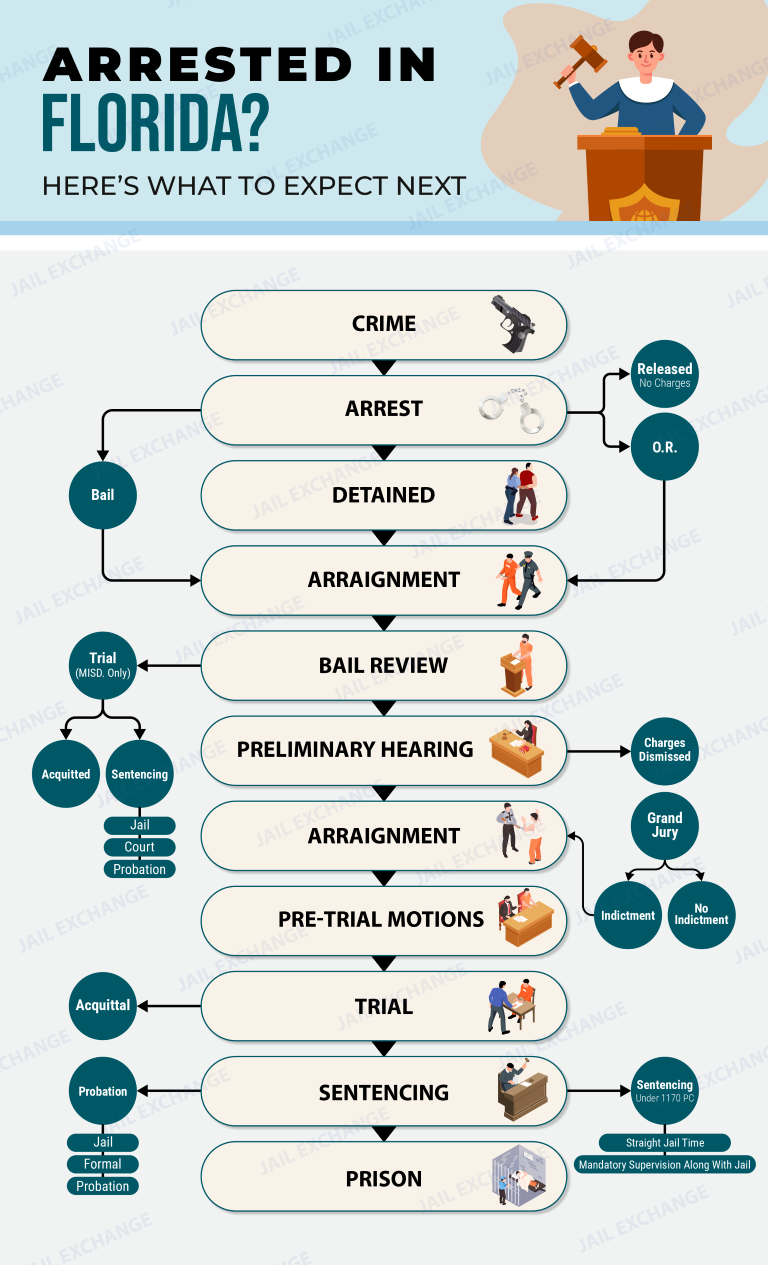
Small crimes often end with an Okeechobee officer passing over a notice to appear. That form names your court date, and nobody hauls you to jail. People who are hauled to the NW 4th Street jail must see a judge within 24 hours under Florida’s rules. That quick hearing is called first appearance. Starting January 2026, one uniform bond schedule covers all 67 Florida counties. The Florida Supreme Court set it up in order AOSC25-69, and it names the smallest bond that can be posted ahead of that hearing. A handful of charges, domestic violence included, still require the judge first. A bond is your promise, often with money behind it, to show up every time court is scheduled. State-licensed bail bond agents can post it for you. Florida’s regulators set their premium at 10% of the bond, which never comes back to you.
Pleas are entered at arraignment. Stealing items worth $100 to $750 is a first-degree misdemeanor; the most a judge can give is a year in jail, and the fine can hit $1,000. Lower-level, second-degree misdemeanors are limited to a 60-day jail stay, plus a fine no higher than $500. The State Attorney offers diversion to some first-time offenders, and meeting every condition gets the case dropped.
The elected 19th Circuit State Attorney keeps an Okeechobee branch and prosecutes all state crimes here. The elected 19th Circuit Public Defender keeps an Okeechobee branch, and a judge can appoint it for a defendant who cannot pay a private lawyer. When an ethics conflict keeps the public defender out, the case goes to Criminal Conflict and Civil Regional Counsel instead. Under section 938.29, Okeechobee judges may order you to repay part of that lawyer’s cost, $50 at minimum on a misdemeanor, and the debt can turn into a lien on your property. Rule 3.191 puts a 90-day limit, starting at formal charging, on bringing a misdemeanor to trial, though defendants can waive it. A six-member jury decides.
Under 18: Okeechobee’s juvenile judge, part of Circuit Court, takes misdemeanors charged against minors. For many first-time minor offenses, local deputies and police can skip the arrest and use a civil citation (section 985.12). A youth who completes the program has no arrest record from it.
2. Okeechobee felonies: cattle or equipment theft, burglary, meth and fentanyl dealing, felony DUI
Any felony could mean a stretch in a Florida prison. Once first appearance wraps up, prosecutors in the local State Attorney branch study the file and, if they go forward, file an information (the official charge) with Circuit Court. Arraignment comes next, and then discovery, the swap of evidence between the two sides.
Florida ranks felonies by degree. Rustling cattle or taking farm equipment worth $750 or more is third degree, and so is a third DUI inside ten years; each can mean 5 years. Burglary of a house is second degree and can mean 15. For first-degree felonies the cap is 30 years, with life for a few. Trafficking meth or fentanyl brings mandatory minimum prison terms that grow with the weight. To figure a sentence, the judge fills in the Criminal Punishment Code scoresheet, adding points for today’s charges and for old convictions. Anyone sent to a Florida prison must serve 85% of the sentence or more.
Rule 3.191 hands prosecutors a 175-day window after formal charges are filed to get a felony to trial; defendants may waive this window. Non-capital felony juries here have six seats. Plea bargains settle most Okeechobee felonies.
Under 18: Okeechobee has no juvenile detention center, so kids who must be held ride to Fort Pierce. The Department of Juvenile Justice operates St. Lucie’s regional center there, at 1301 Bell Ave., for St. Lucie, Martin, Indian River and Okeechobee youth. A detention hearing before a judge must follow within 24 hours.
3. Lake-country violent felonies: murder, armed robbery, rape and sexual battery, shootings and stabbings
Violent charges move through the same courtroom steps, yet a judge can refuse any release before trial. Guns bring in the 10-20-Life law, codified at section 775.087. Its mandatory minimums are 10 years for carrying a gun during crimes such as robbery and 20 for shooting it. When that gunshot causes a death or a serious injury, the penalty runs from 25 years to life.
Florida calls first-degree murder a capital felony. Just two punishments exist for it: death, or a whole life in prison without parole. A death sentence takes a 12-person jury, and a 2023 law lets 8 of those votes be enough. Florida’s men on death row are mostly at Union Correctional Institution near Raiford; its women are at Lowell.
Crime victims get protection from Marsy’s Law, which Florida voters put into Article I, Section 16(b). Among its promises: victims get told when court meets, can attend, and can address the judge at sentencing.
Under 18: A 19th Circuit prosecutor may decide to “direct file” (section 985.557), thereby moving a teenager into the adult system. Youths aged 16 and 17 are eligible on most felonies. Fourteen- and fifteen-year-olds are eligible only for crimes the statute names, like murder, armed robbery or sexual battery. Florida dropped every direct-file requirement in 2019, so it’s always optional now. Finally, under section 985.56, Okeechobee grand jurors may indict a child of any age on a charge carrying death or life.
4. Who keeps warrants from the county courthouse on NW Third Street?
A good first look is the shared court records search, where dockets list any capias. Sheriff's deputies keep the Nineteenth Circuit warrant file and answer at (863) 763-3117. Counsel can schedule your surrender at the NW 4th Street jail, a short walk from the courthouse. Suite 101 on NW Third Street holds the clerk's office for new dates, and Taylor Creek and Basinger cases are filed there too. Florida's statewide wanted persons search, kept by FDLE, adds what agencies outside the county release.
Immigration holds. If ICE lodges an Okeechobee detainer on someone:
- F.S. 908.105 requires telling the Okeechobee bond judge
- notice goes to the Okeechobee state attorney
- Okeechobee bond can still be granted
- the jail may hold them 48 more hours for ICE
- those hours in Okeechobee include weekends and holidays
- for Okeechobee forcible felony cases, unlawful status blocks Okeechobee release before first appearance (F.S. 907.041)
- then the Okeechobee court presumes detention, and the Okeechobee defense can push back
Town courts. Okeechobee has no city or town courts. The 1972 Article V reform phased them out. In Okeechobee, a city ordinance case goes to Okeechobee County Court, which also hears misdemeanors.
We built this page as a simple overview of Okeechobee County criminal cases, and none of it counts as legal advice. For your own charge, get a defense lawyer’s opinion, or phone the 19th Circuit Public Defender’s Okeechobee branch at (863) 763-7977.