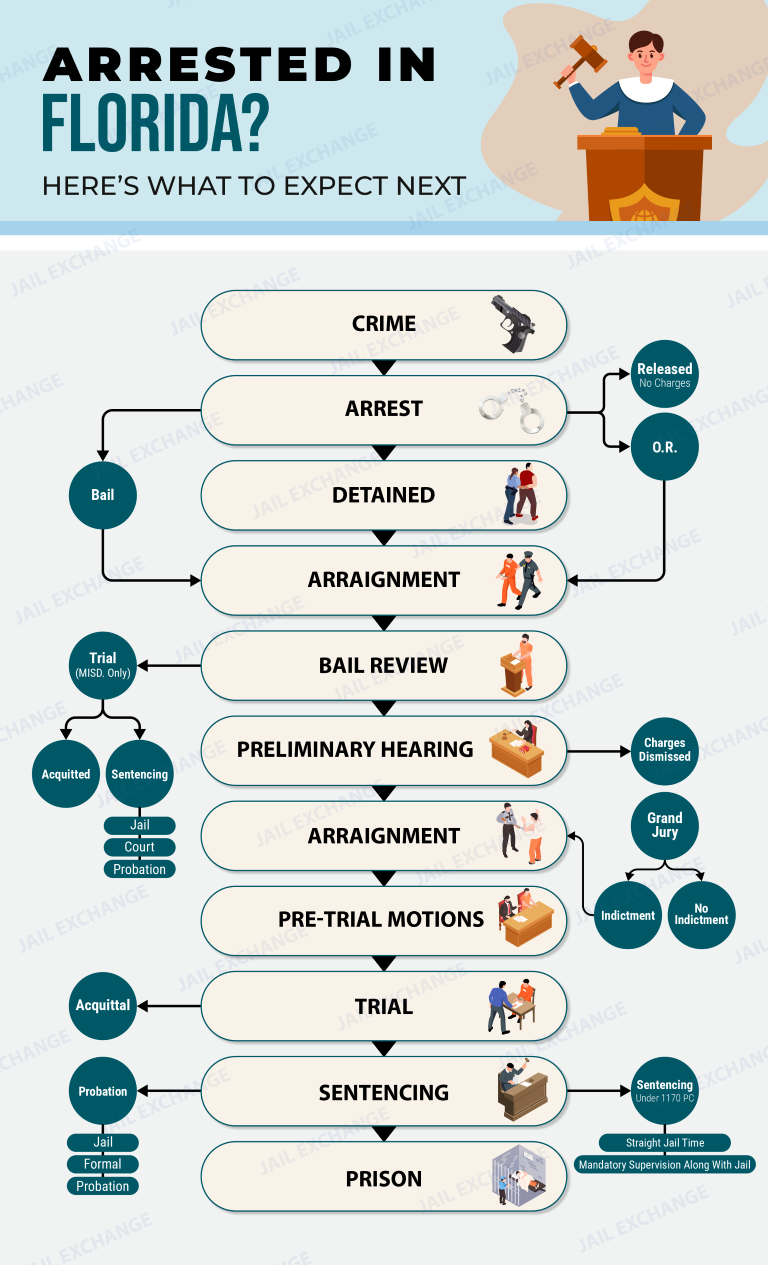
Washington County Jail Criminal Court Process
Criminal Court Process for Washington County Florida
Washington County, Florida: What Happens After a Criminal Charge
Washington County is a quiet, rural part of the Florida Panhandle, with Chipley as its county seat. Even so, its courts follow the same statewide system as big cities. Two trial courts share the work. Washington County Court decides misdemeanors (minor crimes), criminal traffic charges and local ordinance cases. Washington Circuit Court decides felonies (major crimes) and handles juvenile cases. Washington shares the 14th Judicial Circuit with five other counties: Bay, Calhoun, Gulf, Holmes and Jackson. Our bail guide and inmate search cover the other steps.
Criminal court is held at the Washington County Courthouse, 1293 Jackson Avenue, Chipley, FL 32428. The clerk’s criminal department answers at (850) 638-6289, and the clerk’s main line is (850) 638-6285. Anyone 18 or older who is arrested goes to the sheriff’s Washington County Jail in Chipley.
Free case lookup: The Washington County clerk puts its court records on the Online Court Records Search, a free statewide search site. Select “Washington” and enter a name or case number to view the charges. You’ll find the charges, court dates and final results for public cases. Confidential items, like juvenile records, sealed or expunged cases, and Social Security numbers, are not shown.
1. Washington County Court: driving while license suspended, petit theft, DUI, simple assault
Chipley police and county deputies often start a misdemeanor case with a notice to appear. You sign it, agreeing to show up on the date written there. No jail stay is needed. Washington arrestees must see a judge within a day, at first appearance. Since 2024, Florida has used one statewide bond schedule, renewed each year by the Florida Supreme Court, which sets minimum bail for anyone released before that first hearing. Bail is money that guarantees you’ll return to court. Under certain charges, such as most domestic violence arrests, you must stay until a judge reviews things. Judges can also grant pretrial release with conditions. Bondsmen are paid a state-set premium: one dollar of every ten in the bond, never under $100.
Florida misdemeanor punishments are limited. A second-degree misdemeanor, like simple assault, has a maximum of 60 days and $500. A Washington first-degree misdemeanor, like a first DUI or petit theft of $100 or more, is punishable by up to 12 months in jail and a $1,000 fine. Driving on a suspended license can be a second-degree misdemeanor the first time if you knew about the suspension, and it can grow worse with repeats.
Voters elect the 14th Circuit State Attorney, whose office brings every state charge filed in Washington County. The 14th Circuit Public Defender steps in when a judge rules that the accused has no way to pay a lawyer. A conflict sends the case to a different state office, Criminal Conflict and Civil Regional Counsel. Fla. Stat. 938.29 allows courts to bill convicted defendants for public defender services, which can become a lien on property. Some people charged for the first time can complete pretrial diversion and have their case dismissed. Trials for misdemeanors use six jurors. If not waived, trial generally must start within 90 days of formal charging.
Children and teens: Many kids who commit a first small offense in Washington County can get a civil citation. Instead of being arrested, the child completes community service or a class, and there is no arrest record when it’s done. Youth cases that end up in court belong to the Circuit Court’s juvenile judge.
2. Felony matters: home burglary, meth sales, grand theft of a vehicle, forgery
A felony is the level of crime where state prison becomes possible. Following first appearance, prosecutors look at the evidence. When they choose to proceed, an information is filed listing the charges. At the arraignment, the person says how they plead. Under Florida’s speedy trial rule, felonies should reach trial within 175 days of formal charges, though most defendants waive that to prepare.
Florida’s felony ladder goes like this: third degree, 5 years maximum; second degree, 15 years; first degree, 30 years; life felony, up to life. Taking someone’s car is normally charged as third-degree grand theft. Selling meth is typically a second-degree felony. Each sentence begins with a Criminal Punishment Code scoresheet rating both the offense and the person’s past. That number tells the judge the lowest sentence allowed. No Florida prisoner leaves before finishing 85% of the sentence. Under the 10-20-Life law, having a gun during certain felonies brings a 10-year mandatory term, firing it raises that to 20, and causing death or great bodily harm with it triggers 25 years to life.
Plea deals end most Washington County felony cases. Probation, drug court and community control are possible alternatives to prison.
Children and teens: When a Washington County youth is detained on a felony, the usual destination is Panama City’s Bay Regional Juvenile Detention Center, which is run by the state’s Department of Juvenile Justice. A judge reviews whether they must stay there within 24 hours. Prosecutors can use direct file to charge a teen in adult court. It’s allowed for nearly every felony once a teen turns 16, and for listed serious felonies at ages 14 and 15 (Fla. Stat. 985.557). The 2019 legislature took away mandatory direct file, so now it’s always a judgment call by the prosecutor.
3. Violent cases in Chipley: murder, armed home invasion, sexual battery, shooting into a home
Violent felony cases go through the same stages, but the possible sentences are much harsher. A judge can order a person held without bond after a hearing about danger to the community. Armed home invasion robbery is a first-degree felony that can mean life. Firing a gun into a house with people inside is a second-degree felony, and the gun law can add more time. Defendants are usually ordered to stay away from victims and witnesses.
First-degree murder is a capital felony. Florida requires a grand jury, made up of community members who hear evidence in secret, to bring that charge by indictment. Capital trials use 12 jurors. If a Washington jury convicts, it then weighs life without parole against death. Since 2023, it takes at least 8 jurors out of 12 to recommend death. A Chipley jury’s death verdict would send a man clear across north Florida to Union Correctional Institution in Raiford; a woman would go to Lowell Correctional Institution in Marion County.
In Washington County, as across Florida, Marsy’s Law (state constitution, Article I, Section 16(b)) gives victims rights: hearing notices, attendance, and a voice in court. The 14th Circuit State Attorney’s victim advocates help victims and families with each step.
Children and teens: If the charge could mean death or a life term, a grand jury in Florida may bring an indictment against a child no matter the age, and an adult judge then takes the case (Fla. Stat. 985.56). Anyone under 18 when the crime happened is protected from the death penalty. Before a young person can be sentenced to life or a very long term, the judge must hold a special hearing.
4. Who holds warrants from the Chipley courthouse?
Chipley's Fourteenth Circuit warrants rest with the Sheriff's Office; one call to (850) 638-6111 can confirm whether one is active. The online court records search displays each docket, capias included. Through a lawyer, a surrender at the Brickyard Road jail can be set up, and counsel can then ask the judge for release. Suite 101 on Jackson handles new dates, and Vernon, Caryville and Wausau cases are handled there as well. Panhandle families who've moved around can also search FDLE's statewide wanted persons list.
Federal court: Washington County federal cases go to the Northern District of Florida's Panama City Division. Hurricane Michael damaged the Panama City courthouse in 2018, so some of these cases have been heard at the Tallahassee federal courthouse, 111 N. Adams Street. Two things can make a crime federal: it violates an act of Congress, or it happens on property belonging to the national government. Because the county holds hardly any federal property, its federal cases tend to involve moving drugs along Interstate 10, a convicted felon having a gun, counterfeit money, or fraud using the mail or internet. The closest big military site, Tyndall Air Force Base, is in Bay County, not here. There are no tribal lands in Washington County. The Seminole and Miccosukee tribes have their land far to the south. Use the links below.
Immigration holds. If ICE lodges a Washington detainer on someone:
- the Washington bond judge must be told (F.S. 908.105)
- notice goes to the Washington state attorney
- bond is still possible in Washington
- ICE may keep the person up to 48 hours past release
- those hours in Washington include weekends and holidays
- a Washington forcible felony charge plus unlawful status in Washington means no release before first appearance (F.S. 907.041)
- after that hearing, Washington judges start from detention, though Washington defense lawyers can rebut it
Town courts. Since 1972 Article V changes, Washington has had no city courts. Any Washington city ordinance case is heard in Washington County Court instead, alongside misdemeanors.
This overview covers the basics for Washington County and does not replace legal advice. A defense lawyer can give real advice about a specific charge; for case records, the clerk’s criminal department is at (850) 638-6289.