
Anoka County Jail
Anoka County Jail
Jail Phone Number
763-324-5100Anoka County Inmate Search: Jail, Workhouse and Your First Moves
Arrests anywhere from Columbia Heights to St. Francis most often bring the person to the county jail, 325 E Jackson Street, Anoka, MN 55303. The Sheriff's Jail Division runs that building, and its beds mostly hold people whose cases are still open. Sentenced men and women often finish their time at the county workhouse, 3300 4th Avenue N., Anoka, MN 55303. Below you'll find help with warrants, mugshots, deposits, letters, video visits, bail and hearings, starting with the search.
Open the county's Inmate Locator and enter a name. A match tells you whether the person sits in the jail or the workhouse at this moment. Anyone let out during the last 30 days still shows, and a crowding transfer to some other jail is marked on the record. Someone booked within the hour may not be listed quite yet.
Next, scribble down the legal name, birthday and any nickname, then call jail staff at 763-324-5100. Your three questions: Has bail been set? For how much? When does the person first see a judge? Our walkthrough on bail explains paying, and the court walkthrough follows the case from there.
Read inmate search answers
 Read inmate search answers
1. What steps get results from the Inmate Locator?
One search box covers adults at both county buildings. Try it this way:
- Pull up the Inmate Locator.
- Enter the surname first. Too many hits? Add a given name to trim them.
- Pick the matching person and note whether the record says jail or workhouse.
- Scan for a release date, or a remark about a move to an outside jail.
- Jot down whatever number appears on the record, since reading it to staff speeds up a call.
Court status lives in the state court system, separate from this tool. For the booking charge, a bail figure or a release time, ring 763-324-5100.
↑ Back to the question list2. No match in the locator yet?
Coming up empty right after an arrest is common and usually fixes itself. Likely causes:
- Booking is under way. Prints, photos and forms are handled before a record goes live.
- Officers still have them. A city department may hold an interview before the ride to Jackson Street.
- Ticketed and freed. Plenty of misdemeanor stops wrap up with a ticket and a court date, not a cell.
- Released by the court. The first hearing may have ended with the person walking out.
- Housed somewhere else. Full beds can mean a transfer, and a stop made over the line in Hennepin, Ramsey or another county ends at that county's jail.
- Spelled differently. Try other spellings: a nickname, a former last name, or just one part of a two-part surname.
- Still a teen. Anyone under 18 goes through juvenile channels, and the locator covers adults.
For a quick answer, phone 763-324-5100.
↑ Back to the question list3. Jackson Street, the workhouse or a nearby jail: where is Anoka County holding them?
Both adult buildings are in the city of Anoka:
- Anoka County Jail, the Sheriff's Jail Division, 325 E Jackson Street, Anoka, MN 55303, 763-324-5100. Its 238 beds hold mostly people who are not yet sentenced.
- Workhouse, a Community Corrections site in the Vail Building of the Rum River Human Services Center, 3300 4th Avenue N., Anoka, MN 55303, 763-324-4860. This 240-bed, minimum-security unit houses sentenced men and women. With the court's okay and proof of a job, a resident may leave for work during the day (work release, or Huber). Residents without jobs may be put on supervised work crews.
When beds fill up, people from either building can be shifted to an outside jail. Arrests past the county line can send someone to Hennepin, Ramsey or Sherburne instead:
- Hennepin County Jail (Adult Detention Center), Public Safety Facility, 401 South 4th Avenue, Suite 100, Minneapolis, MN 55415, 612-348-5112
- Ramsey County Adult Detention Center, 425 Grove Street, Saint Paul, MN 55101, 651-266-9350
- Sherburne County Jail in Elk River, whose Sheriff's Office is at 13880 Business Center Drive NW, Suite 100, Elk River, MN 55330, 763-765-3500
4. Are Anoka County booking photos and mugshots available?
Under the state's data practices law, a booking photo counts as public data. An agency may sit on a photo temporarily if putting it out would damage an ongoing investigation (Minn. Stat. 13.82, subd. 26). Basic arrest data is open too, such as the charge, custody status and any release, and the arresting agency keeps it (Minn. Stat. 13.82, subd. 2).
So aim a mugshots request at the office behind the arrest. When deputies did it, phone the Sheriff's Office at 763-324-5000 and ask about the booking photo. When a city officer did it, reach out to that city's department.
- ICE booking pictures: ask through ICE's records request page.
- Most federal agencies hold back booking pictures. The U.S. Marshals Service is the exception that sometimes releases one, as in a manhunt.
5. How can VINE alert me when custody changes?
Minnesota VINE, which the state Public Safety department operates, sends a notice if a county jail lets the person go or ships them elsewhere.
- Register online at VINELink or call 877-664-8463. Alerts begin only after you enroll.
- Once someone enters a state prison, VINE no longer covers them. For that, sign up with Minnesota Haven, the DOC's notice system.
- Missed the release? The county's Inmate Locator keeps former residents listed for 30 days.
6. What decides bail at a first appearance in the Tenth District?
Release terms get fixed by a District Court judge during the first appearance. When police arrested someone without a warrant, that appearance has to happen within 36 hours, and that clock ignores the arrest day, Sundays and legal holidays, as the criminal rules direct (Rule 4.02, subd. 5). A second deadline applies too: within 48 hours, weekends included, a judge has to confirm probable cause (Rule 4.03).
- Release comes first. The judge's starting point is freedom on a signed promise to return, with only the conditions that safety or a court return truly calls for (Rule 6.02).
- Often two figures. The same rule makes the judge set a bail amount carrying no conditions. Orders therefore tend to show a smaller sum tied to conditions next to a bigger sum with none.
- Some arrests skip the ticket. Domestic assault, stalking and protection-order arrests can't end with a ticket on the spot; the person goes to jail and then sees a judge (Minn. Stat. 629.72).
- Pretrial reports. In certain cases, Community Corrections, 2100 3rd Avenue, Suite C100, Anoka, MN 55303, 763-324-4800, writes a bail evaluation that the judge reads.
- Bondsmen. Minnesota's Commerce Department licenses them. The premium is $100 or more, and it is not refunded, win or lose (Minn. Stat. 60M.02).
- Money bail left with the court. The court administrator holds it, and the law books it as the defendant's money, no matter which relative paid it in. Fines and restitution owed in the case can be paid out of it before anything comes back. Whatever is left returns to the defendant, who can route it to a parent or friend by signing form CRM602 (Minn. Stat. 629.53).
Check with jail staff at 763-324-5100 on where and when payments are accepted. For more, open our local bail page, while the state bail law overview sums up Minnesota's rules.
↑ Back to the question list7. Where are the charges spelled out?
Filed cases can be looked up free of charge on Minnesota Court Records Online (MCRO). Type a name or case number, then click into the case to read each count and every event so far. Certain juvenile files are kept out of view.
Charges fall into four levels by maximum penalty (Minn. Stat. 609.02, 609.03):
- Petty misdemeanor: fine capped at $300, with no jail time possible.
- Misdemeanor: up to 90 days locked up, up to $1,000 in fines, or the two together.
- Gross misdemeanor: a 364-day cap and a $3,000 fine cap, alone or together.
- Felony: the sentence on the books can reach a year or more in prison.
If nothing is filed yet, staff at 763-324-5100 can read you the booking charge. Court Administration, 763-760-6700, can track down a case number.
↑ Back to the question list8. Who defends people in Anoka County who can't pay a lawyer?
Money tight? Charged with a felony or a gross misdemeanor? Same for a misdemeanor that could mean jail. Then Minn. Stat. 611.14 lets the person ask the court for a public defender. A sworn statement of income and bills goes to the judge, who makes the call. Someone already on needs-based aid gets a head start, since the law presumes they qualify (Minn. Stat. 611.17).
- Speak up at the first hearing. Application forms come from Court Administration, 2100 3rd Ave, Anoka, MN 55303, 763-760-6700, and every answer must be complete and true.
- Public defenders for the Tenth District work from an office at 901 West Main Street, Suite 100, Anoka, MN 55303, 763-422-3350.
Paying for a private attorney works too. Attorneys, probation agents and other court officers may see clients at the jail by showing professional ID, and the jail may allow them contact visits.
↑ Back to the question list9. Screen visits at Jackson Street and the workhouse: what are the rules?
Personal visits at both buildings happen on a screen. The details differ:
- Jail lobby video. Friends and relatives use video stations inside the jail at 325 E Jackson Street, Anoka, MN 55303. Arriving more than five minutes ahead isn't allowed, and groups shouldn't linger in the lobby.
- Jail visits from home. ICSolutions handles paid remote video sessions, which must be booked 24 hours or more in advance.
- Workhouse. Turnkey Corrections kiosks stand in every housing unit. Families schedule through the Inmate Canteen site with a paid account, using a webcam or a phone that does video. Questions go to 763-324-4860.
Hours, ID rules and whether children may join are best checked at 763-324-5100 before the first trip. More pointers sit in our visitation guide.
↑ Back to the question list10. Which deposit methods reach an Anoka County account?
Account funds pay for canteen snacks, soap and similar items, and at the workhouse for phone calls too. Each building has its own methods:
- Jail, by internet. Use Inmate Canteen. The jail's commissary contractor is Turnkey Corrections.
- Jail lobby kiosk. At 325 E Jackson Street, Anoka, MN 55303, a machine accepts cash plus debit and credit cards from 7 a.m. until 10 p.m., seven days a week.
- Workhouse. Card payments work through Inmate Canteen online or in person during visiting hours. Money orders payable to "ACC" are also taken; ring 763-324-4860 for where to deliver one.
The jail bans cash, personal or payroll checks, money orders and gift cards in the mail, so keep money out of envelopes. Deposit questions: 763-324-5100. Read our deposit guide and our commissary explainer.
↑ Back to the question list11. How do calls, tablet messages and pay phones work here?
Inside the jail, people use a phone and messaging service along with a tablet system. Ring 763-324-5100 and ask who provides them, the rates and how families sign up. Workhouse residents use unit pay phones that draw from their store accounts; that staff can be reached at 763-324-4860.
- Scam alert. No one from the Sheriff's Office will call you demanding payment. Hang up on such a caller and dial the jail on your own.
- Keep the case off the line. Talk about the charges belongs in lawyer meetings, not on these calls.
For general setup tips, see the calling guide and the guide to messages.
↑ Back to the question list12. What does a scanned letter need to get through?
Letters to the jail are scanned, and anything outside the rules is sent back. Put the full name first, then this address:
Anoka County Jail, 325 E Jackson Street, Anoka, MN 55303
- Limit each mailing to five pieces.
- Photos must be 4x6 or smaller; sheets of paper, 8.5 by 11 or smaller.
- The jail rejects blank paper, musical, pop-up or oversized cards, cards decorated with stickers or glitter, padded envelopes, boxes and stamps.
- Also rejected: pre-stamped or pre-addressed envelopes, anything stained, and magazines or newspapers.
- Postage-due and C.O.D. items are refused.
- Envelopes marked as legal mail are opened with the recipient present.
Rejected pieces return to the sender, or are destroyed when there is no return address. Letters reaching the jail after a release or transfer bounce back too. Workhouse letters go to: resident's name, Anoka County Corrections, Anoka County Workhouse, 2100 3rd Ave STE C100, Anoka, MN 55303-5037. Our mail tips page has more.
↑ Back to the question list13. Picking up wallets, keys and clothes: who should I call?
Anything logged at booking, like wallets, phones and clothes, is held by the jail. Before collecting items for someone, phone 763-324-5100 and ask for property release, along with these points:
- Does your loved one need to sign paperwork letting you take the items?
- Which photo ID do you need?
- When can you come to 325 E Jackson Street, Anoka, MN 55303?
Workhouse property questions go to 763-324-4860.
↑ Back to the question list14. Who handles a health problem or missing medication inside?
Ring the jail at 763-324-5100 and ask for medical staff. Have a list ready: each drug, its dose, and the prescriber, with that clinic's phone. Mention any risk of withdrawal or a mental health crisis right away. The person inside can also tell jail staff about a health need.
- Workhouse residents: call 763-324-4860.
- Sexual abuse or harassment at the workhouse can be reported on its PREA hotline, 763-324-4886.
- If a life is in danger right now, call 911.
15. Is a warrant out, and what clears one?
Warrant questions start with the Sheriff's Office. Headquarters for the Sheriff's Office is at 13301 Hanson Blvd NW, Andover, MN 55304, 763-324-5000, open 8:00 a.m. to 4:30 p.m. on weekdays. Check a name through the county's Online Warrant Search, or ring the warrants line, 763-422-7500. Statewide, the Department of Corrections names people wanted for supervised-release violations on its Wanted Fugitives page. For filed court cases, which are different from warrants, use Minnesota Court Records Online. Clearing a warrant starts with a lawyer, followed by contact with the issuing court. Here that means Court Administration at 2100 3rd Ave, Anoka, MN 55303, 763-760-6700.
↑ Back to the question list16. Hearing dates at the Anoka County courthouse: how do I check?
Criminal hearings take place at the courthouse, 2100 3rd Ave, Anoka, MN 55303. Call Court Administration at 763-760-6700, or look up scheduled hearings by name with the state's Hearing Search.
- Within about 42 days after the first appearance, there is usually an omnibus hearing, where evidence issues are argued (Rule 11.01).
- Under Rule 11.09, demanding a speedy trial means it must begin within 60 days.
- A person ordered to serve time at the workhouse has to show up at the Vail Building, 3300 4th Avenue N., Anoka, MN 55303, on the exact date and hour given. Missing it brings a warrant. Rescheduling requires a call to 763-324-4860 at least 72 hours early, costs $30 and is allowed once.
Curious how a case unfolds after day one? Our court page lays it out.
↑ Back to the question list17. Federal agents involved: which court and which jail?
Federal crimes are tried in Minnesota's single U.S. District Court. The courthouse nearest this county is the Diana E. Murphy United States Courthouse, 300 South Fourth Street, Minneapolis, MN 55415, with the clerk at 612-664-5000.
- At a detention hearing, the federal judge picks between holding the person until trial and letting them out (18 U.S.C. 3142).
- Pretrial custody belongs to the U.S. Marshals Service, 300 South 4th Street, Suite 402, Minneapolis, MN 55415, 612-664-5900. Its staff can tell families where the person is housed.
- The Sherburne County Jail holds a large share of the Marshals' prisoners in this state. Its Sheriff's Office is at 13880 Business Center Drive NW, Suite 100, Elk River, MN 55330, 763-765-3500.
- After sentencing, the search moves to the Federal Bureau of Prisons inmate locator.
18. An immigration detainer was placed: what follows?
- First, ICE hands the Jackson Street jail its I-247A detainer form.
- In it, ICE wants the person held up to 48 hours after they would otherwise be released (8 CFR 287.7(d)), letting agents get there.
- Minnesota law on detainers was the subject of a state Attorney General opinion issued February 6, 2025. In that view, once someone is due to walk out, a detainer by itself gives a county jail no legal basis to keep them.
- People in ICE custody are often housed in county jails. ICE's own list includes the Sherburne jail, reached through the Sheriff's Office at 13880 Business Center Drive NW, Suite 100, Elk River, MN 55330, 763-765-3500.
- Look the person up with the ICE Online Detainee Locator. The search accepts an A-number or a name with native country.
ICE's ERO St. Paul Field Office sits at 1 Federal Drive, Suite 1601, Fort Snelling, MN 55111, 612-843-8600.
↑ Back to the question list19. Headed to a state prison: how do families follow along?
Prison time puts the person in DOC hands; DOC is short for the Minnesota Department of Corrections. Next, the person stays on Jackson Street until deputies make the drive to the DOC's intake center. Staff there evaluate and classify new arrivals before a fitting prison is chosen.
- Plug a name into the DOC Offender Locator. Fresh arrivals can stay unlisted for several business days.
- For each prison's visit hours and mailing rules, open our Minnesota state prisons guide.
- Most prisoners serve their last third outside prison walls on supervised release, with DOC oversight.
20. Teen arrested? How juvenile custody differs
In Minn. Stat. 260B.007, childhood lasts until the 18th birthday. The District Court has a juvenile division that takes youth cases. A youth taken into custody normally goes home to a parent, unless the youth is a danger or unlikely to show up later (Minn. Stat. 260B.176).
- A youth can sit in secure detention for 36 hours, with weekends and holidays left off. Any longer takes a filed petition plus a judge's sign-off.
- Adult jails and lockups may keep a youth only for a short time: up to 6 hours inside a metro area and 24 hours outside one.
- With a grave charge, a youth aged 14 to 17 can be sent up to adult court. That is called certification. Others become EJJ (extended jurisdiction juvenile) cases, which add a stayed adult sentence.
For a youth's location, ask juvenile court staff through Court Administration, 2100 3rd Ave, Anoka, MN 55303, 763-760-6700, or call Community Corrections, 2100 3rd Avenue, Suite C100, Anoka, MN 55303, 763-324-4800.
↑ Back to the question list21. Sheriff, city police or State Patrol: who arrested them in Anoka County?
With 382,119 residents (an April 1, 2025 estimate from the Minnesota State Demographic Center), the county is policed by these agencies:
- Sheriff's Office, 13301 Hanson Blvd NW, Andover, MN 55304, 763-324-5000. Its deputies patrol Andover, Bethel, Columbus, East Bethel, Ham Lake, Nowthen, Oak Grove and Linwood Township.
- City departments: Anoka Police Department, Blaine Police Department, Centennial Lakes Police Department, Columbia Heights Police Department, Coon Rapids Police Department, Fridley Public Safety Police Division, Lino Lakes Public Safety Police Division, Ramsey Police Department, Spring Lake Park Police Department and St. Francis Police Department.
- Minnesota State Patrol, headquarters at 445 Minnesota Street, Suite 130, Saint Paul, MN 55101, 651-201-7100. For the troopers' district office here, open the State Patrol contact page and choose Anoka in its menu.
Not sure which agency booked the person? Ask jail staff at 763-324-5100, and request that agency's phone number too.
↑ Back to the question listAnoka County bail and bond: the Jackson Street jail, warrants, and court orders
Grown-ups picked up by police in Anoka County are booked into the Anoka County Jail, 325 Jackson Street, Anoka, MN 55303. Below, you will learn how bail works and what to do about warrants and court orders.
The quickest check is the official jail lookup, where you enter whatever name you have. For more, try our Anoka County Jail Roster page, with custody status, active warrants and public defenders.
Still stuck? Dial 763-324-5100 and ask the jail about bail. Anything about hearings lives on our Anoka County court page.
1. Is my family member in the Jackson Street jail in Anoka?
Use Anoka County Inmate Search first. It shows people in custody and people recently released. If a name is missing, the booking may be new, so check again later in the day.
The Jail Division line is 763-324-5100. It is the number the county gives for bail questions.
↑ Back to the question list2. Which Anoka County office is the jail and which is the sheriff?
They are in different places. The jail is at 325 Jackson Street, Anoka 55303. The Sheriff's Office main building is at 13301 Hanson Boulevard NW in Andover, 763-324-5000, open weekdays from 8:00 a.m. to 4:30 p.m.
Do not drive to Andover to pay for someone held in Anoka. Call the jail first at 763-324-5100.
↑ Back to the question list3. How do I post bail for someone at the Anoka County Jail?
Payment hours and accepted forms come from the jail, so call it at 763-324-5100. Ask for the exact amount, the case number, and where and when money is taken.
State law has the court administrator hold accepted cash bail. Bring photo ID. Keep the receipt.
↑ Back to the question list4. Does a sheriff's deputy ever call to collect a bail or fine?
No. The county warns that the Sheriff's Office will never call to demand money. If someone phones with a warrant story and a payment demand, hang up and dial the jail yourself.
Real warrant questions go to the Anoka County warrants line, 763-422-7500.
↑ Back to the question list5. How do I find out if my brother has an Anoka County warrant?
The county's Warrants Unit issues or clears nearly 11,000 warrants a year, so it is a busy office. Anoka County warrants are handled at 763-422-7500. The county also has an online warrant search for public warrant information.
A warrant from another Minnesota county has to be asked about with that county.
↑ Back to the question list6. What are the Tenth District's bail orders for Anoka cases?
The Tenth Judicial District lists three standing orders about money on its standing orders page. Their titles are Release of Cash Bail, Amended Bond Forfeiture, and Denial of Petitions for Bond Reinstatement Past 180 Days.
Ask a lawyer or your bond agent how they apply. The titles suggest a late request to reinstate a bond can be turned down.
↑ Back to the question list7. When does a judge see someone arrested in Anoka County?
Within 36 hours of arrest, not counting the day of arrest, Sundays, or legal holidays. Separately, a judge has to find probable cause within 48 hours of arrest, and that clock counts weekends and holidays. If the 48-hour deadline is missed, the person must be released.
At the first hearing the judge starts from release without money unless safety or a missed court date is a worry.
↑ Back to the question list8. What is a bail evaluation and who does it in Anoka?
For some charges, such as crimes of violence and certain domestic assault cases, state law has the local corrections department write a pretrial bail evaluation before the first hearing. The judge reads it. Anoka County Community Corrections is in the Courthouse at 2100 3rd Avenue, Suite C100, 763-324-4800.
The evaluation gives no dollar amount to the judge.
↑ Back to the question list9. What will a bondsman want from my family?
A bondsman holds a Minnesota Commerce license and court approval. The fee must be the surety's filed rate and at least $100. Ask for the rate in writing.
Collateral needs a numbered receipt. It must be returned within 21 days after you show proof the case is over. Bondsmen are not allowed to put money on an inmate's account.
↑ Back to the question list10. Can I use my house for an Anoka County bond?
Court rules list "other security" next to cash, but no Anoka page explains how to use a home. Ask the court which papers the judge wants and where they are filed. A bondsman may not take a quitclaim deed as collateral, may not keep more collateral than the bond's face amount, and must give a numbered receipt. Do not sign a deed over to anyone before you read exactly what it does.
↑ Back to the question list11. Why does the record show no bail in Anoka?
Often a judge has not acted yet. A probation hold or a warrant from another county also blocks release. Because Minnesota has no death penalty, everyone has a right to bail, but a judge can set conditions or keep someone in when release is unsafe.
After domestic assault arrests, the judge may order no contact and may order firearms turned in.
↑ Back to the question list12. Where does an Anoka County teenager go?
The state juvenile detention association lists an Anoka County Juvenile Center. The county's site also describes the East Central Regional Juvenile Center in Lino Lakes, a shared center for many counties. Neither source says which one holds a specific Anoka youth, so ask. The county main line is 763-324-4000. A youth's record is private, and the adult search will not list a minor.
↑ Back to the question list13. How do I ask for a public defender in Anoka County?
The court can appoint a public defender if your relative cannot pay and faces jail time. Ask at the first hearing, or apply through the state public defender page. The Tenth District has a standing order about rejecting public defender applications that are incomplete, so answer every line. The court picks the lawyer, not the family. Call the county main line, 763-324-4000, and ask for court administration.
↑ Back to the question list14. What if an Anoka County defendant misses court?
If your person misses court, the judge can forfeit the bond and issue a warrant. The court must tell the bondsman within 30 days. Anoka's Tenth District also has a standing order on denying requests to reinstate a bond more than 180 days late, so delay can close a door that was open. Under the statewide bail bond rules, a bond is delinquent when it stays unpaid or unreinstated 90 days after the forfeiture order. Call your lawyer and the bondsman the same day, and ask the warrants unit at 763-422-7500 about the warrant.
↑ Back to the question list15. How do I get cash bail back in Anoka?
Cash bail is the defendant's property, not the payer's. The court holds it until the case reaches a final result. A judge may use it for fines or restitution first, then pay the rest to the defendant or a person the defendant names in writing. The Tenth District has a standing order titled Release of Cash Bail, so ask the court how to file the request and what proof it wants. Bondsman fees are not part of that refund. Keep your receipt with the case number.
↑ Back to the question listAnoka County bail and bond contacts
- County jail: Anoka County Jail, 325 Jackson Street, Anoka, MN 55303; 763-324-5100
- Bond guide: Jail bail and bond guide
- Custody lookup: Anoka County Inmate Search
- Sheriff: 13301 Hanson Boulevard NW, Andover, MN 55304; 763-324-5000
- Warrants: 763-422-7500
- Courts: Anoka County Courthouse, 2100 3rd Avenue, Anoka; county main 763-324-4000
- Corrections: Community Corrections, Suite C100, 763-324-4800
- Juvenile: Anoka County Juvenile Center; East Central Regional Juvenile Center, Lino Lakes; 763-324-4000
Rules and numbers change over time, and judges can order something unique to a case. Confirm payment steps with the jail before any money moves.
Depositing Money in an Inmate's Account so that they can Self Bail

Inmate Canteen (TurnKey Corrections) allows families and approved guarantors to pay court appearance bonds, cash bail, and booking discharge fees online using a credit or debit card. By processing payments remotely, you eliminate the need to obtain cashier's checks or deliver physical cash directly to the detention facility booking window.
Important: Verify Bond Status Before Processing Bail Payments
Bail posting procedures are not uniform across all municipal courts and county detention facilities. While many jails accept card payments around the clock, some require magistrate confirmation or impose physical intake processing periods. Always call the booking desk to verify that booking is complete, an exact cash bond amount has been set, and no additional holds or warrants exist from other jurisdictions, as credit card transaction fees cannot be refunded once authorized.
Step-by-Step Instructions to Pay Cash Bail Online
- Call the jail booking window to confirm the exact dollar amount of the bond and verify that online bail payments are accepted for the defendant.
- Navigate to www.inmatecanteen.com on your computer or mobile device.
- Select Pay Bond / Bail from the main service directory.
- Select the state and facility where the individual is currently detained.
- Search for the defendant using their legal first and last name or assigned booking number.
- Review the active bond requirements, enter your card billing details, and review the non-refundable processing charge.
- Authorize payment, save your confirmation number, and immediately call the booking desk to notify deputies so release paperwork can begin.
What the Inmate Needs to Do
The booking officer verifies payment confirmation in the facility's TurnKey Corrections management terminal. Staff print the official appearance bond and conditions of release. The inmate signs the release paperwork, after which staff complete property return and physical discharge according to facility staffing.
Official Provider: Inmate Canteen Official Website
Customer Service Telephone: 1-715-690-2965
Support Hours: Monday – Friday, 8:00 AM – 5:00 PM CST
Supported Languages: English and Spanish
Other Services Provided by Inmate Canteen (TurnKey Corrections)
In addition to Cash Bail & Bond Payments, Inmate Canteen provides several other communication, financial, and commissary services:
- Trust & Phone Deposits: Deposit money directly into an inmate's jail trust account or phone calling balance.
• Learn more on our website: Trust & Phone Deposits Guide | • Visit official vendor page: Inmate Canteen Deposits - Commissary & Care Packages: Order pre-approved snack boxes, food packages, and clothing directly to the jail.
• Learn more on our website: Commissary Orders Guide | • Visit official vendor page: Inmate Canteen Commissary - Remote Video Visitation: Schedule and join live face-to-face video visits from your computer or smartphone.
• Learn more on our website: Video Visitation Guide | • Visit official vendor page: Inmate Canteen Video Visits - Inmate Tablets & Chirp Units: Learn how handheld devices provide access to messaging, phone calls, and media.
• Learn more on our website: Tablet Programs Guide | • Visit official vendor page: Inmate Canteen Devices
Anoka County Jail Lobby and Home Video Visits
The Anoka County Jail is at 325 Jackson St, Anoka, MN 55303. Friends and family can visit by video at the jail or from home through ICSolutions. Register first and book at least 24 hours ahead, but no more than one week in advance. The jail allows one 20-minute visit per person in custody per day, across both options.
- At the jail: Use the video terminals. Arrive no more than five minutes before your appointment. Up to two adults may visit together; children may accompany the adults and cannot be left unattended.
- From home: The visit is paid. Download and test the app on your device before you schedule, and check the fee in ICSolutions before booking.
Visits start at the appointed time and may change on county holidays or for safety reasons. If you cannot find a slot or need to verify where the person is held, call the jail at 763-324-5100. The Anoka County Workhouse has a separate visiting system.

ICSolutions Video Visitation provides a secure online platform that enables families to conduct scheduled face-to-face video visits with incarcerated loved ones from home using an internet-connected smartphone, tablet, or personal computer equipped with a webcam.
Important: Advance Registration and Visitor Clearance Required
Detention centers do not permit unscheduled or unverified video sessions. Correctional facilities require prospective visitors to submit government-issued photo identification and receive administrative clearance before booking an appointment, an approval process that can take up to 48 hours depending on facility staffing. You should verify your visitor approval status with the facility prior to scheduling. If you do not register well in advance, you will miss your loved one's scheduled visiting window for the week.
Step-by-Step Instructions to Register and Schedule a Video Visit
- Visit www.icsolutions.com and sign into your account.
- Register your visitor profile and upload a clear photo of your government-issued ID (driver's license or passport) for facility background review.
- Wait for email notification confirming facility visitor approval.
- Select Schedule Visit, choose the detention facility, and select the inmate.
- Browse the available schedule calendar, select a time slot, and pay the visitation fee using a credit or debit card.
- Log into the website or app 10 minutes prior to the start time on a device with a functioning camera, microphone, and reliable high-speed internet connection.
What the Inmate Needs to Do
The inmate receives a visitation notification on their housing unit video kiosk or terminal. At the appointed time, they log in with their PIN and sit before the terminal. Inmates and visitors must strictly observe jail dress and conduct rules; sessions are monitored by staff and will terminate immediately upon any violation.
Official Provider: ICSolutions Official Website
Customer Service Telephone: 1-888-506-8407
Support Hours: 24 hours a day, 7 days a week, 365 days a year
Supported Languages: English and Spanish
Other Services Provided by ICSolutions
In addition to Remote Video Visitation, ICSolutions provides calling and voicemail services at participating correctional facilities:
- AdvancePay Prepaid Calling Accounts: Prepay for phone calling minutes so your loved one can call your telephone directly.
• Learn more on our website: AdvancePay Calling Guide | • Visit official vendor page: ICSolutions Prepaid Calling - Inmate Voicemail Services: Leave recorded voice messages that your loved one can listen to on dayroom phones.
• Learn more on our website: Inmate Voicemail Guide | • Visit official vendor page: ICSolutions Voicemail - Access Secure Deposits (Partner Trust Transfers): Deposit trust money into an inmate's account via Keefe Group partner networks.
• Learn more on our website: Inmate Trust Deposits Guide | • Visit official vendor page: Access Corrections Trust Deposits
How a Criminal Case Moves Through the Anoka County Courts in Anoka
Anoka County cases are heard at the Anoka County District Court in the Tenth Judicial District, 2100 Third Avenue, Anoka, MN 55303. The court administration office is at 763-760-6700. After an arrest, people stay at the Anoka County Jail, 325 East Jackson Street, Anoka, MN 55303, and later may move to the county workhouse.
Use the official jail lookup to see who is in custody. Our Anoka County Inmate Search page also covers charges, active warrants and public defenders.
Begin by calling 763-760-6700 for the date of the next appearance. Money questions belong on our Anoka County bail page.
1. The Anoka County courthouse and who works there
Anoka County, the populous suburban county north of Minneapolis, sends its criminal cases to the Anoka County District Court in the city of Anoka, the county seat. The court belongs to Minnesota's Tenth Judicial District. The elected Anoka County Attorney prosecutes every felony and juvenile case plus misdemeanors from the few remaining townships, while cities such as Blaine, Coon Rapids, Andover, Fridley and Ramsey generally prosecute misdemeanors through their own city attorneys or contracted firms. People held after arrest go to the Anoka County Jail, operated by the Sheriff at the county government center complex in downtown Anoka.
- Anoka County District Court, Court Administration (Tenth Judicial District), Anoka County Courthouse, 2100 Third Avenue, Anoka, MN 55303, (763) 760-6700
- Anoka County Attorney's Office, Anoka County Government Center, 2100 Third Avenue, Anoka, MN 55303, (763) 324-5550
- Tenth Judicial District Public Defender, Anoka office (State Board of Public Defense), representing eligible adults and juveniles in Anoka County; Anoka County clients can reach its Anoka office at 901 West Main Street, Suite 100, Anoka, MN 55303, (763) 422-3350
- Anoka County Jail (Anoka County Sheriff's Office), 325 East Jackson Street, Anoka, MN 55303, inmate and jail information (763) 324-5100
- Anoka County Community Corrections, Adult Court Services (bail evaluations, pretrial supervision, probation), 2100 Third Avenue, Suite C100, Anoka, MN 55303, (763) 324-4800
- Anoka County Juvenile Center (includes the East Central Regional Juvenile Center), 7555 Fourth Avenue, Lino Lakes, MN 55014, (763) 324-4540
Which court hears your case. Anoka County has a single criminal trial court. A petty misdemeanor ticket from Blaine, a misdemeanor theft from Coon Rapids, a gross misdemeanor DWI from Ham Lake and a felony assault from Columbia Heights are all filed in the Anoka County District Court, because Minnesota does not use city or municipal courts. The charge level decides who prosecutes and which hearings follow. Misdemeanors and gross misdemeanors committed inside a city are usually prosecuted by that city's attorney, which in many Anoka County suburbs is a private attorney the city has hired. Offenses from a township, and every felony regardless of location, are prosecuted by the Anoka County Attorney.
Where pretrial detainees are held. Adults arrested anywhere in Anoka County who are not cited and released are booked into the Anoka County Jail at 325 East Jackson Street in Anoka, which is part of the same government center complex as the courthouse. Anyone who cannot post bail or satisfy release conditions stays there while the case is pending. Sentenced inmates may later be moved to the separate Anoka County Workhouse run by Community Corrections. For custody status, bail questions and booking information, call the Sheriff's Office at (763) 324-5100.
Unlike Hennepin County, Anoka County does not spread its criminal calendar across suburban courthouses. Criminal hearings, from arraignments to jury trials, take place at the Anoka County Courthouse at 2100 Third Avenue in Anoka. The building is part of a downtown complex that also houses the County Attorney, Community Corrections and the jail, which means in-custody defendants can be brought to court without leaving the campus.
Several offices share the work of a criminal case there:
- Tenth Judicial District judges preside over Anoka County criminal, juvenile and treatment court calendars.
- Court Administration keeps the files, schedules hearings and accepts fine and bail payments; call (763) 760-6700 with questions about a court date.
- The Anoka County Attorney prosecutes felonies, juvenile delinquency and township misdemeanors.
- City attorneys for the county's cities prosecute misdemeanors and gross misdemeanors from inside city limits.
- The Tenth District Public Defender represents Anoka County defendants who cannot afford a lawyer; its Anoka office is at (763) 422-3350.
- Community Corrections prepares bail evaluations and presentence investigations and supervises people on pretrial release and probation.
Your citation, summons or release paperwork lists the date and courtroom. Arrive early to allow time for security screening.
↑ Back to the question list2. What happens after an arrest in Anoka County
Anoka County has a dozen or so city police departments plus the Sheriff's Office and the State Patrol, but the process after an arrest is the same no matter which agency made it.
- Citation or custody. For many misdemeanors, officers issue a citation with a court date and the person goes home. For more serious charges, or when there is a safety concern, the person is taken to the Anoka County Jail.
- Booking. Jail staff record personal information, take fingerprints and photographs, inventory property and check for warrants. On many lower-level charges, release is possible by posting an amount set by the court's bail schedule.
- Bail evaluation. For people who remain in custody, Anoka County Community Corrections staff complete a bail evaluation and record check before the first court appearance so the judge has information about ties to the community, prior record and risk.
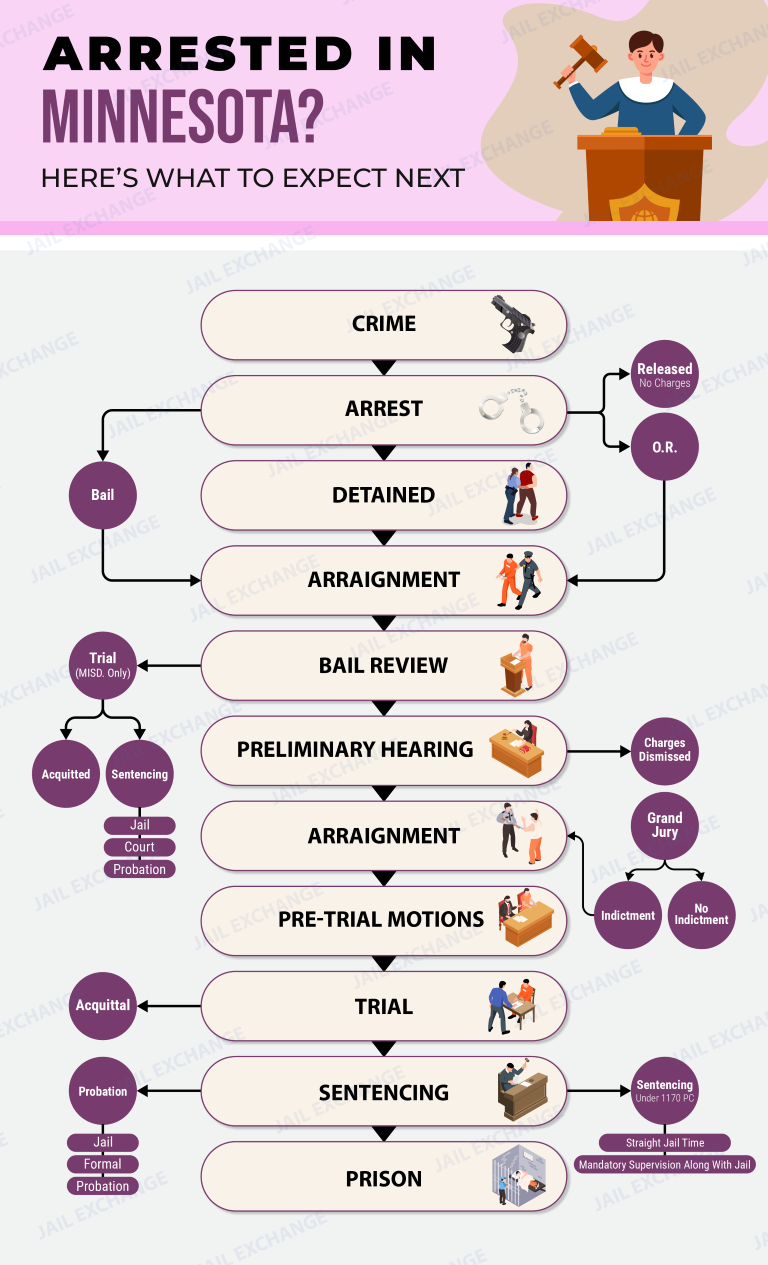
- The 36-hour rule. A person held in jail must be brought before a judge within 36 hours of arrest, not counting the day of arrest, Sundays or legal holidays. If the arrest was made without a warrant, a judge must also find probable cause within 48 hours.
- First appearance. On a felony or gross misdemeanor this is the Rule 5 hearing; on a misdemeanor it is the arraignment. The judge reads the charge, appoints the public defender if the person qualifies, and sets release terms.
- Release conditions. Anoka County judges typically set two bail amounts: a higher one with no conditions, and a lower one that requires compliance with conditions such as no contact with an alleged victim, no alcohol, electronic monitoring or regular check-ins. Release on recognizance is common for minor cases. Commercial bail bonds are legal in Minnesota.
After release, missing a court date usually leads to a warrant and can result in forfeiture of bail, so keep your contact information current with the court.
↑ Back to the question list3. The Anoka County Jail
The Anoka County Jail, at 325 East Jackson Street in Anoka, is run by the Sheriff and holds adults who have been arrested and are awaiting a first appearance, bail or trial. Because it sits in the courthouse complex, defendants in custody are typically escorted directly to their hearings.
Families trying to find someone can use the county's inmate locator or call the Sheriff's Office at (763) 324-5100. Staff can explain whether bail has been set, how it may be posted and when the person is scheduled for court. A bail amount can sometimes be posted at the jail before the first appearance if it was set by schedule; after the hearing, the court's release order controls.
The jail is separate from the Anoka County Workhouse, a Community Corrections facility used primarily for people serving local sentences, and from the Anoka County Juvenile Center in Lino Lakes, which holds youth. Someone convicted and given a local jail term may serve it at the workhouse rather than at the Main Street jail.
↑ Back to the question list4. Getting a public defender in Anoka County
Public defense in Anoka County is provided by the Tenth Judicial District Public Defender, an office of the State Board of Public Defense that maintains an office in Anoka. Its attorneys represent eligible defendants charged with misdemeanors, gross misdemeanors and felonies, along with juveniles in delinquency cases.
- When to ask. Request a public defender at your first appearance or arraignment. In-custody defendants are often met by a public defender before or at the Rule 5 hearing.
- Who qualifies. Eligibility is based on income, household size and assets. You will complete a financial statement, and the judge decides whether to appoint the office.
- What is covered. Appointed counsel is available whenever a conviction could lead to jail. There is no right to a public defender on a petty misdemeanor, which carries only a fine.
- Conflicts. If the office already represents a co-defendant or has another conflict, the court arranges for a different attorney.
Once appointed, the same attorney or unit usually handles the case through plea or trial and sentencing. If you have not heard from your lawyer before a court date, contact the public defender's Anoka office or ask Court Administration for the attorney's name.
↑ Back to the question list5. Prosecutors and diversion in Anoka County
Two kinds of prosecutors appear in Anoka County courtrooms. The Anoka County Attorney's Office, at the government center on Third Avenue, charges all felonies, all juvenile delinquency cases and lower-level offenses from township areas. City attorneys, often attorneys at private firms under contract with a city, handle misdemeanors and gross misdemeanors arising within their cities, such as a DWI stop in Andover or a shoplifting case in Blaine.
Diversion is a significant part of the system. Anoka County Community Corrections has run adult diversion assessments at the misdemeanor, gross misdemeanor and felony levels, and participants who complete the program's requirements, which can include classes, restitution, community work and a program fee, can have their charges dismissed. Whether a case qualifies is up to the prosecutor; first-time, nonviolent offenses are the most likely candidates. On the juvenile side, the County Attorney's Office screens delinquency referrals and can route youth to pre-petition diversion.
Prosecutors also make plea offers that may include a continuance for dismissal, a stay of adjudication or a reduced charge. Ask your attorney whether a diversion program or one of these alternatives fits your case.
↑ Back to the question list6. Treatment and specialty courts in Anoka County
Anoka County operates a treatment court program that combines drug court and veterans treatment court tracks. Participants, usually people whose offenses are tied to substance use or, for veterans, to service-related issues such as PTSD, enter an intensive program with frequent court reviews before a Tenth District judge, chemical dependency treatment, drug and alcohol testing and close supervision by probation. Graduation can lead to a reduced sentence or dismissal, depending on the agreement made at entry.
For repeat or high-risk DWI defendants, Community Corrections has offered intensive pretrial supervision that can include house arrest, remote breath testing and electronic alcohol monitoring, and a domestic assault pretrial program that uses GPS monitoring and testing for higher-risk defendants. Probation also maintains specialized caseloads, including for people with serious mental illness.
Admission to a treatment court is voluntary but selective: the prosecutor, the defense and the treatment team typically must agree. A defense attorney or public defender can explain eligibility and what is expected of participants.
↑ Back to the question list7. Misdemeanor (for example, theft, a first DWI, fifth-degree assault, trespassing)
Most of the cases on the Anoka County criminal calendar are lower-level offenses. Minnesota groups them into petty misdemeanors, which are not crimes and carry only a fine; misdemeanors; and gross misdemeanors. The last two are crimes that can bring jail and a record.
The arraignment
Whether you arrive with a citation or after a night in the Main Street jail, the first court date is the arraignment. The Tenth District judge explains the charge and your rights, asks whether you want a public defender, takes a plea or sets the case over, and confirms release conditions. If you are prosecuted by a city attorney, a lawyer for that city will be in the courtroom; township and county cases are handled by the County Attorney's Office.
After arraignment
Cases that are not resolved go to a pretrial conference, where the parties discuss diversion or a plea. Anoka County misdemeanors often end in dismissal, a continuance for dismissal, a stay of adjudication (no conviction once probation is completed), a reduced charge, or probation with a fine. A defendant who chooses trial is entitled to a six-person jury that must reach a unanimous verdict, and a speedy-trial demand requires trial within 60 days.
Penalties
- Anoka County petty misdemeanor: a $300 maximum fine, and jail is not an option.
- Anoka County misdemeanor: up to 90 days and $1,000, for offenses such as theft of $500 or less, fifth-degree assault and trespass.
- Anoka County gross misdemeanor: up to 364 days and $3,000; theft of more than $500 up to $1,000 and fifth-degree assault with a qualifying prior fall here.
- First DWI in Anoka County: fourth-degree DWI is a misdemeanor. With one aggravating factor, such as an alcohol concentration of 0.16 or more, a child under 16 in the vehicle, or a test refusal, the charge becomes third-degree DWI, a gross misdemeanor. A chemical use assessment is required, the license revocation proceeds separately from the court case, and ignition interlock, plate impoundment and vehicle forfeiture may apply in aggravated cases.
Most Anoka County misdemeanor cases are completed in one to four months.
↑ Back to the question list8. Felony (for example, burglary, felony theft, drug sale, second-degree assault)
Felonies, crimes that can bring more than a year in prison, are charged by the Anoka County Attorney through a criminal complaint. Minnesota reserves grand jury indictments for crimes carrying life imprisonment.
Hearings
At the Rule 5 hearing, held within the 36-hour window for a jailed defendant, the judge reviews the complaint, appoints the Tenth District Public Defender when the defendant qualifies, and sets bail and conditions using the Community Corrections bail evaluation. The Rule 8 hearing follows, when the defense receives discovery and the prosecutor may make an offer. At the omnibus hearing the defense can challenge probable cause and seek suppression of evidence obtained through an unlawful search, an improper interrogation or a flawed identification. Many Anoka County felonies resolve at a pretrial settlement conference. A trial requires a unanimous verdict from 12 jurors, and a defendant may demand trial within 60 days.
Sentencing
After a conviction, Community Corrections prepares a presentence investigation. The judge applies the Minnesota Sentencing Guidelines, a grid that matches offense severity with criminal history score to produce a presumptive stayed sentence (probation) or executed sentence (prison). Departures require substantial and compelling reasons.
- Felony theft in Anoka County: over $1,000 can bring up to 5 years, over $5,000 up to 10, and over $35,000 up to 20.
- Burglary in the Tenth District: first degree, up to 20 years; second degree, up to 10; third degree, up to 5.
- Drug sale charged in Anoka: an Anoka County jury's verdict on first-degree sale exposes the defendant to as much as 30 years.
- Second-degree assault charged in Anoka: assault with a dangerous weapon carries up to 7 years, and a firearm triggers a mandatory minimum prison term.
A stay of imposition can leave a misdemeanor on the record instead of a felony after probation is completed. For an executed sentence, two-thirds is ordinarily served in prison and the final third on supervised release. Anoka County felony cases commonly take four to twelve months.
↑ Back to the question list9. Violent felony (for example, murder, criminal sexual conduct, aggravated robbery)
Violent felonies in Anoka County follow the same Rule 5, Rule 8 and omnibus sequence, but bail is usually high with strict conditions, and many defendants remain in the Anoka County Jail throughout. A first-degree murder charge must be brought by grand jury indictment, which the County Attorney presents.
- First-degree murder in Anoka County: life in prison. Premeditated murder and some other forms carry life without release; for the remaining first-degree murder convictions in Anoka County, parole can be considered after 30 years. Minnesota abolished the death penalty in 1911.
- Second- and third-degree murder: maximums of 40 and 25 years, respectively, in Anoka County.
- First-degree criminal sexual conduct in Anoka County: up to 30 years; 144 months is presumptive for a first offense.
- First-degree aggravated robbery: up to 20 years.
The Tenth District Public Defender represents eligible defendants, often assigning senior trial attorneys. Victims have rights under Minnesota Statutes chapter 611A, including notice of hearings, the right to be present and the right to make a statement at sentencing. Because of forensic work, expert testimony and extensive motions, a violent felony in Anoka County often takes one to two years or longer.
↑ Back to the question list10. Juveniles (under 18) arrested in Anoka County
Youth under 18 accused of offenses in Anoka County are handled in the juvenile division of the Anoka County District Court. The County Attorney's Office reviews each referral and decides whether to file a delinquency petition; for many first-time and lower-level offenses it uses pre-petition diversion, so the youth can avoid formal charges by completing the program.
Youth who must be held are taken to the Anoka County Juvenile Center at 7555 Fourth Avenue in Lino Lakes, (763) 324-4540, never the adult jail. The center includes secure and non-secure programs and the East Central Regional Juvenile Center, which serves Tenth District counties under a joint powers agreement. A detained youth must have a detention hearing within 36 hours, excluding weekends and holidays. The Tenth District Public Defender represents eligible juveniles.
For serious charges, prosecutors may pursue Extended Jurisdiction Juvenile (EJJ) prosecution for some 14- to 17-year-olds, which adds a stayed adult sentence to the juvenile disposition. Anoka prosecutors can also seek certification to adult court for anyone 14 or older; for 16- and 17-year-olds the law presumes certification when the alleged offense carries a presumptive prison term or involved a firearm. A 16- or 17-year-old in Anoka County charged with first-degree murder is tried as an adult. Most Anoka County juvenile files are kept confidential, but felony records involving youth 16 or older can sometimes be viewed by the public.
↑ Back to the question list11. Federal cases (U.S. District Court) from Anoka County
Not every arrest in Blaine, Coon Rapids, Fridley or the city of Anoka ends up at the Third Avenue courthouse. When federal law is used, the case moves to the U.S. District Court for the District of Minnesota, and Anoka County is part of that court's Fourth Division, based at the Diana E. Murphy U.S. Courthouse, 300 S. 4th Street, Minneapolis, MN 55415. Federal juries for Anoka County cases are drawn from the Fourth Division and report to Minneapolis, which is also where nearly every hearing takes place, a short drive down Highway 10 or Interstate 35W. For filings and scheduling, the Clerk's Office in Minneapolis answers at (612) 664-5000.
How an Anoka County arrest becomes a federal case
Federal prosecution follows an investigation by a federal agency, sometimes working alongside Anoka County deputies or city police in a joint task force. The usual agencies are the FBI, the DEA, the ATF, Homeland Security Investigations, the IRS and U.S. Postal Inspectors. Charges seen most often include:
- distributing or conspiring to distribute drugs, particularly large quantities or shipments crossing state lines;
- gun crimes, above all possession of a firearm by someone with a felony record;
- fraud schemes involving banks, mail, wire transfers, government programs or investors;
- child exploitation and online enticement offenses;
- robbery of a bank or credit union, and immigration offenses.
A case that starts with an Anoka County Sheriff's arrest can be "adopted" by federal prosecutors, and nothing prevents both Minnesota and the United States from charging the same conduct.
Prosecutor, defense lawyer and Marshals
The U.S. Attorney's Office for the District of Minnesota brings the charges from its Minneapolis office at the U.S. Courthouse, 300 S. 4th Street, Suite 600, Minneapolis, MN 55415, (612) 664-5600; its St. Paul office is at 316 N. Robert Street, Suite 404, St. Paul, MN 55101, (651) 848-1950. Defendants who qualify for appointed counsel are generally represented by the Office of the Federal Defender for the District of Minnesota, 107 U.S. Courthouse, 300 S. 4th Street, Minneapolis, MN 55415, (612) 664-5858. When that office has a conflict, the judge appoints a private lawyer from the Criminal Justice Act (CJA) panel. The U.S. Marshals Service in Minneapolis, (612) 664-5900, transports and holds federal prisoners.
The federal process, start to finish
After an arrest by federal agents, or on a federal warrant or indictment, the defendant goes before a U.S. magistrate judge for an initial appearance, where the charges are explained and a lawyer is appointed if needed. If prosecutors seek detention, a hearing is usually held within three court days. Under the Bail Reform Act, the magistrate judge either releases the person on conditions supervised by U.S. Probation and Pretrial Services or orders detention because no conditions will reasonably assure court appearances and community safety. Bondsmen have no place in this system, and a cash bail amount is seldom set.
A case that began with a criminal complaint needs a grand jury indictment within 30 days of the arrest, or a preliminary hearing, followed by arraignment. The Speedy Trial Act sets a 70-day deadline for trial, measured from indictment or first appearance, but continuances are routine in complex cases. Most federal prosecutions resolve through plea agreements; a trial jury has 12 members and its verdict must be unanimous. Sentencing comes about three months after a plea or verdict, once U.S. Probation finishes a presentence report, and the judge weighs the advisory U.S. Sentencing Guidelines along with any mandatory minimum. Federal prisoners are not paroled. Even with good-conduct time, at least about 85% of the term is served in a Bureau of Prisons facility, and a period of supervised release follows. Appeals are heard by the Eighth Circuit.
Where federal detainees are held
The Marshals Service does not run its own pretrial jail in Minnesota; it houses federal detainees in county jails under contract, across the state and at times outside it. Someone arrested in Anoka County on a federal charge may therefore be moved to a jail in another county. Relatives can call the Minneapolis Marshals office to find out where the person is being held, and once a sentence begins, the Bureau of Prisons inmate locator shows the assigned facility. Anoka County teenagers under 18 are very rarely charged in federal court.
↑ Back to the question listThis guide outlines the usual course of a criminal case in Anoka County and is not legal advice. If you or someone close to you has been charged, contact a defense attorney or ask the court to appoint the Tenth Judicial District Public Defender; Anoka County Court Administration can be reached at (763) 760-6700, and the Sheriff's Office jail line at (763) 324-5100.
Inmate Canteen (operated by TurnKey Corrections) allows friends and family members to purchase pre-approved commissary packages, including brand-name snacks, confectionery goods, personal hygiene products, stationery, and apparel kits sent directly to an incarcerated loved one. Every package is packed to adhere strictly to facility security regulations, ensuring items pass institutional intake without being rejected at the loading dock.
Important: Package Deadlines and Delivery Windows Vary
Detention centers do not manage care package deliveries under identical schedules. While some facilities allow weekly orders, others restrict deliveries to bi-weekly or monthly distribution windows, and spending limits vary from jail to jail. You should verify the facility's active cutoff schedule and order allowances by calling them directly. If an order is submitted after the weekly processing deadline, delivery will be held until the following cycle, leaving your loved one waiting an extra cycle for fresh snacks, thermal wear, or personal care supplies.
Step-by-Step Instructions to Place a Commissary Package Order
- Confirm the inmate's legal first and last name, date of birth, and assigned booking or inmate ID number.
- Navigate to www.inmatecanteen.com and sign in or create a user profile.
- Select Commissary / Store and choose your state and detention center.
- Search for the inmate to unlock the facility's approved product catalog.
- Select allowable snack foods, candies, personal care goods, and clothing items up to the facility's allowed spending limit.
- Proceed to checkout, enter your debit or credit card billing details, and submit payment.
- Save your digital receipt and confirmation tracking number for your records.
What the Inmate Needs to Do
The inmate does not need an internet account to receive care packages. TurnKey Corrections prepares the order in secure, tamper-evident packaging and delivers it directly to the jail commissary department. Facility staff inspect the shipment and deliver the items during regular housing unit commissary rounds, where the inmate signs for receipt.
Official Provider: Inmate Canteen Official Website
Customer Service Telephone: 1-715-690-2965
Support Hours: Monday – Friday, 8:00 AM – 5:00 PM CST
Supported Languages: English and Spanish
Other Services Provided by Inmate Canteen (TurnKey Corrections)
In addition to Commissary Care Packages, Inmate Canteen provides several other communication, financial, and visitation services:
- Tablets & Chirp Units: Learn how secure handheld devices allow inmates to communicate, read, and message.
• Learn more on our website: Tablet Programs Guide | • Visit official vendor page: Inmate Canteen Devices - Remote Video Visitation: Schedule and join live face-to-face video visits from your computer or smartphone.
• Learn more on our website: Video Visitation Guide | • Visit official vendor page: Inmate Canteen Video Visits - Digital Messaging: Send electronic messages and photos directly to housing pod kiosks and handheld devices.
• Learn more on our website: Digital Messaging Guide | • Visit official vendor page: Inmate Canteen Messaging - Trust & Phone Deposits: Deposit money directly into an inmate's jail trust account or phone calling balance.
• Learn more on our website: Trust & Phone Deposits Guide | • Visit official vendor page: Inmate Canteen Deposits
Buy Commissary for an Inmate in the Anoka County Jail
Anoka County Jail Inmate Commissary - Sending Money or Purchasing Commissary for an Inmate
Anoka County Jail allows inmates to purchase commissary. This can be snacks, hygiene products, stamps, stationary, clothing and even electronics.
You can buy commissary for an inmate using an online service called Inmate Canteen.
Inmate Canteen Customer Service can be reached at 715-690-2965, or by email at support@inmatecanteen.com.

There is a monthly limit of $200-300 on how much inmates can spend on commissary items.
This amount is subject to change so call the facility at 763-324-5100 in order to confirm the amount that cannot be exceeded.
Inmates have access to both an in-house commissary store, and commissary packages that can be purchased and shipped to the inmate by friends and family.
Scroll down for information on the Anoka County Jail's service they use for you being able to purchase commissary items online and have them shipped directly to the inmate.
You can also go to our Inmate Money page for information on how to send money to an inmate.
Inmate Canteen Trust & Phone Deposits allow friends and family members to transfer money directly into an incarcerated person's jail trust account or telephone calling balance using a credit or debit card. Deposited funds give your loved one the financial balance needed to buy personal care goods, over-the-counter medication, snacks, and phone talk time from the facility canteen.
Important: Facility Banking Policies Vary Across Jails
Once a person is booked and moved to a cell, facilities do not always allow cash drop-offs or phone payments directly to the jail window. Some might and you should confirm this by calling the facility and asking. But if you do not register online and fund your loved one's trust account immediately, they may be forced to wait days or weeks for standard paper processing, leaving them without essential soap, clean undergarments, basic medical sundries or snacks.
Step-by-Step Instructions to Register and Deposit Funds
- Confirm the inmate's legal first and last name, date of birth, and assigned booking or inmate ID number.
- Navigate to www.inmatecanteen.com on your computer or mobile device.
- Click on Deposit Funds and select whether to fund the Trust Account (for commissary) or Phone Account (for talk time).
- Select the state and facility where the inmate is currently housed.
- Search for the inmate to confirm their active housing record matches the facility roster.
- Enter your deposit dollar amount, review convenience fees, and enter your debit or credit card billing details.
- Submit payment and save the digital confirmation receipt for your financial records.
What the Inmate Needs to Do
The inmate does not need an internet connection to receive trust funds. Once payment clears, the balance posts directly to their accounting profile in the jail's internal system. The inmate can review their updated balance at the pod kiosk terminal and place their regular weekly commissary order or make outbound phone calls.
Official Provider: Inmate Canteen Official Website
Customer Service Telephone: 1-715-690-2965
Support Hours: Monday – Friday, 8:00 AM – 5:00 PM CST
Supported Languages: English and Spanish
Other Services Provided by Inmate Canteen (TurnKey Corrections)
In addition to Trust & Phone Deposits, Inmate Canteen provides several other communication, financial, and commissary services at participating correctional facilities:
- Commissary & Snack Packs: Order pre-approved snack boxes, food packages, and clothing directly to the jail.
• Learn more on our website: Commissary Orders Guide | • Visit official vendor page: Inmate Canteen Commissary - Remote Video Visitation: Schedule and join live face-to-face video visits from your computer or smartphone.
• Learn more on our website: Video Visitation Guide | • Visit official vendor page: Inmate Canteen Video Visits - Digital Messaging & Chirp Texts: Send electronic messages and photos directly to housing pod kiosks and handheld devices.
• Learn more on our website: Digital Messaging Guide | • Visit official vendor page: Inmate Canteen Messaging
Deposit Money for an Inmate in the Anoka County Jail
The Anoka County Jail at 325 E Jackson Street in Anoka takes money for a person's commissary account in two ways: online or at the cash kiosk in the jail lobby.
- Lobby kiosk: Open to the public from 7 a.m. to 10 p.m., seven days a week. It takes cash.
- Online: Set up an account with Inmate Canteen, the jail's commissary company, and pay with a debit or credit card.
- By mail: Not allowed. The jail does not accept cash, personal checks, payroll checks, money orders or gift cards in the mail.
Account money pays for phone calls, vending machine items, and food and hygiene orders that arrive on Tuesdays and Fridays. The Sheriff's Office will never call you to demand money; if someone does, hang up.
Since March 1, 2026, the Anoka County Jail on East Jackson Street in Anoka, Minnesota, scans incoming personal mail. The person in custody reads a scanned copy, never the paper itself, and the jail throws the originals away after 30 days. Jails began scanning because people were mailing in sheets soaked in drugs like heroin or meth and then dried, so keep anything you want to hold on to at home.
Personal letters, photos and legal mail:
Inmate's Full Name & inmate # if known
Anoka County Jail
325 E Jackson St
Anoka, MN 55303
- Five pieces at most: Each envelope may hold no more than five items to scan, and every page and every photo counts as one.
- Photo size: No print larger than 4 x 6 inches.
- Page size: Nothing bigger than 8½ x 11 inches.
- Greeting cards: Skip musical and pop-up cards, cards with stickers or glitter, and any card larger than 8½ x 11 inches when it is fully open.
- Packaging: Boxes, padded envelopes, plastic bags, bubble wrap, packing peanuts, layered packaging and envelopes with metal parts are refused.
- Supplies: Do not send blank paper, blank or pre-stamped envelopes, or postage stamps.
- Clean pages only: Nothing may be stuck, spilled or sprayed on the mail, and stained or discolored paper is not taken.
- Content: Letters may not encourage breaking jail rules or gang or illegal activity, hold sexually explicit material, or be written in code.
- Postage: Mail marked postage due or C.O.D. is not accepted, and everything must come through the U.S. Postal Service.
- Magazines and newspapers: Anoka's jail turns away every magazine and newspaper, even from the publisher.
- Books: Only new paperbacks shipped straight from a publisher or a store. Hardcovers and violent, pornographic or obscene books are refused.
- Money: Cash, personal or payroll checks, money orders and gift cards can't be mailed. Put money on the account with online deposits instead.
- Legal mail: Staff open legal and privileged mail only with the inmate there to watch.
- Broken rules: If anything in the envelope breaks a rule, the whole mailing goes back to you, or is destroyed if there is no return address. Mail for someone already released or moved is returned to the sender, so check the inmate locator first.
Put your full name and address in the top left corner of every envelope.
ICSolutions provides secure inmate telecommunications systems that allow incarcerated individuals to place outbound telephone calls from housing pods to friends and family. Because correctional facilities do not accept incoming calls, establishing an AdvancePay prepaid account links funds directly to your 10-digit phone number so calls connect without carrier restrictions.
Important: Wireless Carriers Restrict Inmate Calls by Default
Major mobile cellular carriers do not permit traditional collect calls originating from correctional facilities. While some landlines might support direct monthly billing, mobile devices and internet-based telephone numbers require an active prepaid balance or funded debit account, which you can verify by checking with your provider. If you do not register online and fund an account right away, incoming calls from your loved one will automatically fail to ring through to your phone.
Step-by-Step Instructions to Register and Fund an Account
- Visit www.icsolutions.com or call customer support at 1-888-506-8407.
- Click Create an Account and register using your primary 10-digit telephone number and email address.
- Select the state and facility where the inmate is currently detained.
- Link the inmate to your profile using their full legal name and booking ID number.
- Select Prepaid Collect to link funds to your phone number, or choose Debit Telephone to provide the inmate funds to call any approved number.
- Select your deposit amount and complete payment using a credit or debit card.
- Check your mobile phone settings to ensure unknown or automated numbers are not routed directly to spam.
What the Inmate Needs to Do
The inmate dials your 10-digit number from any dayroom phone and enters their assigned PIN. The automated system verifies that your phone number has an active prepaid balance and prompts you to accept the call. All non-privileged conversations are recorded and monitored by the facility.
Official Provider: ICSolutions Official Website
Customer Service Telephone: 1-888-506-8407
Support Hours: 24 hours a day, 7 days a week, 365 days a year
Supported Languages: English and Spanish
Other Services Provided by ICSolutions
In addition to AdvancePay Prepaid Calling Accounts, ICSolutions provides voicemail and video visitation services at participating facilities:
- Inmate Voicemail Services: Leave one-way voice messages that your loved one can listen to on dayroom phones.
• Learn more on our website: Inmate Voicemail Guide | • Visit official vendor page: ICSolutions Voicemail - Remote Video Visitation: Schedule and join live video visits from home using your computer or smartphone.
• Learn more on our website: Video Visitation Guide | • Visit official vendor page: ICSolutions Video Visits - Access Secure Deposits (Partner Trust Transfers): Deposit trust money into an inmate's account via Keefe Group partner networks.
• Learn more on our website: Inmate Trust Deposits Guide | • Visit official vendor page: Access Corrections Trust Deposits
ICSolutions Inmate Voicemail allows family members and approved contacts to leave a private, recorded voice message for an incarcerated individual. Because outside callers cannot phone an inmate directly, this one-way voice messaging feature ensures critical family updates and legal news reach your loved one even when you cannot be near your telephone to answer live calls.
Important: Voicemail Feature Availability Varies by Facility
Inmate voicemail is not enabled at every correctional facility contracted with ICSolutions. Jails determine whether to offer voicemail services based on local security protocols and monitoring capabilities, which you should confirm with the facility directly. If your loved one's detention center does not support voicemail, you must set up an AdvancePay calling account so they can reach you directly during dayroom phone hours.
Step-by-Step Instructions to Leave an Inmate Voicemail
- Log into your existing profile at www.icsolutions.com or dial 1-888-506-8407.
- Confirm that your loved one's detention facility supports the voicemail feature.
- Dial the facility's dedicated ICSolutions voicemail access telephone number provided on your dashboard.
- Follow the automated voice prompts and enter the inmate's booking identification number.
- Record your personal voice message (typically up to 3 minutes in length).
- Accept the call charges using funds from your prepaid account balance or a credit card.
What the Inmate Needs to Do
When the inmate logs onto any housing unit telephone using their assigned PIN, the automated system notifies them that a new voicemail is waiting in their queue. The inmate follows the audio prompts to play the recording. All messages are subject to monitoring and recording by correctional staff.
Official Provider: ICSolutions Official Website
Customer Service Telephone: 1-888-506-8407
Support Hours: 24 hours a day, 7 days a week, 365 days a year
Supported Languages: English and Spanish
Other Services Provided by ICSolutions
In addition to Inmate Voicemail Services, ICSolutions operates live calling and video visitation options:
- AdvancePay Prepaid Calling Accounts: Prepay for phone calling minutes so your loved one can call your telephone directly.
• Learn more on our website: AdvancePay Calling Guide | • Visit official vendor page: ICSolutions Prepaid Calling - Remote Video Visitation: Schedule and join live video visits from home using your computer or smartphone.
• Learn more on our website: Video Visitation Guide | • Visit official vendor page: ICSolutions Video Visits - Access Secure Deposits (Partner Trust Transfers): Deposit trust money into an inmate's account via Keefe Group partner networks.
• Learn more on our website: Inmate Trust Deposits Guide | • Visit official vendor page: Access Corrections Trust Deposits
Information for this service is currently unavailable.

ICSolutions provides secure, corrections-grade handheld tablets designed for prison and jail living units. Through these handheld devices, incarcerated individuals can communicate with family via digital messaging and video calls, stream approved music, play games, read eBooks, and access institutional legal research databases without leaving their bunks.
Important: Tablet Hardware Deployment and Rental Rules Vary
Detention centers do not manage tablet distribution identically. While some agencies issue individual personal tablets to every detainee at booking, others utilize shared pod docking stations or restrict tablet use to specific dayroom hours, which you should confirm with the facility directly. Although core educational and legal resources are generally provided free of charge, sending messages, listening to music, or making phone calls from the tablet requires an active balance funded by outside contacts.
Step-by-Step Instructions to Fund ICSolutions Tablet Services
- Verify that ICSolutions tablets are deployed at the inmate's current detention center.
- Navigate to www.icsolutions.com and sign into your user profile.
- Select Debit Telephone or Inmate Media Account depending on your facility's funding categories.
- Link the inmate to your account by entering their full legal name or facility inmate ID.
- Select your deposit amount, review convenience fees, and enter your credit or debit card details.
- Submit payment, save your receipt, and notify your loved one that funds have been added.
What the Inmate Needs to Do
The inmate unlocks their assigned tablet using their unique facility PIN. Once logged on, they can open the media store to purchase songs, read digital books, write messages, or initiate phone calls using available credits. Tablets are plugged into secure housing docking carts nightly for charging and administrative monitoring.
Official Provider: ICSolutions Official Website
Customer Service Telephone: 1-888-506-8407
Support Hours: 24 hours a day, 7 days a week, 365 days a year
Supported Languages: English and Spanish
Other Services Provided by ICSolutions
In addition to Tablet Programs, ICSolutions manages several communication, financial, and visitation services:
- Inmate Messaging & Digital Mail: Send electronic messages and photos directly to an inmate's tablet or pod terminal.
• Learn more on our website: Digital Messaging Guide | • Visit official vendor page: ICSolutions Messaging - Prepaid Phone Calling Accounts: Fund calling minutes so your loved one can call your telephone directly.
• Learn more on our website: Phone Calling Guide | • Visit official vendor page: ICSolutions Phone Calling - Remote Video Visitation: Schedule and join live video visits from home using your computer or smartphone.
• Learn more on our website: Video Visitation Guide | • Visit official vendor page: ICSolutions Video Visits
Anoka County County Jails
Anoka County Juvenile Facilities
- Jail (Main): 763-324-5100
- Leave Voice Mail message for Inmate: 763-575-8506
- Sheriff: 763-324-5000
The Anoka County Jail serves the following cities and towns of Anoka County: Andover, Anoka, Bethel, Blaine, Brooklyn Park, Burns, Cedar, Circle Pines, Columbia Heights, Columbus, Coon Rapids, East Bethel, Fridley, Ham Lake, Lexington, Lino Lakes, Linwood, Oak Grove, Ramsey, Saint Francis and Spring Lake Park.