
Harriet Tubman Residential Center
Harriet Tubman Residential Center
Physical Address
6706 Pine Ridge RoadAuburn, NY 13021
Jail Phone Number
315-704-6290Cayuga County Inmate Search: Locating Someone at the County House Road Jail
Arrests by Auburn police, Sheriff's deputies, state troopers and three village departments all lead to the Cayuga County Jail, 7445 County House Road, Auburn, NY 13021. The Sheriff's Custody Division runs this 214-bed jail. Below are the steps to find someone inside, followed by bail, court, calls, mail, money, visits and the arresting agencies.
Open the Sheriff's inmate lookup first. New York's statewide VINE service gives custody status by name as a backup. The Sheriff also shares a weekly arrest report and a weekly warrants list as PDF files on the Sheriff's Office page.
The fastest answer comes by phone. Call the jail at 315-253-2911, and keep the legal name and birthday nearby. Ask what the charges are, whether a judge set bail, and the date of the next hearing. For getting someone out, see our bail page. To follow the hearings, use our court page.
Read inmate search answers
 Read inmate search answers
1. Searching the Cayuga County Jail: which tools work best?
Use more than one tool, since each has a different lag. Work through these in order:
- Open the Sheriff's inmate lookup and type the last name.
- Search VINELink for New York. It shows custody status and the facility. Adding a birth date trims a long list of matches.
- Scan the newest weekly arrest report on the Sheriff's page. It covers a full week, so a booking from this morning may come later.
- Phone the jail at 315-253-2911. Give the full spelling of the name, plus the birthday.
- Jot down the inmate number staff read to you. Letters use it, and online bail asks for a separate criminal history number.
2. Lookup came back blank: why might that happen?
An empty result rarely means bad news. Common reasons:
- Booking takes time. Prints, photos and forms can run a few hours.
- They already left. Most people charged with misdemeanors and many lower felonies must be released, and many never come to jail at all because police hand them an appearance ticket.
- They are still at a police station. In the city, call the Auburn Police Department at 315-253-3231.
- They moved. A transfer to a DOCCS prison, a federal hold or another county's jail would take them off the list.
- Age. Under-18s are held in juvenile detention instead.
- Spelling. Search again with a former last name or a nickname, or switch the first and middle names.
When in doubt, the jail's main line, 315-253-2911, can say whether the person was booked and released.
↑ Back to the question list3. Might a nearby county's lockup be holding them?
County House Road is home to the county's only adult jail. Call 315-253-2911 to ask where women are housed and whether someone was moved. Someone picked up near a border, or wanted by another county, could be at one of these:
- Onondaga County Justice Center, 555 S. State Street, Syracuse, NY 13202, 315-435-1770
- Jamesville Correctional Facility, 6660 E Seneca Turnpike, Jamesville, NY 13078, 315-435-5581
- Oswego County Jail, 39 Churchill Road, Oswego, NY 13126, 315-349-3300
- Cortland County Correctional Facility, 54 Greenbush Street, Cortland, NY 13045, 607-756-4275
- Tompkins County Jail, 779 Warren Road, Ithaca, NY 14850, 607-257-5316
- Seneca County Correctional Facility, 6150 State Route 96, Romulus, NY 14541, 315-220-3469
- Wayne County Jail, 7376 Route 31, Lyons, NY 14489, 315-946-9711
4. Are Cayuga County booking photos ever released?
New York keeps most booking photos private. Its open records law treats handing out an arrest photo as an invasion of privacy (Public Officers Law § 89(2)(b)(viii)). The exception is when police need the photo out for a real law enforcement reason.
- The Sheriff's weekly arrest report names recent arrests. For questions about a photo, reporters and others can call the Sheriff's Office at 315-253-1222.
- Federal booking photos generally stay out of public view. An exception: the Marshals, a federal agency, sometimes put one out, say, when hunting for a fugitive.
- For photos taken by ICE, use the ICE records request form.
5. VINE alerts: how can family hear about a release or transfer?
Yes, through VINE. This free statewide hotline is what New York's sheriffs use to track custody in county jails. Register by phone at 888-846-3469, or online through VINELink for email or text alerts. Signing up is never automatic.
- After a status change, VINE keeps calling a registered number until the PIN is entered or 48 hours pass.
- The person in custody is not told who registered.
- Once someone is in state prison, DOCCS runs its own victim notice program covering parole hearings and release dates.
Because alerts can lag, a call to 315-253-2911 is still the surest check on a release.
↑ Back to the question list6. Getting out of the Cayuga County Jail: how is release decided?
New York's bail reform dates to January 1, 2020. It requires judges to free most people facing misdemeanor or nonviolent felony charges. They release on recognizance or set conditions (CPL 510.10(3)). Only "qualifying offenses," violent felonies among them, open the door to money bail or remand (CPL 510.10(4)).
- A judge decides at arraignment, in Auburn City Court, a town or village court, or the county's centralized arraignment part.
- When bail is set, the order must offer three or more forms, with one a partially secured or unsecured bond (CPL 520.10).
- The jail accepts cash and major credit cards in its lobby.
- Card payments, at the jail or online, go through GovPayNet with pay location code 6079 and a fee that is never refunded.
Step-by-step payment help, bond agent rules and refunds are on our bail page.
↑ Back to the question list7. Where do families learn the exact charges?
The booking charges are available from jail staff at 315-253-2911. The Sheriff's weekly arrest report also lists recent arrests.
Early charges can change. Police file the first papers, and the District Attorney decides what to pursue. A felony is formally charged only when a grand jury indicts. The District Attorney's Office is at 95 Genesee Street, Auburn, NY 13021, 315-253-1391.
A felony is a serious crime that may lead to state prison. The law grades felonies by letter, from A, the worst, to E. Misdemeanors are lesser crimes with a local jail term of 364 days or less. Violations are not crimes. To read the court file, call the court that has the case. Our court page lists every one.
↑ Back to the question list8. Free defense for a jailed person: how is a lawyer assigned?
Lawyers for people who can't pay come from the county's Assigned Counsel Program, 152 Genesee Street, Floor 2, Auburn, NY 13021, 315-253-1402. Being jailed creates a presumption of eligibility under state rules, and an assignment should follow any request.
- Counsel must be ready at arraignment (Executive Law § 832(4)).
- Counsel is also guaranteed whenever a judge sets or reviews a securing order (CPL 510.10(2)).
- Hiring private counsel is always an option for the family.
- Federal cases get the Federal Public Defender in Syracuse, 4 Clinton Square, Floor 3, Syracuse, NY 13202, 315-701-0080.
9. Planning a visit to County House Road: what should you ask?
Call the jail at 315-253-2911 before you go. Ask for the current visit days, how to book a slot, what ID to bring and whether video visits are offered. State jail rules set a floor for every county jail:
- Weekly visiting time must total two hours or more, with no single visit shorter than 30 minutes (9 NYCRR 7008.3).
- In the first 24 hours after admission, a non-contact visit is available on request (9 NYCRR 7008.4).
- Contact visits allow touch, within reason (9 NYCRR 7008.6).
- Visitors must prove who they are, and people under 18 may need a parent or written permission (9 NYCRR 7008.5).
- Visitors and their things may be searched (9 NYCRR 7008.7).
More tips are in our guide to jail visits.
↑ Back to the question list10. Commissary funds: which deposit methods does the jail accept?
People in the jail can't hold cash. The Sheriff's FAQ lists two ways to fund a commissary account:
- Money order by mail. Make it out to the person, and send it to the jail at 7445 County House Road, Auburn, NY 13021.
- Lobby kiosk. A money kiosk in the jail lobby adds funds for a small fee.
Ask the jail at 315-253-2911 about limits and lobby hours. For deposit tips see our inmate money page, and for what the account buys, our commissary page. Never mail cash.
↑ Back to the question list11. Collect calls and reply-only email: how does contact work?
The jail does not pass along phone messages, and people inside can't take incoming calls. After booking, they may make collect calls only, and every call may be recorded. New York jail rules also give each person the right to make calls when they first arrive (9 NYCRR 7002.8).
Email works one way at the start. A person in the jail can buy email through commissary and write to you, and you may reply. You can't send the first message. Staff may read every email.
Talking about the case on a jail call is risky, since calls may be recorded, so leave that to the lawyer. More on calls is in our phone guide, and more on messages in our email guide.
↑ Back to the question list12. Addressing a letter to a Cayuga County inmate: what format?
Put the person's name and inmate number, if you know it, above the jail's street address. The Sheriff's own sample looks like this:
John Doe #000000
7445 County House Road, Auburn, NY 13021
- State rules put no cap on the number of letters sent or received (9 NYCRR 7004.1).
- Staff can open a personal letter to check it for contraband (9 NYCRR 7004.3). Actually reading it is allowed only under a written order stating the reasons.
- An envelope from a lawyer, a legal aid office or a court is opened with the person watching (9 NYCRR 7004.4).
- Anyone without funds gets free stationery and postage each week, enough for a pair of one-ounce letters or more (9 NYCRR 7004.2).
Ask the jail about photos, books and cards before sending them. Our guide to jail mail has general tips.
↑ Back to the question list13. Stored belongings: when and how are they handed back?
Whatever the person carried at booking goes into storage. To arrange a pickup, call 315-253-2911 and ask which days and hours work, whether the person must sign a release for you, and how any commissary balance is paid out. Bring a photo ID to 7445 County House Road, Auburn, NY 13021.
↑ Back to the question list14. Illness, injury or crisis inside: whom should family call?
The jail has its own medical and mental health offices. Staff there can't discuss a diagnosis or treatment plan, but they will listen to your worries.
- Jail medical office: 315-253-3061
- Jail mental health office: 315-253-1028
- Complaints about treatment: shift supervisor, 315-253-3002
- Sexual abuse concerns: PREA coordinator, 315-253-1562
- County mental health crisis line: 315-253-0341
Under Civil Rights Law § 28, officers who hold someone under arrest are responsible for that person's health care, mental health included. Complaints can also go to the state Commission of Correction, the agency watching over every county jail, at 80 S. Swan Street, Albany, NY 12210, 518-485-2346. In an emergency, call 911.
↑ Back to the question list15. Is there a Cayuga County warrant out, and how do I check?
Deputies from the Sheriff's Office handle warrants countywide. Ask them at 315-253-1222. Its Records Section, open weekdays 8:30 a.m. to 4:00 p.m., is at 315-253-1148. Each week the Sheriff adds an active warrants list to the Sheriff's web page. City police keep their own warrant log and take calls at 315-253-3235. The New York State Police wanted list covers statewide cases. Clearing one is a two-step job: get a lawyer, then appear with that lawyer before the issuing court, or phone the court to request another date. County Court is at 152 Genesee Street, Auburn, NY 13021, 315-237-6450.
↑ Back to the question list16. Upcoming hearings: which court office has the next date?
Each court tracks its own calendar:
- Felonies after indictment: County Court, 152 Genesee Street, Auburn, NY 13021, 315-237-6450
- City cases: Auburn City Court, 157 Genesee Street, Auburn, NY 13021, 315-237-6420
- Town and village cases: the local justice court, listed with phones on our court page
WebCriminal, the state's online search, reaches just some courts and drops any case without an upcoming date, so phoning is the better bet here. The assigned lawyer can also give the date.
↑ Back to the question list17. Federal prisoners from this area: where are they held?
According to the Sheriff's Custody page, the county jail takes in prisoners for federal agencies, including the Marshals and the Bureau of Prisons. A federal prisoner may be close by.
- Call the Marshals' district office, 100 South Clinton Street, Floor 10, Syracuse, NY 13261, 315-473-7601, to ask where the person is held.
- The case runs in federal court in the James Hanley Federal Building, 100 South Clinton Street, Syracuse, NY 13261, 315-234-8500. The first appearance includes a detention hearing (18 U.S.C. 3142), which decides jail or home until trial.
- Look up court filings on PACER.
- After sentencing, search the Federal Bureau of Prisons inmate locator.
18. Immigration custody: how do families track a detained person?
Should ICE seek custody of someone in the county jail, expect this sequence:
- ICE puts a written detainer, Form I-247A, on file with the jail.
- The detainer requests custody for up to 48 hours after they would otherwise be released (8 CFR 287.7(d)).
- Upstate pickups frequently end at ICE's Buffalo (Batavia) Service Processing Center, 4250 Federal Drive, Batavia, NY 14020. Detainee information is at 585-344-6500, 8 a.m. to 4 p.m. Detainees there cannot take incoming calls.
- Then try the ICE Online Detainee Locator.
New York law shapes what local jails do. A 2018 state appeals ruling, People ex rel. Wells v DeMarco, concluded local officers lack any state-law basis for civil immigration arrests. Executive Law § 170-k, adopted in 2026, ended 287(g) agreements and forbids deals to jail people purely over civil immigration status, while judicial warrants and court orders are still honored. Civil Rights Law § 28 protects people going to court from civil arrests without a judge's warrant or order.
↑ Back to the question list19. Sentenced to state prison: which DOCCS tools find them?
A state sentence usually starts with a wait on County House Road. When the county reports the person ready, the Department of Corrections and Community Supervision (DOCCS) collects them within ten business days. A stay at a reception center for screening comes first, then a move to a long-term prison.
- Search the DOCCS Incarcerated Lookup using a DIN, or an exact last name with birth year. It goes offline briefly each night around 11:45 p.m.
- Our New York state prisons page lists visiting and mail rules prison by prison.
- Without internet, DOCCS staff in Albany, 1220 Washington Avenue, Albany, NY 12226, help locate people at 518-457-5000 on business days.
20. Arrested teens: where do minors from Cayuga County go?
Nobody under 18 is booked into the County House Road jail. Under Raise the Age, felonies by teens of 16 or 17 go to a Youth Part, while probation intake takes their misdemeanors. A youth held before trial goes to a juvenile detention center. A child who stays in custody must appear in Family Court quickly (Family Court Act § 307.3). That hearing must happen within 72 hours, or sooner when a court session falls earlier.
To learn where a youth is held, call the Probation Department's juvenile officer at 315-253-1689, or Family Court at 315-237-6400. The state keeps a juvenile detention list too.
↑ Back to the question list21. Police, deputies or troopers: who made the arrest?
The Census Bureau's July 1, 2025 estimate is 74,365 residents. The county has no county police force. These agencies make arrests here:
- Cayuga County Sheriff's Office, 7445 County House Road, Auburn, NY 13021, 315-253-1222. Its road patrol covers 800 square miles.
- Auburn Police Department, 46 North Street, Auburn, NY 13021, non-emergency 315-253-3231.
- New York State Police, Troop E: the station at 1551 Clark Street Road, Auburn, NY 13021, and the station at 48 West Cayuga Street, Moravia, NY 13118, share 315-255-2766.
- Moravia Village Police, Village Justice Center, 48 W Cayuga Street, Moravia, NY 13118, 315-497-0287.
- Weedsport Village Police (part time), 8892 South Street, Weedsport, NY 13166. Leave messages at Village Hall, 315-834-6634.
- Port Byron Village Police (part time), officer in charge 315-776-4099.
- County 911 dispatch for the three village departments: 315-253-2224.
Every other town and village is patrolled by Sheriff's deputies and state troopers:
- Towns: Aurelius, Brutus, Cato, Conquest, Fleming, Genoa, Ira, Ledyard, Locke, Mentz, Montezuma, Moravia, Niles, Owasco, Scipio, Sempronius, Sennett, Springport, Sterling, Summerhill, Throop, Venice and Victory.
- Villages: Aurora, Cato, Cayuga, Fair Haven, Meridian and Union Springs.
Cayuga County Bail and Release
January 1, 2020, brought bail reform to New York, and judges must now send most people home without money bail. Amendments followed in 2020, 2022 and 2023, but that rule still covers lower charges. Anyone held after an arrest in Auburn or the nearby towns goes to the Cayuga County Jail, 7445 County House Road, Auburn, NY 13021. Below: who decides release, how to pay and what delays it.
Begin with the Sheriff's inmate lookup, and try statewide VINE by name as well. Our Jail Roster page deals with custody itself: who sits behind bars, open warrants, recent bookings, mugshots, the charges, getting a public defender and claiming property.
Dial the jail at 315-253-2911 with three questions: did a judge set bail, what is the figure, and what is the person's criminal history number? Online payment calls for that number. Once your loved one is home, our court page picks up the case.
1. Who handles release after an arrest in Cayuga County, and how fast?
That job belongs to a judge, at the first court date, known in New York as the arraignment. CourtHelp, the state court help site, says arraignment usually follows arrest within 24 hours. City arrests land in Auburn City Court, Historic Old Post Office Building, 157 Genesee Street, Auburn, NY 13021, 315-237-6420. Town and village arrests start with the local justice for that town or village.
The court system also lists a "Cayuga CAP," short for centralized arraignment part. Local judges take turns in it so new arrests get heard off hours with a defense lawyer on hand (Judiciary Law § 212(1)(w)).
Each person gets a decision made just for them. The judge has to explain it on the record or on paper (CPL 510.10(1)). Felony holds also run on a timer: 120 hours, stretched to 144 when Saturday, Sunday or a holiday is in the mix. Past that, release follows unless the case has moved or an exception fits (CPL 180.80).
↑ Back to the question list2. Which four securing orders can the judge pick?
"Securing order" is the legal label for the release ruling (CPL 500.10). The judge picks one of these:
- ROR. Short for release on recognizance. A signed pledge to return is enough, with no cash.
- Non-money conditions. Home, under rules like reporting to a program or avoiding a named person. No fee may be charged for these (CPL 500.10(3-a)).
- Bail. Money or a bond parked with the court as a guarantee.
- Remand. Held without bail, which only certain felonies allow.
If bail is the choice, three or more forms must appear on the order (CPL 520.10). One must be a no-deposit (unsecured) or low-deposit (partially secured) bond, chosen by the court. With a partially secured bond, the cash put down tops out at one tenth of the total (CPL 500.10(18)). With an unsecured bond, nobody puts money down. The signers just owe the full sum if a court date is missed.
Ankle monitors come last, after every other option fails. Any monitoring order expires after 60 days unless renewed at a fresh hearing (CPL 510.40(4)).
↑ Back to the question list3. What does bail usually cost on Cayuga County charges?
No price list exists for bail in New York. It helps to know the ladder of charges first. Felonies are the serious crimes, graded A at the top through E, and they can mean state prison. Misdemeanors rank lower, in classes A and B, and carry 364 days or less in a local jail. Violations, the bottom rung, are not crimes.
Most misdemeanor and nonviolent felony cases end in release by law (CPL 510.10(3), 530.20(1)). Only a "qualifying offense" listed in CPL 510.10(4) allows money bail or remand. The big groups are:
- Violent felonies, robbery and second-degree assault among them
- Class A felonies
- Sex offenses and sex trafficking named in the statute
- Violating a protection order, or choking a relative or household member
- Charges tied to someone's death
- Threats aimed at a witness, or witness tampering
- Escape, or skipping out on bail
- New felonies while on probation or post-release supervision
- Repeat harm to people or property during release on a like charge
- Certain gun charges, third-degree weapon possession included
Money matters too. The judge must consider the person's financial situation and whether posting bail would bring undue hardship (CPL 510.10(1)). DCJS figures for 2024 show non-NYC town and village courts released 75% on recognizance and set bail in 13% of arraignments. For your person's exact amount, phone 315-253-2911.
↑ Back to the question list4. Paying bail in person at County House Road: what are the steps?
The Sheriff's FAQ lists two ways to post bail: in person at the jail or online. The jail shares the Public Safety Building at 7445 County House Road, Auburn, NY 13021. For a lobby visit:
- Ring 315-253-2911 and confirm the amount plus the court or judge on the order.
- Ask what hours the lobby accepts bail.
- Pack a photo ID.
- Staff will want your name, address, employer or line of work, and a phone number.
- Hand over cash, a card, or some of each.
- Save the receipt. The money stays legally yours unless it is forfeited (CPL 520.15).
For paying from home, the Sheriff's jail and inmate FAQ sends people to GovPayNet, a card processing firm. Gather the criminal history number, birth date, bail figure, court or judge, plus pay location code 6079. Jail staff supply all but the code over the phone. Cards work only for their own holder.
↑ Back to the question list5. Do the Genesee Street courts or police desks accept bail?
State law names several places to deposit cash bail, including the court behind the order and the sheriff holding the person (CPL 520.15). With proof of deposit in hand, the jail must free the person at once. Phone ahead:
- Auburn City Court, Historic Old Post Office Building, 157 Genesee Street, Auburn, NY 13021, 315-237-6420, weekdays 8 a.m. to 4 p.m.
- County Court (indicted felonies), 152 Genesee Street, Auburn, NY 13021, 315-237-6450, weekdays 9 a.m. to 5 p.m.
- Town and village justices: reach the court that did the arraignment. Each one's phone sits on our court page.
Three questions cover any clerk's window. Which forms of bail does the order name? Which payments does the clerk handle? Will the clerk notify the jail, or should you carry the receipt over yourself? Bring photo ID and the docket number.
A person still at a station house hasn't reached court yet. Phone that agency, for instance the Auburn Police Department at 315-253-3231, and ask whether a ticket or an arraignment comes next.
↑ Back to the question list6. Cash, cards or GovPayNet: what does the jail allow?
Cash plus Visa, MasterCard, American Express and Discover all appear on the Sheriff's FAQ. Splitting one bail between bills and plastic is fine too. Under state law, a credit card payment is a valid kind of bail (CPL 500.10(9)).
- GovPayNet handles each card charge and tacks on a service fee. You lose that fee for good, even after the bail is returned.
- The name on the card has to match the payer. Borrowed cards get turned away.
- Planning to bring a money order, certified check or agent's bond? Clear it with 315-253-2911 first.
- Cash never goes in the mail.
Look over the judge's paperwork, too. It spells out the forms the court takes, and one of them has to be a low- or no-deposit bond.
↑ Back to the question list7. Hiring a bondsman in New York: what rules protect you?
Bail agents need a state license, issued by DFS (the Department of Financial Services). Check the agent on the DFS bail bond search before signing anything.
- Price ceiling. The premium maxes out at 10% of the first $3,000, then 8% of the slice from $3,000 to $10,000, then 6% above that (Insurance Law § 6804). A $5,000 bond costs $460 at most.
- When the premium returns. Normally it is kept. Within 14 days, though, it all comes back if the person stays locked up or gets released on recognizance or without money bail.
- Add-ons. On top of the premium, the only allowed charges are certain listed expenses, like returning a client to court after a warrant.
- Collateral. DFS suggests keeping it modest, for example 10% of the bond. Agents must return it 45 days after getting exoneration paperwork, unless the bail was forfeited.
- Paper trail. Signed, detailed receipts are required when you pay and when collateral returns.
Nonprofit charitable bail funds can also cover cash bail. File problems on the DFS complaint form.
↑ Back to the question list8. Bail is paid but the person is still inside: why?
Each bail belongs to one case only. Watch for these other holds:
- Another case or warrant. City, town and village court warrants reach their home county plus bordering counties (CPL 530.70).
- Parole violation. The jail keeps parole violators, and parole must clear them on its own.
- Bound for state prison. Some people sit here awaiting transfer to DOCCS.
- Federal custody. The Custody Division also houses prisoners for the U.S. Marshals Service and the Federal Bureau of Prisons.
- ICE. A detainer could apply, covered further down.
Have jail staff at 315-253-2911 list every hold before money changes hands. Concerns about treatment go to the shift supervisor, 315-253-3002.
↑ Back to the question list9. When is remand without bail allowed in New York?
Only a qualifying felony opens the door to remand (CPL 510.10(4)). The 2023 state budget dropped the old "least restrictive" test and handed judges more say over bail on serious crimes.
Town, village and city judges have less power here. They cannot free or bail out anyone facing a class A felony (CPL 530.20(2)). The same goes for someone with two felony convictions already. Release then rests with County Court. Before freeing anyone on a felony, a local judge must let the prosecutor be heard and must review the criminal record report.
Prosecution comes from the District Attorney's Office, 95 Genesee Street, Auburn, NY 13021, 315-253-1391.
↑ Back to the question list10. What can loved ones do to get bail reduced?
Requests come from the defense lawyer, but relatives supply much of the proof.
- Gather pay stubs, a lease or mortgage bill, proof of family ties and a frank budget.
- Mention nominal bail to the lawyer. A defendant may request this token sum at any point, and the judge must grant it when the request is voluntary (CPL 510.10(5)).
- For a case in a city, town or village court, one appeal of bail to a County Court judge is possible (CPL 530.30). A second try is not.
- Count the days. Someone jailed on a felony walks out if the prosecution isn't trial-ready within 90 days of commitment (CPL 30.30(2)).
Can't reach the assigned lawyer? The Assigned Counsel Program answers at 315-253-1402.
↑ Back to the question list11. How does the Assigned Counsel Program work in Cayuga County?
Free defense here runs through the Assigned Counsel Program, 152 Genesee Street, Floor 2, Auburn, NY 13021, 315-253-1402. State law obliges each county to fund such a plan (County Law § 722).
- Counsel is a right whenever a securing order is weighed or revisited (CPL 510.10(2)).
- Counties must have lawyers available at arraignment without holding up the hearing (Executive Law § 832(4)).
- Eligibility is presumed for people behind bars, and for incomes under 250% of federal poverty guidelines.
- Pay earned by a husband or wife stays out of the math.
- Judges rule on eligibility, and a provisional assignment can cover the gap.
12. Where are the courts that hear cases from Auburn and the towns?
This is New York's 7th Judicial District, and appeals head to the Fourth Department. Court buildings and phones:
- County Court and Supreme Court (felonies), 152 Genesee Street, Auburn, NY 13021, 315-237-6450, weekdays 9 a.m. to 5 p.m. A drug treatment court meets here.
- City Court (city misdemeanors and early felony steps), Historic Old Post Office Building, 157 Genesee Street, Auburn, NY 13021, 315-237-6420, weekdays 8 a.m. to 4 p.m., with its own drug treatment court.
- Family Court (young people), 157 Genesee Street, Auburn, NY 13021, 315-237-6400, weekdays 9 a.m. to 5 p.m. Phone first to confirm the entrance.
- Town and village justice courts take arrests outside city limits. The Unified Court System's town and village court directory lists them.
- Federal court, James Hanley Federal Building, 100 South Clinton Street, Syracuse, NY 13261, 315-234-8500.
13. Refunds and forfeits: when is Cayuga County bail money returned?
Bail money goes back to the payer once the case closes, provided no court date was missed. A conviction costs 3% of the sum in county fees. A dismissal or acquittal returns all of it (General Municipal Law § 99-m). Judges sign the refund order, yet CourtHelp notes the court itself never mails the check.
Skipping court with no good excuse triggers forfeiture (CPL 540.10).
- Showing up before the final adjournment with a solid reason may lead the judge to undo it.
- On cash bail, the county treasurer owes written notice to the person who paid.
- Asking to recover forfeited money has a one-year deadline, plus five days' notice to the District Attorney (CPL 540.30).
Felony refund questions go to County Court, 315-237-6450. Local cases go to the court that took the bail.
↑ Back to the question list14. Leftover commissary money and personal items: how are they collected?
Settle cash and belongings questions before release if possible. Phone 315-253-2911 at 7445 County House Road, Auburn, NY 13021, and ask two things: how unused commissary funds get refunded, and when stored property may be picked up.
Carry photo ID. Collecting on someone's behalf? Check if the jail needs their written okay. Our guide to inmate accounts and commissary guide fill in the details.
↑ Back to the question list15. A federal charge from Cayuga County: who rules on detention?
The Syracuse Division of the U.S. District Court for the Northern District of New York takes federal criminal cases from here. Its home is the James Hanley Federal Building, 100 South Clinton Street, Syracuse, NY 13261, 315-234-8500, open 8:30 a.m. to 5:00 p.m.
- At the first appearance a federal magistrate or judge weighs detention versus release until trial (18 U.S.C. 3142).
- Before trial, federal prisoners are kept by the Marshals, whose district headquarters is at 100 South Clinton Street, Floor 10, Syracuse, NY 13261, 315-473-7601.
- The Custody Division lists the Marshals among agencies it houses prisoners for, so a federal defendant may stay on County House Road. Ask the Marshals.
- Federal defenders work from 4 Clinton Square, Floor 3, Syracuse, NY 13202, 315-701-0080.
- Following sentencing, check the Federal Bureau of Prisons inmate locator.
16. Will posting bail clear an ICE detainer?
No. Bail answers the state charge. A detainer is a separate federal ask. Step by step:
- ICE starts by handing the jail a detainer, known as Form I-247A.
- That request reaches up to 48 hours after they would otherwise be released (8 CFR 287.7(d)).
- Agents may arrive for a pickup. A common destination upstate is ICE's Buffalo (Batavia) Service Processing Center, 4250 Federal Drive, Batavia, NY 14020, 585-344-6500.
- Track them through the ICE Online Detainee Locator.
State law narrows the jail's role. A 2018 appeals ruling, People ex rel. Wells v DeMarco, found no state law lets local police or jail staff carry out civil immigration arrests. Executive Law § 170-k, enacted in 2026, voids local 287(g) agreements and bans deals to detain people solely on civil immigration grounds, while still allowing compliance with judicial warrants and court orders. Under Civil Rights Law § 28, a party or witness on the way to court, in the courtroom or headed home can't face a civil arrest unless a judge authorized it in writing.
↑ Back to the question list17. Sentenced to more than a year: what happens next?
Terms of a year or under are done at the county jail. Longer felony terms belong to the Department of Corrections and Community Supervision (DOCCS). A "state ready" label from county officials starts a ten-business-day clock for DOCCS to pick the person up. Reception staff run tests and set a security level, and a transfer to a fitting prison follows.
- Type a name or a DIN (Department Identification Number) into the DOCCS Incarcerated Lookup.
- See our guide to New York state prisons for each facility.
- The DOCCS central office, 1220 Washington Avenue, Albany, NY 12226, helps callers locate someone on weekdays at 518-457-5000.
18. Teens and Raise the Age: what if a minor was arrested?
Raise the Age changed things for older teens. A felony case against a 16- or 17-year-old opens in a Youth Part, not regular adult court. A teen kept in custody goes to youth detention instead of the County House Road jail. Nonviolent felony cases shift to Family Court. The District Attorney can block that only by proving "extraordinary circumstances" within 30 days (CPL 722.23(1)).
- Misdemeanor arrests of teens head to probation intake.
- Officers owe a parent immediate notice once a child is in custody (Family Court Act § 305.2).
- A child kept in custody must reach Family Court fast: the next court day, or 72 hours, whichever arrives first (Family Court Act § 307.3).
To learn where a teen is held, reach the Probation Department's juvenile officer, 152-154 Genesee Street, Floor 3, Auburn, NY 13021, 315-253-1689, or Family Court at 315-237-6400.
↑ Back to the question listCayuga County Criminal Court Guide
Three courts on Genesee Street in Auburn, plus a ring of town and village justices, decide criminal cases in this county. Adults awaiting trial are housed at the Cayuga County Jail, 7445 County House Road, Auburn, NY 13021. This guide covers every courthouse, how a case moves, who the lawyers are, warrants, federal and immigration holds, and teen cases.
Check the Sheriff's inmate lookup or statewide VINE to confirm someone is being held. Our Inmate Lists page digs into custody itself: new bookings, live warrants, the charges, getting belongings back, mugshots and public defenders.
Ring the jail at 315-253-2911. Ask what court the charge sits in and the person's next date there. If a judge set bail, our bail page lays out each way to pay it.
1. Misdemeanor or felony: which Cayuga County court gets the case?
Charges come in three sizes. Felonies are the heavy ones. The law ranks them by letter, A down to E, and A is the worst. A conviction can mean state prison. Misdemeanors sit lower, split into class A and class B, and a county jail term for one tops out at 364 days (Penal Law § 70.15). A violation is an offense, yet not a crime.
- City, town and village courts: these are the local courts. They hear misdemeanors, violations and traffic tickets. In felony cases they handle only the first steps, like the arraignment and an early hearing on the evidence.
- County Court: picks up a felony after a grand jury indictment. Supreme Court, in the same building, may also take felony charges.
- Family Court and the Youth Part: young people's cases, explained in the teen answer below.
These courts are part of the 7th Judicial District. An appeal goes up to the Fourth Department of the Appellate Division.
↑ Back to the question list2. Which Genesee Street buildings hold the main courts?
The county's bigger courts sit a short walk apart in downtown Auburn:
- Supreme and County Court, 152 Genesee Street, Auburn, NY 13021, 315-237-6450. Open Monday through Friday, 9 a.m. to 5 p.m. Its drug treatment court can be reached through extension 1.
- Auburn City Court, inside the Historic Old Post Office Building, 157 Genesee Street, Auburn, NY 13021, 315-237-6420. Open weekdays from 8 a.m. to 4 p.m., and home to a second drug treatment court.
- Family Court, 157 Genesee Street, Auburn, NY 13021, 315-237-6400. Weekdays 9 a.m. to 5 p.m. Phone first so you head to the right door.
Night and weekend arrests may go to the county's centralized arraignment part, listed by the courts as the "Cayuga CAP." Ask the jail where a late-night arraignment took place. Probation also staffs liaisons for a behavioral health court from 152-154 Genesee Street, Floor 3, Auburn, NY 13021, 315-294-8115.
↑ Back to the question list3. Outside the city limits, where do town and village justices sit?
Every town keeps a justice court, and a few villages run their own. These are confirmed on the Unified Court System list or a village directory:
- Brutus Town Court, 9021 North Seneca Street, Weedsport, NY 13166, 315-834-6618
- Cato Town Court, 11320 Shortcut Road, Cato, NY 13033, 315-626-6904
- Genoa Town Court, 1000 Bartnick Road, Genoa, NY 13071, 315-364-6722
- Ledyard Town Court, 1099 Poplar Ridge Road, Aurora, NY 13026, 315-364-5708
- Locke Town Court, mail to PO Box 149, Locke, NY 13092, 315-497-2932
- Montezuma Town Court, 8192 Dock Street, Montezuma, NY 13117, 315-776-9163
- Moravia Town Court, 48 West Cayuga Street, Moravia, NY 13118, 315-497-0968
- Moravia Village Court, 315-497-9295, run from the village's Justice Center, 48 West Cayuga Street, Moravia, NY 13118
- Niles Town Court, 5921 New Hope Road, Moravia, NY 13118, 315-497-0066
- Owasco Town Court, 2 Bristol Avenue, Auburn, NY 13021, 315-253-9021
- Port Byron Village Court, 52 Utica Street, Port Byron, NY 13140, 315-776-9692
- Scipio Town Court, mail to PO Box 61, Scipio Center, NY 13147, 315-364-5325
- Throop Town Court, 7471 Robinson Road, Auburn, NY 13021, 315-253-0089
The towns of Aurelius, Conquest, Fleming, Ira, Mentz, Sempronius, Sennett, Springport, Sterling, Summerhill, Venice and Victory also have town courts. The Unified Court System's court finder lists their addresses and hours. For the villages of Aurora, Cayuga, Fair Haven, Meridian, Union Springs and Weedsport, the finder shows whether a village court sits or the town court takes the case. The County Court clerk can also help at 315-237-6450.
↑ Back to the question list4. Arraignment day: what does the judge do?
Plenty of people go home from the station with a paper ticket. For most charges below a class D felony, police must give an appearance ticket with a court date. They hold the person only when an exception fits, such as an open warrant or a family-violence charge (CPL 150.20(1)).
Those who are held see a judge at arraignment, usually within about 24 hours. At that hearing:
- The judge reads out the charges.
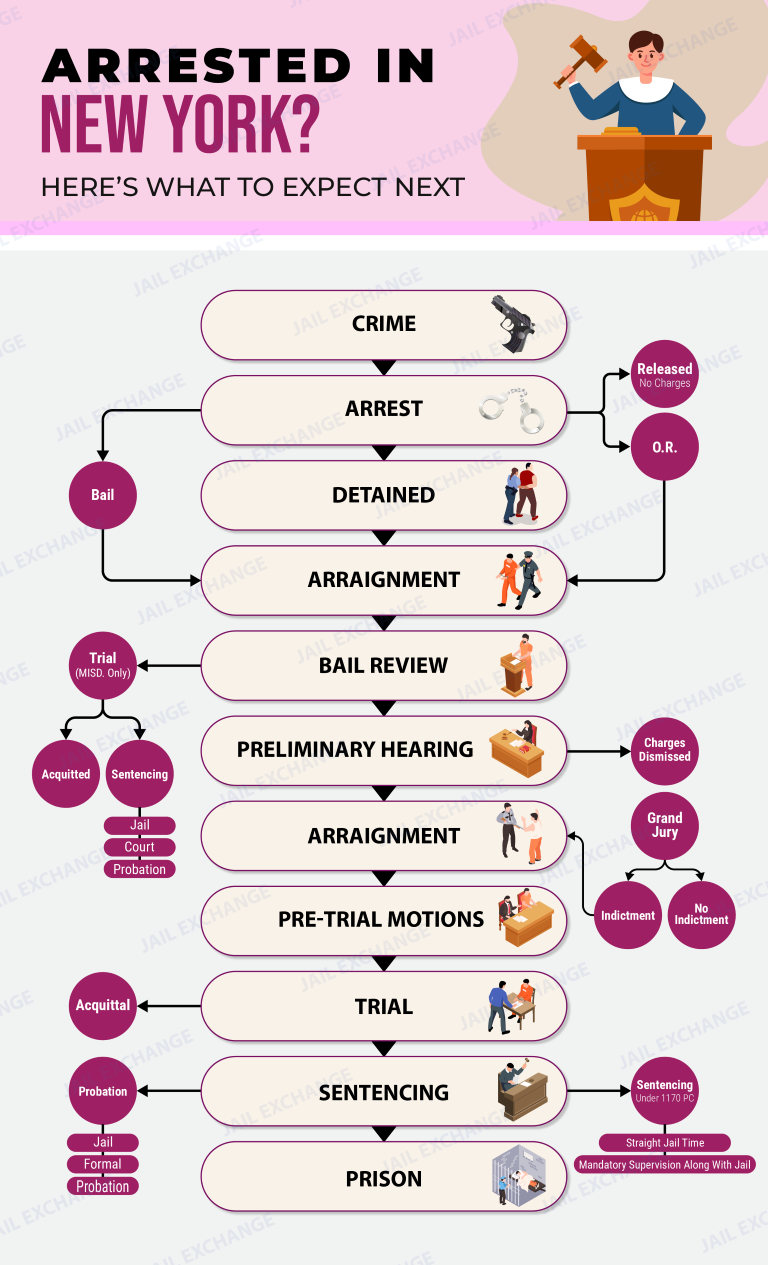
- A lawyer stands with the person, assigned free if they can't pay (CPL 510.10(2)).
- The judge chooses among release, conditions, bail or remand, then states why on the record (CPL 510.10(1)).
- In felony cases, the prosecutor gets a turn before any release, and the judge reads the rap sheet (CPL 530.20(2)).
Felony holds carry a deadline. Release must follow unless a preliminary hearing has begun, the grand jury has voted to indict, or prosecutors show a compelling reason. The limit is 120 hours, or 144 if the span covers a Saturday, Sunday or holiday (CPL 180.80). Written notice to the District Attorney lets the accused testify before the grand jury (CPL 190.50(5)).
↑ Back to the question list5. How does a misdemeanor move in a local Cayuga County court?
Misdemeanor cases begin and end in the court where the arraignment took place. Discovery, the hand-over of evidence, has deadlines: 20 days from arraignment when the defendant sits in jail, 35 days when out (CPL 245.10(1)(a)). They must also be ready for trial on time: 90 days when the top charge can bring more than three months, 60 days for lesser misdemeanors, and 30 days for a violation (CPL 30.30(1)).
Maximum penalties under the Penal Law:
- Class A misdemeanor: a $1,000 fine at most, and jail up to 364 days (Penal Law §§ 70.15, 80.05)
- Class B misdemeanor: no more than three months, and $500 or less
- Violation: 15 days at most, and $250
- A judge may order probation instead, lasting two or three years on a class A and a single year on a class B (Penal Law § 65.00)
- Conditional discharge: release on court rules with no supervision, for one year (Penal Law § 65.05)
People whose addiction drove the offense may ask about the drug treatment court in Auburn City Court. A conviction for a violation or traffic infraction is usually sealed right away (CPL 160.55), and Clean Slate seals most misdemeanors three years after sentence or release (CPL 160.57).
↑ Back to the question list6. From felony complaint to sentence: how does the process go?
Felonies begin in a local court and finish in County Court. The usual path:
- Arraignment on the felony complaint, in City Court, a town court or the CAP.
- A first check on the evidence. If the person is held, the 120- or 144-hour window forces fast action: either a judge hears the evidence at a preliminary hearing, or grand jurors take it up (CPL 180.80).
- Indictment. Grand jurors decide whether to charge.
- A second arraignment, this time in County Court, where the person pleads.
- Discovery and motions. The prosecution has six months to declare trial readiness (CPL 30.30(1)).
- A plea bargain or a trial, and sentencing if convicted.
Prison caps under Penal Law § 70.00(2): life (class A), 25 years (B), 15 (C), seven (D), four (E). Judges may also hand down a definite term of a year or under on a class D or E felony when anything longer would be unduly harsh, though not for repeat felons (Penal Law § 70.00(4)). Fines reach $5,000 or double the gain (Penal Law § 80.00). Felony probation terms are three, four or five years long (Penal Law § 65.00(3)). Some drug-driven felonies qualify for judicial diversion into treatment (CPL Article 216), which County Court's drug treatment court handles.
↑ Back to the question list7. Violent felonies: which tougher rules apply?
Violent felonies follow their own set of rules from arrest to sentence:
- Release. These are qualifying offenses, which opens the door to bail and, for a felony, remand (CPL 510.10(4)).
- Fixed sentences. The judge picks one number of years, inside a range that climbs with the class: 1.5 to 4 years for class E at the bottom, up to 5 to 25 years for class B (Penal Law § 70.02(3)). Post-release supervision comes after (Penal Law § 70.45).
- Examples. Second-degree assault is a class D violent felony, while first-degree robbery and first-degree burglary rank as class B.
- Protection orders. In family-offense cases, a final order at sentencing can run up to eight years past a felony sentence (CPL 530.12(5)).
- Youthful offender. A young person convicted of a class A felony or an armed felony usually can't get this softer status (CPL 720.10).
- Sealing. Clean Slate skips sex offenses and most class A felonies (CPL 160.57).
8. Which Cayuga County offices prosecute and defend criminal cases?
Prosecutions here are handled by the District Attorney, an elected official, from 95 Genesee Street, Auburn, NY 13021, 315-253-1391. Its District Attorney website has office news and victim help.
If paying a lawyer is out of reach, the Assigned Counsel Program steps in, 152 Genesee Street, Floor 2, Auburn, NY 13021, 315-253-1402. It assigns private lawyers paid by the county under County Law § 722.
- Counties must make counsel available at arraignment (Executive Law § 832(4)).
- A lawyer should be assigned on request, even before the paperwork on money is done.
- Jailed people, and households under 250% of federal poverty guidelines, are presumed to qualify.
After a conviction, probation supervision runs from the Probation Department, 152-154 Genesee Street, Floor 3, Auburn, NY 13021, 315-253-1246, weekdays 8 a.m. to 5 p.m.
↑ Back to the question list9. Court dates and case status: how can families check?
WebCrims, the state's free WebCriminal search, reaches only part of the state. Its coverage is the five boroughs, Long Island's two counties, six named County Courts and roughly 60 city courts. Cases appear only while open and set for a future date. Finished, sealed and youthful offender cases drop off, and so do cases stalled on a warrant.
The phone is the surest route here. Jot the legal name and birthday on paper before you call:
- Felony after indictment: County Court, 315-237-6450
- City cases: Auburn City Court, 315-237-6420
- Town and village cases: phone that court, using the list in answer 3
Lawyers from the Assigned Counsel Program, 315-253-1402, can also tell their clients the next date.
↑ Back to the question list10. How do I check for a Cayuga County warrant and clear it?
In the towns, Sheriff's deputies carry out warrants. Inside the city, Auburn police do. To check on a warrant, the numbers are 315-253-1222 for the Sheriff's Office and 315-253-3235 for the city police command desk. Three official lists help: the weekly active warrants report on the Sheriff's Office page, the city's APD Warrant Log and the State Police wanted list. Clearing one starts with a lawyer. With that lawyer, the person can walk into the issuing court, or phone it and ask for a fresh date. Felony warrants belong to County Court, 152 Genesee Street, Auburn, NY 13021, 315-237-6450.
↑ Back to the question list11. How do federal charges from Cayuga County proceed?
Any federal charge filed here lands in the Syracuse Division of the U.S. District Court for the Northern District of New York, James Hanley Federal Building, 100 South Clinton Street, Syracuse, NY 13261, 315-234-8500. The clerk's office keeps 8:30 a.m. to 5:00 p.m. hours.
- Detention is decided right at the start of a federal case. The judge weighs the charge, the proof, the person's past and local ties, and any risk to others (18 U.S.C. 3142).
- Deputy marshals keep federal defendants locked up before trial and drive them to each hearing. The U.S. Marshals Service district office: 100 South Clinton Street, Floor 10, Syracuse, NY 13261, 315-473-7601. The Marshals also use beds at the county jail, according to the Sheriff's Custody page.
- The Federal Public Defender's office handles defense for those who can't pay, at 4 Clinton Square, Floor 3, Syracuse, NY 13202, 315-701-0080.
- In most felony cases, the judge reads a probation report before sentencing.
- Court files are on PACER. Once sentenced, use the Federal Bureau of Prisons inmate locator.
12. How can an ICE detainer affect the criminal case?
The state case itself carries on. Where a detainer bites is release day. On the federal side, expect these steps:
- ICE (Immigration and Customs Enforcement) lodges a detainer with the jail, using Form I-247A.
- That paper asks for the person to be kept up to 48 hours after they would otherwise be released (8 CFR 287.7(d)).
- ICE officers then come to collect the person. ICE's Buffalo Field Office, 130 Delaware Avenue, Buffalo, NY 14202, 716-843-7600, runs a large upstate holding site in Batavia.
- Look the person up on the ICE Online Detainee Locator.
New York sets limits. In People ex rel. Wells v DeMarco (2018), the Appellate Division ruled that no New York law gives state or local officers power over civil immigration arrests. In 2026, Executive Law § 170-k made local 287(g) agreements void and barred agreements to detain people just for civil immigration reasons. Court orders and judicial warrants are still followed. Civil Rights Law § 28 covers parties and witnesses who come to court in good faith, plus their family or household members. None of them may be civilly arrested going to, at, or coming back from court. The one exception is an arrest backed by a judge's warrant or order.
↑ Back to the question list13. Bound for a state prison term: where does the person go?
Jail sentences up to one year are served locally, on County House Road. Anything longer on a felony is a state term with the Department of Corrections and Community Supervision (DOCCS). DOCCS must pick the person up inside ten business days after the county reports them ready. Reception staff fingerprint and photograph each new arrival, run health and program checks, and assign a security level before a transfer to a long-term prison.
- Find the person with the DOCCS Incarcerated Lookup.
- Check parole status on the DOCCS parolee lookup.
- Learn about visits and mail at each facility on our New York prisons page.
14. How does Cayuga County handle charges against a teenager?
Age decides the court:
- Ages 12 to 17, most acts: Family Court, as a juvenile delinquency case (Family Court Act § 301.2).
- Ages 13 to 15, the gravest felonies: "juvenile offenders," such as for murder or armed robbery, begin in adult court (CPL 1.20(42)).
- 16 or 17, charged with a felony: called adolescent offenders, they start in the Youth Part. A violent felony is reviewed six days after arraignment, and most other felonies are moved to Family Court (CPL 722.23).
- 16 or 17, charged with a misdemeanor: probation intake handles it.
Officers must notify a parent at once. Questioning is allowed only in a room the court system has designated, or at home with a parent's consent, and it must be video recorded (Family Court Act § 305.2). A teen held before trial is placed in juvenile detention rather than the adult jail. To learn where, call the Probation Department's juvenile officer at 315-253-1689, or Family Court at 315-237-6400.
↑ Back to the question list15. Crime victims in Cayuga County: where can they turn?
The District Attorney's Crime Victim Witness Coordinator walks victims through court. Call 315-253-1494 or visit 95 Genesee Street, Auburn, NY 13021.
- Medical bills, counseling and funeral costs may be covered by the state Office of Victim Services. Call 800-247-8035.
- VINE sends custody alerts. Register at 888-846-3469 or on VINELink.
- When a family-offense case is dropped or pleaded down, prosecutors should try to let the victim know about a Family Court petition (CPL 530.12(14)).
- Crisis help: the Domestic Violence Line at 800-253-3358, the SAVAR sexual assault hotline at 315-252-2112, and the county mental health crisis line at 315-253-0341.
Information for this service is currently unavailable.
Information for this service is currently unavailable.
Information for this service is currently unavailable.
Information for this service is currently unavailable.
Information for this service is currently unavailable.
Information for this service is currently unavailable.
Cayuga County County Jails
Cayuga County Juvenile Facilities
Nearby counties
- Juvenile: 315-704-6290
The Harriet Tubman Residential Center serves the following cities and towns of Cayuga County: Auburn, Aurelius, Brutus, Cato, Conquest, Fleming, Genoa, Ira, Ledyard, Locke, Mentz, Montezuma, Moravia, Niles, Owasco, Port Byron, Scipio, Sempronius, Sennett, Springport, Sterling, Summerhill, Throop, Union Springs, Venice and Victory. At times this facility may also house inmates arrested in the following counties: Albany County, Allegany County, Bronx County, Broome County, Cattaraugus County, Chautauqua County, Chemung County, Chenango County, Clinton County, Columbia County, Cortland County, Delaware County, Dutchess County, Erie County, Essex County, Franklin County, Fulton County, Genesee County, Greene County, Hamilton County, Herkimer County, Jefferson County, Kings County, Lewis County, Livingston County, Madison County, Monroe County, Montgomery County, Nassau County, New York County, Niagara County, Oneida County, Onondaga County, Ontario County, Orange County, Orleans County, Oswego County, Otsego County, Putnam County, Queens County, Rensselaer County, Richmond County, Rockland County, St. Lawrence County, Saratoga County, Schenectady County, Schoharie County, Schuyler County, Seneca County, Steuben County, Suffolk County, Sullivan County, Tioga County, Tompkins County, Ulster County, Warren County, Washington County, Wayne County, Westchester County, Wyoming County and Yates County.