Bellevue Hospital Prison Ward Criminal Court Process
Criminal Court Process for New York County New York
Bellevue Hospital Prison Ward Court Cases: Following the Case From a Hospital Bed
The Bellevue Hospital Prison Ward sits inside a public hospital at 462 1st Avenue, New York, NY 10016. DOC officers guard people there who need hospital care while their criminal cases go on. Patients come from arrests across all five boroughs. This page follows the case from the first hearing to the last one.
Start with DOC's Person in Custody Lookup. It shows the facility, the charges and the next court date. Our Inmate Search page is the place for arrest and custody questions. Go there to locate a person, see who is held, spot new arrests, check warrants and charges, find mugshots, reach a public defender and pick up property.
Call the Criminal Court Information Line at 646-386-4900 on a weekday from 9 a.m. to 5 p.m. Before you dial, write the person's birth date and legal name on paper. You want the docket number, the courtroom assigned, and the next hearing date. Money questions are covered on our bail page.
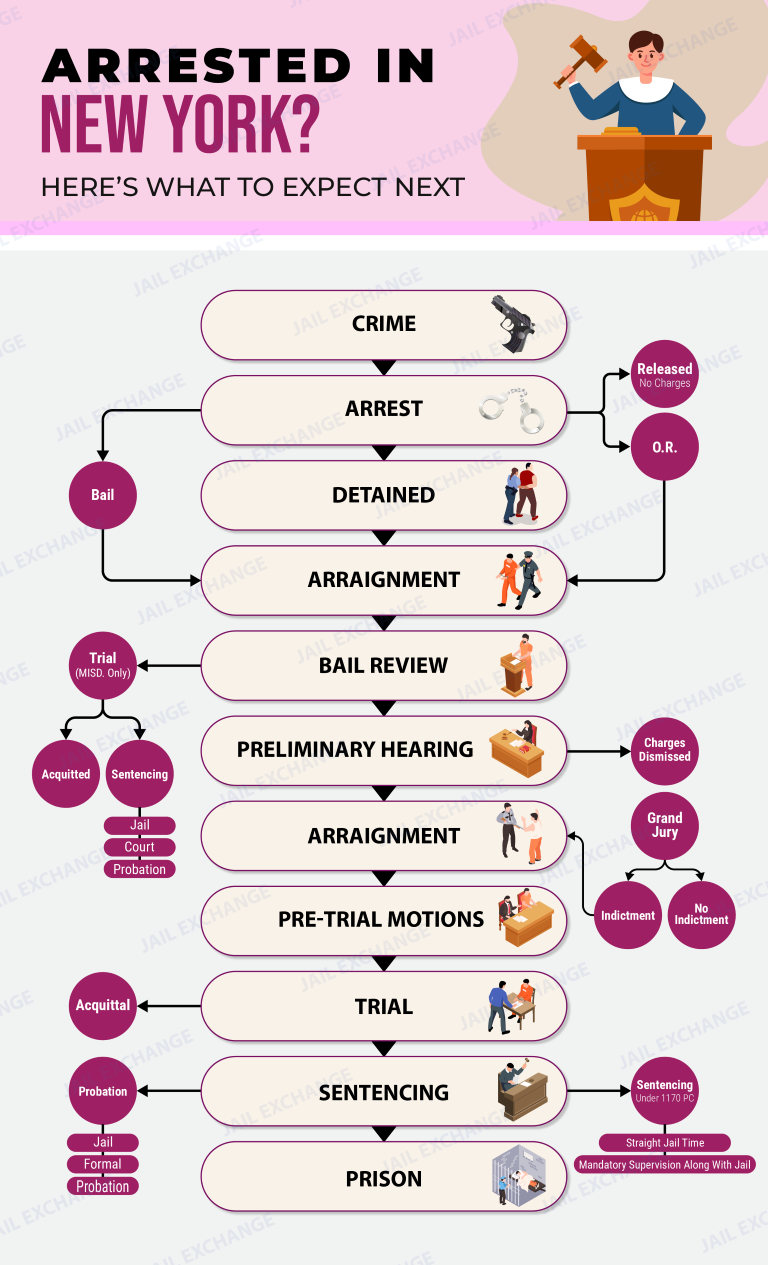
1. How serious is the charge, legally speaking?
The charge type decides which courthouse runs the case and how long it may last. New York sorts offenses into four rough steps, from smallest to largest:
- Violation: not a crime at all, with at most 15 days behind bars.
- Class B misdemeanor: 3 months, tops.
- Class A misdemeanor: 364 days, tops.
- Felony: more than a year, ranging from class E (up to 4 years) to class A (up to life).
The complaint read at arraignment names the charge and its class. The lawyer can explain it in plain words, and the lookup lists it too.
↑ Back to the question list2. Where does each borough hear criminal cases?
Queens. Criminal Court and Supreme Court share one building at 125-01 Queens Boulevard, Kew Gardens, NY 11415. Arraignments run daily from 9 a.m. to 11 p.m. (718-298-0792). After indictment, felony files are kept by the Supreme Court record room. The Queens DA works from the same address (718-286-6000). Free lawyers come from The Legal Aid Society, 120-46 Queens Boulevard, Kew Gardens, NY 11415 (718-286-2000), or Queens Defenders, 118-21 Queens Blvd, Suite 212, Forest Hills, NY 11375 (844-783-3673). Family Court is at 151-20 Jamaica Avenue, Jamaica, NY 11432 (718-298-0197).
Staten Island. Criminal Court and Supreme Court both sit at 26 Central Avenue, Staten Island, NY 10301. Criminal Court is 718-675-8558; the Criminal Term Office is 718-675-8760. The Richmond County DA is at 130 Stuyvesant Place, Staten Island, NY 10301 (718-876-6300). The Legal Aid Society defends people from 60 Bay Street, Staten Island, NY 10301 (347-422-5333). Family Court is at 100 Richmond Terrace, Staten Island, NY 10301 (718-675-8800).
Brooklyn. Criminal Court is at 120 Schermerhorn Street, Brooklyn, NY 11201 (347-404-9400). Felonies move to Supreme Court at 320 Jay Street, Brooklyn, NY 11201 (347-296-1076). The Kings County DA is at 350 Jay Street, Brooklyn, NY 11201 (718-250-2340). Defense comes from The Legal Aid Society, 111 Livingston Street, Brooklyn, NY 11201 (718-237-2000), or Brooklyn Defender Services, 177 Livingston Street, Brooklyn, NY 11201 (718-254-0700). Family Court is at 330 Jay Street, Brooklyn, NY 11201 (347-401-9610).
The Bronx. Criminal Court is at 215 East 161st Street, Bronx, NY 10451 (718-618-2400). Supreme Court, Criminal, is at 265 East 161st Street, Bronx, NY 10451 (718-618-3100). The Bronx DA is at 198 East 161st Street, Bronx, NY 10451 (718-590-2000). Defenders: The Legal Aid Society, 260 East 161st Street, Bronx, NY 10451 (718-579-3000), and The Bronx Defenders, 360 East 161st Street, Bronx, NY 10451 (718-838-7878). Family Court is at 900 Sheridan Avenue, Bronx, NY 10451 (718-618-2098).
Manhattan. Criminal Court and Supreme Court are at 100 Centre Street, New York, NY 10013 (Criminal Court 646-386-4511; Supreme Court 646-386-4000). More felony parts meet at 111 Centre Street, New York, NY 10013 (646-386-4300). The DA's office: 1 Hogan Place, New York, NY 10013 (212-335-9000). Defenders: The Legal Aid Society, 49 Thomas Street, New York, NY 10013 (212-732-5000); New York County Defender Services, 100 William Street, New York, NY 10038 (212-803-5100); Neighborhood Defender Service, 317 Lenox Avenue, New York, NY 10027 (212-876-5500). Family Court is at 60 Lafayette Street, New York, NY 10013 (646-386-5223).
Each borough also has a Youth Part in Supreme Court for teen felony cases. To learn which room, call the Supreme Court number for that borough.
↑ Back to the question list3. Which DOC jails might a Bellevue patient move to or from?
A patient's address can change as their health does. Doctors send people in, and DOC moves them back out once they are well enough. Here is the full city jail map:
- Bellevue Hospital Prison Ward, 462 1st Avenue, New York, NY 10016: patients admitted to the hospital under guard.
- Bellevue Outposted Therapeutic Housing Unit, same building: opened April 2026 with 104 beds. Health staff treat serious long-term illness here when a full hospital stay isn't needed.
- Elmhurst Hospital Prison Ward, 79-01 Broadway, Queens, NY 11370: Queens' guarded hospital unit.
- Eric M. Taylor Center, 10-10 Hazen Street, East Elmhurst, NY 11370: the front door for men new to the jail system. Some units watch mental health closely.
- Rose M. Singer Center, 19-19 Hazen Street, East Elmhurst, NY 11370: all women, before and after sentencing, plus women's intake. One unit houses transgender, nonbinary and intersex people who need it.
- George R. Vierno Center, 09-09 Hazen Street, East Elmhurst, NY 11370: men awaiting trial or serving time. It has mental health units, one for serious illness.
- Otis Bantum Correctional Center, 16-00 Hazen Street, East Elmhurst, NY 11370: men in cells and open dorms. It also runs a unit with tighter rules.
- Robert N. Davoren Complex, 11-11 Hazen Street, East Elmhurst, NY 11370: men, with many aged 18 to 21.
- RESH (RMSC Enhanced Supervised Housing), 19-19 Hazen Street, East Elmhurst, NY 11370: men punished for jail rule breaks. It has its own clinic and visit area.
- West Facility, 16-06 Hazen Street, East Elmhurst, NY 11370: single cells, some kept for people with diseases that spread.
- Teens held by a court stay with ACS at Crossroads Juvenile Center, 17 Bristol Street, Brooklyn, NY 11212, or Horizon Juvenile Center, 560 Brook Avenue, Bronx, NY 10455.
4. What are community courts and treatment courts?
Some cases go to smaller courts built to solve problems, not just punish. A judge or lawyer can steer a case there.
- Midtown Community Justice Center, 314 West 54th Street, New York, NY 10019: clerk 646-264-1330, weekdays 9 a.m. to 4:30 p.m.
- Red Hook Community Justice Center, 88-94 Visitation Place, Brooklyn, NY 11231: 718-923-8200.
- Manhattan treatment courts, 111 Centre Street, New York, NY 10013: 646-386-4626.
- Queens Misdemeanor Treatment Court, 125-01 Queens Boulevard, Kew Gardens, NY 11415: 718-298-0911. Queens Felony Treatment Courts share the building: 718-298-1303.
- Bronx Diversion and Treatment Court, 265 East 161st Street, Bronx, NY 10451: 718-618-3172.
- Staten Island Treatment Court, 26 Central Avenue, Staten Island, NY 10301: 718-675-8530.
For Brooklyn's treatment courts, ask the Brooklyn Criminal Court clerk.
↑ Back to the question list5. How does a first hearing work for someone taken to Bellevue?
Arraignment opens the case in front of a judge. Charges are read out, a lawyer steps in, and the judge rules on release. For most people this takes place roughly 24 hours after the arrest.
A hospital trip can change that timing. If police brought the person to the emergency room right after the arrest, the arraignment may be delayed until they are well enough. If the person was already on Rikers and got sick, the arraignment already happened, and the case simply moves on.
Most people wait at central booking before arraignment. The NYPD runs it inside each borough's criminal courthouse. The NYPD usually gets people there within 4 to 6 hours. Family can't visit at booking. Phone lines by borough:
- Bronx: 215 East 161st Street, Bronx, NY 10451, 718-618-2400 (Bronx Central Booking; the Bronx Criminal Court answers arraignment questions on it too)
- Staten Island: inside the Staten Island Criminal Court, 26 Central Avenue, Staten Island, NY 10301, 718-876-8493 (Staten Island Central Booking)
- Queens: 125-01 Queens Boulevard, Kew Gardens, NY 11415, 718-268-4523 (Queens Central Booking)
- Brooklyn: 120 Schermerhorn Street, Brooklyn, NY 11201, 718-875-6319 (Brooklyn Central Booking)
- Manhattan: 100 Centre Street, New York, NY 10013, 212-347-2801 (Manhattan Central Booking)
Start with the booking line where police made the arrest, and request the arrest number. Then call the Criminal Court in that same borough with it. Ask whether the person has been arraigned and, if not, when and in which courtroom. Have the full name and birthday on hand.
↑ Back to the question list6. What stages does a misdemeanor pass through?
A misdemeanor usually never leaves Criminal Court. The usual stages:
- Arraignment: charge read aloud, release ruled on
- Discovery: the DA hands over its evidence. If your loved one is still jailed, that is due by day 20. If they are out, by day 35 (CPL 245.10).
- Talks between the lawyers, which may lead to a plea deal or dismissal
- Hearings and, if no deal, a trial
Speedy trial rules set the clock (CPL 30.30). For a class A misdemeanor, the DA's window to be trial-ready is 90 days. Class B cases get 60 days. Someone sitting in jail goes free sooner: after 30 days on a class A, or 15 on a class B, if the DA still isn't ready.
↑ Back to the question list7. What happens on a felony case?
Felony cases begin in Criminal Court but finish in Supreme Court. The big step in between is the grand jury, a group of citizens who decide whether to indict.
- Felony complaint deadline: 120 hours in jail, with no preliminary hearing held and no indictment voted, means the person goes free. Weekends and holidays add a day, making it 144 hours. The DA can block release with a strong reason (CPL 180.80).
- The accused can tell their side to the grand jury. The lawyer serves written notice on the DA, and the person signs a waiver of immunity (CPL 190.50(5)).
- Once indicted, the person faces trial or a plea in Supreme Court, Criminal Term, in that same borough.
- On felonies, the DA's trial-ready deadline is six months. A person locked up for 90 days with the DA still not ready must be released (CPL 30.30).
8. Are violent felony charges handled differently?
Yes. Violent felonies carry set prison terms, called determinate sentences, and judges have less room. For a first offense the ranges are:
- 5 to 25 years: class B, for example robbery in the first degree
- 3.5 to 15 years: class C, for example burglary in the second degree
- 2 to 7 years: class D, for example assault in the second degree
- 1.5 to 4 years: class E
A judge can also set money bail or order remand on these charges. Ask the defense lawyer how a plea offer compares with what the law allows after trial.
↑ Back to the question list9. Who brings the case against the person?
The District Attorney for the borough where the arrest happened prosecutes the case. A hospital stay in Manhattan does not move a Bronx or Queens case to Manhattan. The case stays in the borough of the alleged crime.
Prosecutors decide what to charge, make plea offers, present cases to the grand jury and argue about release. Questions about the case itself are best sent through the defense lawyer. Each DA office and its number appears in the borough list above.
↑ Back to the question list10. How does the person get a free lawyer?
Can't pay a lawyer? The court supplies one at no charge. At arraignment the judge assigns one from the borough's defender offices, listed in the courthouse answer above. Being in jail itself helps show need, and so does income under 250 percent of the federal poverty level.
A conflict of interest can rule out every defender office. In that case a private attorney is picked from the Assigned Counsel Plan's panel, at city expense. The plan's office is at 253 Broadway, Room 200, New York, NY 10007, 212-676-0066.
Tell the lawyer about the hospital stay and any health issue. It may matter for release, for court dates and for what a fair outcome looks like.
↑ Back to the question list11. How can I look up the case and the next court date?
- DOC lookup: the Person in Custody Lookup lists the next court date and courthouse for anyone DOC holds.
- WebCrims: the state court system's WebCrims shows active criminal cases with a future date, searchable by name or docket number.
- Phone: the Criminal Court Information Line, 646-386-4900, weekdays 9 a.m. to 5 p.m.
- VINE: sign up at VINELink or call 888-846-3469 to hear when custody status changes.
Each docket number opens with letters for the borough. Manhattan cases start with NY, Brooklyn cases with KN, Queens with QN, the Bronx with BX and Staten Island with RI.
↑ Back to the question list12. Does a stay at Bellevue pause the court case?
No. The case keeps going even while the person is a patient. DOC brings people from its jails to court each day, and in April 2025 it brought almost 99 percent of those due in court.
Sometimes a patient is too sick to travel. Then the defense lawyer can ask the judge for an adjournment, which means a new date. The judge decides. Families should keep in touch with the lawyer so they know if a date moved.
A missed date while in DOC custody is not the same as skipping court. The real danger comes after release. If the person is free and too sick to attend, the lawyer must tell the court quickly. Before issuing a bench warrant for someone who is out, a judge generally has to give 48 hours' notice (CPL 510.50).
↑ Back to the question list13. Might a warrant be out there, and what does clearing it take?
NYPD officers serve most city warrants. Check the NYPD Wanted page, plus the State Police's wanted and missing page. The U.S. Marshals take federal fugitive tips at 888-869-4589.
The Criminal Court Information Line, 646-386-4900, can tell you if a court warrant exists. So can a WebCrims search. A warrant does not expire.
Only a judge can clear it. The person must appear before the judge who issued it. Bring a lawyer, photo ID and the docket number. Giving up at any police precinct also works. Courthouse addresses are in the borough answer above.
↑ Back to the question list14. Which court hears a federal case from the city?
Federal crimes skip city courts. When the arrest happened in Manhattan or the Bronx, the case belongs to the U.S. District Court for the Southern District of New York, 500 Pearl Street, New York, NY 10007, 212-805-0136. For Brooklyn, Queens and Staten Island, the Eastern District handles it at 225 Cadman Plaza East, Brooklyn, NY 11201, 718-613-2600.
- Federal Defenders of New York, Manhattan: 52 Duane Street, New York, NY 10007 (10th floor), 212-417-8700.
- Federal Defenders of New York, Brooklyn: 300 Cadman Plaza West, Brooklyn, NY 11201 (16th floor), 718-330-1200.
- Pretrial Services, Manhattan: 500 Pearl Street, New York, NY 10007 (Room 550), 212-805-4300. Brooklyn: 718-613-2570.
- Federal case records are on PACER.
Most federal detainees in the city are held at MDC Brooklyn, 80 29th Street, Brooklyn, NY 11232, 718-840-4200.
↑ Back to the question list15. Can ICE take a patient from the Bellevue ward?
ICE may file Form I-247A with DOC. That paper, a detainer, requests that the jail hold someone so agents can collect them. The federal rule, 8 CFR 287.7(d), caps that hold at up to 48 hours after they would otherwise be released.
New York draws its own lines. In the 2018 case People ex rel. Wells v. DeMarco, a state court ruled that New York law doesn't let local officers or jailers make civil immigration arrests. Jails may decline a detainer, the state Attorney General advises, unless a judicial warrant backs it. Civil Rights Law § 28 shields people traveling to or from court from civil immigration arrest.
New York City adds another layer through Administrative Code § 9-131. Under it, DOC "may be permitted to cooperate" just in two situations. One is a conviction for an offense the city counts among its "violent or serious crimes," set by the city's 2014 Local Laws 58 and 59. A second trigger: the person's name may match a terrorist watch list. Separately, the 2017 Local Law 228 says no city worker or dollar may be spent on federal immigration enforcement, and requests must be tracked.
To search ICE custody, use the ICE Online Detainee Locator. The New York City Field Office of ICE lists its address as 26 Federal Plaza, 9th Floor, Suite 9-110, New York, NY 10278, 212-436-9315.
↑ Back to the question list16. Will a Bellevue patient serve a sentence in state prison?
Only if the sentence runs past a year. Misdemeanor terms, and the rare felony term of a year or less, are served with DOC in city custody. Longer felony terms go to the New York State Department of Corrections and Community Supervision (DOCCS). Once the city flags someone as ready for state prison, DOCCS must collect them inside ten business days.
Find the person on the DOCCS Incarcerated Lookup or by calling 518-457-5000. Our New York prisons page describes each prison.
↑ Back to the question list17. How are teen cases handled in New York City?
Under Raise the Age, young people are kept out of adult jails. How a case goes depends on age and charge:
- 16 or 17, felony charge: starts in Supreme Court's Youth Part, which can pass it to Family Court.
- 16 or 17, misdemeanor: usually routed to probation intake.
- 13 to 15, certain grave felonies: the Youth Part again.
- Children charged as juvenile delinquents: Family Court, which gives no criminal record and sets no bail.
Police are required to reach a parent quickly (Family Court Act § 305.2). A teen held by a judge goes to ACS at Crossroads (17 Bristol Street, Brooklyn, NY 11212, 718-240-3800) or Horizon (560 Brook Avenue, Bronx, NY 10455, 718-292-0065).
↑ Back to the question list18. What help is there for victims in a Bellevue patient's case?
Victims have rights too, and every DA office runs a victim unit. Call the one in the borough where the crime took place:
- Bronx Crime Victims Assistance Bureau: 198 East 161st Street, Bronx, NY 10451, 718-590-2115
- Brooklyn DA Victim Services: 350 Jay Street, Brooklyn, NY 11201, 718-250-3820
- Staten Island Family Justice Center: 126 Stuyvesant Place, Staten Island, NY 10301, 718-697-4300
- Queens Crime Victims Advocate Program: 125-01 Queens Boulevard, Kew Gardens, NY 11415, 718-286-6812
- Manhattan DA's office, 1 Hogan Place, New York, NY 10013, 212-335-9000
The state Office of Victim Services can help pay medical, counseling and other costs: 800-247-8035. A judge may also issue an order of protection, which can forbid the accused from coming near (CPL 530.12). VINE also alerts victims when a person's custody changes.
↑ Back to the question list