Rikers Island - Otis Bantum Correctional Center Criminal Court Process
Criminal Court Process for New York County New York
Otis Bantum Court Guide: Following His Case Through the Months
Men held at the Otis Bantum Correctional Center, 16-00 Hazen Street, East Elmhurst, NY 11370, are often waiting on cases that move slowly. His case is heard in the borough of arrest: Brooklyn, Staten Island, Manhattan, Queens or the Bronx. This guide names every courthouse, explains each stage, and shows how to track dates.
DOC's Person in Custody Lookup shows his jail and his next date. The arrest itself is the focus of the Recent Arrests section of our site. Families turn to it to find someone, check recent arrests, charges and active warrants, look for mugshots, get a public defender, and claim his property.
Begin with a phone call to 646-386-4900, the city's Criminal Court Information Line, on a weekday between 9 a.m. and 5 p.m. Ask for his docket number, the courtroom part and the next date. If you hope to bring him home before trial, our bail payment guide covers amounts, reviews and where to pay.
1. Which courts handle an OBCC detainee's misdemeanor or felony?
Every arrest in the city starts in the New York City Criminal Court. That is where he sees a judge for the first time, called arraignment. Misdemeanors and violations stay in Criminal Court until they end, by plea, dismissal or trial.
A felony also begins in Criminal Court, but it cannot be finished there. After a grand jury indicts, the file is sent up to the Supreme Court, Criminal Term, of that borough. Despite the name, that is a trial court, not the top appeals court.
Federal charges are a separate track, handled in U.S. District Court. Young people below 18 follow a separate route, through the Youth Part and Family Court. Later answers explain both.
↑ Back to the question list2. Where is each borough's criminal courthouse?
Brooklyn. Kings County Criminal Court is at 120 Schermerhorn Street, Brooklyn, NY 11201, 347-404-9400. People held after arrest are arraigned there every day from 9 a.m. to 1 a.m.; clerks work weekdays 9 a.m. to 5 p.m. Indicted felonies go to Kings County Supreme Court, Criminal Term, 320 Jay Street, Brooklyn, NY 11201, 347-296-1076, open 9 a.m. to 5 p.m.
Staten Island. Richmond County Criminal Court shares 26 Central Avenue, Staten Island, NY 10301 with the borough's Supreme Court. Call 718-675-8558 for Criminal Court. Arraignments run weekdays 9 a.m. to 5 p.m. and weekend mornings 9:30 a.m. to 1 p.m. Felony matters go through the Criminal Term Office, Room 240, 718-675-8760.
Manhattan. New York County Criminal Court sits at 100 Centre Street, New York, NY 10013, 646-386-4511. Arraignments go on daily from 9 a.m. to 1 a.m., and the clerk keeps weekday hours of 9 a.m. to 5 p.m. Supreme Court felony cases are heard in that building and at 111 Centre Street, New York, NY 10013. The Central Clerk's Office is Room 1000, 646-386-4000; the Ancillary Clerk is Room 927 at 111 Centre, 646-386-4300. Hours are 9 a.m. to 4:30 p.m.
Queens. Queens Criminal Court and Queens Supreme Court, Criminal Term, both use 125-01 Queens Boulevard, Kew Gardens, NY 11415. The Criminal Court clerk is at 718-298-0792, weekdays 9 a.m. to 4:30 p.m. Arraignments happen daily from 9 a.m. to 11 p.m. For Supreme Court files, the Record Room in Room 710 answers 718-298-1400.
The Bronx. Bronx Criminal Court is at 215 East 161st Street, Bronx, NY 10451, with a second building at 265 East 161st. Arraignment questions go to 718-618-2400, and the clerk's office to 718-618-2460. Arraignments run daily, 9 a.m. to 1 a.m. Indicted cases move to Bronx County Supreme Court, Criminal, at the Hall of Justice, 265 East 161st Street, Bronx, NY 10451, 718-618-3100.
↑ Back to the question list3. Are there community or treatment courts that could take his case?
Unlike upstate counties, the five boroughs have no local justice courts. Criminal Court instead runs two neighborhood branches for low-level cases:
- Midtown Community Justice Center, 314 West 54th Street, New York, NY 10019. The clerk, at 646-264-1330, answers case and date questions weekdays 9 a.m. to 4:30 p.m.
- Red Hook Community Justice Center, 88-94 Visitation Place, Brooklyn, NY 11231. Clerks there take calls at 718-923-8200, weekdays 9 a.m. to 5 p.m.
Treatment courts trade a jail sentence for a program of drug or alcohol treatment, with regular check-ins before a judge. For some felonies, CPL Article 216 lets a judge divert an eligible man into treatment. Over a long wait, this can be worth raising with his lawyer:
- Manhattan Diversion, Felony and Misdemeanor Treatment Courts: 111 Centre Street, New York, NY 10013, 646-386-4626.
- Queens Felony Treatment Courts, 718-298-1303, and Queens Misdemeanor Treatment Court, 718-298-0911: both at 125-01 Queens Boulevard, Kew Gardens, NY 11415.
- Bronx Diversion/Treatment Court, 718-618-3172, and the Bronx Misdemeanor Treatment Intervention Court, 718-618-3602: both at 265 East 161st Street, Bronx, NY 10451.
- Brooklyn Treatment Court: 320 Jay Street, Brooklyn, NY 11201. Two numbers are listed for it, so ask the Supreme Court clerk at 347-296-1076 to confirm.
- Staten Island Treatment Court: 26 Central Avenue, Staten Island, NY 10301, 718-675-8530.
4. Is Otis Bantum the only jail that could hold him between court dates?
No. DOC can move a man between buildings as his case drags on, and the lookup always shows his current one. Here is what each site is for in 2026:
- Eric M. Taylor Center, 10-10 Hazen Street, East Elmhurst, NY 11370: the first stop for every newly admitted man, plus some mental observation beds.
- George R. Vierno Center, 09-09 Hazen Street, East Elmhurst, NY 11370: men on both sides of sentencing. Mental observation beds are here, and so is PACE, a program for severe mental illness.
- Otis Bantum Correctional Center, 16-00 Hazen Street, East Elmhurst, NY 11370: adult men in dormitories and cells, including mental observation beds and a Special Management Unit.
- Robert N. Davoren Complex, 11-11 Hazen Street, East Elmhurst, NY 11370: men, with young adults ages 18 to 21 among them.
- Rose M. Singer Center, 19-19 Hazen Street, East Elmhurst, NY 11370: the jail for women, where women's intake happens too. Its Special Considerations Unit houses gender non-conforming, non-binary, intersex and transgender people.
- RESH (Enhanced Supervised Housing), 19-19 Hazen Street, East Elmhurst, NY 11370: men moved to restrictive housing after a rule violation was proven. Intake, health care and visits happen in its own spaces.
- West Facility, 16-06 Hazen Street, East Elmhurst, NY 11370: single cells, and the Communicable Disease Unit.
- Bellevue Hospital Prison Ward, 462 1st Avenue, New York, NY 10016, and Elmhurst Hospital Prison Ward, 79-01 Broadway, Queens, NY 11370: guarded hospital units for patients needing hospital treatment.
- Bellevue Outposted Therapeutic Housing Unit, 462 1st Avenue, New York, NY 10016: a 104-bed medical unit that opened in April 2026. It serves men with serious health needs who do not require a hospital bed.
- No one under 18 goes to DOC. ACS holds teens at its two youth centers, Crossroads and Horizon, with details in the under-18 answer.
Wherever he sleeps, DOC buses him to every court date. Its April 2025 court report shows 98.9% of scheduled people were brought.
↑ Back to the question list5. What happens at his first hearing?
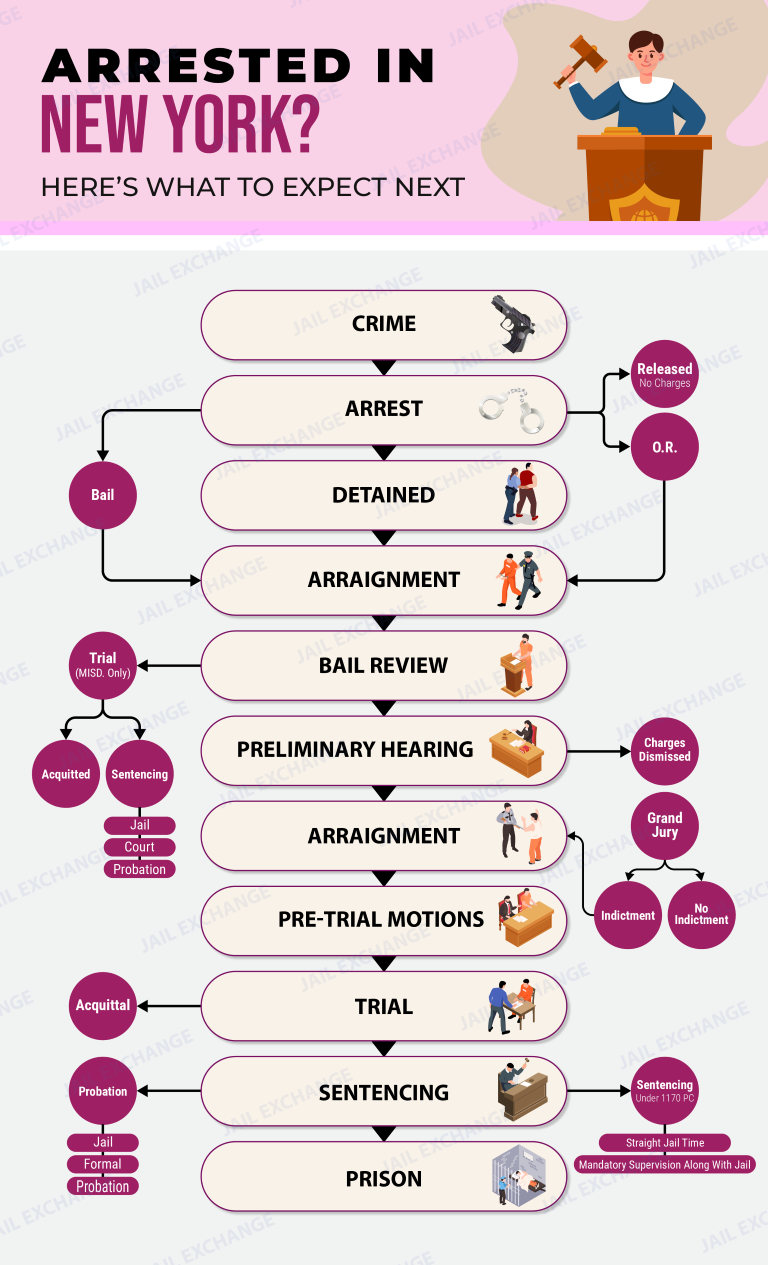
Arraignment is short, often only minutes. The judge reads the charges, makes sure he has a lawyer, and decides release: his own promise, conditions, bail or remand. A misdemeanor plea can happen that day. On a felony complaint, he cannot plead guilty to the felony in Criminal Court.
He spends the hours before this hearing at central booking, where the NYPD keeps him. Every borough has a site, and each one sits in that borough's criminal courthouse.
Brooklyn Central Booking is at 120 Schermerhorn Street, Brooklyn, NY 11201, 718-875-6319. Manhattan Central Booking is at 100 Centre Street, New York, NY 10013, 212-347-2801. Staten Island Central Booking is inside the Staten Island Criminal Court, 26 Central Avenue, Staten Island, NY 10301, 718-876-8493. Queens Central Booking is at 125-01 Queens Boulevard, Kew Gardens, NY 11415, 718-268-4523. Bronx Central Booking is at 215 East 161st Street, Bronx, NY 10451, 718-618-2400; that number also takes arraignment calls for the Bronx Criminal Court.
Most men reach booking 4 to 6 hours after police take them in. Family can't see him there. Phone the booking site that matches where he was arrested. They can give you his arrest number. With it, the Criminal Court clerk for that borough can name the hour and the courtroom.
The judge also sets the next date. If he stays in, write it down; it starts the long wait. Felony complaints carry a firm clock. Unless a grand jury votes or a hearing starts within 120 hours, he goes home on his promise. A weekend or holiday raises the limit to 144 hours. Delay he caused or agreed to does not count, and a few other exceptions apply (CPL 180.80).
↑ Back to the question list6. How long can a misdemeanor case take, and what are the penalties?
Common city misdemeanors include petit larceny, third-degree assault and minor drug possession. They stay in Criminal Court. The law sets top penalties by class:
- Class A: the most jail allowed is 364 days, with fines as high as $1,000 (Penal Law §§ 70.15, 80.05). Probation lasts two to three years.
- Class B: a 90-day jail limit, and fines capped at $500. Probation, when ordered, lasts a year.
- Violations, which are not crimes: no more than 15 days, and $250 at most.
A conditional discharge, with conditions but no supervision, lasts one year for a misdemeanor (Penal Law § 65.05). Under CPL 30.30(1), the DA gets 90 days to be trial-ready on a class A count and 60 on a class B count. If he is locked up, release is required after 30 days (class A) or 15 days (class B) without readiness. Delays the defense asks for usually pause those clocks. If the case ends in his favor, the record is sealed (CPL 160.50).
↑ Back to the question list7. What are the felony steps that make a case last months?
A felony moves through more stages, and each one takes time:
- Felony complaint. Arraignment in Criminal Court on the police charges.
- Grand jury. The DA presents evidence in secret. He may testify if his lawyer gives the DA notice in writing before the vote and he signs a waiver (CPL 190.50(5)).
- Indictment. If the grand jury votes to charge him, the case moves to Supreme Court, Criminal Term, in his borough.
- Discovery. The DA hands over evidence automatically: 20 days after arraignment when he is jailed, 35 when he is free (CPL 245.10). Big cases can get a 30-day extension. Changes that took effect August 7, 2025 narrowed the list and require the defense to object early.
- Motions and hearings. Lawyers argue over evidence and searches.
- Plea or trial. Most cases end by plea. The state has six months to be ready for felony trial, or 90 days before a jailed man must be released (CPL 30.30).
Maximum prison terms are set in Penal Law § 70.00. Class A felonies carry up to life. For class B the cap is 25 years, and class C stops at 15. The ceiling for class D is 7 years, and for class E it is 4. On some D or E felonies, the judge has the option of a term of one year or under.
↑ Back to the question list8. Why do violent felony charges change the outlook?
Penal Law § 70.02 lists the violent felonies. A conviction means a definite number of years inside, followed by post-release supervision. First-degree robbery is one class B example; it means 5 years at minimum and 25 at most. Class C charges, like second-degree burglary, range from three and a half years up to 15. Second-degree assault is a class D, with 2 to 7 years. Class E brings one and a half to 4 years.
These charges also allow bail or remand at arraignment, so a man facing one is more likely to wait in jail. The stakes push many cases toward long negotiations and full trials, which is one reason some men spend a year or more on Rikers before a verdict.
↑ Back to the question list9. Why do cases stall for months while he sits at OBCC?
Long stays usually trace back to a few causes: a grand jury not yet heard, discovery still coming in, motions, crowded court calendars, or a trial date pushed back. Each adjournment can add weeks. The law gives some limits, and his lawyer can use them:
- The 120-hour rule on felony complaints (CPL 180.80).
- The speedy trial clock: release once 90 days pass in custody on a felony without the state ready, or 30 days on a class A misdemeanor (CPL 30.30(2)).
- A one-time bail review by a Supreme Court judge before the case leaves Criminal Court (CPL 530.30).
Inside, his housing is not fixed either. City rules require a classification system (40 RCNY § 1-02(f)), and DOC reviews each man's level about every 60 days. Families can help by keeping a calendar of every date, asking the lawyer what each one was for, and noting each delay and who asked for it.
↑ Back to the question list10. Who prosecutes, and who defends him for free?
Each borough has its own District Attorney. Nonprofit defenders take most arraignments, and the Assigned Counsel Plan covers conflicts. State standards presume a jailed person qualifies for a free lawyer.
Brooklyn: District Attorney, 350 Jay Street, Brooklyn, NY 11201, Action Center 718-250-2340. Defenders: The Legal Aid Society, 111 Livingston Street, Floor 9, Brooklyn, NY 11201, 718-237-2000; Brooklyn Defender Services, 177 Livingston Street, Floor 7, Brooklyn, NY 11201, 718-254-0700.
Staten Island: District Attorney, 130 Stuyvesant Place, Staten Island, NY 10301, 718-876-6300. Defender: The Legal Aid Society, 60 Bay Street, Staten Island, NY 10301, 347-422-5333.
Manhattan: District Attorney, 1 Hogan Place, New York, NY 10013, 212-335-9000. Defenders: The Legal Aid Society, 49 Thomas Street, New York, NY 10013, 212-732-5000; New York County Defender Services, 100 William Street, Floor 20, New York, NY 10038, 212-803-5100; Neighborhood Defender Service, 317 Lenox Avenue, New York, NY 10027, 212-876-5500.
Queens: District Attorney, 125-01 Queens Boulevard, Kew Gardens, NY 11415, 718-286-6000. Defenders: The Legal Aid Society, 120-46 Queens Boulevard, Kew Gardens, NY 11415, 718-286-2000; Queens Defenders, 118-21 Queens Boulevard, Suite 212, Forest Hills, NY 11375, 844-783-3673.
The Bronx: District Attorney, 198 East 161st Street, Bronx, NY 10451, 718-590-2000. Defenders: The Legal Aid Society, 260 East 161st Street, Bronx, NY 10451, 718-579-3000; The Bronx Defenders, 360 East 161st Street, Bronx, NY 10451, 718-838-7878.
The Assigned Counsel Plan is at 253 Broadway, Room 200, New York, NY 10007, 212-676-0066.
↑ Back to the question list11. How do I follow his next date from outside Otis Bantum?
Use more than one tool, because each has limits:
- Person in Custody Lookup. DOC's lookup shows his next court date while he is held.
- WebCrims. The state's WebCrims search includes all five boroughs' criminal courts. Search by his name (at least two letters of each) and pick the county. It lists only active cases with a future date, so closed, sealed and youthful offender cases do not appear.
- By phone. The Criminal Court Information Line, 646-386-4900, helps with Criminal Court cases. After indictment, call the Supreme Court clerk in his borough, listed in the courthouse answer.
- His lawyer. The best source for what happened in court and why.
The letters in a docket number show the borough. Brooklyn uses KN and Staten Island uses RI. Manhattan dockets start with NY, Queens with QN and the Bronx with BX. Keep his docket and indictment numbers with his NYSID for every call.
↑ Back to the question list12. Did a missed date bring a bench warrant, and what clears one?
A missed court date can lead a judge to sign a bench warrant, and NYPD officers carry it out. Official wanted lists are the NYPD Wanted page and the New York State Police wanted and missing page. Phone 646-386-4900, the Criminal Court Information Line, on a weekday to ask if one exists. WebCrims shows open cases with future dates, but a warrant case may lack one, so phone too. Clearing it takes an appearance before a judge at the issuing court; bring a lawyer if you can. Surrender at an NYPD precinct is another route; use the precinct finder. Each courthouse's address and phone is in the borough answer on this page.
↑ Back to the question list13. Federal charges: does a man at OBCC go to a different court?
Yes. A federal case never runs through Criminal Court. A Manhattan or Bronx arrest lands in the Southern District, 500 Pearl Street, New York, NY 10007, Clerk's Office 212-805-0136, weekdays 8:30 a.m. to 5 p.m. For Brooklyn, Queens or Staten Island, it is the Eastern District, 225 Cadman Plaza East, Brooklyn, NY 11201, 718-613-2600.
A magistrate judge rules on detention at his first federal hearing, under 18 U.S.C. 3142. Pretrial Services interviews him first: Manhattan office 212-805-4300, Brooklyn office 718-613-2570. People who cannot pay get a lawyer from Federal Defenders of New York:
- 52 Duane Street, Floor 10, New York, NY 10007, 212-417-8700.
- 300 Cadman Plaza West, Floor 16, Brooklyn, NY 11201, 718-330-1200 (One Pierrepont Plaza).
Federal dockets are on PACER, which charges $0.10 a page. The U.S. Marshals choose where a federal detainee waits for trial, often MDC Brooklyn. After sentencing, check the BOP inmate locator.
↑ Back to the question list14. Can an immigration detainer change how his case goes?
The criminal case and an immigration case are separate. With Form I-247A, ICE may request that DOC keep a man up to 48 hours after they would otherwise be released (8 CFR 287.7(d)). The criminal case keeps going either way. A detainer does not change his court dates, but it matters if he is close to release.
Several New York rules apply. Civil Rights Law § 28 protects anyone traveling to a courthouse, attending, or going home. Civil arrest there needs a judge's signed order or warrant. City detainer laws (Administrative Code § 9-131) allow DOC to honor a detainer in a short list of cases involving serious convictions. Under Local Law 228 of 2017, city agencies may not spend their resources on immigration enforcement. If ICE takes custody, the ICE Online Detainee Locator can find him. Immigration questions go to the ICE New York City Field Office, 26 Federal Plaza, Suite 9-110, New York, NY 10278, 212-436-9315. Before any plea, he should ask his defense lawyer what it could mean for his immigration status.
↑ Back to the question list15. If convicted, which prison system takes him?
A sentence capped at a year is served in a city jail, usually on Rikers. Longer felony terms move him to a state prison run by the Department of Corrections and Community Supervision (DOCCS). Time already spent in jail is usually credited toward the sentence, which matters after a long wait.
After sentencing, DOCCS takes him to a reception center for intake. There he gets a DIN, staff study his needs, and he is assigned to a prison. Find him on the DOCCS Incarcerated Lookup, or call 518-457-5000 on weekdays. To read about each state facility, visit our New York state prisons page.
↑ Back to the question list16. What court handles a case when the accused is under 18?
Teens never go to Rikers. Felony charges at 16 or 17 make a teen what the law names an adolescent offender. The Youth Part, a part of Supreme Court, hears them first. Most non-violent ones then go to Family Court. Prosecutors can block that move only with a motion, filed inside 30 days, that proves extraordinary circumstances (CPL 722.23). Younger children face juvenile delinquency cases in Family Court. There is no bail there, and the child gets a free lawyer.
- Manhattan Family Court: 60 Lafayette Street, New York, NY 10013, 646-386-5223.
- Brooklyn Family Court: 330 Jay Street, Brooklyn, NY 11201, 347-401-9610.
- Queens Family Court: 151-20 Jamaica Avenue, Jamaica, NY 11432, 718-298-0197.
- Bronx Family Court: 900 Sheridan Avenue, Bronx, NY 10451, 718-618-2098.
- Staten Island Family Court: 100 Richmond Terrace, Staten Island, NY 10301, 718-675-8800.
A teen held before trial is sent by ACS to Crossroads Juvenile Center, 17 Bristol Street, Brooklyn, NY 11212, 718-240-3800, or Horizon Juvenile Center, 560 Brook Avenue, Bronx, NY 10455, 718-292-0065.
↑ Back to the question list17. Where can a crime victim get help in the city?
Every DA's office has a team that helps victims of crimes in that borough:
- Brooklyn: Victim Services Unit, 718-250-3820.
- Queens: Crime Victims Advocate Program, 718-286-6812.
- The Bronx: Crime Victims Assistance Bureau, 718-590-2115.
- Staten Island: Family Justice Center, 126 Stuyvesant Place, Staten Island, NY 10301, 718-697-4300, weekdays 9 a.m. to 5 p.m., no appointment needed.
- Manhattan: Witness Aid Services Unit, reached through the main DA line, 212-335-9000.
For costs the crime caused, such as medical or counseling bills, contact the state Office of Victim Services at 800-247-8035. In family-violence cases, the court can issue an order of protection (CPL 530.12). To learn when someone is released or moved, sign up for alerts through VINE or call 888-846-3469.
↑ Back to the question list