Lane County Juvenile Detention Center Criminal Court Process
Criminal Court Process for Lane County Oregon
Lane County Criminal Court Guide
Adults charged here usually wait for their first hearing in the Lane County Jail, 101 West 5th Avenue, Eugene, OR 97401. Felonies and most misdemeanors then move to the circuit court at 125 East 8th Avenue, Eugene, OR 97401, while eight city courts and one justice court take smaller matters. Once sentenced, some do work release at the Residential Reentry Center beside the jail. This guide shows which court owns a case, every stage up to sentencing, and how to track a court date.
Want to know if your loved one is still behind bars? Open the Sheriff's AIC Viewer. Our Recent Arrests page handles the custody questions families ask first: finding someone, who was booked lately, outstanding warrants, what a charge means, getting a public defender and claiming property.
Next, on a weekday, phone the circuit court's criminal case line at 541-682-7692. Share the full name and birth date, and write down the case number plus the next hearing. While the person is still held, our bail page explains the road to release.
1. Misdemeanor or felony: whose courtroom is it?
The state's trial court is the circuit court, and every Oregon county has one. Ours belongs to the Second Judicial District. Oregon groups its 36 circuit courts into 27 districts (ORS 3.012).
- Felonies (crimes that can mean prison) are always circuit court cases.
- Misdemeanors land there too, except when a city court keeps one that happened inside its city.
- City (municipal) courts take city code cases plus certain state charges filed by their own officers.
- The justice court in Florence deals with traffic tickets and other violations. Lane's county government runs it, separate from the state judiciary.
A violation, such as most speeding tickets, carries a fine and never jail. Neither city courts nor the justice court show up in the state's online search, so phone them for case news.
↑ Back to the question list2. Where are the courthouses in Lane County?
- Circuit court, 125 East 8th Avenue, Eugene, OR 97401, 541-682-4020. Doors open 8:00 a.m. to 5:00 p.m. on weekdays, closed legal holidays. Youth cases are heard at its second site, the Juvenile Justice Center, 2727 Martin Luther King Jr. Blvd., Eugene, OR 97401.
- Jail courtroom. Circuit court arraigns people in custody at 1:30 p.m. inside the jail, 101 West 5th Avenue, Eugene, OR 97401. Get there half an hour ahead. Leave food, drinks and phones behind, since there are only a handful of lockers.
- Justice court, 900 Greenwood St, Florence, OR 97439, 541-997-2535. Hours run 8:00 a.m. to 4:30 p.m., Monday through Thursday. Wednesday mornings until noon, calls roll to voicemail. Check in by phone before driving out to the coast.
- Federal cases go to Eugene's Wayne L. Morse U.S. Courthouse, 405 East Eighth Avenue, Suite 2100, Eugene, OR 97401. Clerk's Office 503-326-8000, weekdays 8:00 a.m. to 5:00 p.m.
Handy circuit court numbers: Calendar and Docketing 541-682-6521, Court Records 541-682-7487, Pretrial Release Services 541-682-4201.
↑ Back to the question list3. Do Springfield, Florence and other towns hold court?
Yes. These eight cities run a municipal court:
- Eugene Municipal Court, 1102 Lincoln Street, Eugene, OR 97401, 541-682-5400. The counter is staffed 8:00 a.m. to 4:00 p.m., Monday through Thursday, with a lunch gap from noon to 12:30. Its jailed defendants are arraigned at the jail at 11 a.m.
- Springfield Municipal Court, 230 Fourth Street, Springfield, OR 97477, 541-726-3748, weekdays 8:00 a.m. to 4:30 p.m. Someone jailed on a Springfield or Eugene city charge may sit in the Springfield Municipal Jail, 344 A Street, Springfield, OR 97477, rather than the county jail.
- Florence Municipal Court, 900 Greenwood Street, Florence, OR 97439, 541-997-3123, Monday through Thursday, 8:00 a.m. to 4:30 p.m. Florence city cases can be held in the small Florence Municipal Jail in the same building.
- Cottage Grove Municipal Court, City Hall, 400 E. Main Street, Cottage Grove, OR 97424, clerk 541-767-4115. Sessions fall on the first and third Thursdays.
- Junction City Municipal Court, 680 Greenwood Street, Junction City, OR 97448, 541-998-1113. The clerk keeps weekday hours of 8:00 a.m. to 5:00 p.m. Court generally meets the 2nd and 4th Thursdays, and criminal arraignments start at 9:15 a.m.
- Coburg Municipal Court, City Hall, 91136 N Willamette St., Coburg, OR 97408, 541-682-7859
- Veneta Municipal Court, City Hall, 88184 8th Street, Veneta, OR 97487, 541-935-2191. Once a month, on the third Thursday, it hears traffic, parking and city code cases, starting with 8:30 a.m. arraignments.
- Oakridge Municipal Court: dial 541-782-2258 to get its address and session days.
Creswell, Lowell and Westfir: ask that city's hall, or the circuit court at 541-682-4020, where a local case is filed. Dunes City's hall answers at 541-997-3338.
↑ Back to the question list4. At arraignment, what should families expect?
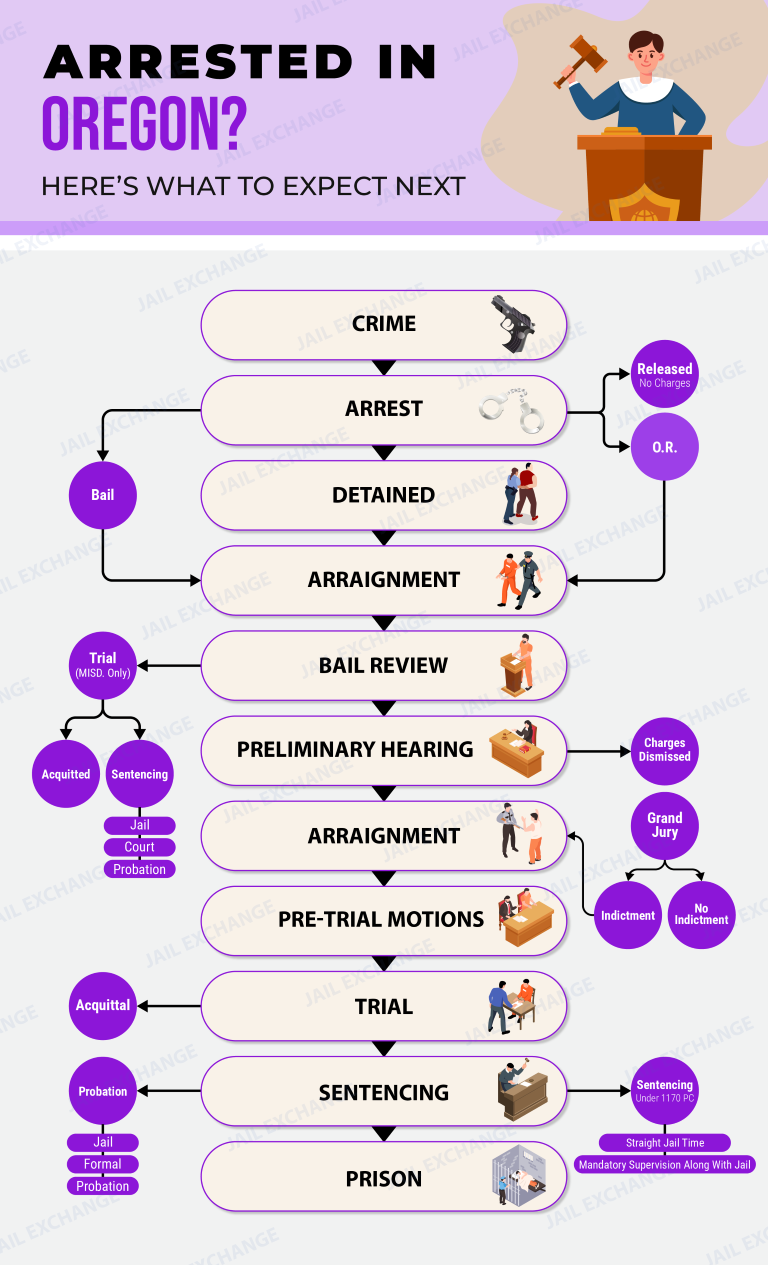
Lawyers call it the arraignment. Someone in jail gets one within 36 hours of being taken into custody, skipping Saturdays, Sundays and holidays (ORS 135.010). A person given a citation and sent home normally has about 30 days (ORS 133.060). Here, jailed defendants appear from inside the jail, frequently by video.
Expect these things to happen:
- The court reads out the charge and asks for a plea (ORS 135.020).
- The right to a lawyer is explained. A person short on money can request an appointed one on the spot.
- Felony defendants have to attend personally. Misdemeanor defendants can let their attorney appear for them (ORS 135.030).
- Release gets decided: on a promise, under conditions or with security (ORS 135.245).
- On felony charges, the person also learns they may ask for a preliminary hearing (ORS 135.070).
Relatives may watch. The jail courtroom has little seating, so arrive early.
↑ Back to the question list5. How do DUII and theft misdemeanors move along here?
Drunk driving (DUII) and theft fill a large share of misdemeanor calendars. Most are filed in circuit court, though a city court can keep one from inside its limits. The usual path:
- Arraignment, where the plea is guilty, not guilty or no contest.
- Negotiation between the deputy DA and the defense. Plenty of cases end with a deal.
- Trial, in front of a judge or six to twelve jurors. A guilty verdict has to be unanimous (Ramos v. Louisiana, 2020).
- Sentence, which can mix jail, probation, fines, classes and treatment.
How much jail is possible depends on the class. A Class A charge, the top level, risks a sentence of 364 days or less. For Class B the cap is six months; Class C stops at 30 days. Since September 1, 2024, drug possession is its own kind of misdemeanor under HB 4002, with as much as 180 days. Even so, treatment and probation usually come first. Finishing them can end the charge.
The circuit court also has a Drug Court for people with addiction. It takes at least nine months of treatment. Expect surprise drug tests and many visits with the judge.
↑ Back to the question list6. What are the stages of a Lane County felony case?
- First arraignment on a complaint, held at the jail. Release is settled here.
- Charging. Prosecutors take the case to a grand jury for an indictment, or a judge weighs the evidence at a preliminary hearing. If the person is jailed, that hearing must come within five court days (ORS 135.070). With no probable cause, the case is dropped and the person walks out (ORS 135.175).
- Second arraignment on the formal charge, with a new plea.
- Getting ready for trial: both sides swap evidence, file motions and may bargain.
- Trial. Twelve jurors must all agree to convict.
- Sentencing on Oregon's grid. One axis measures how serious the crime is. The other measures criminal history.
The ceiling for prison time:
- Class A felony: up to 20 years
- Class B felony: up to 10 years
- Class C felony: up to 5 years
Anyone given prison goes to the Oregon Department of Corrections. Short jail terms and probation are handled locally.
↑ Back to the question list7. Why are Measure 11 cases treated so strictly?
Oregon voters approved Measure 11 in November 1994. For listed crimes against people, it fixes a minimum prison term, and good behavior earns no time off. Murder means 25 years or more. Robbery and assault in the first degree each mean at least 90 months.
- Staying in jail. With murder or treason and clear proof, release must be refused. For other violent felonies, prosecutors may request a hearing aimed at keeping the person locked up (ORS 135.240).
- Victim contact. Domestic violence, sex crime and bias crime defendants are barred from reaching the victim, even with a relative as go-between (ORS 135.247).
- Plea deals. When a violent felony is charged, the victim gets a say before a plea bargain (Or. Const. art. I, § 42).
- Teens. SB 1008 sends 15 to 17 year olds with a Measure 11 charge to adult court only after a waiver hearing.
8. Who are the prosecutors and defenders here?
The prosecution. Oregon voters in every county choose their own District Attorney (ORS 8.610). This one works from 125 East 8th Avenue, Room 400, Eugene, OR 97401, 541-682-4261, open weekdays 8:00 a.m. to noon and 1:00 to 5:00 p.m. City prosecutors take the municipal court cases.
The defense. Court-appointed lawyers are funded by the Oregon Public Defense Commission. The steps:
- At arraignment, tell the judge you want a lawyer.
- Fill in the financial form. A screener reviews it, and the judge rules.
- A $20 application fee usually applies. It can be waived, and a later contribution may be ordered. Lack of money never blocks an appointment.
Defenders are in short supply statewide. When a jailed defendant has no lawyer a full week after the first hearing, the federal Betschart order generally means release on conditions. The case stays open. Families paying for their own attorney can get names from the Oregon State Bar referral line, 503-684-3763.
↑ Back to the question list9. How do I look up a Lane County case or court date?
Anyone can use OJD Records and Calendar Search at no charge and without signing up. It covers circuit court cases.
- Type the last name, then the first.
- Click into the case. You'll see the basics, the parties, hearings held and outcomes, but no filed documents.
- Upcoming dockets sit on the circuit court calendars page.
- Turn on text hearing reminders to avoid a missed date.
When the website is offline, public terminals at the courthouse still work. Clerks can give case facts over the phone, but no legal advice, at Criminal Case Info, 541-682-7692. For a fee, OJCIN OnLine shows the official register. Juvenile files are never public online. For city cases, call the city court that has them.
↑ Back to the question list10. Could an open warrant be out there?
Deputies and city officers serve warrants countywide. Phone the Sheriff's Office, 541-682-4150, to ask whether one exists, or look up the name on OJD's case portal. Wanted lists come from FBI Portland, the Marshals Service (15 Most Wanted) and the state prison system (Oregon DOC Most Wanted). Every warrant lists a release amount. To clear it, first get a lawyer's advice. Next, show up in person where the warrant was signed, or call there and request a hearing. For circuit court warrants, go to 125 East 8th Avenue, Eugene, OR 97401, or call 541-682-4020.
↑ Back to the question list11. How do federal prosecutions from Lane County unfold?
The Eugene Division of the U.S. District Court for the District of Oregon takes federal charges from around here. Its building: Wayne L. Morse U.S. Courthouse, 405 East Eighth Avenue, Suite 2100, Eugene, OR 97401.
- Federal prosecutors from the U.S. Attorney's Eugene branch sit upstairs in Suite 2400, 541-465-6771.
- A detention hearing sorts out where the defendant spends the months before trial (18 U.S.C. 3142).
- Federal detainees stay in the Marshals' custody until trial. Oregon's Marshals office: 1000 Southwest 3rd Avenue, Room 401, Portland, OR 97204, 503-326-2209. Housing may be a county jail on contract, or FCI Sheridan, 27072 Ballston Road, Sheridan, OR 97378, 503-843-4442.
- The Federal Public Defender, 859 Willamette St., Suite 200, Eugene, OR 97401, 541-465-6937, represents federal defendants who can't pay.
- Following sentencing, search the Federal Bureau of Prisons inmate locator.
12. Can an ICE request change the state case?
The criminal case moves forward on its own track. Here is where immigration comes in:
- ICE lodges its detainer, Form I-247A.
- Its request: custody for up to 48 hours after they would otherwise be released (8 CFR 287.7(d)).
- Oregon's sanctuary laws (ORS 181A.820 to 181A.829; HB 3265 of 2021) forbid the state's officers and jails from carrying out any immigration request a judge hasn't signed. So Oregon jails generally release people on schedule even when an ICE detainer is on file, and they don't give out release dates for immigration enforcement.
- Civil immigration arrests can't happen in an Oregon courthouse without a judge's signed warrant or order (HB 3265).
- ICE oversees Oregon from its Seattle Field Office. Its Portland office: 4310 S Macadam Ave, Suite 300, Portland, OR 97239, 503-326-4165.
- To locate someone ICE holds, use the ICE Online Detainee Locator.
Pleading guilty can hurt a noncitizen's status. Talk it through with the defense lawyer first.
↑ Back to the question list13. Which prison takes someone after sentencing?
Once a judge imposes prison, the Oregon Department of Corrections takes over. Intake at Coffee Creek Correctional Facility, 24499 SW Grahams Ferry Road, Wilsonville, OR 97070, lasts around a month for every new arrival. Women remain there. Men head to a different state prison.
- Find their location using the Oregon Offender Search.
- General questions: 503-945-9090.
- Facility details are on our Oregon state prisons page.
A county office apart from the jail supervises probation and life after prison: Parole and Probation Services, 2699 Roosevelt Blvd, Eugene, OR 97402, 541-682-3040.
↑ Back to the question list14. When a teenager is charged, what court is used?
The circuit court hears youth matters at the Juvenile Justice Center, 2727 Martin Luther King Jr. Blvd., Eugene, OR 97401. Detention on that campus is run by the county's Youth Services, 541-682-4700. Youths don't go to the adult jail.
- The county juvenile department serves ages 12 to 17, and a judge may place a youth on county probation.
- State-level youth lockups belong to the Oregon Youth Authority.
- Beginning in 2020, a Measure 11 charge against a 15 to 17 year old stays in juvenile court unless a waiver hearing moves it (SB 1008).
- Youth files are left out of the online court search.
Reach the District Attorney's Juvenile Division at 541-682-4702.
↑ Back to the question list15. How are Lane County crime victims protected?
Victims' rights are written into Oregon's Constitution (Or. Const. art. I, § 42; Or. Const. art. I, § 43). A few kick in automatically, for example speaking at sentencing or a release hearing. Others, like being told about hearings ahead of time, start only after a request.
- Victim Services Division, District Attorney's Office, 125 East 8th Avenue, Room 400, Eugene, OR 97401, 541-682-4523. Staff and volunteers work weekdays from 8:00 a.m. to 5:00 p.m. on court support and protective orders.
- Custody alerts: sign up with VISOR or call 855-691-6246. Registration can be anonymous.
- Money for crime costs: Crime Victims' Compensation, Oregon Department of Justice, 1162 Court St. NE, Salem, OR 97301, 800-503-7983. It can cover hospital bills, therapy and missed wages after violent crime, though not stolen or damaged property.