
Springfield Municipal Jail
Springfield Municipal Jail
Physical Address
344 A StreetSpringfield, OR 97477
Jail Phone Number
541-744-4177Lane County Inmate Search: Locate a Loved One in the Eugene Jail
After an arrest anywhere from Florence to Oakridge, most adults are booked at the Lane County Jail, 101 West 5th Avenue, Eugene, OR 97401. The Sheriff's Office runs it as the intake and release center for the county. Beside it, the Residential Reentry Center houses sentenced people on work release, who keep jobs; call 541-682-2297. This page walks you through finding the person, then visits, calls, mail, money, court dates and the agency that made the arrest.
Start with the Sheriff's AIC Viewer, where AIC stands for "adult in custody." It lists only people inside the jail at this moment, with each person's details and the charges the arresting officers filed. A name that is missing usually means the person is not held there right now.
For anything the viewer can't answer, phone jail reception at 541-682-4263, Monday through Friday, 8:00 a.m. to 7:00 p.m. Write down the ID number, what they're accused of and when they go before a judge. Our bail page then shows how they can get out.
Read inmate search answers
 Read inmate search answers
1. Searching the Lane County AIC Viewer, step by step
Anyone can use the viewer for free, even on a cell phone.
- Load the AIC Viewer and pick its booking search.
- Enter the surname. If too many matches appear, narrow it with a first name.
- Tap the record. You'll see a description of the person and the offenses the arresting agency wrote down.
- Save the ID number somewhere. Mail, deposits and phone accounts all ask for it.
A listed charge is only an accusation, not a conviction. Updates come often, yet earlier jail stays drop off the list. History questions belong with the court that had the case.
↑ Back to the question list2. No match on the viewer: what next?
According to the jail, a name that doesn't come up means that person isn't in its custody. Here's why that might be:
- Booking isn't finished. Processing takes time, so recheck in a few hours.
- Released already. Many walk out within hours on a signed promise.
- Held by a city. Springfield and Florence police run small jails of their own for city cases.
- Under 18. Youths are sent to a separate juvenile facility.
- A different spelling. Search a maiden name, a middle name or each half of a hyphenated name.
Reception at 541-682-4263 can look the person up for you. After hours, dial the Sheriff's main line, 541-682-4150, and press 1 for dispatch, which is staffed 24/7.
↑ Back to the question list3. Which other jails near Lane County might hold them?
Felony suspects can only be held at the main jail. Still, check these spots:
- Springfield Municipal Jail, 344 A Street, Springfield, OR 97477, 541-744-4177. Its 98 beds make it the biggest city jail in Oregon. Men and women on misdemeanor cases stay here before and after trial, including Eugene city cases, and the city runs its own Springfield inmate lookup.
- Cottage Grove and Junction City police no longer run jails. People they arrest go to the Lane County Jail or to Springfield.
- Florence Police Correctional Facility, the city jail at 900 Greenwood Street, Florence, OR 97439, 541-997-3515. It holds people on Florence city charges and those serving short city sentences.
An arrest close to the edge of the county could lead to a neighbor's jail:
- Linn County Jail, 1115 Jackson St. SE, Albany, OR 97322, 541-967-3901
- Benton County Jail, 190 NW 4th St., Corvallis, OR 97330, 541-766-6866
- Douglas County Jail, 1036 SE Douglas Ave, Roseburg, OR 97470, 541-440-4450
- Lincoln County Jail, 251 West Olive Street, Newport, OR 97365, 541-265-4277
- Deschutes County Adult Jail, 63333 West Highway 20, Bend, OR 97703, 541-388-6661
- Klamath County Jail, 3201 Vandenberg Road, Klamath Falls, OR 97603, 541-883-4197
4. Are booking photos shown in the viewer?
No photos appear. On January 1, 2022, the jail pulled booking pictures from the viewer to follow Oregon's HB 3273 (2021). Under that law, police may share a booking photo only for limited reasons. Examples are hunting a fugitive, giving it to the person pictured or the victim, or after a conviction.
- To ask for booking records the lawful way, use the Sheriff's public records portal. A paper request can also be left at the Records Window inside the jail lobby, 101 West 5th Avenue, Eugene, OR 97401, paid by check or money order to LCSO.
- ICE holds its own photos. Request them on its FOIA portal.
- Federal agencies keep their mugshots private. The one exception: the Marshals Service sometimes releases a picture, such as of someone on the run.
5. Release and transfer alerts through VISOR
VISOR (Victim Information System in ORegon) does the job VINE does in other states. It is free, and it is offered by the state Department of Corrections for both county jails and state prisons.
- Look a person up by name, State ID (SID) or county ID.
- Pick how you'd like to hear: a call, an email or a text. Notices go out on release, transfer, escape or death.
- No account is required. Signing up can be anonymous, and the person held won't learn you registered.
- Help by phone, day or night: 855-691-6246.
Treat alerts as an extra layer, not full protection. For a safety plan, contact the District Attorney's Victim Services Division at 541-682-4523.
↑ Back to the question list6. How does release from the Lane County Jail work?
Oregon law presumes release on a person's own promise, called recognizance (ORS 135.245). Judges can add rules or set security, the state's word for bail. When they do, families normally pay a tenth of it (ORS 135.265).
- Under a standing order from the presiding judge, jail staff can release many people on minor charges without waiting for court.
- Domestic violence, sex crimes and Measure 11 charges are held for arraignment. For people in custody it comes within 36 hours of booking, skipping weekends and holidays.
- Oregon has no bail bond businesses, so money goes straight to the court or jail.
- On circuit court cases, Pretrial Release Services answers questions at 541-682-4201.
Every step, cost and refund rule is spelled out on our bail page.
↑ Back to the question list7. Learning the exact charges
What the viewer shows are the arresting agency's charges. Those may not last. The District Attorney's Office decides the formal charges, and the court file lists them after filing.
- Search the name for free on the OJD Records and Calendar Search.
- Or phone the circuit court's Criminal Case Info desk at 541-682-7692.
- The DA's office sits at 125 East 8th Avenue, Room 400, Eugene, OR 97401, 541-682-4261.
Municipal court charges stay off the state search. Ask the city court directly.
↑ Back to the question list8. Defense counsel for someone held here
Lawyers are requested at the first court date. The person tells the judge, then completes a financial form. The Oregon Public Defense Commission pays appointed counsel. Most people are charged a $20 application fee, which may be waived. Being broke never means going without a lawyer.
Right now the state lacks enough public defenders. After seven days, a federal case called Betschart kicks in. If a jailed person has no lawyer by then, the court must generally release them on conditions. The case keeps going.
Defense attorneys can see clients at the jail Monday through Friday. In-person and call slots run 8:00 a.m. to 11:30 a.m. and 12:45 p.m. to 5:00 p.m., with evening calls from 6:30 p.m. to 8:30 p.m. Families who want to hire a lawyer can reach the Oregon State Bar Lawyer Referral Service toll free at 800-452-7636.
↑ Back to the question list9. Lane County Jail visits: rules and scheduling
No visit can happen until the person has been classified, which may take three days. Visit times follow their privilege level and can shift. Call 541-682-4263 between 7:30 a.m. and 5:00 p.m., then choose "Jail and AIC Information" and "Visiting, Mail, and Other AIC Related Questions."
- Getting approved: the person inside sends a Visitor Request Form listing your full name, date of birth, address, phone and how you're related. Changes are allowed every two weeks.
- Timing: reach check-in half an hour ahead. It shuts 10 minutes before your slot.
- ID: grown-ups need a current state ID, driver's license or passport. A parent or legal guardian must bring any child and show that child's original birth certificate every visit. Ages 15 to 18 add their own state ID or student body card.
- Dress code: no see-through, revealing, tight or gang-style clothing. Wear shoes.
- Security: expect a metal detector. Eating, drinking and smoking aren't allowed in the lobby or booths.
- Video visits: book them at the ground-floor kiosks or online. The lobby stations cost nothing from 7:30 a.m. to 5:00 p.m. every day, and each person gets one free remote visit weekly.
More pointers are on our visitation page.
↑ Back to the question list10. Adding money to a trust account
Money sent in lands in the person's trust account. It covers snacks, hygiene supplies and other items. Pick one of three methods:
- Use the kiosk upstairs at the reception area. It takes cash and cards.
- Go to the jail's deposit service online.
- Call the toll-free deposit line, 866-345-1884.
All deposits carry a fee, apart from cash the person brought in at booking. Money orders and checks mailed for accounts get turned away, and mailing cash is never safe. Families can also order commissary packages from that same service. Our guide to sending money and commissary page say more.
↑ Back to the question list11. Calls, texts and tablet messages
Calls go out only. Nobody inside can take an incoming call. The rate is $0.09 per minute, and five calls of up to 15 minutes each are free every week. Staff record all calls except those with lawyers and verified clergy, so keep the case out of conversation.
- Set up a prepaid or debit phone account online, at the lobby kiosk, or with Customer Care, 727-349-1561. Calling that number also blocks calls from the jail.
- On the tablets, an email is $0.50, a text is $0.10 once 8 free texts a month are used, an approved photo is $0.50 and a voicemail is $1.00.
- Phone cards from a store won't work. Housing units have set phone times that staff don't share.
Rates are explained on our jail calls page, and tablet messages on our messaging page.
↑ Back to the question list12. Writing to someone in the Lane County Jail
Starting September 26, 2025, personal letters travel to a Florida scanning center. Each one is scanned and sent to the person's tablet or housing kiosk. Address the envelope this way:
Smart Communications / Lane County Adult Corrections Facility
Adult in Custody Name and ID Number
c/o Mail Processing Center
PO Box 9225, Seminole, FL 33775-9225
- The full name and ID Number come from the viewer, or from reception at 541-682-4263. Put a real return address on it.
- Up to 10 photos fit in one letter, each 4x6 or smaller. Polaroids and nude pictures are refused.
- Plain postcards are scanned like letters. Leave off glitter, stickers, glue, tape, perfume, crayon drawings and blank sheets.
- Reading material must be new and prepaid, shipped directly by the publisher or a store.
Our inmate mail page covers rules common at Oregon jails.
↑ Back to the question list13. Collecting belongings after release
Belongings taken during booking are stored by staff until the person walks out. Phone reception, 541-682-4263, on a weekday to arrange a pickup. Ask whether the owner must sign a form letting a relative collect.
Pickup is at the jail, 101 West 5th Avenue, Eugene, OR 97401, and the lobby opens on weekdays only. Carry photo ID. Property kept as evidence is separate. The Sheriff's Property and Evidence office handles it at 541-682-4332.
↑ Back to the question list14. Health care and medication in jail
Reach the Jail Medical Section at 541-682-2213. Share the person's name, their health conditions and every medicine they take. If they are headed to court or the jail, send along a written list or the empty prescription bottles.
Under Oregon law, needed care must be given even if someone can't pay a health fee (ORS 169.150). Jails also need emergency medical and dental care, and staff must look in on each person at least hourly (ORS 169.076). If you fear self-harm or a mental health emergency, tell staff at once.
↑ Back to the question list15. Checking for an open warrant
Deputies handle warrants outside the cities, and city officers handle them in town. The Sheriff's Office, at 541-682-4150, answers warrant questions. Circuit court cases, warrant entries included, can be looked up through OJD Records and Calendar Search. Wanted lists that cover Oregon: Oregon DOC Most Wanted, the Marshals Service's top 15 and FBI Portland. Talk to a lawyer before surrendering. Next, appear at the issuing court in person, or phone it to request a new hearing date. Circuit court: 125 East 8th Avenue, Eugene, OR 97401, 541-682-4020.
↑ Back to the question list16. Upcoming hearing dates by court
Which calendar to check depends on the court:
- Circuit court: search the name online at the state's free records site, or call Calendar and Docketing, 541-682-6521. Hearing reminders by text are offered through the OJD reminder page.
- Eugene Municipal Court: 1102 Lincoln Street, Eugene, OR 97401, 541-682-5400.
- Springfield Municipal Court: 230 Fourth Street, Springfield, OR 97477, 541-726-3748. People in custody normally go before the judge at 1:00 p.m. the next business day.
From the main jail, the first appearance happens on site: 11 a.m. for Eugene city charges, 1:30 p.m. for circuit court. Our court page names every court in the county and each stage of a case.
↑ Back to the question list17. Arrested by federal agents?
Federal cases from this region are heard in Eugene, in the Wayne L. Morse courthouse of the U.S. District Court, 405 East Eighth Avenue, Suite 2100, Eugene, OR 97401.
- The first step is a detention hearing, at which a magistrate judge decides on jail before trial (18 U.S.C. 3142).
- Until trial, the U.S. Marshals hold custody. Some stay in county jails the Marshals pay; others go to FCI Sheridan, 27072 Ballston Road, Sheridan, OR 97378, 503-843-4442.
- Ask the Marshals' Portland office where the person is: 1000 Southwest 3rd Avenue, Room 401, Portland, OR 97204, 503-326-2209.
- Once sentenced, the person can be searched by name or register number on the Federal Bureau of Prisons inmate locator.
18. When immigration agents want the person
- ICE sends the jail its detainer form, the I-247A.
- That form asks for custody up to 48 hours after they would otherwise be released (8 CFR 287.7(d)).
- Under Oregon's sanctuary laws (ORS 181A.820 to 181A.829; HB 3265 of 2021), an immigration request binds local police and jails only once a judge puts a signature on it. In general, then, an ICE detainer alone won't keep someone in an Oregon jail, and jails won't hand ICE release information for enforcement.
- ICE can still arrest people in other ways. Oregon is part of its Seattle Field Office, and the Portland office is at 4310 S Macadam Ave, Suite 300, Portland, OR 97239, 503-326-4165. The Eugene check-in office, 211 East 7th Avenue, Suite 120, Eugene, OR 97401, 541-434-3231, opens on the last Tuesday of the month.
- Track a detained person on the ICE Online Detainee Locator. Enter the alien registration number, or the full name and native country.
19. Locating someone sent to state prison
A prison sentence hands the person to the state. Intake lasts roughly 30 days, at Coffee Creek Correctional Facility, 24499 SW Grahams Ferry Road, Wilsonville, OR 97070. In-person visits are off limits during intake, while phone calls and letters go through. Letters must carry the State ID (SID) number.
- The Oregon Offender Search shows the prison they're in.
- The Department of Corrections answers at 503-945-9090. Intake questions go to 503-570-2259.
- Each prison is described on our Oregon state prisons page.
20. A teenager in juvenile detention
Minors are held at the juvenile detention center operated by Youth Services, 2727 Martin Luther King Jr. Blvd., Eugene, OR 97401, 541-682-4700. It is locked and staffed 24 hours, and its residents never appear on the adult viewer.
- Parents can't phone their child directly. The main number gives updates and connects to the youth's counselor.
- Visiting is Wednesday from 6:00 to 8:00 p.m., Sunday from 2:30 to 4:45 p.m., and holidays from 2:30 to 4:45 p.m. The counselor decides who is on the list. Bring photo ID.
- Siblings under 18 need a parent with them. No one under 12 may visit.
- Send letters in the youth's name to 2727 Martin Luther King Jr. Blvd., Eugene, OR 97401.
21. Which police agency in Lane County made the arrest?
Each charge on the viewer names the agency behind it. The county has about 381,584 residents (Census estimate, July 1, 2025), served by these departments:
- Sheriff's Office, 125 East 8th Avenue, Eugene, OR 97401, 541-682-4150. Deputies cover unincorporated land and contract towns such as Creswell and Veneta.
- Eugene Police Department (Eugene, pop. 179,352): the Sheriff's line can point you to the right number.
- Springfield Police Department (pop. 63,304), 230 4th Street, Springfield, OR 97477, 541-726-3714
- Cottage Grove Police Department (pop. 10,909), 400 East Main Street, Cottage Grove, OR 97424, 541-942-9145
- Florence Police Department (pop. 9,664), 900 Greenwood Street, Florence, OR 97439, 541-997-3515
- Junction City Police Department (pop. 7,472), 672 Greenwood Street, Junction City, OR 97448, 541-998-1245
- Oakridge Police (pop. 3,197) and Coburg Police (pop. 1,456): get their numbers from the Sheriff's Office.
- Lowell, Westfir and Dunes City: ask the Sheriff's Office which agency patrols them.
- Oregon State Police, Springfield Area Command Center, 3620 Gateway Street, Suite B, Springfield, OR 97477, 541-726-2536. On a cell phone, dial *OSP.
- University of Oregon Police Department, 2141 E 15th Ave, Eugene, OR 97403, 541-346-2919
- Tribal Police of the Confederated Tribes of Coos, Lower Umpqua and Siuslaw Indians, 5647 Highway 126, Suite 100, Florence, OR 97439, 541-997-6011, which patrols tribal property.
Lane County Bail and Release
Deputies, troopers and most city officers here book adults into the Lane County Jail, 101 West 5th Avenue, Eugene, OR 97401. The Sheriff's Office runs it, and no other jail in the county can hold someone on a felony. Next door, its Residential Reentry Center is a work-release program for sentenced people, 541-682-2297. Below, you'll find how Oregon's security system works, what a deposit really costs, which windows accept money, and why some people stay locked up after paying.
First, check the Sheriff's inmate viewer. It lists only the people locked up at this moment. Our Inmate Lists page covers the arrest side of things: who is in a cell tonight, recent bookings, open warrants, charges, appointed defense lawyers and reclaiming property.
Phone jail reception at 541-682-4263 on a weekday between 8:00 a.m. and 7:00 p.m. Ask three things: can the person leave on a promise, was a security amount set, and when is the first hearing? Our court page follows the case from there.
1. Who makes the release call in Lane County?
A judge does, most often at arraignment, the person's first time in court. Oregon gives a jailed person 36 hours to get there, not counting weekends or holidays (ORS 135.010). Here, in-custody arraignments take place inside the jail, at 1:30 p.m. for circuit court and 11 a.m. for Eugene Municipal Court.
The judge rules on release right then. If more time is needed, the release hearing comes within 48 hours, and five days is the outer limit (ORS 135.245).
Plenty of people skip that wait. A standing order from each county's presiding judge, built on the Chief Justice's statewide guidelines (ORS 135.233), lets the jail free many low-level arrests on a signed promise. Soon after booking, a release officer interviews most people and sends a report to the judge (ORS 135.235). In this county that job belongs to the court's Pretrial Release Services, 541-682-4201.
↑ Back to the question list2. Which three release types does Oregon use?
The law here says "security." Most families still say "bail." Either way, ORS 135.230 sets out three paths home:
- Personal recognizance. A written promise to attend each hearing, with nothing paid. Judges must begin here (ORS 135.245).
- Conditional release. Home, but with rules. Typical ones are staying away from a victim, no drinking, a curfew or reporting to a pretrial officer.
- Security release. The promise is backed by money or property. In most cases, a tenth of the amount is what gets paid.
Oregon judges have to use the least strict choice that still protects the victim and the public. A GPS ankle bracelet or alcohol monitor is a common rule. The Sheriff's Electronic Monitoring Program tracks people out before trial for the state's pretrial office, at 541-682-2139.
↑ Back to the question list3. What security do common charges carry?
No chart lists a dollar figure for each crime. The statewide guidelines put charges into three bins:
- Out on a promise. Most nonperson misdemeanors (many theft or trespass cases), most nonperson Class C felonies and driving while suspended. The jail can often let these people go without a judge.
- Home with conditions. DUII; misdemeanors against a person where no family or partner violence is claimed; a Class C felony against a person; most Class B felonies. The court picks the conditions.
- Held for the judge. Domestic violence, sex offenses, Measure 11 crimes, any Class A felony, failure to appear, eluding police, a felon caught with a gun and a few others. These people stay put until the first hearing.
Once a judge names a security amount, the deposit is normally 10 percent, with $25 as the floor (ORS 135.265). So $5,000 security takes a $500 deposit, and $50,000 takes $5,000. Every warrant states its own amount (ORS 133.140). To learn the number in your case, ring Pretrial Release Services at 541-682-4201 or jail reception at 541-682-4263.
↑ Back to the question list4. How is a deposit posted at the Lane County Jail?
ORS 135.265 and 135.270 let a court clerk, or anyone the court names, take the deposit. Here that is often the jail. For a circuit court case, work through these steps:
- Call jail reception, 541-682-4263, between 8:00 a.m. and 7:00 p.m. on a weekday. Know the exact legal spelling and the birthday before you dial.
- Get the security amount, the case number and the name of the court.
- Ask where deposits are accepted today, the hours, and what forms of payment are fine.
- Head to the Main Jail Lobby, 101 West 5th Avenue, Eugene, OR 97401. Doors are open 8:00 a.m. to 8:30 p.m. on weekdays. Weekends and holidays it stays shut.
- Show a photo ID. Hold on to the receipt, since a refund is paid only to the name printed there.
The jail warns that release times can't be predicted, even after payment. Questions about release terms in circuit court go to Pretrial Release Services, 541-682-4201.
↑ Back to the question list5. Can city charges be paid at a court or police desk?
City charges have their own windows. Each city court takes security only on its own cases.
Eugene Municipal Court, 1102 Lincoln Street, Eugene, OR 97401, 541-682-5400. Its counter is open Monday through Thursday, 8:00 a.m. to 4:00 p.m., with a break from noon to 12:30.
- When the court is closed, the city's Police Records unit accepts bail on that court's charges. It works whichever jail has the person: the Lane County Jail or the Springfield Municipal Jail.
- You may pay in person or by phone. The city's Post Bail page lays out the steps and how to contact Police Records.
- The receipt prints the court date and time, and says if attendance is required.
- Plan on 45 minutes to an hour from the time paperwork reaches the jail.
Springfield Municipal Court, second floor of the Springfield Justice Center, 230 Fourth Street, Springfield, OR 97477, 541-726-3748. People on these charges sit in the Springfield Municipal Jail, 344 A Street, Springfield, OR 97477, 541-744-4177. That 98-bed city jail holds men and women on misdemeanor cases, before and after trial. Florence police run a smaller one, the Florence Municipal Jail, 900 Greenwood Street, Florence, OR 97439, for Florence city charges and short city sentences.
- From 8:00 a.m. to 4:30 p.m. on weekdays, pay at the court window.
- Outside those hours, Police Records on the first floor handles it. The police line is 541-726-3714.
- At night the doors are locked. Lift the entry lobby phone and say you came to post bail.
- In-custody cases usually go before the judge at 1:00 p.m. on the next business day.
6. What money can families bring to each window?
Each window sets its own rules. Ask first so the trip isn't wasted.
- City of Eugene charges: Police Records takes cash, Visa or MasterCard. Checks are refused, and so is a credit card in another person's name.
- Springfield charges: the court at 541-726-3748 can tell you its accepted payments. That court never asks for gift cards, crypto or other unusual payment, so a caller who does is running a scam.
- Circuit court cases: confirm with the jail at 541-682-4263 what payment it can take for a deposit on that day.
- Using property: a family can skip the 10 percent and post the full amount in cash. Or it can pledge stocks, bonds or Oregon land worth twice as much, with a sworn statement (ORS 135.265).
Cash never belongs in the mail. Hang up on anyone who phones promising a quick release for a fee.
↑ Back to the question list7. Do Oregon families ever use bail bond agents?
Oregon does not use commercial bail bonds or bail bondsmen; families post the deposit directly. That is good news for your wallet. No company keeps a fee, and most of the deposit can return once the case wraps up.
A surety is still allowed. That means a relative or friend puts their name on the release agreement, promising to pay the whole security amount if the defendant misses court (ORS 135.230). Signing is a big step, because the debt could be the full sum, far more than the 10 percent deposit.
Anyone selling a paid "bond" in Oregon is a warning sign. Run any offer past the jail at 541-682-4263.
↑ Back to the question list8. Could another hold keep them inside after paying?
One deposit frees a person on one case only. Check for these before paying:
- More than one case. Say there's a city charge plus a circuit court charge. Each case must be cleared separately.
- Someone else's warrant. A warrant from another county or another state is handled by the court that wrote it.
- Supervision. Someone on probation or parole may get a hold placed by their officer. Local supervision runs through Parole and Probation Services, 2699 Roosevelt Blvd, Eugene, OR 97402, 541-682-3040.
- Charges on the hold list. Domestic violence, sex offenses and Measure 11 cases wait for the first hearing.
- A federal case. On federal charges, release comes from a federal judge.
Before you spend a dollar, ask the jail at 541-682-4263 to read every hold on the person.
↑ Back to the question list9. Which charges let a judge refuse release outright?
Release is the rule for most people. The big exceptions are murder, aggravated murder and treason. For those, a judge must refuse release when the proof of guilt is plain (Or. Const. art. I, § 14; Or. Const. art. I, § 43; ORS 135.240).
A violent felony means someone was seriously hurt or faced a threat of serious injury. In those cases, the defense can ask for a hearing at arraignment. Release is denied if the court then finds a danger that the person will physically hurt or sexually harm the victim or the public (ORS 135.240).
No contact with the victim is allowed in domestic violence, sex offense or bias crime cases. That covers calls from the jail and messages passed along by relatives (ORS 135.247, 135.250). Please don't relay notes. Doing so can lead to new charges.
Prosecutors who oppose release work at the District Attorney's Office, 125 East 8th Avenue, Room 400, Eugene, OR 97401, 541-682-4261.
↑ Back to the question list10. How is a security amount reduced?
Judges may change the security amount or the release rules when circumstances change (ORS 135.285). It starts with a written motion from the defense lawyer. Local rule SLR 4.051(3) sets release motions for 9:00 a.m. on Tuesdays and Fridays:
- Monday or Tuesday filings: the coming Friday.
- Wednesday or Thursday filings: the coming Tuesday.
- Friday filings: one week later, on Friday.
Gather proof of a steady job, the person's home, school, people who will help and the amount your family can manage. Suggest rules that ease the court's concerns, such as a monitor. Court Calendar and Docketing can give the hearing time at 541-682-6521.
↑ Back to the question list11. How does Lane County appoint defense lawyers?
The Oregon Public Defense Commission (OPDC) runs public defense statewide. The name took effect January 1, 2024, and the agency joined the executive branch on January 1, 2025.
- At the first appearance, the person says they want a lawyer.
- A money form follows, covering income, savings and dependents. A court screener reviews it.
- Expect a $20 application fee in most cases. Judges can waive it, and they may order a payment toward costs later.
- No one goes without a lawyer because they can't pay.
The state is short of defenders. As 2025 closed, roughly 2,500 Oregonians had no appointed lawyer yet, and some 160 of those sat in jail. Betschart, an order from federal court, generally requires release on conditions for anyone jailed without a lawyer seven days past the first appearance. The case itself goes on. The circuit court at 541-682-4020 can say which lawyer was assigned.
↑ Back to the question list12. Which courts hear Lane County cases?
- Circuit court (every felony and most misdemeanors), 125 East 8th Avenue, Eugene, OR 97401. Juvenile matters meet at the Juvenile Justice Center, 2727 Martin Luther King Jr. Blvd., Eugene, OR 97401. One number serves both, 541-682-4020, from 8:00 a.m. to 5:00 p.m. on weekdays.
- Justice court (traffic and other violations across the county except inside Eugene), 900 Greenwood St, Florence, OR 97439, 541-997-2535. Open Monday to Thursday.
- Eugene Municipal Court, 1102 Lincoln Street, Eugene, OR 97401, 541-682-5400
- Springfield Municipal Court, 230 Fourth Street, Springfield, OR 97477, 541-726-3748
- Florence Municipal Court, 900 Greenwood Street, Florence, OR 97439, 541-997-3123
- Cottage Grove Municipal Court, City Hall, 400 E. Main Street, Cottage Grove, OR 97424, 541-767-4115
- Junction City Municipal Court, 680 Greenwood Street, Junction City, OR 97448, 541-998-1113
- Coburg Municipal Court, City Hall, 91136 N Willamette St., Coburg, OR 97408, 541-682-7859
- Veneta Municipal Court, City Hall, 88184 8th Street, Veneta, OR 97487, 541-935-2191
- Oakridge Municipal Court: phone 541-782-2258 to learn where it sits.
- Federal court, in the Wayne L. Morse building, 405 East Eighth Avenue, Suite 2100, Eugene, OR 97401, Clerk's Office 503-326-8000
13. How do Lane County deposit refunds and forfeits work?
Did the person keep every rule until the case ended? Then the clerk repays 85 percent to whoever the receipt names. The remaining 15 percent stays as a cost, never under $5 or over $750, along with any interest earned (ORS 135.265). A $1,000 deposit means $150 is kept and $850 comes back.
- Fines, fees or restitution in the case may be paid out of the deposit first.
- Springfield Municipal Court allows up to four weeks for a refund. It mails a check to the payer, or to a person listed on its Assignment of Security Deposit form.
- The city of Eugene tells families not to count on a refund, because the money usually goes to the case.
Skipping a court date can wipe out far more than the deposit. A warrant can issue, and the judge can order the whole security amount forfeited. The defendant then has 30 days to prove the absence was not their fault (ORS 135.280). A fresh charge of failure to appear can follow. Its level tracks the original case: misdemeanor cases bring a Class A misdemeanor count, and felony cases bring a Class C felony count (ORS 162.195, 162.205). Refund questions go to the circuit court, 541-682-4020.
↑ Back to the question list14. How do families pick up account money and belongings?
Sort out cash and personal things before release day if you can. Jail reception at 541-682-4263 can explain how the last of the account money gets returned, and on which days stored items may be claimed. Pickups are at the jail, 101 West 5th Avenue, Eugene, OR 97401.
Carry a photo ID. When collecting for someone else, ask whether they need to sign a form that lets you. The lobby is closed on weekends and holidays. Our inmate money page explains deposits and balances in plain terms.
↑ Back to the question list15. How are federal charges handled before trial?
Federal cases from around here belong to the Eugene Division of the U.S. District Court for the District of Oregon. Its home is the Wayne L. Morse U.S. Courthouse, 405 East Eighth Avenue, Suite 2100, Eugene, OR 97401, open from 8:00 a.m. to 5:00 p.m. on weekdays.
- At a detention hearing, often the first appearance, a federal judge decides who goes home (18 U.S.C. 3142). Oregon's 10 percent deposit plays no part.
- A report for that hearing comes from U.S. Pretrial Services, Room 1800 in the same building, 541-431-4080.
- Before trial, people stay in U.S. Marshals custody, in a contract county jail or at FCI Sheridan, 27072 Ballston Road, Sheridan, OR 97378, 503-843-4442. The Marshals' office is at 1000 Southwest 3rd Avenue, Room 401, Portland, OR 97204, 503-326-2209.
- Defendants who can't afford a lawyer can get help from the Federal Public Defender, 859 Willamette St., Suite 200, Eugene, OR 97401, 541-465-6937.
- Sentenced federal prisoners can be tracked on the Federal Bureau of Prisons inmate locator.
16. Does a paid deposit end an ICE detainer?
A deposit settles the state charge and nothing more. An immigration hold runs like this:
- Federal immigration officers (ICE) start by lodging a detainer with the jail on their Form I-247A.
- ICE wants the jail to hold on to the person up to 48 hours after they would otherwise be released (8 CFR 287.7(d)).
- Under Oregon's sanctuary laws (ORS 181A.820 to 181A.829; HB 3265 of 2021), officers and jails in this state honor an immigration request only with a judge's signature on it. That means an ICE detainer by itself generally won't keep anyone locked up here. Release details aren't passed along for immigration enforcement either.
- ICE's Seattle Field Office oversees Oregon. Its office in Portland is at 4310 S Macadam Ave, Suite 300, Portland, OR 97239, 503-326-4165.
- Look the person up on the ICE Online Detainee Locator using a name and country of birth.
17. Where does someone serve a long Oregon sentence?
Prison time is served under the Oregon Department of Corrections. Everyone sentenced to prison, man or woman, begins with roughly 30 days of intake at Coffee Creek Correctional Facility, 24499 SW Grahams Ferry Road, Wilsonville, OR 97070. After that, men transfer to their assigned prison, and women remain at Coffee Creek.
- Use the Oregon Offender Search to look someone up.
- Department questions: 503-945-9090.
- For each prison, see our Oregon state prisons page.
Shorter jail terms can stay local. Some sentenced people join the Sheriff's work crew, 541-682-2117, and sleep at home.
↑ Back to the question list18. What happens when a Lane County minor is arrested?
Youths aged 12 through 17 are never booked as adults here; their cases belong to the county juvenile department. Youths who aren't sent home are kept at the juvenile detention center run by Youth Services, 2727 Martin Luther King Jr. Blvd., Eugene, OR 97401, 541-682-4700, staffed day and night.
SB 1008 (2019) ended automatic adult trials for 15 to 17 year olds charged with Measure 11 crimes. Adult court now takes a waiver hearing first. The District Attorney's Juvenile Division answers at 541-682-4702. Parents can phone detention to learn the youth's location and hearing date.
↑ Back to the question listSpringfield Municipal Jail Inmate Visitation
Friends and Family – Hours for visits at Springfield Municipal Jail are shared by phone, not on a public listing. Call 541-744-4177 to hear the days and times that are in effect. Keeping hours unpublished can protect privacy, support security, and allow individual or unit times.
How to Arrange a Visit
Have the legal name and date of birth, your own ID, and a booking number if you have it. Ask when the person becomes eligible, because many jails wait from 48 hours up to a week after booking. Tell the person who answers your name and your relationship, and be courteous and precise.
When you get through, ask when you may come for a visit, what official identification to present, how far ahead you need to lock in a time, whether you may visit in person, by video, or both, and how long visits last. Also ask if an approved visitor list is required and how you get placed on it, dress expectations and what you may bring into the visit, and if a child can come along and what is required.
Usual Visiting Expectations
Most facilities expect something like the rules below. Check the details for this Oregon jail when you call.
- Typically you will be asked to store cell phones, smartwatches, jewelry, purses, and bags in your vehicle or a locker before you go in.
- People recently released from that jail usually cannot visit without permission from the sheriff or the jail administrator.
- Plan on carrying your ID and a car key only; other personal items are usually left outside.
- A visit can be cancelled without notice, such as when the jail is on lockdown or conducting a count.
- Most jails may ask for a minor's birth certificate or proof of legal guardianship before the child can visit.
- No food, drinks, or gum are typically allowed in the visiting area.
Lane County Criminal Court Guide
Adults charged here usually wait for their first hearing in the Lane County Jail, 101 West 5th Avenue, Eugene, OR 97401. Felonies and most misdemeanors then move to the circuit court at 125 East 8th Avenue, Eugene, OR 97401, while eight city courts and one justice court take smaller matters. Once sentenced, some do work release at the Residential Reentry Center beside the jail. This guide shows which court owns a case, every stage up to sentencing, and how to track a court date.
Want to know if your loved one is still behind bars? Open the Sheriff's AIC Viewer. Our Recent Arrests page handles the custody questions families ask first: finding someone, who was booked lately, outstanding warrants, what a charge means, getting a public defender and claiming property.
Next, on a weekday, phone the circuit court's criminal case line at 541-682-7692. Share the full name and birth date, and write down the case number plus the next hearing. While the person is still held, our bail page explains the road to release.
1. Misdemeanor or felony: whose courtroom is it?
The state's trial court is the circuit court, and every Oregon county has one. Ours belongs to the Second Judicial District. Oregon groups its 36 circuit courts into 27 districts (ORS 3.012).
- Felonies (crimes that can mean prison) are always circuit court cases.
- Misdemeanors land there too, except when a city court keeps one that happened inside its city.
- City (municipal) courts take city code cases plus certain state charges filed by their own officers.
- The justice court in Florence deals with traffic tickets and other violations. Lane's county government runs it, separate from the state judiciary.
A violation, such as most speeding tickets, carries a fine and never jail. Neither city courts nor the justice court show up in the state's online search, so phone them for case news.
↑ Back to the question list2. Where are the courthouses in Lane County?
- Circuit court, 125 East 8th Avenue, Eugene, OR 97401, 541-682-4020. Doors open 8:00 a.m. to 5:00 p.m. on weekdays, closed legal holidays. Youth cases are heard at its second site, the Juvenile Justice Center, 2727 Martin Luther King Jr. Blvd., Eugene, OR 97401.
- Jail courtroom. Circuit court arraigns people in custody at 1:30 p.m. inside the jail, 101 West 5th Avenue, Eugene, OR 97401. Get there half an hour ahead. Leave food, drinks and phones behind, since there are only a handful of lockers.
- Justice court, 900 Greenwood St, Florence, OR 97439, 541-997-2535. Hours run 8:00 a.m. to 4:30 p.m., Monday through Thursday. Wednesday mornings until noon, calls roll to voicemail. Check in by phone before driving out to the coast.
- Federal cases go to Eugene's Wayne L. Morse U.S. Courthouse, 405 East Eighth Avenue, Suite 2100, Eugene, OR 97401. Clerk's Office 503-326-8000, weekdays 8:00 a.m. to 5:00 p.m.
Handy circuit court numbers: Calendar and Docketing 541-682-6521, Court Records 541-682-7487, Pretrial Release Services 541-682-4201.
↑ Back to the question list3. Do Springfield, Florence and other towns hold court?
Yes. These eight cities run a municipal court:
- Eugene Municipal Court, 1102 Lincoln Street, Eugene, OR 97401, 541-682-5400. The counter is staffed 8:00 a.m. to 4:00 p.m., Monday through Thursday, with a lunch gap from noon to 12:30. Its jailed defendants are arraigned at the jail at 11 a.m.
- Springfield Municipal Court, 230 Fourth Street, Springfield, OR 97477, 541-726-3748, weekdays 8:00 a.m. to 4:30 p.m. Someone jailed on a Springfield or Eugene city charge may sit in the Springfield Municipal Jail, 344 A Street, Springfield, OR 97477, rather than the county jail.
- Florence Municipal Court, 900 Greenwood Street, Florence, OR 97439, 541-997-3123, Monday through Thursday, 8:00 a.m. to 4:30 p.m. Florence city cases can be held in the small Florence Municipal Jail in the same building.
- Cottage Grove Municipal Court, City Hall, 400 E. Main Street, Cottage Grove, OR 97424, clerk 541-767-4115. Sessions fall on the first and third Thursdays.
- Junction City Municipal Court, 680 Greenwood Street, Junction City, OR 97448, 541-998-1113. The clerk keeps weekday hours of 8:00 a.m. to 5:00 p.m. Court generally meets the 2nd and 4th Thursdays, and criminal arraignments start at 9:15 a.m.
- Coburg Municipal Court, City Hall, 91136 N Willamette St., Coburg, OR 97408, 541-682-7859
- Veneta Municipal Court, City Hall, 88184 8th Street, Veneta, OR 97487, 541-935-2191. Once a month, on the third Thursday, it hears traffic, parking and city code cases, starting with 8:30 a.m. arraignments.
- Oakridge Municipal Court: dial 541-782-2258 to get its address and session days.
Creswell, Lowell and Westfir: ask that city's hall, or the circuit court at 541-682-4020, where a local case is filed. Dunes City's hall answers at 541-997-3338.
↑ Back to the question list4. At arraignment, what should families expect?
Lawyers call it the arraignment. Someone in jail gets one within 36 hours of being taken into custody, skipping Saturdays, Sundays and holidays (ORS 135.010). A person given a citation and sent home normally has about 30 days (ORS 133.060). Here, jailed defendants appear from inside the jail, frequently by video.
Expect these things to happen:
- The court reads out the charge and asks for a plea (ORS 135.020).
- The right to a lawyer is explained. A person short on money can request an appointed one on the spot.
- Felony defendants have to attend personally. Misdemeanor defendants can let their attorney appear for them (ORS 135.030).
- Release gets decided: on a promise, under conditions or with security (ORS 135.245).
- On felony charges, the person also learns they may ask for a preliminary hearing (ORS 135.070).
Relatives may watch. The jail courtroom has little seating, so arrive early.
↑ Back to the question list5. How do DUII and theft misdemeanors move along here?
Drunk driving (DUII) and theft fill a large share of misdemeanor calendars. Most are filed in circuit court, though a city court can keep one from inside its limits. The usual path:
- Arraignment, where the plea is guilty, not guilty or no contest.
- Negotiation between the deputy DA and the defense. Plenty of cases end with a deal.
- Trial, in front of a judge or six to twelve jurors. A guilty verdict has to be unanimous (Ramos v. Louisiana, 2020).
- Sentence, which can mix jail, probation, fines, classes and treatment.
How much jail is possible depends on the class. A Class A charge, the top level, risks a sentence of 364 days or less. For Class B the cap is six months; Class C stops at 30 days. Since September 1, 2024, drug possession is its own kind of misdemeanor under HB 4002, with as much as 180 days. Even so, treatment and probation usually come first. Finishing them can end the charge.
The circuit court also has a Drug Court for people with addiction. It takes at least nine months of treatment. Expect surprise drug tests and many visits with the judge.
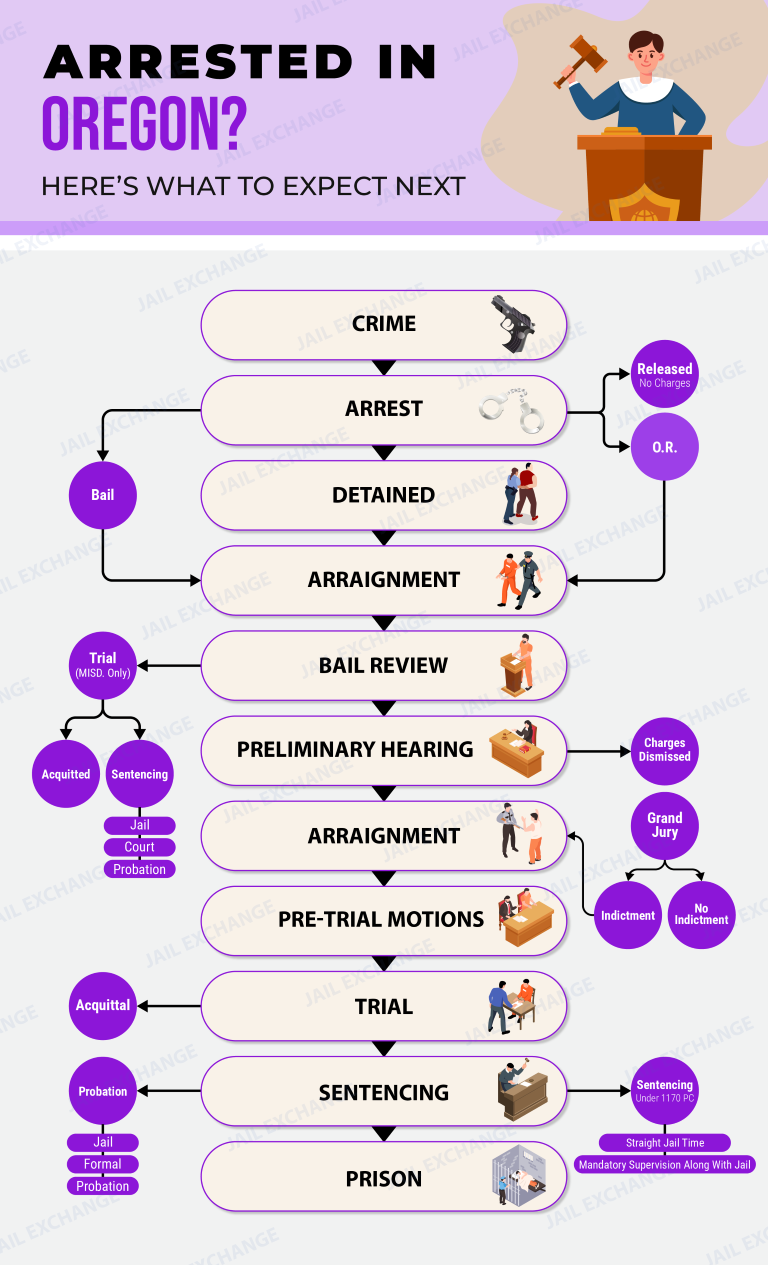
↑ Back to the question list6. What are the stages of a Lane County felony case?
- First arraignment on a complaint, held at the jail. Release is settled here.
- Charging. Prosecutors take the case to a grand jury for an indictment, or a judge weighs the evidence at a preliminary hearing. If the person is jailed, that hearing must come within five court days (ORS 135.070). With no probable cause, the case is dropped and the person walks out (ORS 135.175).
- Second arraignment on the formal charge, with a new plea.
- Getting ready for trial: both sides swap evidence, file motions and may bargain.
- Trial. Twelve jurors must all agree to convict.
- Sentencing on Oregon's grid. One axis measures how serious the crime is. The other measures criminal history.
The ceiling for prison time:
- Class A felony: up to 20 years
- Class B felony: up to 10 years
- Class C felony: up to 5 years
Anyone given prison goes to the Oregon Department of Corrections. Short jail terms and probation are handled locally.
↑ Back to the question list7. Why are Measure 11 cases treated so strictly?
Oregon voters approved Measure 11 in November 1994. For listed crimes against people, it fixes a minimum prison term, and good behavior earns no time off. Murder means 25 years or more. Robbery and assault in the first degree each mean at least 90 months.
- Staying in jail. With murder or treason and clear proof, release must be refused. For other violent felonies, prosecutors may request a hearing aimed at keeping the person locked up (ORS 135.240).
- Victim contact. Domestic violence, sex crime and bias crime defendants are barred from reaching the victim, even with a relative as go-between (ORS 135.247).
- Plea deals. When a violent felony is charged, the victim gets a say before a plea bargain (Or. Const. art. I, § 42).
- Teens. SB 1008 sends 15 to 17 year olds with a Measure 11 charge to adult court only after a waiver hearing.
8. Who are the prosecutors and defenders here?
The prosecution. Oregon voters in every county choose their own District Attorney (ORS 8.610). This one works from 125 East 8th Avenue, Room 400, Eugene, OR 97401, 541-682-4261, open weekdays 8:00 a.m. to noon and 1:00 to 5:00 p.m. City prosecutors take the municipal court cases.
The defense. Court-appointed lawyers are funded by the Oregon Public Defense Commission. The steps:
- At arraignment, tell the judge you want a lawyer.
- Fill in the financial form. A screener reviews it, and the judge rules.
- A $20 application fee usually applies. It can be waived, and a later contribution may be ordered. Lack of money never blocks an appointment.
Defenders are in short supply statewide. When a jailed defendant has no lawyer a full week after the first hearing, the federal Betschart order generally means release on conditions. The case stays open. Families paying for their own attorney can get names from the Oregon State Bar referral line, 503-684-3763.
↑ Back to the question list9. How do I look up a Lane County case or court date?
Anyone can use OJD Records and Calendar Search at no charge and without signing up. It covers circuit court cases.
- Type the last name, then the first.
- Click into the case. You'll see the basics, the parties, hearings held and outcomes, but no filed documents.
- Upcoming dockets sit on the circuit court calendars page.
- Turn on text hearing reminders to avoid a missed date.
When the website is offline, public terminals at the courthouse still work. Clerks can give case facts over the phone, but no legal advice, at Criminal Case Info, 541-682-7692. For a fee, OJCIN OnLine shows the official register. Juvenile files are never public online. For city cases, call the city court that has them.
↑ Back to the question list10. Could an open warrant be out there?
Deputies and city officers serve warrants countywide. Phone the Sheriff's Office, 541-682-4150, to ask whether one exists, or look up the name on OJD's case portal. Wanted lists come from FBI Portland, the Marshals Service (15 Most Wanted) and the state prison system (Oregon DOC Most Wanted). Every warrant lists a release amount. To clear it, first get a lawyer's advice. Next, show up in person where the warrant was signed, or call there and request a hearing. For circuit court warrants, go to 125 East 8th Avenue, Eugene, OR 97401, or call 541-682-4020.
↑ Back to the question list11. How do federal prosecutions from Lane County unfold?
The Eugene Division of the U.S. District Court for the District of Oregon takes federal charges from around here. Its building: Wayne L. Morse U.S. Courthouse, 405 East Eighth Avenue, Suite 2100, Eugene, OR 97401.
- Federal prosecutors from the U.S. Attorney's Eugene branch sit upstairs in Suite 2400, 541-465-6771.
- A detention hearing sorts out where the defendant spends the months before trial (18 U.S.C. 3142).
- Federal detainees stay in the Marshals' custody until trial. Oregon's Marshals office: 1000 Southwest 3rd Avenue, Room 401, Portland, OR 97204, 503-326-2209. Housing may be a county jail on contract, or FCI Sheridan, 27072 Ballston Road, Sheridan, OR 97378, 503-843-4442.
- The Federal Public Defender, 859 Willamette St., Suite 200, Eugene, OR 97401, 541-465-6937, represents federal defendants who can't pay.
- Following sentencing, search the Federal Bureau of Prisons inmate locator.
12. Can an ICE request change the state case?
The criminal case moves forward on its own track. Here is where immigration comes in:
- ICE lodges its detainer, Form I-247A.
- Its request: custody for up to 48 hours after they would otherwise be released (8 CFR 287.7(d)).
- Oregon's sanctuary laws (ORS 181A.820 to 181A.829; HB 3265 of 2021) forbid the state's officers and jails from carrying out any immigration request a judge hasn't signed. So Oregon jails generally release people on schedule even when an ICE detainer is on file, and they don't give out release dates for immigration enforcement.
- Civil immigration arrests can't happen in an Oregon courthouse without a judge's signed warrant or order (HB 3265).
- ICE oversees Oregon from its Seattle Field Office. Its Portland office: 4310 S Macadam Ave, Suite 300, Portland, OR 97239, 503-326-4165.
- To locate someone ICE holds, use the ICE Online Detainee Locator.
Pleading guilty can hurt a noncitizen's status. Talk it through with the defense lawyer first.
↑ Back to the question list13. Which prison takes someone after sentencing?
Once a judge imposes prison, the Oregon Department of Corrections takes over. Intake at Coffee Creek Correctional Facility, 24499 SW Grahams Ferry Road, Wilsonville, OR 97070, lasts around a month for every new arrival. Women remain there. Men head to a different state prison.
- Find their location using the Oregon Offender Search.
- General questions: 503-945-9090.
- Facility details are on our Oregon state prisons page.
A county office apart from the jail supervises probation and life after prison: Parole and Probation Services, 2699 Roosevelt Blvd, Eugene, OR 97402, 541-682-3040.
↑ Back to the question list14. When a teenager is charged, what court is used?
The circuit court hears youth matters at the Juvenile Justice Center, 2727 Martin Luther King Jr. Blvd., Eugene, OR 97401. Detention on that campus is run by the county's Youth Services, 541-682-4700. Youths don't go to the adult jail.
- The county juvenile department serves ages 12 to 17, and a judge may place a youth on county probation.
- State-level youth lockups belong to the Oregon Youth Authority.
- Beginning in 2020, a Measure 11 charge against a 15 to 17 year old stays in juvenile court unless a waiver hearing moves it (SB 1008).
- Youth files are left out of the online court search.
Reach the District Attorney's Juvenile Division at 541-682-4702.
↑ Back to the question list15. How are Lane County crime victims protected?
Victims' rights are written into Oregon's Constitution (Or. Const. art. I, § 42; Or. Const. art. I, § 43). A few kick in automatically, for example speaking at sentencing or a release hearing. Others, like being told about hearings ahead of time, start only after a request.
- Victim Services Division, District Attorney's Office, 125 East 8th Avenue, Room 400, Eugene, OR 97401, 541-682-4523. Staff and volunteers work weekdays from 8:00 a.m. to 5:00 p.m. on court support and protective orders.
- Custody alerts: sign up with VISOR or call 855-691-6246. Registration can be anonymous.
- Money for crime costs: Crime Victims' Compensation, Oregon Department of Justice, 1162 Court St. NE, Salem, OR 97301, 800-503-7983. It can cover hospital bills, therapy and missed wages after violent crime, though not stolen or damaged property.
Information for this service is currently unavailable.

Access Secure Deposits (Smart Deposit) allows families and friends to securely transfer money directly into an incarcerated person's jail trust account using a debit or credit card. Deposited funds become immediately available for your loved one to purchase essential hygiene goods, over-the-counter medication, food items, and writing materials from the facility commissary.
Important: Inmate Banking Policies Vary by Facility
Once a person is booked and moved to a cell, facilities do not always allow cash drop-offs or phone payments directly to the jail. Some might and you should confirm this by calling the facility and asking. But if you do not register online and fund your loved one's trust account immediately, they may be forced to wait days or weeks for standard paper processing, leaving them without essential soap, clean undergarments, basic medical sundries or snacks.
Step-by-Step Instructions to Register and Access Service
- Obtain the inmate's legal first and last name, date of birth, and official six- to ten-digit Booking or Inmate ID number.
- Visit the official Access Corrections portal at www.accesscorrections.com or download the Access Corrections mobile app.
- Select the state and the exact detention facility or county jail where the inmate is currently housed.
- Add the inmate as a contact and confirm their identity from the facility roster.
- Enter your debit or credit card billing information, choose your deposit amount, review the facility processing fee, and submit your payment.
- Save and print your transaction confirmation number for verification.
What the Inmate Needs to Do
The inmate does not need internet access to receive your deposit. Once approved, the funds post directly to their facility account balance. The inmate can verify their balance at the dayroom kiosk or on their trust statement and start ordering items on the next designated commissary day.
Official Provider: Access Corrections / Keefe Group Official Website
Customer Service Telephone: 1-866-345-1884
Support Hours: 24/7/365
Supported Languages: English and Spanish
Other Services Provided by Access Corrections / Keefe Group
In addition to Access Secure Deposits (Trust Money), Access Corrections / Keefe Group provides several other communication, financial, and visitation services at participating correctional facilities:
- Digital Messaging & Photos: Send digital letters and pictures straight to the inmate's kiosk or tablet.
• Learn more on our website: Digital Messaging & Photos Guide | • Visit official vendor page: Access Corrections / Keefe Group Digital Messaging & Photos - Commissary Care Packages: Order pre-approved food boxes, thermal clothes, and snack bundles directly to the jail.
• Learn more on our website: Commissary Care Packages Guide | • Visit official vendor page: Access Corrections / Keefe Group Commissary Care Packages
Deposit Money for an Inmate in the Springfield Municipal Jail
Free is possible at the Springfield Municipal Jail, 344 A Street in Springfield. Of the four ways to fund a trust account, two can cost nothing.
The first is cash at the jail lobby, which carries no fee; the lobby also takes a money order or a cashier's check. The second is the mail, also free: send a money order or cashier's check to Springfield Municipal Jail, 344 A Street, Springfield, OR 97477, with the person's name on it. The jail doesn't say whose name belongs on the payee line, so ring 541-744-4177 before you fill it in.
The other two use a card through Access Corrections, online at Access Corrections or by phone at 866-345-1884. The fee depends on the amount:
- Under $20: $2.95 online, $3.95 by phone
- $20 to $99.99: $5.95 online, $6.95 by phone
- $100 to $199.99: $7.95 online, $8.95 by phone
- $200 to $300: $9.95 online, $10.95 by phone
Once it posts, the money is the person's, though the City can claim part of it for fees they owe. The rest is handed back when they're released.
Information for this service is currently unavailable.

NCIC Inmate Communications provides telecommunications services that allow incarcerated individuals to place outbound voice calls from dayroom telephones to family and friends. Because correctional facilities do not permit incoming phone calls, establishing an NCIC prepaid calling account connects calls directly to your cell phone or landline without being blocked by wireless carriers.
Important: Mobile Phones Automatically Block Inmate Calls
Cellular phone carriers automatically reject standard collect calls originating from jail phone systems. While some residential landlines might permit direct monthly billing, mobile devices and internet-based telephone lines require an active prepaid calling balance, which you can verify by checking with your provider. If you do not register online and fund an NCIC account right away, your loved one will receive an automated disconnect announcement when attempting to call your number.
Step-by-Step Instructions to Register and Fund an Account
- Visit account.ncic.com or call NCIC customer care at 1-800-943-2189.
- Click Create Account and register using the primary 10-digit telephone number where you want to receive calls.
- Select the state and correctional facility where your loved one is currently detained.
- Search for and add the inmate using their full legal name or booking ID number.
- Select your deposit dollar amount and enter your debit or credit card billing details.
- Submit payment and ensure your mobile phone settings allow calls from automated or unfamiliar correctional numbers.
What the Inmate Needs to Do
The inmate dials your 10-digit number from any dayroom telephone and keys in their assigned PIN. The automated system verifies that your phone number has an active prepaid balance and prompts you to press a digit to accept the call. All personal telephone conversations are recorded and monitored by facility staff.
Official Provider: NCIC Official Website
Customer Service Telephone: 1-800-943-2189
Support Hours: 24 hours a day, 7 days a week, 365 days a year
Supported Languages: English and Spanish
Other Services Provided by NCIC Inmate Communications
In addition to Prepaid Phone Calling, NCIC provides several other digital communication and visitation services at participating facilities:
- Remote Video Visitation: Schedule and join live face-to-face video visits from home using your computer or smartphone.
• Learn more on our website: Video Visitation Guide | • Visit official vendor page: NCIC Video Visits - Inmate Messaging Services: Send electronic messages and photos directly to an inmate's housing unit terminal.
• Learn more on our website: Inmate Messaging Guide | • Visit official vendor page: NCIC Messaging
Information for this service is currently unavailable.
Information for this service is currently unavailable.
Lane County County Jails
Lane County City Jails
Lane County Juvenile Facilities
Nearby counties
- Jail (Main): 541-682-4263
- Adult Probation: 541-682-3040
- Eugene Police: 541-682-5111
- Jail Administration: 541-682-3729
- Juvenile: 541-682-4700
- Juvenile Probation: 541-682-3040
- Public Defender: 541-484-2611
- Sheriff: 541-682-4150
The Springfield Municipal Jail serves the following cities and towns of Lane County: Coburg, Cottage Grove, Creswell, Dunes City, Eugene, Florence, Junction City, Lowell, Oakridge, Springfield, Veneta and Westfir.