
Sheriff Al Cannon Detention Center
Sheriff Al Cannon Detention Center
Detention Center
843-202-7200Charleston County Inmate Search: Locating Someone at the Leeds Avenue Jail
Adults booked anywhere in Charleston County go to the Sheriff Al Cannon Detention Center, 3841 Leeds Ave., North Charleston, SC 29405. Tower A, the oldest part, has eight housing units, a library and training rooms. Towers B and C have 21 more units, the lobby, video visiting, medical care and an infirmary. Youths stay at a separate juvenile center off the main grounds.
The Sheriff's inmate lookup works from a range of arrest dates and can include people already let go. Each record gives charge details, booking status, a release date and earlier bookings. A very fresh arrest might not appear until booking wraps up.
Phone the jail at 843-202-7200. Give the inmate's legal name plus birth date. Next, ask about booking status, the charges and the bond court time. Our bail page spells out bonding out, while our court page tracks each hearing.
Read inmate search answers
 Read inmate search answers
1. What are the steps in the Charleston County inmate lookup?
The lookup runs on the county's own website. To use it:
- Go to the inmate lookup.
- Tick the box that proves you are a person, not a robot.
- Pick a start and end date that covers the day of the arrest.
- To find someone who may have left already, choose the option that adds past inmates.
- Open the matching record. It lists each charge, the booking status, any release date and past bookings.
- Write down the ID number. Staff and mail both use it.
The page also shows how many men and women are in the jail that day. A listing is not proof of guilt, and the county says so on the page.
↑ Back to the question list2. What if the date search shows nobody by that name?
Several things can leave the results empty:
- Still in booking. Records appear only after intake ends.
- The date range is too narrow. Widen it by a day on each side.
- They are out. Bond court sits several times a day, so release can be quick. Add past inmates to the search.
- The arrest was across a county line. Neighbors in Berkeley, Dorchester or Colleton counties run their own jails.
- They are under 18. Teens go to the Sheriff's separate juvenile center.
- A federal agency made the arrest. Federal prisoners are placed wherever the U.S. Marshals arrange.
Staff can check by phone at 843-202-7200. If that line is tied up, the second main number is 843-202-7222.
↑ Back to the question list3. Which tower or nearby jail could be holding them?
All adults from this county are held at one campus, 3841 Leeds Ave., North Charleston, SC 29405, 843-202-7200. Its parts serve different jobs:
- Tower A. The original 1966 building. It holds eight housing units, the library and staff training space.
- Towers B and C. Offices, the control center, kitchen, laundry, lobby, visiting space and medical unit. They also hold 21 direct-supervision housing units, where an officer works inside the unit, and a state-licensed infirmary.
- Charleston County Juvenile Detention Center. A Sheriff's Office facility off the main campus for youths. For its address and visiting rules, call the Sheriff's Office at 843-202-1700.
The old Work Camp and the modular housing units closed in 2020. Ask the jail which tower a person is in, since that can change.
Arrests close to the Berkeley, Dorchester, Colleton or Georgetown line may end up in those jails:
- Hill-Finklea Detention Center (Berkeley County), 300 California Ave., Moncks Corner, SC 29461, 843-719-4546
- Dorchester County Detention Center, 220 Hodge Road, Summerville, SC 29483, 843-832-0215
- Colleton County Detention Center, 22 Klein Street, Walterboro, SC 29488, 843-549-5742
- Georgetown County Detention Center, 2394 Browns Ferry Road, Georgetown, SC 29442, 843-545-3400
4. Are Charleston County mugshots part of the lookup?
The lookup is built around charges, booking status and release dates. The Sheriff's Office handles booking photo questions at 843-202-1700. South Carolina treats jail rosters as public records (S.C. Code 30-4-30(D)(3)).
- A website that posts mugshots must take one down for free within 30 days. That rule applies after a dismissal, an expungement or a not guilty verdict. The request goes by certified mail with proof (S.C. Code 17-1-60).
- Federal agencies seldom release booking photos. A U.S. Marshals notice about a fugitive is the main exception.
- Immigration booking photos can be sought in writing through the ICE records request page online.
5. Will VINELink tell me if they leave Leeds Avenue?
Yes. VINELink South Carolina tracks custody status and location, so it tells you where someone is held as well as when they leave. Alerts are free. The same service answers by phone at 866-727-2846, in English or Spanish.
On VINELink, search by name or by an offender or SID number. Once a person moves to state prison, the Department of Corrections Division of Victim Services also sends release notices. Its line is 803-896-1733, and sign-up is by a mailed form.
↑ Back to the question list6. How does release from the Leeds Avenue jail work?
Most people see a magistrate at Centralized Bond Court within 24 hours (S.C. Code 22-5-510). It sits at 3831 Leeds Avenue, Suite 200, North Charleston, SC 29405, at 10 a.m., 2 p.m. and 6 p.m. on weekdays. On weekends and holidays it sits at 10 a.m. and 2 p.m. Ring the magistrates' office at 843-202-6600 with questions.
- For charges that can't bring death, the judge starts from release on a signed promise (S.C. Code 17-15-10).
- The judge may set a cash or surety bond, order a GPS monitor or add rules like no contact with a victim.
- Murder, and other charges where death or life behind bars is possible, wait for a circuit judge to set bond.
- After the bond is posted, the jail has four hours to let the person go.
City of Charleston charges can be heard at the city's bond court on Lockwood Boulevard. Our bail and bond page explains bondsmen, payments and refunds.
↑ Back to the question list7. Where do I see the charges filed against them?
Start with the inmate lookup, which lists charge details on each booking. At bond court, the judge reads the charges out loud.
- The arresting agency must give the bond judge the person's record, open charges and incident reports (S.C. Code 22-5-510(E)).
- Crime reports that describe what happened and where are public in South Carolina (S.C. Code 30-4-50(A)(8)). Request a copy from the arresting agency.
- For felony charges that move up to General Sessions, the Clerk of Court can help at 843-958-5000.
8. How does someone held on Leeds Avenue get a lawyer?
A person who can't afford counsel can ask the bond judge for a public defender. They swear to their finances in writing, and a $40 fee applies unless the clerk waives or lowers it (S.C. Code 17-3-30).
- Public Defender for this county: 101 Meeting Street, 5th Floor, Charleston, SC 29401, 843-958-1850.
- Lawyers may meet clients in person at the jail Monday to Friday, except county holidays. Times are 9 to 11 a.m., 1:30 to 4 p.m. and 7 to 10 p.m.
9. How do Charleston County jail visits work?
Personal visits here are video visits only, booked through the vendor's website after you make an account. Rules from the detention center:
- The person must be held 72 hours before a first visit.
- Each person can have up to three 30-minute visits in any 7-day stretch.
- Visit times: 8:00 to 10:50 a.m., 1:00 to 4:25 p.m. and 7:00 to 10:00 p.m. The last start times you can book are 10:20 a.m., 3:55 p.m. and 9:30 p.m.
- A parent or legal guardian has to join any visitor age 16 or younger.
- Out-of-state visitors who show an out-of-state photo ID may get one visit without booking, if a slot is open.
- A dress code applies. Tank tops, halter tops and see-through clothing are turned away.
Our visitation guide walks through setting up an account. For questions, call 843-202-7200.
↑ Back to the question list10. How do I fund a Charleston County inmate account?
The jail is cashless, so money goes in through one of three channels:
- Lobby kiosk at 3841 Leeds Ave., North Charleston, SC 29405.
- Online through the deposit website the jail names, using site number 229405.
- Mailed money order. The payee is the Sheriff Al Cannon Detention Center. The memo line carries the inmate's name plus ID#. Send it to: Inmate Name and ID#, Charleston County Detention Center, 3841 Leeds Avenue, North Charleston, SC 29405.
Mailed cash or personal checks get turned away. Money that arrives before 8:00 a.m. Monday can be spent on that week's canteen order, which is capped at $100 a week. Our money deposit guide and commissary guide have more detail.
↑ Back to the question list11. Phones, tablets and e-messages on Leeds Avenue: what are the rules?
At booking, the person gets one free local call. After that, calls go out collect through the jail's phone company. Its customer service line is 800-844-6591 for setting up an account.
- Tablets cost a $5.00 subscription that lasts 30 days. Not every person in custody has one.
- Messages use stamps: one stamp, at $0.25, sends text. Two stamps add a photo, and three add a video.
- Tablets also offer e-books, classes, a law library and media.
Leave case details for conversations with the lawyer. Our jail call guide and inmate messaging guide cover sign-up steps.
↑ Back to the question list12. Where does mail for an Al Cannon inmate go?
Letters and cards are sent to a digital mail center in Tampa, Florida, not to Leeds Avenue. The jail stopped taking personal mail on site on May 1, 2023. Address it like this:
- Incarcerated Individual and ID#
- Charleston, SC County Jail
- C/O Securus Digital Mail Center
- PO Box 20207, Tampa, FL 33622
Each page is scanned so the person can read it on a tablet. Photos and drawings are fine. Send paper only, letter size (8.5 by 11 inches) or smaller. Packages and certified mail go back to the sender. Originals are destroyed 60 days after upload, unless you include a stamped envelope addressed to yourself.
Food, clothes, books, magazines, newspapers, toiletries, stamps, cash, checks, musical cards and Polaroids are all refused. People without money get two free letters a week. See our jail mail guide for tips.
↑ Back to the question list13. When can family collect property from the jail lobby?
Property and cash come back at the jail lobby, 3841 Leeds Ave., North Charleston, SC 29405. Release hours run every day from 7:30 a.m. to 4:30 p.m. and from 7:30 p.m. to 4:30 a.m.
- To hand items to family, the person in custody signs a Valuable Property/Cash Release Form.
- Checks are written in the name of the person in custody.
- After any money on the account has been used, staff release cash only to bondsmen or lawyers.
- Bring a government photo ID.
Call 843-202-7200 before you drive over to ask what is being held.
↑ Back to the question list14. Who handles medical care inside the Charleston County jail?
Towers B and C house the jail's medical unit and an infirmary licensed by the state health agency. By law, the county must give people in jail food, water, clothing and access to medical care (S.C. Code 24-5-80).
For a health worry, call 843-202-7200 and ask for medical. Have the drug name, dose and prescribing doctor's number ready. Tell staff at once if self-harm or a mental health crisis is a worry. For a life-threatening emergency, dial 911.
↑ Back to the question list15. How do I check for a Charleston County warrant?
Deputies serve warrants in unincorporated areas and towns without police, and city officers serve them in town. The Sheriff's online warrant search is the first place to look. For a phone check, call the Sheriff's Office at 843-202-1700 and ask for warrants. Also review the state probation agency's most wanted offenders and the national 15 Most Wanted fugitives. A bench warrant ends when the person, ideally with a lawyer, turns in to the issuing court or gets a new date from it. General Sessions warrants go through the Clerk of Court, 100 Broad Street, Suite 106, Charleston, SC 29401, 843-958-5000.
↑ Back to the question list16. Which court office has their next hearing date?
Magistrates, city judges and the circuit court each run separate calendars. Pick the right office:
- Magistrate cases and preliminary hearings: Summary Court office, 4045 Bridge View Drive, Suite B143, North Charleston, SC 29405, 843-202-6600.
- Felonies in General Sessions: Clerk of Court, 100 Broad Street, Suite 106, Charleston, SC 29401, 843-958-5000.
- City cases: Municipal Court, 180 B Lockwood Boulevard, Charleston, SC 29403, 843-724-7460.
The inmate lookup also links to South Carolina's court records search. Our court process page follows a case from bond court to sentencing.
↑ Back to the question list17. Where is a federal defendant from Leeds Avenue housed?
U.S. Attorneys file local federal cases in the Charleston Division of the U.S. District Court for the District of South Carolina, at the J. Waties Waring Judicial Center, 83 Meeting Street, Charleston, SC 29401, 843-579-1401.
- A federal judge chooses jail or release for the time the case is pending. The ruling is made at the opening federal hearing (18 U.S.C. 3142).
- Pretrial housing is arranged by the U.S. Marshals, who may use a local jail. Their office is at 85 Broad Street, Room 260, Charleston, SC 29401, 843-727-4255.
- After a prison sentence, search the Federal Bureau of Prisons inmate locator by name or register number.
18. What happens when ICE lodges a detainer here?
A paid bond does not stop an immigration detainer. The usual order:
- Leeds Avenue staff log Form I-247A, which is how ICE asks them to keep someone.
- Staff may keep the person up to 48 hours after they would otherwise be released (8 CFR 287.7(d)).
- Agents arrive during those 48 hours to take the person.
- Use the ICE Online Detainee Locator. Type the name and native country, or an A-number.
Under state law, the jail checks the immigration status of anyone held on a criminal charge within 72 hours. Homeland Security is told about anyone found to be here unlawfully (S.C. Code 23-3-1100). Bond judges must also factor in unlawful presence and flight risk (S.C. Code 22-5-510(D)(4)). The ICE office serving South Carolina is at 3950 Faber Place Drive, North Charleston, SC 29405, 843-746-9800.
↑ Back to the question list19. Which search shows someone in an SCDC prison?
Sentences over three months are served under the South Carolina Department of Corrections (S.C. Code 24-3-20). Shorter ones usually stay at the county jail.
- Every new state prisoner goes through reception and evaluation first. No in-person visits happen then, unless that stage runs past 30 days.
- The person then moves to an assigned prison.
- Search the state inmate search. It shows people in state prisons as of midnight the night before, not county inmates.
- Headquarters: 4444 Broad River Road, Columbia, SC 29210, 803-896-8500. SC VINE line for custody alerts: 866-727-2846.
- Since November 3, 2025, only people on the approved visitor list can put money on a state prisoner's account.
- Our South Carolina prison directory covers each facility.
20. Where is a youth under 18 taken?
Children under 18 are handled by Family Court, except 17-year-olds charged with the most serious felonies (S.C. Code 63-19-20(1)). Adult jails can hold a youth for no longer than six hours, and no child 10 or under is ever jailed (S.C. Code 63-19-820).
- Local youths stay at the Charleston County Juvenile Detention Center, which the Sheriff's Office runs. To reach it, phone 843-202-1700.
- A judge reviews the detention within 48 hours, weekends and holidays aside (S.C. Code 63-19-830).
- The state Department of Juvenile Justice keeps a local office at 3887 Leeds Ave., North Charleston, SC 29405, 843-740-1649.
21. Which Charleston County department or agency arrested them?
The arresting agency can tell you why the person was picked up. Many local departments share a 24-hour non-emergency dispatch line, 843-743-7200.
County-wide
- Sheriff's Office, non-emergency 843-202-1700. Deputies patrol unincorporated areas and towns with no police force, such as Seabrook Island.
- South Carolina Highway Patrol, Troop 6, 2070 Northbrook Blvd, Suite A-20, North Charleston, SC 29406, 843-953-6000.
City and town police
- Charleston Police Department, 180 Lockwood Blvd., Charleston, SC 29403, front desk 843-577-7434.
- North Charleston Police Department, City Hall, 2500 City Hall Lane, North Charleston, SC 29406. Central Bureau 843-740-2812, South Bureau 843-308-4718, North Bureau 843-207-0666.
- Mount Pleasant Police Department, 100 Ann Edwards Lane, Mount Pleasant, SC 29464, 843-884-4176. The lobby is open 24 hours.
- Isle of Palms Police Department, 30 J.C. Long Boulevard, Isle of Palms, SC 29451, 843-886-6522.
- Folly Beach: City Hall, 21 Center St., Folly Beach, SC 29439, 843-588-2447. Ask for the police department.
For an arrest in James Island, Sullivan's Island, Kiawah Island, Hollywood, Ravenel, Lincolnville, McClellanville, Awendaw, Meggett or Rockville, call county dispatch. Staff will connect you with the agency that patrols there.
Campus police
- The Citadel Public Safety, 208 Richardson Ave., Charleston, SC 29409, 843-953-5114.
- CofC Public Safety, 89 St. Philip Street, Charleston, SC 29424, 843-953-5609.
- Medical University of South Carolina, 171 Ashley Avenue, Charleston, SC 29425. Call the main line, 843-792-2300, and ask for public safety.
Charleston County Bail and Release
When police arrest an adult in Charleston County, booking happens at the Sheriff Al Cannon Detention Center, 3841 Leeds Ave., North Charleston, SC 29405, which the Sheriff's Office runs. Tower A holds eight housing units, and Towers B and C hold 21 more, plus the lobby, medical care and an infirmary. Youths go to a separate juvenile center off the main campus. Below you will learn about bond court, bond types, paying, bondsmen and refunds.
Step one is checking custody. The Sheriff's inmate lookup lets you search a range of arrest dates. Our Jail Roster page deals with the arrest itself: fresh bookings, the counts filed, warrants still open, booking photos, court-appointed lawyers and claiming belongings at release.
Next, phone the jail at 843-202-7200. Have the birth date handy along with the legal name, then ask about the charges, whether a bond has been set and which bond court session is next. After release, our court page shows how the case moves on.
1. Who sets bond after a Charleston County arrest?
A magistrate sets it at Centralized Bond Court, 3831 Leeds Avenue, Suite 200, North Charleston, SC 29405. That is on the same street as the jail. The magistrates' main office answers at 843-202-6600. Hearings run on a fixed schedule:
- Monday through Friday at 10 a.m., 2 p.m. and 6 p.m.
- Saturday, Sunday and holidays at 10 a.m. and 2 p.m.
State law says every person arrested gets a bond hearing within 24 hours (S.C. Code 22-5-510). The judge reads the charges and sets the bond and any rules. Nobody enters a plea at this stage, and victims may attend and speak. After the bond reaches the jail, release must follow within four hours.
Cases brought by the City of Charleston can go to the city's own bond court instead, at 180 B Lockwood Boulevard, Charleston, SC 29403, 843-724-7460. It meets weekdays at 9:00 a.m. and 2:00 p.m., and at 8:30 a.m. and 10:30 a.m. on weekends and holidays. City judges have the power to set and accept bonds (S.C. Code 14-25-115).
↑ Back to the question list2. What kinds of bond are possible in South Carolina?
For any charge that can't bring death, the starting point is release on a written promise to return (S.C. Code 17-15-10). The judge moves away from that only if the promise seems unlikely to get the person back to court, or if someone would be at risk. The choices are:
- Personal recognizance. A signature is enough to leave. Nothing is paid unless they skip court.
- Cash bond. Someone pays every dollar of it up front. Instead of signing a recognizance, a person may deposit cash with the magistrate or city judge (S.C. Code 22-5-530).
- Surety bond. You hire a licensed bondsman, who pledges the whole sum to the court and keeps a fee for that promise.
- Ten percent deposit. With the judge's OK, a cash deposit worth no more than a tenth of the bond goes to the clerk of court. This is not allowed for violent charges, or for a gun felony charged while already on bond (S.C. Code 17-15-15).
- GPS monitor. A judge may order an ankle monitor in place of a money bond or on top of one (S.C. Code 17-15-35).
Every bond carries basic rules. The person must come to court, stay in South Carolina and stay out of trouble (S.C. Code 17-15-20). The judge can add more, like no contact with a victim.
↑ Back to the question list3. How much is bond for common Charleston County charges?
Bond is set one person at a time, so there is no price list. The magistrate weighs the charge, past convictions and the person's local ties. These groups show how the charge shapes the result:
- Small charges in summary court, with a top penalty of $500, 30 days or both. The law starts from a signed promise. In city cases, a surety bond can't be more than the highest fine.
- Third-degree assault and battery. The top penalty is $500, 30 days or both (S.C. Code 16-3-600(E)(2)).
- Shoplifting of $2,000 or less. Up to $1,000, 30 days or both, heard in a magistrate or city court (S.C. Code 16-13-110).
- Shoplifting worth more than $2,000. This is a felony. Under $10,000, the cap is five years. At $10,000 and up, it is ten years.
- Other felonies. The class sets the top prison term, from 5 years for Class F to 30 years for Class A (S.C. Code 16-1-20).
- Violent crimes on the state list. A magistrate may set a bond or refuse one (S.C. Code 16-1-60).
- Murder and other charges that can bring death or life. Only a circuit judge can set bond.
To learn the exact amount once bond court ends, phone the jail at 843-202-7200.
↑ Back to the question list4. Bonding someone out at the Leeds Avenue jail: what's the process?
The jail stands at 3841 Leeds Ave., North Charleston, SC 29405. Work through these steps:
- Call 843-202-7200. If the line is busy, try the other main number, 843-202-7222.
- Ask for the bond amount, the bond type and every charge it covers.
- Ask where the money is taken: at the jail, the bond court or the clerk of court. Also ask which kinds of payment are accepted and who the payee should be.
- For a surety bond, call a licensed bondsman. The bondsman files the paperwork with the court.
- Carry photo ID and the precise amount. Hold on to each receipt.
Under state law, the person should walk out within four hours after the bond is in (S.C. Code 22-5-510). The main entrance has a metal detector and a bag scanner, so leave anything sharp at home.
↑ Back to the question list5. Can a court window take the bond instead?
Yes, and the right office depends on which court has the case.
- City of Charleston Municipal Court, 180 B Lockwood Boulevard, Charleston, SC 29403, 843-724-7460. The cashier window takes fines and bonds Monday to Friday, 8 a.m. to 5 p.m. Clerks there take cash, certified checks, money orders and cards. Personal checks are refused. By mail, the city wants a money order or cashier's check in its name. Questions can also go to bondcourt@charleston-sc.gov.
- Magistrate cases go through the Summary Court office, 4045 Bridge View Drive, Suite B143, North Charleston, SC 29405, 843-202-6600. Ask there how a cash bond is paid and where.
- Ten percent deposits go to the Clerk of Court, 100 Broad Street, Suite 106, Charleston, SC 29401, 843-958-5000. The office is open Monday to Friday, 8:30 a.m. to 5 p.m.
6. Which payments do the courts and jail take?
Cash, money orders and cashier's checks are the safest choices. Phone ahead before relying on a card. The city court window is the clearest case. It takes cash, certified checks, money orders and cards, but never a personal check.
The county has a card payment portal for magistrate courts. It is built for tickets, fines and bench warrants, not for bonding someone out of jail. It adds a $1.00 portal fee plus 1.7 percent and does not take part payments. Posting may take as long as 72 hours.
For a jail bond, ask the jail at 843-202-7200 which payments it takes before you drive over. Never send cash in the mail.
↑ Back to the question list7. What can a South Carolina bondsman charge?
The South Carolina Department of Insurance licenses every bondsman and runner. State law caps what they charge (S.C. Code 38-53-170(e)):
- The fee, called a premium, can't be more than 15 percent of the bond.
- The minimum fee is the larger of $100 or a tenth of the bond.
- Installment plans start with at least $100 down and must be paid off within 18 months.
- That premium is what the bondsman earns. Even dropped charges won't get it refunded.
- Collateral goes back to you no later than ten days after the bondsman's duty ends, as long as no bench warrant is out.
- Missing a premium payment, by itself, is not enough reason to turn the person back in (S.C. Code 38-53-50(B)).
Soliciting business at a courthouse, magistrate's office or jail is against the rules for bondsmen. So is steering you to a particular attorney. To check a license, call the department's licensing staff at 803-737-0719. To complain, contact the South Carolina Department of Insurance, 1201 Main Street, Suite 1000, Columbia, SC 29201, 803-737-6160.
↑ Back to the question list8. What keeps someone in the Charleston County jail after bond?
A bond covers only its own charge. Before you pay, ask the jail at 843-202-7200 to read you every hold. Common ones:
- A second case. A city charge and a magistrate charge each need their own bond.
- A warrant from somewhere else. Another county or state may want the person first.
- Probation or parole. An alleged violation of supervision can add its own hold. The Charleston office of Probation, Parole and Pardon Services is at 1357 Remount Road, Suite 7, North Charleston, SC 29406, 843-740-1553.
- A charge only a circuit judge can bond. The person waits for that hearing.
- A new violent or gun felony while on bond. The first bond is revoked by law, with a circuit court hearing within 30 days (S.C. Code 17-15-55(C)).
- A federal or immigration hold. State bond does not end either one.
9. When can a judge in South Carolina refuse bond?
Under the state constitution, most people can get bail, and the amount may not be excessive (S.C. Const. art. I, § 15). A judge may still deny it for three groups of charges, after weighing the proof:
- crimes that can bring the death penalty
- crimes that can bring life in prison
- violent crimes named in state law, such as armed robbery, kidnapping, carjacking and first- or second-degree burglary (S.C. Code 16-1-60)
The judge must look at the person's record, other open cases, any bond they are already out on, gang database listing, and unlawful presence in the country with risk of flight (S.C. Code 17-15-30). Family ties, work, money and past missed court dates count too. Committing a violent crime while on bond for another one counts as a separate felony carrying as much as five years (S.C. Code 17-15-270).
Prosecutors who argue about bond work for the Ninth Circuit Solicitor's Office, O.T. Wallace Building, 101 Meeting Street, Charleston, SC 29401, 843-958-1900.
↑ Back to the question list10. Can a lawyer get the bond lowered?
Either side can ask a judge to change the bond or its rules, after notice and a hearing (S.C. Code 17-15-50). Here is the usual path:
- A defense lawyer files a motion to reduce or change the bond.
- For magistrate cases, the Centralized Preliminary Hearing Court may hear it. It sits daily at 3831 Leeds Avenue, Suite 100, North Charleston, SC 29405, 843-202-6600.
- For General Sessions charges, a circuit judge can review a bond that a magistrate set (S.C. Code 17-15-55). File through the Clerk of Court, 100 Broad Street, Suite 106, Charleston, SC 29401, 843-958-5000.
- Bring proof of a job, a home, family ties and what you can truly pay.
- Suggest conditions that ease the judge's concern, like wearing a GPS monitor (S.C. Code 17-15-35).
The state can also ask for an emergency hearing to raise or revoke a bond. A circuit judge must hold it within 48 hours.
↑ Back to the question list11. Who can get a public defender in Charleston County?
A person too poor to hire an attorney gets one appointed, unless they turn it down (S.C. Code 17-3-10). They swear to their income and debts on a form, and a $40 application fee applies. The clerk may lower or waive the fee for someone who can't pay (S.C. Code 17-3-30). For a child, the parent signs and owes the fee.
The local office belongs to the Ninth Circuit, which serves Charleston and Berkeley counties (S.C. Code 17-3-510):
- Public Defender, 101 Meeting Street, 5th Floor, Charleston, SC 29401, 843-958-1850
- South Carolina Commission on Indigent Defense, 1330 Lady Street, Suite 401, Columbia, SC 29201, 803-734-1343
Ask about the form at bond court, or call the office the next business day.
↑ Back to the question list12. Which courts handle Charleston County cases?
Most first hearings happen near the jail. Later steps move downtown.
- Magistrate courts, one phone for all three, 843-202-6600: Centralized Bond Court, 3831 Leeds Avenue, Suite 200, North Charleston, SC 29405; Centralized Preliminary Hearing Court, 3831 Leeds Avenue, Suite 100, North Charleston, SC 29405; and the Summary Court office, 4045 Bridge View Drive, Suite B143, North Charleston, SC 29405.
- Court of General Sessions, Clerk of Court, 100 Broad Street, Suite 106, Charleston, SC 29401, 843-958-5000. Felonies and serious misdemeanors.
- Family Court, 100 Broad Street, Suite 143, Charleston, SC 29401, 843-958-4400. Charges against children.
- City of Charleston Municipal Court, 180 B Lockwood Boulevard, Charleston, SC 29403, 843-724-7460.
- Mt. Pleasant Municipal Court, 100 Ann Edwards Lane, Mt. Pleasant, SC 29464, 843-884-6796
- Sullivan's Island Municipal Court, 2056 Middle Street, Sullivan's Island, SC 29482, 843-883-5734.
- Federal court, J. Waties Waring Judicial Center, 83 Meeting Street, Charleston, SC 29401, 843-579-1401.
Other towns also handle their own tickets. For a town case, call the Summary Court office to learn which court has it.
↑ Back to the question list13. How is bond money returned, and when is it lost?
Cash left with a court is paid back after it has served its purpose, which in practice means the case has closed and the person made every hearing (S.C. Code 17-15-220). A 10 percent deposit is returned after the bond rules are met, minus any restitution the judge ordered (S.C. Code 17-15-15). The bondsman's premium is never refunded.
Skipping court puts the money at risk:
- The judge issues a bench warrant.
- On a felony, willfully missing court can bring up to $5,000 and five years. On a misdemeanor with a top term of a year or more, it can bring up to $1,000 and one year (S.C. Code 17-15-90).
- If the person is still missing 90 days after the bench warrant, a surety bond is forfeited (S.C. Code 38-53-70).
- A judge may forgive part or all of a forfeited bond when the miss was not on purpose (S.C. Code 17-15-180).
To get money back, call the court that took it. For General Sessions cases, that is the Clerk of Court at 843-958-5000.
↑ Back to the question list14. How are cash and belongings picked up at release?
The jail hands back property and cash every day during two windows, 7:30 a.m. to 4:30 p.m. and 7:30 p.m. to 4:30 a.m. Go to 3841 Leeds Ave., North Charleston, SC 29405.
- The person in custody must sign a Valuable Property/Cash Release Form before anything goes to you.
- Any check is written to the person in custody, not to you.
- After any money has been spent or moved on the person's jail account, the jail stops handing out cash from it. A bondsman or a lawyer is the only exception.
- Bring a photo ID.
Call 843-202-7200 first to ask what is waiting. Our inmate account guide explains deposits and leftover balances.
↑ Back to the question list15. Who handles bond in a Charleston County federal case?
Federal charges brought against someone from this county are filed in the Charleston Division of the U.S. District Court for the District of South Carolina. That division also covers Berkeley, Clarendon, Colleton, Dorchester and Georgetown counties. The court sits at the J. Waties Waring Judicial Center, 83 Meeting Street, Charleston, SC 29401, 843-579-1401, open weekdays from 8:30 a.m. to 4:30 p.m.
- At the first federal appearance, the judge weighs jail against release (18 U.S.C. 3142). Postponing it is allowed, five days at most when defense counsel asks and three when federal prosecutors ask.
- Before trial, U.S. Marshals hold the person. Reach their local office at 85 Broad Street, Room 260, Charleston, SC 29401, 843-727-4255, to learn where the person is housed.
- When a prison term is handed down, use the Federal Bureau of Prisons inmate locator.
16. Will ICE still hold them after bond is posted?
Yes, it can. Posting bond settles only the state charge. Federal immigration officers work on their own track:
- Leeds Avenue staff get a detainer on Form I-247A, signed by an officer of Immigration and Customs Enforcement (ICE).
- Staff there may hold the person up to 48 hours after they would otherwise be released (8 CFR 287.7(d)).
- Federal agents then come to Leeds Avenue to take custody.
- Look them up in the ICE Online Detainee Locator. Enter the legal name plus the nation where they were born, or use their A-number.
State law goes further. When someone is jailed on a criminal charge, staff have 72 hours to find out if that person is in the U.S. unlawfully. If so, they must alert the Department of Homeland Security (S.C. Code 23-3-1100). A bond judge must also consider whether the person is here unlawfully and likely to flee (S.C. Code 22-5-510(D)(4)). ICE's South Carolina office is at 3950 Faber Place Drive, North Charleston, SC 29405, 843-746-9800.
↑ Back to the question list17. What follows a sentence longer than three months?
A term no longer than three months normally stays local, in the county jail (S.C. Code 24-3-30). Longer sentences go to the South Carolina Department of Corrections, which picks the place (S.C. Code 24-3-20).
- New state prisoners start with reception and evaluation. No in-person visiting happens during that step unless it runs beyond 30 days.
- Afterward, the department assigns a permanent prison.
- Use the SCDC inmate search. It shows people in state custody as of midnight the day before.
- The department is at 4444 Broad River Road, Columbia, SC 29210, 803-896-8500. The separate SC VINE line, 866-727-2846, sends custody alerts.
- See our South Carolina prisons guide for each facility.
18. Where does a teen arrested here end up?
Family Court treats people younger than 18 as children. One group is left out: 17-year-olds facing a top-tier felony (Classes A to D) or a felony with a 15-year-plus maximum (S.C. Code 63-19-20(1)). Here, youths are held at the Charleston County Juvenile Detention Center, a division of the Sheriff's Office set apart from the main jail. To reach it, call the Sheriff's Office at 843-202-1700.
- Holding a child in an adult lockup is capped at six hours. Children age 10 and under may never be locked up (S.C. Code 63-19-820).
- A judge holds a detention hearing within 48 hours, and Saturdays, Sundays and holidays don't eat into that time (S.C. Code 63-19-830).
- Teens aged 14 to 16 facing serious felonies can have the case moved up to General Sessions following a hearing (S.C. Code 63-19-1210).
- The Department of Juvenile Justice office is at 3887 Leeds Ave., North Charleston, SC 29405, 843-740-1649.
Online family video visits at Sheriff Al Cannon Detention Center
Personal visits are online only. Set up an account through Securus and select the adult Sheriff Al Cannon Detention Center in North Charleston. The Sheriff requires the person to have been in custody at least 72 hours. General population residents may have up to three visits per seven calendar days, up to 30 minutes each. The policy allows no more than two visitors at once. Visitors under 17 must be accompanied by a parent or guardian.
Daily personal video windows (Eastern)
- 8:00–10:50 a.m.; last start 10:20 a.m.
- 1:00–4:25 p.m.; last start 3:55 p.m.
- 7:00–10:00 p.m.; last start 9:30 p.m.
Schedule through Securus, use the times displayed for the person, and confirm the price before paying. Attorney visits follow a separate in-person schedule. Use the Sheriff’s visiting information or call 843-529-7300 for facility questions.

Securus Video Connect allows families to conduct scheduled face-to-face video visits with incarcerated loved ones from home. Using a computer with a webcam or the Securus mobile app, visitors can join live video sessions without traveling to the facility or waiting in jail visitor lobbies.
Important: Advance Registration and Visitor Clearance Required
Detention centers do not permit unscheduled or unverified video sessions. Correctional facilities require prospective visitors to submit government-issued photo identification and receive administrative clearance before booking an appointment, an approval process that can take up to 48 hours depending on facility staffing. You should verify your visitor approval status with the facility prior to scheduling. If you do not register well in advance, you will miss your loved one's scheduled visiting window for the week.
Step-by-Step Instructions to Register and Schedule a Video Visit
- Visit securustech.online or open the Securus mobile app.
- Register your account and upload a clear photograph of your government-issued ID (driver's license or passport) for facility background review.
- Wait for email confirmation indicating that facility administration has granted visitor approval.
- Select Schedule a Visit, choose your detention facility, and select the inmate.
- Browse the available schedule calendar, select an open 20- or 30-minute time slot, and pay the fee using a credit or debit card.
- Log into the website or app 10 minutes prior to the start time on a device with a functioning camera, microphone, and reliable high-speed internet connection.
What the Inmate Needs to Do
The inmate receives an alert on their housing unit video kiosk or personal tablet. At the scheduled time, they log in with their PIN and sit in front of the terminal. Inmates and visitors must strictly observe jail dress and conduct rules; sessions are monitored by staff and will terminate immediately upon any violation.
Official Provider: Securus Technologies Official Website
Customer Service Telephone: 1-800-844-6591
Support Hours: 24 hours a day, 7 days a week, 365 days a year
Supported Languages: English and Spanish
Other Services Provided by Securus Technologies
In addition to Securus Video Connect, Securus and its subsidiary JPay offer several other communication, financial, and visitation services:
- AdvanceConnect Prepaid Calling: Prepay for phone calling credits so your loved one can call your mobile phone directly.
• Learn more on our website: AdvanceConnect Calling Guide | • Visit official vendor page: Securus AdvanceConnect - Direct Bill Phone Calling: Establish an invoiced monthly billing account for qualified residential landlines.
• Learn more on our website: Direct Bill Phone Calling Guide | • Visit official vendor page: Securus Direct Bill - JPay Money Deposits (Trust & Canteen): Send money directly into an inmate's jail trust account for commissary store purchases.
• Learn more on our website: Money Deposits Guide | • Visit official vendor page: JPay Money Transfers - JPay Email Messaging & Photos: Send electronic letters, photos, and VideoGrams directly to their tablet or kiosk.
• Learn more on our website: Email Messaging Guide | • Visit official vendor page: JPay Email Services
Charleston County Criminal Court Guide
People charged with a crime in Charleston County wait for court at the Sheriff Al Cannon Detention Center, 3841 Leeds Ave., North Charleston, SC 29405. Its Tower A has eight housing units, while Towers B and C add 21 more along with medical care, an infirmary and visiting space. Teens are held apart at a juvenile detention center. This guide covers magistrate, city and circuit courts and every step from bond court to sentencing.
Check custody on the official inmate lookup. It also links to the state's court records search. Our Inmates in Custody page stays with the arrest itself: the latest jail intakes, plain-English charge details, warrants on file, booking pictures, court-appointed counsel and claiming property.
Then call the court. For a felony, ring the Clerk of Court at 843-958-5000. For a smaller charge, the magistrates answer at 843-202-6600. Ask for the case number and hearing date, and keep both somewhere handy. When release matters most right now, our bail page walks you through bond.
1. Magistrate, city or circuit court: who hears what?
In South Carolina, the most a judge could give for a charge decides where it is heard.
- Summary courts are the magistrate and city courts. They try charges with a top penalty of a $500 fine, 30 days in jail or both (S.C. Code 22-3-550; S.C. Code 14-25-65). Shoplifting of $2,000 or less also stays here, with fines up to $1,000. A jury in magistrate court has six people (S.C. Code 22-3-545). These courts also hold bond hearings and preliminary hearings.
- The Court of General Sessions handles criminal matters for the circuit court. It tries felonies and bigger misdemeanors, always in the county where the alleged crime happened.
- Family Court hears most charges against people under 18.
This county shares the Ninth Judicial Circuit with Berkeley County (S.C. Code 14-5-610). That means one Circuit Solicitor and one circuit public defender serve both.
↑ Back to the question list2. Where are the Charleston County criminal courthouses?
Early hearings take place on Leeds Avenue, beside the jail. Felony trials move to Broad Street downtown.
- Centralized Bond Court, 3831 Leeds Avenue, Suite 200, North Charleston, SC 29405. Sessions run weekdays at 10 a.m., 2 p.m. and 6 p.m., and weekends and holidays at 10 a.m. and 2 p.m.
- Centralized Preliminary Hearing Court, 3831 Leeds Avenue, Suite 100, North Charleston, SC 29405. It meets daily.
- Summary Court office, 4045 Bridge View Drive, Suite B143, North Charleston, SC 29405, 843-202-6600. This number serves all three magistrate sites above.
- Clerk of Court for General Sessions, 100 Broad Street, Suite 106, Charleston, SC 29401, 843-958-5000. Open Monday to Friday, 8:30 a.m. to 5 p.m.
- Family Court clerk, 100 Broad Street, Suite 143, Charleston, SC 29401, 843-958-4400.
Plan for the security line at each building, and arrive early.
↑ Back to the question list3. Which Charleston County towns run a Municipal Court?
Town courts hear tickets and minor charges written inside town limits. The ones with confirmed contact details:
- City of Charleston Municipal Court, 180 B Lockwood Boulevard, Charleston, SC 29403, 843-724-7460. Open 8 a.m. to 5 p.m. Its bond court sits weekdays at 9:00 a.m. and 2:00 p.m., and weekends and holidays at 8:30 a.m. and 10:30 a.m. Cases for people still in jail are heard by video Monday to Thursday at 3 p.m. and Friday at 8:30 a.m.
- Mt. Pleasant Municipal Court, 100 Ann Edwards Lane, Mt. Pleasant, SC 29464, 843-884-6796
- Sullivan's Island Municipal Court, Town Hall, 2056 Middle Street, Sullivan's Island, SC 29482, 843-883-5734. Court meets on the first two Tuesdays of each month at 3 p.m.
- Folly Beach court business goes through City Hall, 21 Center St., Folly Beach, SC 29439, 843-588-2447.
- Seabrook Island court business goes through Town Hall, 2001 Seabrook Island Road, Seabrook Island, SC 29455, 843-768-9121.
- Ravenel Town Hall, 5962 Highway 165, Suite 100, Ravenel, SC 29470, 843-889-8732. Ask for the court clerk.
Mount Pleasant, North Charleston, Isle of Palms, Kiawah Island and Hollywood cases also start in local courts. Call the Summary Court office at 843-202-6600 for the right address.
↑ Back to the question list4. Bond court on Leeds Avenue: what happens there?
Bond court comes first, within 24 hours of the arrest (S.C. Code 22-5-510). A magistrate presides, or a city judge for a city case.
- The judge reads out the charges.
- The arresting agency gives the court the person's record, open charges, incident reports and any bonds already in place.
- The judge sets a bond and its rules, or sends a murder or life-sentence charge on to a circuit judge.
- Nobody pleads guilty or not guilty yet.
- Victims have a right to be there and speak.
- A person with little money can start the public defender paperwork in that courtroom.
When the charge is above a magistrate's trial power, the defense may demand a preliminary hearing. That demand is due within 10 days after the bond hearing (Rule 2(a), SCRCrimP). A magistrate then checks if the state has enough evidence to keep the case going.
↑ Back to the question list5. How do shoplifting and simple assault cases move?
Most small charges stay in magistrate or city court from start to finish. A typical case runs like this:
- The person gets a ticket or an arrest warrant, then a bond.
- The court sets a trial date.
- The person pleads guilty or asks for a trial. A judge alone can decide it, or six jurors can.
- A judge decides the sentence after a guilty plea or verdict.
Common local charges and their top penalties:
- Third-degree assault and battery: up to $500, 30 days or both (S.C. Code 16-3-600(E)(2)).
- Shoplifting of $2,000 or less: up to $1,000, 30 days or both (S.C. Code 16-13-110(B)).
- A Class C misdemeanor tried in General Sessions: up to one year. Class B allows two years and Class A three (S.C. Code 16-1-20).
Young adults ages 17 to 20 facing a first alcohol charge may qualify for the Alcohol Education Program. Its fee is $250, and it can be lowered (S.C. Code 17-22-550). Ask the Solicitor's office.
↑ Back to the question list6. How does a Charleston County felony case move forward?
Felonies begin in magistrate court and finish in the Court of General Sessions.
- Arrest and bond court. Bond is set within a day. For the most serious charges, a circuit judge sets it instead.
- Preliminary hearing. It must be requested within 10 days of bond court (Rule 2(a), SCRCrimP). It is held at 3831 Leeds Avenue, Suite 100, North Charleston, SC 29405.
- Solicitor's review. The Circuit Solicitor decides what charges to pursue and whether to offer a plea deal or diversion.
- General Sessions. The case is heard downtown, where it ends in a plea, a dismissal or a trial.
- Sentencing. The judge sets the term within the limits for the crime's class.
Top prison terms by class (S.C. Code 16-1-20): Class A, 30 years; B, 25; C, 20; D, 15; E, 10; F, 5. Theft from a store above $2,000 counts as a felony too: five years at most if under $10,000, and ten years at most beyond that.
First-time, nonviolent defendants can ask about Pretrial Intervention. Finishing it ends in a dismissal, and the person can then seek an expungement (S.C. Code 17-22-150). Fees are a $100 application fee plus a $250 participation fee, and both can be waived for those who can't pay (S.C. Code 17-22-110).
↑ Back to the question list7. Why do violent charges follow stricter rules?
State law names a set list of violent crimes, including murder, attempted murder, armed robbery, carjacking, kidnapping, first- and second-degree burglary and some drug trafficking (S.C. Code 16-1-60). That label changes the case at several points:
- Bond. A magistrate may refuse bond for a listed violent crime. When death or life in prison is a possible punishment, as with murder, only a circuit judge may set bond.
- Diversion. Pretrial Intervention is closed to violent crimes and to DUI (S.C. Code 17-22-50).
- Repeat charges. Getting charged with another violent or gun felony during release on bond wipes out the first bond automatically. A circuit court hearing follows within 30 days (S.C. Code 17-15-55(C)).
- Extra charge. A violent crime committed while on bond for another one is a separate felony worth up to five years (S.C. Code 17-15-270).
- Murder. Punishment is either death or a prison term of 30 years up to life (S.C. Code 16-3-20(A)).
Because the stakes are so high, get a lawyer involved as early as you can.
↑ Back to the question list8. Who are the Solicitor and public defender here?
The prosecutor is the Ninth Circuit Solicitor's Office. It handles General Sessions cases in both counties of the circuit.
- Main office: O.T. Wallace Building, 101 Meeting Street, Charleston, SC 29401, 843-958-1900.
- Berkeley County office: 300-B California Avenue, Moncks Corner, SC 29461, 843-719-4529.
- Its diversion services include Pretrial Intervention, the Alcohol Education Program and juvenile arbitration. Diversion is offered at the Solicitor's choice.
The defense is free for those with too little money to hire counsel. The public defender takes the case after the person swears to their finances on a form. A $40 fee applies, and the clerk can cut it or drop it (S.C. Code 17-3-30).
- Public Defender, 101 Meeting Street, 5th Floor, Charleston, SC 29401, 843-958-1850.
- South Carolina Commission on Indigent Defense, 1330 Lady Street, Suite 401, Columbia, SC 29201, 803-734-1343.
9. How do I track a General Sessions or magistrate case?
Start online, then confirm by phone.
- The county inmate lookup shows charge details, booking status and release dates. It also has a link to the state court records search for case details.
- For General Sessions dates, call the Clerk of Court at 843-958-5000.
- For magistrate cases, call the Summary Court office at 843-202-6600.
- For city cases, call the city court at 843-724-7460.
Clerks find a file faster with the legal name, date of birth and a case or warrant number. Watch out for texts or letters titled "Final Notice - Court Enforcement Action" with a QR code. City police warn these are a scam, and the city does not send such demands.
↑ Back to the question list10. How do I find a Charleston County warrant and get it cleared?
Both deputies and city police serve arrest and bench warrants in this county. Search the Sheriff's warrant search, or call the Sheriff's Office at 843-202-1700 and ask for warrants. Wider lists: the U.S. Marshals 15 Most Wanted page, along with the Probation, Parole and Pardon Services most wanted page. To clear one, hire or phone a lawyer first. Next, surrender to whichever judge signed it, or phone that judge's office about rescheduling. Felony warrants are handled by the Clerk of Court, 100 Broad Street, Suite 106, Charleston, SC 29401, 843-958-5000.
↑ Back to the question list11. How do federal charges from Charleston County proceed?
Federal charges go to the U.S. District Court for the District of South Carolina, Charleston Division. Cases are heard at the J. Waties Waring Judicial Center, 83 Meeting Street, Charleston, SC 29401, 843-579-1401. The office keeps weekday hours, 8:30 a.m. to 4:30 p.m.
- At the first federal hearing, a Charleston Division judge picks release or pretrial jail (18 U.S.C. 3142). Defense counsel can ask to put that off five days at most, and federal prosecutors three.
- Until trial, the person stays a U.S. Marshals prisoner. Their office is at 85 Broad Street, Room 260, Charleston, SC 29401, 843-727-4255. Staff can say where the person is housed.
- Once a prison term is set, look the person up on the Federal Bureau of Prisons inmate locator.
12. How does an I-247A detainer touch the state case?
The criminal case and the immigration matter move on two tracks. In order:
- The Leeds Avenue jail gets Form I-247A, a detainer issued by Immigration and Customs Enforcement (ICE).
- The form allows a hold of up to 48 hours after they would otherwise be released (8 CFR 287.7(d)).
- When the state case stops holding the person, ICE may take them.
- Check the ICE Online Detainee Locator. It needs a name with a birth country, or an A-number.
South Carolina jails must find out, within 72 hours of booking someone on a criminal charge, whether that person is unlawfully present. If so, the Department of Homeland Security gets notice (S.C. Code 23-3-1100). Bond judges also weigh unlawful presence and flight risk (S.C. Code 22-5-510(D)(4)). A plea can carry immigration effects, so tell the defense lawyer about any hold early. The ICE office for the state is at 3950 Faber Place Drive, North Charleston, SC 29405, 843-746-9800.
↑ Back to the question list13. Where do sentences of more than three months go?
A term of up to three months is usually served locally (S.C. Code 24-3-30). For longer terms, the South Carolina Department of Corrections takes over and chooses the place (S.C. Code 24-3-20).
- First comes reception and evaluation, a sorting stage with no in-person visits unless it lasts beyond 30 days.
- After that, the person is assigned to a prison.
- Find them on the state inmate search, which is current as of the past midnight.
- Corrections headquarters: 4444 Broad River Road, Columbia, SC 29210, 803-896-8500.
- Read our guide to South Carolina state prisons.
14. How are charges against a Charleston County teen handled?
Most charges against minors go to Family Court. Seventeen-year-olds are handled as adults when the charge is a serious felony, meaning Class A through D or one punishable by 15 years or more (S.C. Code 63-19-20(1)).
- Youths held here go to the Charleston County Juvenile Detention Center, run by the Sheriff's Office. Call 843-202-1700 to reach it.
- Within 48 hours a judge must decide if detention continues. Weekend and holiday hours are skipped in that count (S.C. Code 63-19-830).
- For a serious felony, a judge may send a 14-, 15- or 16-year-old's case up to General Sessions after a hearing (S.C. Code 63-19-1210).
- Family Court clerk: 100 Broad Street, Suite 143, Charleston, SC 29401, 843-958-4400.
- Department of Juvenile Justice county office: 3887 Leeds Ave., North Charleston, SC 29405, 843-740-1649.
15. What rights do crime victims have?
The state constitution gives victims the right to be told of the arrest and of any bond hearing, and to speak there (S.C. Const. art. I, § 24). Police must try to reach the victim first. If notice came too late, the judge must delay the bond hearing (S.C. Code 16-3-1525).
- Free custody alerts come from VINELink South Carolina, or by phone at 866-727-2846, in English or Spanish.
- The Attorney General's Victim Advocacy Division helps at 803-737-3739, 1000 Assembly Street, Room 519, Columbia, SC 29201.
Relatives should keep clear of the victim, even indirectly through friends. Contact can violate bond conditions and bring new charges.
↑ Back to the question list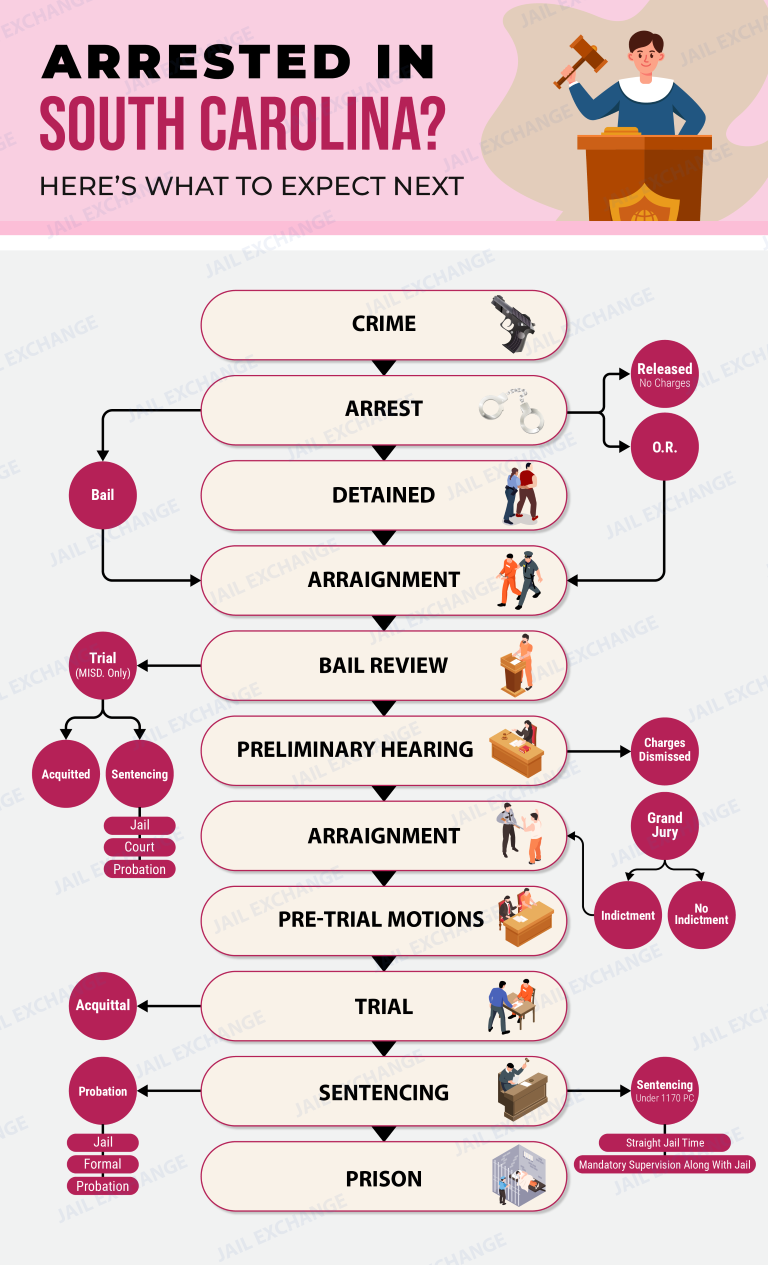

icare (operated by Aramark Correctional Services) is a specialized gift package and commissary program that allows family members to order brand-name snack bundles, confectioneries, hygiene kits, and freshly prepared hot meals sent directly to an incarcerated loved one. Every package is packed to adhere strictly to facility security regulations.
Important: Order Cutoffs and Delivery Windows Vary by Jail
Detention centers do not manage care package deliveries under identical schedules. While some facilities allow weekly orders, others restrict deliveries to bi-weekly or monthly distribution windows, and spending limits vary from jail to jail. You should verify the facility's active cutoff schedule and order allowances by calling them directly. If an order is submitted after the weekly processing deadline, delivery will be held until the following cycle, leaving your loved one waiting an extra cycle for fresh meals or personal snacks.
Step-by-Step Instructions to Place an icare Package Order
- Obtain the inmate's legal first and last name, date of birth, and assigned booking or inmate ID number.
- Visit www.icaregifts.com on your computer or mobile device.
- Select Find a Loved One and choose the state and detention facility.
- Search for the inmate using their ID number or legal last name to unlock the facility-specific catalog.
- Browse available fresh food items, snack packs, candy selections, and hygiene kits, adding items up to the facility's spending cap.
- Proceed to checkout, enter your debit or credit card billing details, and submit your order.
- Save your digital receipt and confirmation tracking number for your records.
What the Inmate Needs to Do
The inmate does not need an internet account to receive care packages. Aramark prepares the shipment in tamper-evident security packaging and delivers it directly to the facility commissary department. Staff inspect the delivery and distribute it during scheduled housing unit delivery rounds, where the inmate signs the delivery manifest.
Official Provider: icare Gifts Official Website
Customer Service Telephone: 1-888-439-5020
Support Hours: Monday – Friday, 8:00 AM – 9:00 PM EST; Saturday – Sunday, 9:00 AM – 5:00 PM EST
Supported Languages: English and Spanish
Other Services Associated with Aramark Corrections
Depending on individual facility agreements, additional trust funding and commissary services may be available:
- Inmate Trust Fund Deposits: Transfer funds directly to an inmate's jail trust account for independent commissary spending.
• Learn more on our website: Inmate Trust Deposits Guide | • Visit official vendor page: icare Inmate Services
Buy Commissary for an Inmate in the Sheriff Al Cannon Detention Center
Sheriff Al Cannon Detention Center Inmate Commissary - Sending Money or Purchasing Commissary for an Inmate
Sheriff Al Cannon Detention Center allows inmates to purchase commissary. This can be snacks, hygiene products, stamps, stationary, clothing and even electronics.
You can buy commissary for an inmate using an online service called icare gifts.

There is a monthly limit of $200-300 on how much inmates can spend on commissary items.
This amount is subject to change so call the facility at 843-202-7200 in order to confirm the amount that cannot be exceeded.
Inmates have access to both an in-house commissary store, and commissary packages that can be purchased and shipped to the inmate by friends and family.
Scroll down for information on the Sheriff Al Cannon Detention Center's service they use for you being able to purchase commissary items online and have them shipped directly to the inmate.
You can also go to our Inmate Money page for information on how to send money to an inmate.
TouchPay Inmate Trust Money Deposits
Provider: TouchPay Direct • A ViaPath Technologies Company (GTL Financial)

TouchPay (operated by GTL Financial Services and part of ViaPath Technologies) provides payment processing solutions enabling family members to deposit funds directly into an incarcerated person's jail trust and commissary account. Deposited funds allow the inmate to purchase commissary food items, clothing, hygiene essentials, and medical sundries, or transfer balances to phone time.
Important: Facility Site IDs and Deposit Limits Vary
Once a person is booked and moved to a housing unit, facilities do not always allow cash drop-offs or phone payments directly to the jail window. Some might and you should confirm this by calling the facility and asking. In addition, each correctional agency requires a specific TouchPay Site ID number to route payments accurately. If you do not register online and fund your loved one's trust account immediately, they may be forced to wait days or weeks for standard paper processing, leaving them without essential soap, clean undergarments, basic medical sundries or snacks.
Step-by-Step Instructions to Register and Deposit Trust Funds
- Obtain the inmate's legal first and last name, date of birth, and assigned facility booking ID number, along with the jail's 3- to 5-digit TouchPay Site ID.
- Navigate to www.touchpayonline.com or dial automated phone payments at 1-866-232-1899.
- Select Trust Deposits and enter the facility Site ID or search by state and agency name.
- Confirm the inmate's profile matches the facility's active housing roster.
- Enter the deposit dollar amount, review convenience and transaction fees, and input your credit or debit card billing information.
- Submit payment and record your confirmation tracking number for your financial records.
What the Inmate Needs to Do
The inmate does not need an internet account to receive trust funds. Once authorized, funds post directly to their facility accounting balance in the jail's internal system. The inmate can review their updated balance at a dayroom kiosk terminal or on their trust receipt and place orders on their regular commissary distribution day.
Official Providers: TouchPay Official Website | ViaPath Technologies
Customer Service Telephone: 1-866-232-1899 (Automated & Live Support)
Support Hours: Automated Deposits 24/7/365; Live Support Monday – Friday, 8:00 AM – 7:00 PM CST
Supported Languages: English and Spanish
Other Services Provided by TouchPay (ViaPath Technologies)
In addition to Trust Money Deposits, TouchPay and ViaPath handle bail bonding and inmate telephone services:
- TouchPay Cash Bail & Bond Payments: Pay appearance bonds and release fees online 24/7 to expedite custody release.
• Learn more on our website: Cash Bail & Bonding Guide | • Visit official vendor page: TouchPay Bail Services - AdvancePay Phone Calling Accounts: Prepay for phone calling credits so your loved one can call your mobile phone directly.
• Learn more on our website: AdvancePay Calling Guide | • Visit official vendor page: ViaPath ConnectNetwork Calling
Deposit Money for an Inmate in the Sheriff Al Cannon Detention Center
North Charleston's Sheriff Al Cannon Detention Center is a cashless jail: nobody inside may keep U.S. currency. Money sent for an inmate is credited to their canteen account.
Timing matters. A deposit has to be in before 8:00 AM Monday to count for that week's canteen, and each inmate is capped at $100 of canteen spending per week.
- Online with TouchPay, entering site number 229405.
- At the lobby kiosk inside the detention center.
- By money order. Every one must be payable to "Sheriff Al Cannon Detention Center," and the memo line should hold the inmate's name and number and nothing more. Mail to Charleston County Detention Center, 3841 Leeds Avenue, North Charleston, SC 29405. Any money order that has been changed or altered is returned to whoever sent it.
Phone and tablet funds sit in a different account from canteen money. When the inmate is released, whatever remains is paid out as a check in their name.
The Sheriff Al Cannon Detention Center on Leeds Avenue in North Charleston is the Charleston County jail, run by the Charleston County Sheriff's Office. Since May 1, 2023, the jail has not taken personal mail at the building. Letters go to a mail-scanning service and appear on the inmate's tablet instead, which keeps out paper that was soaked in drugs and dried before mailing.
Personal letters, photos and drawings (scanned):
Inmate's Full Name & ID#
Charleston, SC County Jail
C/O Securus Digital Mail Center
PO Box 20207
Tampa, FL 33622
Money orders and legal mail (to the jail):
Inmate's Full Name & ID#
Charleston County Detention Center
3841 Leeds Avenue
North Charleston, SC 29405
- First line: The inmate's name and ID number. Wrong addressing can get a letter sent back or held up.
- What scans: The service scans letters, pictures and drawings printed or written on paper no larger than 8.5 x 11 inches. Bigger sheets, anything that isn't paper, packages and certified mail are returned.
- Getting originals back: Include a stamped envelope addressed to yourself. Otherwise the paper is destroyed 60 days after it is uploaded.
- Not allowed by mail: Books, magazines, newspapers, Polaroids, musical or electronic cards, stamps, envelopes, writing paper, food, clothing, toiletries, phone cards, cash and checks.
- Writing supplies: Inmates buy their own, and those with no money get two free personal letters a week.
- Money orders: Make them payable to the Sheriff Al Cannon Detention Center, with the inmate's name and number only on the memo line. One that is altered or made out any other way is returned. Money in before 8 a.m. Monday counts toward that week's canteen. The jail lobby has a deposit kiosk, or you can send money online.
- Legal mail: Lawyers and courts send it to the jail on Leeds Avenue, never to the scanning service.
- Return address: Your full name and address are required on the envelope.
Tablets also carry electronic messages, which follow the same content rules as paper mail.
Securus AdvanceConnect is a prepaid calling account that links directly to your mobile phone or landline number, allowing you to receive outbound calls from an incarcerated individual. Because correctional phone systems never allow incoming calls, funding an AdvanceConnect balance ensures calls are accepted immediately without being blocked by cell carriers.
Important: Mobile Networks Block Inmate Calls Without Prepaid Funds
Correctional facilities do not allow collect billing to cell phones, and mobile carriers automatically block incoming collect calls from detention centers. While some residential landlines may allow direct billing, mobile phones and VoIP services require an active prepaid AdvanceConnect balance, which you can verify with your phone provider. If you do not register online and fund your account right away, your loved one will hear an automated error message stating that your number cannot accept calls.
Step-by-Step Instructions to Register and Fund AdvanceConnect
- Go to securustech.online or open the Securus mobile app.
- Select Sign Up and create your account using your 10-digit telephone number and email address.
- Search for your facility by state and agency name, then add the inmate using their full legal name or booking ID.
- Select AdvanceConnect under calling accounts.
- Choose your deposit amount, review convenience and transaction fees, and enter your credit or debit card billing details.
- Authorize payment and confirm that your mobile phone allows calls from automated or unknown correctional numbers.
What the Inmate Needs to Do
The inmate picks up any dayroom phone or logs onto their handheld tablet, dials your 10-digit number, and enters their assigned PIN. The automated system verifies that your AdvanceConnect account has an active balance and connects the call. All calls are subject to recording and monitoring by facility staff.
Official Provider: Securus Technologies Official Website
Customer Service Telephone: 1-800-844-6591
Support Hours: 24 hours a day, 7 days a week, 365 days a year
Supported Languages: English and Spanish
Other Services Provided by Securus Technologies
In addition to AdvanceConnect Prepaid Calling, Securus Technologies and its subsidiary JPay provide several other communication, financial, and visitation services:
- Direct Bill Phone Calling: Establish a monthly billed calling account for verified landline numbers.
• Learn more on our website: Direct Bill Phone Calling Guide | • Visit official vendor page: Securus Direct Bill - Securus Video Connect: Schedule and join live video visits from home using your computer or smartphone.
• Learn more on our website: Video Visitation Guide | • Visit official vendor page: Securus Video Connect - JPay Money Deposits (Trust & Canteen): Send money directly into an inmate's jail trust account for commissary store purchases.
• Learn more on our website: Money Deposits Guide | • Visit official vendor page: JPay Money Transfers - JPay Email Messaging & Photos: Send electronic messages, photo attachments, and VideoGrams directly to their tablet or kiosk.
• Learn more on our website: Email Messaging Guide | • Visit official vendor page: JPay Email Services
Securus Direct Bill is an invoiced telephone calling service designed for approved residential landlines, law offices, and commercial businesses. Instead of prepaying funds in advance, calls received from an incarcerated individual are billed directly to your account on a monthly itemized billing invoice.
Important: Direct Bill Requires Credit Approval and Qualifying Lines
Direct Bill is not available for mobile cell phones, internet VoIP numbers, or customers with poor or unestablished telephone credit history. Correctional facilities enforce strict telecommunications billing rules, which you can verify by calling Securus customer care. If your line does not meet credit approval standards, you must open an AdvanceConnect prepaid account instead to receive incoming calls from your loved one.
Step-by-Step Instructions to Set Up a Direct Bill Account
- Contact Securus customer service at 1-800-844-6591 or submit an application via securustech.net.
- Provide your billing name, service address, and qualifying residential or business landline telephone number.
- Submit to a standard credit evaluation performed by Securus to determine billing eligibility.
- Establish your authorized monthly credit limit upon approval.
- When your phone rings with a call from the detention center, follow the recorded operator instructions and press the requested key to accept charges.
- Pay your monthly billing invoice online, by phone, or through the mail.
What the Inmate Needs to Do
The inmate dials your phone number from any dayroom telephone and keys in their assigned PIN. The automated system verifies that your account is in good standing and has not exceeded its monthly spending ceiling before connecting the call. All non-privileged conversations are recorded and monitored.
Official Provider: Securus Technologies Official Website
Customer Service Telephone: 1-800-844-6591
Support Hours: 24 hours a day, 7 days a week, 365 days a year
Supported Languages: English and Spanish
Other Services Provided by Securus Technologies
In addition to Direct Bill Calling, Securus and its subsidiary JPay offer several other communication, financial, and visitation services:
- AdvanceConnect Prepaid Calling: Fund a prepaid calling account tied to your mobile phone number.
• Learn more on our website: AdvanceConnect Calling Guide | • Visit official vendor page: Securus AdvanceConnect - Securus Video Connect: Schedule and join live video visits from home using your computer or smartphone.
• Learn more on our website: Video Visitation Guide | • Visit official vendor page: Securus Video Connect - JPay Money Deposits (Trust & Canteen): Send money directly into an inmate's jail trust account for commissary store purchases.
• Learn more on our website: Money Deposits Guide | • Visit official vendor page: JPay Money Transfers - JPay Email Messaging & Photos: Send electronic letters, photos, and VideoGrams directly to their tablet or kiosk.
• Learn more on our website: Email Messaging Guide | • Visit official vendor page: JPay Email Services
Securus eMessaging provides a digital messaging service that allows family members to send electronic letters, digital photos, and eCards directly to an incarcerated loved one via handheld tablets and housing unit kiosks. Messages are screened electronically, delivering communication within hours instead of waiting days for postal mail delivery.
Important: Physical Mail Bans and Stamp Requirements Vary
Inmates cannot receive incoming phone calls, and traditional postal mail rules differ across correctional systems. While some jails continue to accept handwritten letters, many facilities have transitioned entirely to electronic messaging or digital mail scanning, which you can verify by checking facility rules. If you do not register online and purchase eMessaging stamps right away, your loved one may face lengthy periods without direct written contact from family.
Step-by-Step Instructions to Register and Send eMessages
- Go to securustech.online or open the Securus mobile app.
- Sign into your verified profile or create an account with your email and phone number.
- Select eMessaging from your service dashboard.
- Link the inmate to your account by selecting the facility and entering their legal name or booking ID.
- Purchase an eMessaging stamp book using a debit or credit card.
- Type your message in the editor, attach photos or eCards if permitted, and optionally include a prepaid reply stamp.
- Submit your message to the facility's screening queue.
What the Inmate Needs to Do
All electronic correspondence is screened by correctional staff before delivery. Once approved, the message arrives in the inmate's inbox on their assigned Securus tablet or housing unit kiosk. The inmate opens the message, views attached photos, and drafts an electronic reply using their available stamp balance.
Official Provider: Securus Technologies Official Website
Customer Service Telephone: 1-800-844-6591
Support Hours: 24 hours a day, 7 days a week, 365 days a year
Supported Languages: English and Spanish
Other Services Provided by Securus Technologies
In addition to eMessaging, Securus provides calling, video visitation, and trust money services:
- AdvanceConnect Prepaid Calling: Prepay for phone calling credits so your loved one can call your mobile phone directly.
• Learn more on our website: AdvanceConnect Calling Guide | • Visit official vendor page: Securus AdvanceConnect - Securus Video Connect: Schedule and join live video visits from home using your computer or smartphone.
• Learn more on our website: Video Visitation Guide | • Visit official vendor page: Securus Video Connect - JPay Money Deposits (Partner Trust Transfers): Send money directly into an inmate's jail trust account for commissary shopping.
• Learn more on our website: Money Deposits Guide | • Visit official vendor page: JPay Money Transfers
Securus Technologies (Aventiv) deploys secure, corrections-grade community tablets to incarcerated individuals across state prison systems and county jails. Operating over a private, encrypted facility network, these devices provide access to digital messaging (eMessaging), phone calls, educational courses, job search tools, eBooks, podcasts, and streaming music directly from housing units.
Important: Tablet Hardware Deployment and Rental Rules Vary
Detention centers do not manage tablet distribution identically. While some agencies issue individual personal tablets to every detainee at booking, others utilize shared pod docking stations or restrict tablet use to specific dayroom hours, which you should confirm with the facility directly. Although core educational and legal resources are generally provided free of charge, sending messages, listening to music, or making phone calls from the tablet requires an active balance funded by outside contacts.
Step-by-Step Instructions to Support and Fund Securus Tablets
- Verify that Securus handheld tablets are deployed at your loved one's specific facility.
- Log into your account at securustech.online or launch the Securus mobile app.
- Ensure the inmate is linked to your contact list using their legal name and booking ID number.
- Purchase eMessaging Stamps for digital messaging, fund an AdvanceConnect account for phone calls, or deposit funds into their Inmate Debit account for music and media.
- Review all transaction charges, complete payment with a credit or debit card, and save your confirmation receipt.
- Notify your loved one that funds have posted so they can access their media and communication apps.
What the Inmate Needs to Do
The inmate unlocks their assigned tablet using their facility PIN or biometric verification. They can access free rehabilitative and educational materials at no charge, or open communication and media applications to draft messages, place phone calls, or stream music using available balances. Devices are docked during quiet hours and shift changes for secure recharging and data synchronization.
Official Provider: Securus Technologies Official Website
Customer Service Telephone: 1-800-844-6591
Support Hours: 24 hours a day, 7 days a week, 365 days a year
Supported Languages: English and Spanish
Other Services Provided by Securus Technologies
In addition to Tablet Services, Securus provides calling, messaging, video visitation, and trust money transfers:
- eMessaging & Digital Mail: Send electronic messages, photo attachments, and eCards directly to an inmate's tablet.
• Learn more on our website: eMessaging Guide | • Visit official vendor page: Securus eMessaging - AdvanceConnect Prepaid Calling: Prepay for phone calling credits so your loved one can call your telephone directly.
• Learn more on our website: AdvanceConnect Calling Guide | • Visit official vendor page: Securus AdvanceConnect - Securus Video Connect: Schedule and join live video visits from home using your computer or smartphone.
• Learn more on our website: Video Visitation Guide | • Visit official vendor page: Securus Video Connect - JPay Money Deposits (Partner Trust Transfers): Send money directly into an inmate's jail trust account for commissary shopping.
• Learn more on our website: Money Deposits Guide | • Visit official vendor page: JPay Money Transfers
Nearby counties
- Detention Center: 843-529-7300
- Adult Probation: 843-740-1553
- Arrest Warrants: 843-529-7391
- Charleston County Area - Non-Emergency: 843-743-7200
- Charleston Police: 843-577-7434
- District Attorney: 843-958-1900
- Juvenile: 843-202-1700
- Juvenile Probation: 843-740-1649
- Mt. Pleasant Police: 843-884-4176
- North Charleston Police (North): 843-740-2800
- North Charleston Police (South): 843-308-4718
- Public Defender: 843-958-1850
- Sheriff: 843-202-1700
The Sheriff Al Cannon Detention Center serves the following cities and towns of Charleston County: Awendaw, Charleston, Folly Beach, Hollywood, Isle of Palms, James Island, Johns Island, Kiawah Island, Lincolnville, McClellanville, Mount Pleasant, North Charleston, Ravenel, Seabrook Island, Sullivan's Island and Summerville.