
Marion County Detention Center
Marion County Detention Center
Jail Phone Number
843-423-0121Marion County Jail Inmate Search: Finding Your Person in Mullins
Deputies, troopers and police from Marion, Mullins, Nichols and Sellers all book their arrests into the Marion County Detention Center, 2715 E. Highway 76, Suite D, Mullins, SC 29574. It is a Sheriff's Office jail. Start here to locate your person. Further down, we cover charges, bond, lawyers, video visits, letters, account deposits, property, warrants and court dates.
Your best first stop is the jail's Current Inmates and Releases page, which shows fresh bookings and recent releases. Copy down the inmate ID number there, because mail and deposits need it. Away from a screen? The county's Law Enforcement Complex main line, 843-423-8216, has an automated inmate information system that can read you the ID number.
To confirm a booking by phone, call the jail at 843-423-0121. Booking staff will want a legal name plus birth date. In return they can share the charges and when bond court meets next. Our bail page explains paying bond, and our court page picks up from there.
Read inmate search answers
 Read inmate search answers
1. Where do I look someone up in the Marion County jail?
- Pull up the Current Inmates and Releases page on a phone or computer. Names fill in a moment after the page opens, so be patient.
- Scroll or search for the surname. With many names showing, a quick Ctrl+F or the find option in your phone's browser saves time.
- Glance at the releases too, in case your person already walked out.
- Jot down the inmate ID number. Letters to the jail must carry it, and it speeds up deposits.
- Still stuck? Dial the automated inmate information system on the main line, 843-423-8216, or the jail itself at 843-423-0121.
State law makes jail lists covering the last three months a public record (S.C. Code 30-4-30(D)(3)).
↑ Back to the question list2. Why might a new arrest be missing from the roster?
A name can be absent for a handful of reasons:
- Booking is still underway. A brand-new arrest can take a while to appear.
- A crash or injury. Anyone coming from a motor vehicle accident must be cleared by a qualified medical provider before booking, so your person may still be at a hospital.
- Already released. Bond may have been paid, or a judge ordered release.
- Moved. Another county, state prison custody or a federal hold can explain it.
- Under 18. Youths are held apart from the adult jail.
- Spelling. Spellings vary, so retry using a nickname, a former surname, or one piece of a double surname.
For a straight answer, call 843-423-0121 and ask for Booking.
↑ Back to the question list3. Could they be held outside the Mullins jail?
Adults arrested anywhere in this county go to the Detention Center, 2715 E. Highway 76, Suite D, Mullins, SC 29574, 843-423-0121. It houses people waiting for trial, people serving sentences of 90 days or less and people sentenced in Family Court. Newcomers usually sit in the booking holding area until bond is set.
When an arrest happened across a county line, try the jail for that county:
- Dillon County Detention Center, 1027 Old Latta Highway, Dillon, SC 29536, 843-841-3730
- Florence County Detention Center, 6719 Friendfield Rd., Effingham, SC 29541, 843-665-9944
- J. Reuben Long Detention Center (Horry County), 4150 J. Reuben Long Ave., Conway, SC 29526, 843-915-5140
- Williamsburg County Detention Center, 200 South Jackson Street, Kingstree, SC 29556, 843-355-6381
Youths who are held go to Columbia, to the Juvenile Detention Complex at 1725 Shivers Road, Columbia, SC 29210, 803-896-9440.
↑ Back to the question list4. Is a booking photo ever released?
In South Carolina, records that name people jailed in the past three months are open to the public. Mugshot requests are handled by deputies; call 843-423-8216 to ask whether one can be released. News outlets go through the same office.
- Sites that post booking photos cannot charge to remove one. Once charges end without a conviction, including an expungement, mail the site a certified removal request. It then has 30 days (S.C. Code 17-1-60).
- For an image in immigration files, start an online FOIA filing with ICE through its records request page.
- Photos from federal arrests seldom leave the Marshals Service, except during a manhunt for an escaped or wanted person.
5. Will anyone ping me if they leave or change jails?
SC VINE is free. It confirms custody and names the facility, then sends an alert when either changes. Register through VINELink South Carolina or phone 866-727-2846, in English or Spanish. Register once for every inmate you track.
Victims also hear from the Detention Center at release time, working with the Sheriff's Victim Services division. If something cannot wait, phone the jail at 843-423-0121.
↑ Back to the question list6. What does bond look like for someone in the Marion County jail?
Bond court happens on the same Highway 76 complex every single day. Weekday sessions start at 9:00 a.m. and 3:00 p.m., and weekend and holiday sessions at 9:00 a.m. State law promises that hearing within 24 hours of arrest (S.C. Code 22-5-510). For a charge that could mean a life sentence, bond is decided by a circuit judge.
Money for bond goes to the Magistrate's Office, 2715 East Highway 76, Suite B, Mullins, SC 29574, 843-292-5238, open weekdays 8:30 a.m. to 4:00 p.m. That window accepts cash, money orders and major credit cards. Jail staff will not point you to any bondsman. Our bail guide lays out every type of bond, fee limits and refunds.
↑ Back to the question list7. Who will tell me the booking charges?
Call the jail at 843-423-0121, or ask the Magistrate's Office at 843-292-5238 once bond court is done. After the case is filed, the state court records search lists each charge; select this county first.
The 12th Circuit Solicitor prosecutes serious charges. Its local office is at 101 Court St., Marion, SC 29571, 843-431-5040. Its staff can say which office is handling a case.
↑ Back to the question list8. Is free legal help available behind bars?
Yes, through the public defender. The person signs a sworn financial form and pays a $40 application fee, which may be cut or waived (S.C. Code 17-3-30). Applications go through the county public defender office, 221 North Main Street, Marion, SC 29571, 843-423-3303.
A family may also hire a private attorney. During booking, people may call a lawyer, family member or pastor. Every other call from the jail phones is recorded.
↑ Back to the question list9. How are video visits set up at the Marion County Detention Center?
Every visit here takes place on a video screen. You can choose between two kinds:
- On-site visits from the jail lobby cost nothing. Book them at least 24 hours early, and the person inside must accept.
- Remote visits from home run $0.30 a minute. No booking is needed, as long as the kiosk in the person's housing unit is open.
Visiting generally runs 9:00 a.m. to 11:00 p.m. It pauses for meals from 11:30 a.m. to 12:30 p.m. and from 4:00 to 5:00 p.m., and hours can differ by housing unit. Before your first visit:
- Create a login with the jail's video provider. Upload a photo of yourself and a readable copy of a government-issued ID.
- Only the account holder may visit, one visitor per session. A child under 18 may join only with a parent or grandparent who is on that adult's account.
- Dress modestly. Tank tops, lingerie, short shorts, spandex and see-through clothes are refused.
- You may not record a visit. Staff record and review every session.
- Account or tech trouble goes to the video provider's support line, 800-729-8355.
Our visitation guide has more tips.
↑ Back to the question list10. How does cash reach their commissary balance?
Commissary snacks, soap and phone minutes all come out of this account. Deposits can be made two ways:
- The kiosk in the Detention Center lobby, 2715 E. Highway 76, Suite D, Mullins, SC 29574. A cash deposit carries a $3.00 fee, and a card deposit carries a fee tied to the amount.
- Online, through the website of the jail's commissary company. Search by name or account number. A fee applies, and the receipt arrives by email.
The jail sends back cash, checks and postal money orders that arrive in the mail, so never mail money. Relatives can also buy commissary items online. Orders go in weekly and are delivered on Fridays. Call 843-423-0121 with questions, and see our deposit guide or our commissary guide.
↑ Back to the question list11. Can they call out, text or message from inside?
Jail phones make outgoing calls only. People inside cannot take incoming calls, and officers will not relay messages. Every call is recorded and monitored, so save case talk for the lawyer.
- Open a prepaid phone account by calling 800-729-8355. You can fund calls to any number, to one number, or accept collect calls.
- Money can be moved from a canteen account to a phone account by the person inside.
- Tablets carry electronic messages that cost less than a stamp. Families buy gift message packages or accept collect messages.
- The same tablets hold more than 30,000 free e-books, a free law library and scanned mail.
For a true family emergency, call 843-423-0121 and ask for command staff. To learn more, read our jail calls page or our inmate messaging page.
↑ Back to the question list12. What address do letters need for someone in Marion County custody?
Personal mail is scanned off site and shown on the tablets. Address the envelope in this order:
- Marion County Detention Center
- Inmate name and ID number
- Facility ID#: 5118
- PO Box 18247
- Greensboro, NC 27419
Letters missing the facility name, state, inmate name or ID number go unprocessed. On the outside, write your full name and a complete return address, and add enough postage, since postage-due mail is refused. More rules:
- Send copies, not originals. Originals are destroyed after scanning, which happens within 24 hours.
- Ten pages or fewer per envelope, none bigger than a standard letter-size sheet.
- Photos are fine, except Polaroids. Leave off glitter, glue, tape, 3D designs and cards with electronics.
- Packages are refused. Books are accepted only when religious, such as a Bible or Quran.
Legal mail marked "Legal Mail," and new publications sent one per package by a publisher or national distributor, go to the street address instead: 2715 East Highway 76, Ste D, Mullins, SC 29574, with the inmate's name and ID number. Officers open legal envelopes while the addressee watches. Our mail guide covers the basics.
↑ Back to the question list13. Who can collect their clothes and belongings?
Officers list and store everything a person brings to booking, and any cash goes on the jail account. Clothes from home are refused. Underwear can be bought through commissary instead.
- Someone outside can pick things up once your person completes a Property Release Form listing that pickup person.
- Thirty days after release, unclaimed items are disposed of.
- For a car hauled away by a tow truck, contact the arresting agency.
To arrange a pickup at the Detention Center, 2715 E. Highway 76, Suite D, Mullins, SC 29574, call 843-423-0121.
↑ Back to the question list14. What if they need a doctor, medicine or glasses?
A contracted health provider treats people at the jail and reviews every prescription. Everyone is screened during booking. To get medicine or glasses to your person:
- Drop off prescription eyeglasses and valid prescriptions at the Detention Center, 2715 E. Highway 76, Suite D, Mullins, SC 29574, Monday through Friday, 7:00 a.m. to 5:00 p.m.
- Emergency prescriptions are taken at any hour.
- Have a list ready before you call: the drug, the dose and the prescriber.
Share health worries with the jail at 843-423-0121. In an emergency, dial 911.
↑ Back to the question list15. Could my relative have an open warrant?
Outside town limits, Sheriff's deputies serve arrest and bench warrants; inside the four towns, town police can serve them as well. Ask the Sheriff's Office at 843-423-8216, or the Magistrate's Office, 2715 East Highway 76, Suite B, Mullins, SC 29574, 843-292-5238. Filed cases show on the state court records search. Wanted-person lists are kept by South Carolina probation officials (Most Wanted Offenders) and by federal marshals (15 Most Wanted), though few local names appear there. To clear it, talk with a defense attorney first. Then your person can walk in and surrender, or the attorney can request a new hearing from the judge who signed it. The Clerk of Court, 1305 N Main St, Marion, SC 29571, 843-423-8240, keeps General Sessions warrants.
↑ Back to the question list16. Which court date comes next for them?
- Bond court sits daily at the Magistrate's Office, 2715 East Highway 76, Suite B, Mullins, SC 29574, 843-292-5238. The same office handles minor cases and preliminary hearings.
- Felony cases belong to the Court of General Sessions through the Clerk of Court, 1305 N Main St, Marion, SC 29571, 843-423-8240. The Solicitor sets the first General Sessions dates by the quarter of arrest. An arrest made from October through December 2026 gets an initial appearance on January 14, 2027.
- Town charges are heard in the municipal court of Marion, Mullins, Nichols or Sellers. Call the town court for its calendar.
Upcoming General Sessions terms appear on the county's court rosters. For the full path a case follows, open our criminal court page.
↑ Back to the question list17. What if federal agents are holding them?
Federal cases from the Pee Dee land at the Florence Division of the federal court, McMillan Federal Building, 401 West Evans Street, Florence, SC 29501, 843-676-3820.
- Whether they go free before trial gets decided in federal court, usually at a detention hearing soon after arrest (18 U.S.C. 3142).
- From then until trial, the U.S. Marshals pick the jail. Their Florence office, 401 West Evans Street, Suite 341, Florence, SC 29501, 843-662-0750, can tell you which one.
- After sentencing, look them up on the Federal Bureau of Prisons inmate locator by name or register number.
18. What if immigration has placed a hold?
- A person wanted by ICE gets a detainer, on Form I-247A, placed with the jail.
- That detainer lets the jail keep them up to 48 hours after they would otherwise be released, under 8 CFR 287.7(d).
- South Carolina jails must check status within three days of booking someone on a criminal charge. Anyone without lawful status is then referred to the Department of Homeland Security (S.C. Code 23-3-1100). Bond judges weigh that status too (S.C. Code 22-5-510(D)(4)).
- After ICE takes custody, use the ICE Online Detainee Locator. Type the A-number, or else the name with the person's home country. Blank results? ICE says to phone its field office.
- ICE in South Carolina: 3950 Faber Place Drive, North Charleston, SC 29405, 843-746-9800.
19. Has my relative moved on to an SCDC prison?
A sentence over three months usually means a transfer to the South Carolina Department of Corrections (S.C. Code 24-3-20). After a General Sessions sentence, the move can take up to two business days while papers are handled.
- Type a name or SCDC number into the SCDC incarcerated inmate search. It covers state prisons as of the previous midnight, not county jails.
- Each new arrival gets an SCDC number within a week and goes through reception and evaluation before a prison is chosen.
- SCDC is at 4444 Broad River Road, Columbia, SC 29210, 803-896-8500. The SC VINE line, which sends custody alerts, is 866-727-2846.
- Visiting, mail and deposits for each prison are covered in our South Carolina state prisons guide.
20. What happens when a Marion County teen is arrested?
Family Court and juvenile justice workers take over for most people under 18. A child may stay in an adult lockup for six hours or less, and a child age ten or younger is never locked up (S.C. Code 63-19-820).
- Detained youths are kept at the Juvenile Detention Complex, 1725 Shivers Road, Columbia, SC 29210. Call 803-896-9440 about visits.
- Family Court reviews each youth detention within 48 hours, leaving weekend days and holidays off the clock (S.C. Code 63-19-830).
- The local Department of Juvenile Justice office sits at 1305 North Main St., Marion, SC 29571, 843-431-1110.
Older teens can be charged as adults. A 17-year-old accused of a serious felony, one in the top four classes or carrying 15 years or more, goes to adult court (S.C. Code 63-19-20(1)).
↑ Back to the question list21. Which Marion County police force made the arrest?
The Census put this county at 28,242 residents on July 1, 2025. Arrests in the county come from these departments:
- Sheriff's Office, 1811 North Hwy 501 Bypass, Marion, SC 29571, 843-423-8216, the shared main line (press 2 for the Sheriff). Deputies patrol everywhere outside town limits.
- Marion Police Department, 1024 South Main St., Marion, SC 29571, 843-423-8616
- Mullins Police Department, 843-464-0707. Mail goes to PO Drawer 408, Mullins, SC 29574. City Hall is at 151 East Front Street, Mullins, SC 29574.
- Nichols Police Department, 514 W. Mullins Street, Nichols, SC 29581, 843-289-7834
- Sellers Police Department, PO Box 36, Sellers, SC 29592, 843-752-5009
- South Carolina Highway Patrol, Troop 5, 3415 East Palmetto Street, Florence, SC 29506, 843-661-4700
For non-emergency dispatch anywhere in the county, the 911 center answers at 843-423-8274.
↑ Back to the question listMarion County Bond and Release
Whoever makes the arrest, whether deputies, town police or the Highway Patrol, booking happens at the Marion County Detention Center, 2715 E. Highway 76, Suite D, Mullins, SC 29574. The Sheriff's Office runs this jail. Read on to learn who sets bond, the daily bond court times, the window where money is paid, bondsman fee limits and what can delay release even after the money is in.
Confirm your person is still in custody on the jail's Current Inmates and Releases list. Arrest questions get answered on our Recent Arrests page, from mugshots and new bookings to open warrants. It also explains charges, where someone is held, property pickup and public defenders.
Your first phone call goes to the Magistrate's Office at 843-292-5238. Ask three things: has bond been set, what is the amount, and which bond court session has the case. When your person is back home, our court page takes over with every step that follows.
1. Who decides bond for a Marion County arrest?
For nearly everyone booked at the Detention Center, a magistrate decides bond. Bond court belongs to the Magistrate's Office, 2715 East Highway 76, Suite B, Mullins, SC 29574, 843-292-5238. That office shares the Highway 76 complex with the jail. Court is held seven days a week:
- Weekdays: 9:00 a.m. and 3:00 p.m.
- Saturdays, Sundays and holidays: 9:00 a.m.
A busy magistrate can push a session later. A hearing may also be held back so a victim who asks to attend has time to arrive. Until bond is set, most new arrivals wait in the booking holding area.
South Carolina requires the hearing within 24 hours of an arrest. Once the bond is delivered, the clock starts: four hours is the most the jail may take to let the person out (S.C. Code 22-5-510). On charges written in a town court, the town judge may set bond as well (S.C. Code 14-25-115).
↑ Back to the question list2. What bond types can a magistrate choose?
South Carolina's constitution protects bail for most defendants (S.C. Const. art. I, § 15). Jail staff say bonds here are most often cash, surety or 10 percent. A judge can pick from this full menu:
- Personal recognizance. Your person signs a pledge to appear and owes nothing today. For every charge that is not capital, the law begins from this point (S.C. Code 17-15-10).
- Cash. You pay the whole bond yourself. A cash deposit left with the magistrate or town judge may be used instead of the pledge (S.C. Code 22-5-530).
- Surety. A licensed bondsman guarantees the total and charges your family for that promise.
- Ten percent. If the judge permits, you may put down cash worth up to 10 percent of the bond with the court. People charged with violent crimes, or with a gun felony while already on bond, cannot use it (S.C. Code 17-15-15).
- GPS monitoring. An ankle monitor can replace money bond or ride along with it (S.C. Code 17-15-35).
Three terms come with every bond: appear in court each time, remain in South Carolina and stay on good behavior (S.C. Code 17-15-20). Extra conditions can be added after notice and a hearing (S.C. Code 17-15-50).
↑ Back to the question list3. How high is bond on everyday charges like shoplifting?
Bond amounts in this county are not printed on a chart. The magistrate weighs the charge, any criminal record, work, family, finances, years spent living nearby and earlier no-shows in court. Pending charges, an existing bond on another case and any gang database listing must be considered too (S.C. Code 17-15-30). Felony bonds tend to run higher, jail staff say. Here is how familiar charges stack up:
- Assault and battery, third degree: a low-level charge capped at $500 and 30 days (S.C. Code 16-3-600(E)(2)).
- Shoplifting, $2,000 or less: tried in summary court, capped at $1,000 and 30 days.
- Shoplifting, more than $2,000: a felony. Below $10,000 the cap is five years. From $10,000 up, it is ten years (S.C. Code 16-13-110(B)).
- Listed violent crimes, second-degree burglary for example: bond may be granted or denied by the magistrate (S.C. Code 16-1-60).
- Murder, or a charge that could mean life behind bars: bond is a circuit judge's job.
- Traffic cases with a cash fine: paying the fine at the Magistrate's Office often settles them.
The amount set for your person is available from the Magistrate's Office at 843-292-5238 once bond court is over.
↑ Back to the question list4. How do we post bond and bring them home?
The jail lobby is not where bond is paid. Both cash and surety bonds are handled at the Magistrate's Office. Work through it like this:
- Look up your person on the current inmate list. Copy down the exact name and the inmate ID number.
- Let bond court finish. Then phone 843-292-5238 for the dollar figure and which type was ordered.
- Head to 2715 East Highway 76, Suite B, Mullins, SC 29574. Bonds are taken there Monday to Friday, 8:30 a.m. until 4:00 p.m., closed on holidays.
- Pay the amount in cash, with a money order or by major credit card. A bondsman you hired files the surety bond at the same counter.
- Magistrate staff prepare the release order and route it to booking.
- At the jail, officers verify the order, run an NCIC check, search for other warrants and notify any victim. Half an hour is typical, but some releases run past an hour, and the law allows up to four.
Officers change shifts at 7:00 a.m. and 7:00 p.m., and movement slows then, so releases near those hours can lag. Line up a ride, because nobody is driven home from the jail. When bond is set on a weekend or holiday, call the Magistrate's Office to ask how and when payment can be made.
↑ Back to the question list5. Do town courts or the clerk ever take bond?
The Magistrate's Office at 843-292-5238 handles most bonds, but two other offices may come into play.
Bonds on town charges can be set and accepted by the town judge (S.C. Code 14-25-115). If a town police officer made the arrest, ring that town's court and ask where its bonds get paid:
- Marion Municipal Court, 1024 S. Main St., Marion, SC 29571, 843-423-8616
- Mullins Municipal Court, 151 E. Front St., Mullins, SC 29574, 843-464-0707
- Nichols Municipal Court, 514 West Mullins Street, Nichols, SC 29581, 843-526-2193
- Sellers Municipal Court, 2552 Hwy 301, Sellers, SC 29592, 843-752-5009
Under state law, a 10 percent deposit is made with the clerk of court (S.C. Code 17-15-15). The Clerk of Court sits at 1305 N Main St, Marion, SC 29571, 843-423-8240, weekdays 8:30 a.m. to 5:00 p.m. Before you go, ask the Magistrate's Office which counter should get your deposit.
↑ Back to the question list6. Is bond paid by card, cash or money order?
The Magistrate's Office, 2715 East Highway 76, Suite B, Mullins, SC 29574, takes bond money in three forms:
- Cash
- Money orders
- Major credit cards
Personal checks are turned away. Before driving over, ask whether a card fee applies and how to fill out the payee on a money order. The Magistrate's online payment link serves traffic tickets, so expect to handle bond face to face. Reach the office at 843-292-5238.
↑ Back to the question list7. How do bondsmen operate in Marion County?
A bondsman, or surety, pledges the whole bond to the court on your person's behalf. The family pays a fee for that pledge, known as the premium. The Detention Center will not recommend any bonding company or share contact details for one. Once bond court ends, the person inside may phone a bondsman and relatives.
State law keeps bondsmen in check (S.C. Code 38-53-170):
- A license from the South Carolina Department of Insurance is required.
- The premium is limited by law to 15 percent of the bond. Its minimum is the larger of $100 or 10 percent.
- Payment plans start with at least $100 down and last 18 months at most.
- Bondsmen may not drum up business at courthouses, magistrate offices or jails, and steering you to a lawyer is forbidden too.
- Think of the premium as the bondsman's earnings. You will not see it again.
Complaints go to the South Carolina Department of Insurance, 1201 Main Street, Suite 1000, Columbia, SC 29201, 803-737-6160.
↑ Back to the question list8. What keeps someone in the Marion County jail after bond?
Posting bond is a big step, though not always the final one. Watch for these holds:
- Warrants elsewhere. Officers search the magistrate system before letting anyone go. A warrant from some other court or county can mean a fresh hold.
- Charging papers on the way. An arresting agency may keep someone for as long as 24 hours while its charging documents arrive.
- Supervision violations. A probation or parole problem may trigger a hold from the South Carolina Department of Probation, Parole and Pardon Services, 293 Greystone Boulevard, Columbia, SC 29210, 803-734-9220. Local offices appear in its county office directory.
- Immigration. With an ICE detainer, the jail may hold someone up to 48 hours after they would otherwise be released.
- A second violent or gun felony. If a person on bond for one such felony is arrested on another, the law cancels the first bond, and within 30 days a circuit court takes up the case (S.C. Code 17-15-55(C)).
To learn what is holding your person, call the jail at 843-423-0121.
↑ Back to the question list9. When may a South Carolina judge refuse bail?
Our state constitution allows bail to be denied in three groups of cases, with due weight given to the evidence (S.C. Const. art. I, § 15):
- Capital charges, where death is a possible sentence
- Charges where life in prison is possible
- Violent offenses listed by name in state law (S.C. Code 16-1-60)
Magistrates are barred from setting bond for murder or for any charge that could bring execution or life imprisonment (S.C. Code 22-5-510(A)). Those hearings belong to a circuit judge, so families often wait longer. On the other listed violent offenses, the magistrate decides between a bond and no bond. Bail can never be excessive.
The 12th Circuit Solicitor's Office handles prosecution of serious cases here. When it asks a circuit judge to revoke or modify a bond, an emergency hearing can happen within 48 hours (S.C. Code 17-15-55(B)). The local office is at 101 Court St., Marion, SC 29571, 843-431-5040. The main office is at 180 N. Irby St., Florence, SC 29501, 843-665-3091.
↑ Back to the question list10. Can a high bond be cut down?
If the figure is out of reach, a lawyer can request a second look. A circuit judge can revisit bond on any charge that belongs in General Sessions, even when a magistrate or town judge set it (S.C. Code 17-15-55). Conditions can be changed too, after notice and a hearing (S.C. Code 17-15-50).
- Ask your person's lawyer, appointed or hired, to file for a bond review.
- Gather pay stubs, proof of a home nearby and the names of relatives who rely on your person. Judges weigh exactly these ties.
- The review happens in the Court of General Sessions. Its case files sit with the Clerk of Court, 1305 N Main St, Marion, SC 29571, 843-423-8240.
Ask the lawyer up front whether a review has a real chance.
↑ Back to the question list11. Can my person get a public defender?
A court will appoint a lawyer for someone who is unable to pay one (S.C. Code 17-3-10). The applicant fills out a sworn statement of finances and pays a $40 application fee. If paying it is not possible, the clerk may reduce or drop the fee (S.C. Code 17-3-30).
- Public defender office for this county: 221 North Main Street, Marion, SC 29571, 843-423-3303
- South Carolina Commission on Indigent Defense: 1330 Lady Street, Suite 401, Columbia, SC 29201, 803-734-1343
Apply right away, so counsel can help with bond and those first court dates. Hiring a private attorney stays an option throughout the case.
↑ Back to the question list12. Which courts hear Marion County cases?
Different stages of a case play out in different places:
- Magistrate's Office, home of bond court, minor charges and preliminary hearings: 2715 East Highway 76, Suite B, Mullins, SC 29574, 843-292-5238
- Court of General Sessions and Family Court, reached through the Clerk of Court: 1305 N Main St, Marion, SC 29571, 843-423-8240
- Marion Municipal Court: 1024 S. Main St., Marion, SC 29571, 843-423-8616
- Mullins Municipal Court: 151 E. Front St., Mullins, SC 29574, 843-464-0707
- Nichols Municipal Court: 514 West Mullins Street, Nichols, SC 29581, 843-526-2193
- Sellers Municipal Court: 2552 Hwy 301, Sellers, SC 29592, 843-752-5009
- Federal charges: U.S. District Court, Florence Division, McMillan Federal Building, 401 West Evans Street, Florence, SC 29501, 843-676-3820
Florence County and this county together form the 12th Judicial Circuit (S.C. Code 14-5-610).
↑ Back to the question list13. Will we get bond money back?
The answer turns on how bond was paid:
- Cash. When the case is closed and your person never missed court, whoever paid can ask the court for a refund (S.C. Code 17-15-220).
- Ten percent deposit. This comes back once every bond condition is satisfied. Any restitution the judge orders comes out first (S.C. Code 17-15-15).
- Premium paid to a bondsman. That is a fee, so it never returns.
Skipping court has a steep price. The judge signs a bench warrant, and if the person is not surrendered within 90 days, a surety bond is forfeited (S.C. Code 38-53-70). Failing to appear on purpose is its own crime too. For someone released on a felony, it carries as much as five years and a $5,000 fine. A misdemeanor with a year or more on the line brings up to one year and $1,000 for a willful no-show (S.C. Code 17-15-90).
Refund questions and timing go to the Magistrate's Office at 843-292-5238 or the Clerk of Court at 843-423-8240.
↑ Back to the question list14. What happens to their phone, wallet and jail cash?
At booking, officers count any cash in a person's pockets and credit it to a jail account, because nobody inside keeps money. Everything else is logged and stored until release day. A few points:
- Belongings nobody claims within 30 days of release are disposed of.
- A friend or relative can collect items once the jailed person names them on a signed Property Release Form.
- Towed car? Ask whichever police agency arrested your person.
How leftover account money is handed back is a question for the Detention Center, 2715 E. Highway 76, Suite D, Mullins, SC 29574, 843-423-0121.
↑ Back to the question list15. Who decides release on federal charges here?
Federal prosecutors take charges from around Mullins and Marion to the federal courthouse in Florence, the McMillan Federal Building, 401 West Evans Street, Florence, SC 29501, 843-676-3820. Office hours are 8:30 a.m. to 4:30 p.m. on weekdays.
- Release is up to a federal judge. The detention hearing happens when your person first stands before that judge, though the defense can seek up to five days of delay and prosecutors up to three (18 U.S.C. 3142).
- The U.S. Marshals pick the jail where your person waits for trial. Ask their Florence office, 401 West Evans Street, Suite 341, Florence, SC 29501, 843-662-0750, for the location.
- After sentencing, the Federal Bureau of Prisons inmate locator shows where the person went.
16. Can immigration keep someone after bond is posted?
Paying bond settles the local charge only. An immigration hold is a different matter:
- The process begins with Form I-247A, a detainer that ICE gives the jail.
- A federal rule, 8 CFR 287.7(d), lets the jail keep the person up to 48 hours after they would otherwise be released. That gives ICE time to come.
- South Carolina goes further. Jail staff must check, inside 72 hours, whether someone held on a criminal charge lacks lawful status. They notify the Department of Homeland Security about each such person (S.C. Code 23-3-1100).
- The bond judge also has to weigh unlawful presence and any flight risk (S.C. Code 22-5-510(D)(4)).
- To find someone ICE has moved, try the ICE Online Detainee Locator. Type in the A-number. A full name with the birth country works too.
- The ICE office covering South Carolina sits at 3950 Faber Place Drive, North Charleston, SC 29405, 843-746-9800.
17. Which prison system takes long sentences from Marion County?
Besides people awaiting trial, the Detention Center keeps those sentenced to 90 days or less. By law, terms of three months or less stay in the county. Longer terms move the person to the South Carolina Department of Corrections, and that agency chooses the prison (S.C. Code 24-3-20, 24-3-30).
- Following a General Sessions sentence, transfer paperwork may need up to two business days.
- First comes reception and evaluation for every newcomer to state prison. Visitors can come in person once it ends, or once 30 days pass if it takes longer.
- Try the SCDC inmate search, updated through the last midnight. County jail inmates are left off it.
- The department's headquarters is at 4444 Broad River Road, Columbia, SC 29210, 803-896-8500. To check custody, call SC VINE at 866-727-2846.
- Our South Carolina state prisons page covers visiting and mail prison by prison.
18. What happens when a child or teen is arrested?
Family Court, not adult bond court, handles nearly all charges against people under 18. Older teens are the exception. At 17, someone charged with a serious felony (Class A to D, or any felony with at least 15 years possible) is tried in adult court (S.C. Code 63-19-20(1)).
- The six-hour mark is the limit in an adult jail for a child, and children age ten and younger may not be jailed for any reason (S.C. Code 63-19-820).
- A youth who must stay detained is held at the Juvenile Detention Complex, 1725 Shivers Road, Columbia, SC 29210. Visits are arranged at 803-896-9440.
- A judge has 48 hours, weekends and holidays excluded, to hold a detention hearing. That judge rules on continued detention (S.C. Code 63-19-830).
- Children aged 14 to 16 who face serious felony charges may be transferred to adult court, but a hearing comes first (S.C. Code 63-19-1210).
Questions about a youth's case go to the local Department of Juvenile Justice office, 1305 North Main St., Marion, SC 29571, 843-431-1110.
↑ Back to the question listMarion County Detention Center Inmate Visitation
All family visits use video through Pay Tel Connect. Create an account, upload your photo and valid government-issued ID, and accept the visitation agreement. The county’s rules distinguish two options:
- At the jail: Free. Request the visit at least 24 hours ahead. The person in custody must confirm before it is scheduled. If approved for a visit at 2715 East Highway 76 in Mullins, call the jail at 843-423-8216 to confirm where to check in.
- From home: No advance appointment. Connect during visiting hours when the person’s kiosk is available. The county lists 30 cents per minute; check your account before paying.
Normal hours are 9 a.m. to 11 p.m. Eastern, excluding 11:30 a.m.–12:30 p.m. and 4–5 p.m. for meals. On-site availability can vary. For Pay Tel setup or video problems, call 800-729-8355.

PayTel Video Visitation allows friends and family members to schedule and conduct live, face-to-face video visits with incarcerated loved ones from home. Using an internet-connected smartphone, tablet, or personal computer equipped with a webcam, visitors connect directly through housing-unit video stations or assigned tablets, eliminating the need to travel to the correctional facility.
Important: Advance Registration and Visitor Clearance Required
Detention centers do not permit unscheduled or unverified video sessions. Correctional facilities require prospective visitors to submit government-issued photo identification and receive administrative clearance before booking an appointment, an approval process that can take up to 48 hours depending on facility staffing. You should verify your visitor approval status with the facility prior to scheduling. If you do not register well in advance, you will miss your loved one's scheduled visiting window for the week.
Step-by-Step Instructions to Register and Schedule a Video Visit
- Visit www.paytel.com or launch the PayTel Connect mobile app.
- Register your visitor profile and upload a clear photograph of your government-issued ID (driver's license or passport) for facility background review.
- Wait for email notification confirming facility visitor approval.
- Select Video Visitation, choose the detention facility, and select the inmate.
- Browse the available schedule calendar, select an open time slot, and pay the visitation fee using a credit or debit card.
- Log into the website or mobile app 10 minutes prior to the start time on a device with a functioning camera, microphone, and stable high-speed internet connection.
What the Inmate Needs to Do
The inmate receives a visitation notification on their housing unit video kiosk or assigned tablet. At the appointed time, they log in with their PIN and sit before the terminal. Inmates and visitors must strictly observe jail dress and conduct rules; sessions are monitored by staff and will terminate immediately upon any violation.
Official Provider: PayTel Official Website
Customer Service Telephone: 1-800-729-8355
Support Hours: Monday – Friday, 8:00 AM – 9:00 PM EST; Saturday, 9:00 AM – 6:00 PM EST
Supported Languages: English and Spanish
Other Services Provided by PayTel Communications
In addition to Video Visitation, PayTel provides calling, messaging, and tablet services at participating facilities:
- Prepaid Phone Calling Accounts: Prepay for phone calling credits so your loved one can call your telephone directly.
• Learn more on our website: Prepaid Calling Accounts Guide | • Visit official vendor page: PayTel Prepaid Calling - Inmate Messaging & Digital Communications: Send electronic messages and photos directly to an inmate's terminal.
• Learn more on our website: Inmate Messaging Guide | • Visit official vendor page: PayTel Messaging - Inmate Tablets & Digital Services: Learn how handheld devices provide access to messaging, phone calls, and media.
• Learn more on our website: Tablet Programs Guide | • Visit official vendor page: PayTel Tablets
Marion County Criminal Court Guide
Two court levels handle crimes from this county. Summary court, meaning the Magistrate's Office or one of four town courts, hears the start of every case, and serious ones move up to the Court of General Sessions. While a case is open, adults who cannot make bond stay at the Marion County Detention Center, 2715 E. Highway 76, Suite D, Mullins, SC 29574. Below are the court offices, the path a case takes, and ways to track dates and warrants.
Is your person still in jail? The jail's current inmate list will tell you. Our Jail Roster page answers custody questions, such as recent bookings, warrants on file and charge details. It also covers booking photos, finding a person who is held, applying for a public defender and collecting property.
For the court and the date, ring the Clerk of Court at 843-423-8240. If bond has not been posted yet, our bail page walks through bond court and paying.
1. Which Marion County court takes my person's charge?
Two layers of state court handle crimes in this county:
- Summary courts. This means the Magistrate's Office plus the four town courts. They try lesser charges, usually capped at a $500 fine, 30 days in jail, or both (S.C. Code 22-3-550, 14-25-65). Some laws raise that cap. Shoplifting of $2,000 or less, for one, can bring a $1,000 fine (S.C. Code 16-13-110). Bond court and preliminary hearings are summary court jobs as well.
- The Court of General Sessions. As the criminal arm of the circuit court, it takes every felony and the heavier misdemeanors for crimes committed in the county. The 12th Judicial Circuit covers just two counties, this one and Florence (S.C. Code 14-5-610).
Most charges against people under 18 go to Family Court, which works through the Clerk of Court, 1305 N Main St, Marion, SC 29571, 843-423-8240. Federal crimes are tried in Florence, at 401 West Evans Street, Florence, SC 29501, 843-676-3820.
↑ Back to the question list2. Where are Marion County's criminal court offices?
- Magistrate's Office, 2715 East Highway 76, Suite B, Mullins, SC 29574, 843-292-5238. A single countywide office runs bond court, minor criminal and traffic cases and preliminary hearings. Bonds and fines are taken weekdays from 8:30 a.m. to 4:00 p.m., holidays excepted. Its email is Magistratecourt@marionsc.org.
- Clerk of Court for General Sessions and Family Court, 1305 N Main St, Marion, SC 29571, 843-423-8240. Hours run Monday to Friday, 8:30 a.m. to 5:00 p.m. Letters go to P.O. Box 295, Marion, SC 29571.
The Magistrate's Office stands on Highway 76 in the same complex as the Detention Center, roughly halfway between Mullins and the city of Marion. For the courtroom where a General Sessions hearing will be held, ask the Clerk's staff.
↑ Back to the question list3. Which towns hold their own court?
Marion, Mullins, Nichols and Sellers each keep a municipal court. A town court hears ordinance violations, traffic tickets and small crimes from inside town limits, and its judge can set bond (S.C. Code 14-25-115).
- Marion Municipal Court, 1024 S. Main St., Marion, SC 29571, 843-423-8616
- Mullins Municipal Court, 151 E. Front St., Mullins, SC 29574, 843-464-0707
- Nichols Municipal Court, 514 West Mullins Street, Nichols, SC 29581, 843-526-2193
- Sellers Municipal Court, 2552 Hwy 301, Sellers, SC 29592, 843-752-5009
Pay a town ticket through that town's own court. The county's online ticket link serves Magistrate tickets. Charges from outside town limits go to the Magistrate's Office at 843-292-5238.
↑ Back to the question list4. How does the bond hearing go?
This is the first step in every case. Bond court meets on weekdays at 9:00 a.m. and 3:00 p.m., and at 9:00 a.m. on weekends and holidays. The hearing has to be held inside the first 24 hours after arrest (S.C. Code 22-5-510). At that session:
- The magistrate goes over each charge and picks the type and amount of bond.
- Police supply the judge with the criminal history, other open charges and any bonds the person already has (S.C. Code 22-5-510(E)).
- A victim may be told of the hearing and may speak. The session can be held back so the victim can come.
- Weekday sessions also take guilty pleas on minor charges.
Charges beyond a magistrate's trial power allow a preliminary hearing, but only if your person asks. The request must come within 10 days after bond court (Rule 2(a), SCRCrimP). The hearing, held by a magistrate, checks whether there is enough proof for the case to go on.
↑ Back to the question list5. How are small charges like shoplifting or simple assault handled?
Small cases never leave summary court:
- The court date appears on the ticket, the summons or the bond paperwork.
- Anyone wanting a jury in magistrate court must ask in writing before that date. Six people sit on that jury (S.C. Code 22-3-545).
- Fines on many minor cases can be paid at the Magistrate's Office.
- Skipping the date brings a bench warrant, and a driver's license can be suspended until it is cleared.
Maximum sentences for some common charges:
- Third-degree assault and battery: $500 and 30 days (S.C. Code 16-3-600(E)(2)).
- Shoplifting goods worth $2,000 or less: $1,000 and 30 days.
- Class A, B and C misdemeanors, tried in General Sessions: three years, two years and one year (S.C. Code 16-1-20).
6. Which dates follow a felony arrest?
The 12th Circuit Solicitor prosecutes felonies in the Court of General Sessions. That office publishes a calendar giving each arrest two early court dates, based on the months when the arrest took place:
- Arrested July through September 2026: initial appearance October 8, 2026; docket appearance November 5, 2026.
- Arrested October through December 2026: initial appearance January 14, 2027; docket appearance March 18, 2027.
- Arrested January through March 2027: initial appearance April 22, 2027; docket appearance June 8, 2027.
The class of a felony limits how long a sentence can run (S.C. Code 16-1-20). Class A carries up to 30 years. Classes B, C and D cap at 25, 20 and 15 years. Classes E and F cap at 10 and 5. Murder carries the harshest range of all, starting at 30 years and reaching life or death (S.C. Code 16-3-20(A)). Stealing more than $2,000 worth of goods from a store is a felony as well.
Dates can move, so confirm yours with the Clerk of Court at 843-423-8240.
↑ Back to the question list7. What changes for a violent or very serious felony?
A charge on the state's violent offense list shifts the case in several ways (S.C. Code 16-1-60):
- Bond. The magistrate can decline to set bond. For murder or a crime punishable by death or life, bond is out of the magistrate's hands entirely, and a circuit judge sets it (S.C. Code 22-5-510(A)).
- Arrest while on bond. If a new violent or gun felony arrest comes while an earlier bond is in force, that earlier bond is voided, and the circuit court reviews it within 30 days (S.C. Code 17-15-55(C)). Such a crime is also chargeable on its own as a felony, worth up to five years (S.C. Code 17-15-270).
- Deposits. The 10 percent cash bond option is closed (S.C. Code 17-15-15).
- Diversion. Pretrial Intervention will not accept violent charges (S.C. Code 17-22-50).
- Young defendants. Grave felony charges against children 14 to 16 may move to General Sessions once a transfer hearing is held (S.C. Code 63-19-1210).
8. Which office prosecutes, and where is the public defender?
Felony prosecution belongs to the 12th Circuit Solicitor's Office, which covers Florence County as well. You will find its local branch at 101 Court St., Marion, SC 29571, 843-431-5040. The main office is at 180 N. Irby St., Florence, SC 29501, 843-665-3091. Forms and program details are on the Solicitor's website.
No money for a lawyer? Your person can apply for a public defender. Applying means signing a sworn statement about money and paying a $40 fee, which the clerk can shrink or waive (S.C. Code 17-3-30, 17-3-45). The public defender's county office is at 221 North Main Street, Marion, SC 29571, 843-423-3303. Statewide questions go to the South Carolina Commission on Indigent Defense, 1330 Lady Street, Suite 401, Columbia, SC 29201, 803-734-1343.
↑ Back to the question list9. Which programs can lead to a dismissal?
Entry into a diversion program is the Solicitor's call. The 12th Circuit runs these:
- Pretrial Intervention (PTI) for first-time, nonviolent charges. Completing PTI gets the charge dismissed. After that, an expungement request is possible (S.C. Code 17-22-150). It costs a $100 application fee and a $250 participation fee, $350 in all, and people who cannot pay can have the fees waived (S.C. Code 17-22-110). DUI and violent charges are excluded.
- Alcohol Education Program for people aged 17 to under 21, with a $250 fee (S.C. Code 17-22-550).
- Traffic Education Program for small traffic tickets.
- Treatment courts: veterans treatment court, adult DUI court, a program for first DUI offenses, plus drug courts for adults and for juveniles.
- Youth programs: juvenile arbitration and juvenile PTI.
To apply, contact the Solicitor's local office, 101 Court St., Marion, SC 29571, 843-431-5040.
↑ Back to the question list10. Where can I track a Marion County case online?
- Open the South Carolina Judicial Branch case records search and pick this county from the list.
- See the county's court rosters for upcoming General Sessions terms.
- Phone the Clerk of Court, 1305 N Main St, Marion, SC 29571, 843-423-8240, about General Sessions and Family Court dates.
- Phone the Magistrate's Office, 2715 East Highway 76, Suite B, Mullins, SC 29574, 843-292-5238, about bond court, preliminary hearings and minor cases.
Searches work best when you know the legal name and birth date. Court records show the case, not the jail. To see whether your person is still held, use the jail's inmate list.
↑ Back to the question list11. How do we check and clear a warrant here?
Deputies with the Sheriff's Office handle warrant service outside town limits, while police in Marion, Mullins, Nichols and Sellers handle it in town. Ask the Sheriff's Office whether a warrant exists by calling 843-423-8216, or the Magistrate's Office, 2715 East Highway 76, Suite B, Mullins, SC 29574, 843-292-5238, since its records cover bench warrants for missed court. For wanted fugitives, check the state probation agency's Most Wanted Offenders. Federal fugitives show up on the U.S. Marshals' 15 Most Wanted. Talk to a lawyer before trying to clear a warrant. Your person can then report to the court that signed the warrant, while the lawyer asks for a new date if needed. For a General Sessions warrant, call or visit the Clerk of Court: 1305 N Main St, Marion, SC 29571, 843-423-8240.
↑ Back to the question list12. What if the case lands in federal court?
Federal charges against people from this county go to the U.S. District Court for the District of South Carolina, Florence Division, at the McMillan Federal Building, 401 West Evans Street, Florence, SC 29501, 843-676-3820.
- A detention hearing comes right at the first appearance. The federal judge decides there whether your person goes home or stays held, though a short postponement is possible if either side requests it (18 U.S.C. 3142).
- Ask the U.S. Marshals' Florence office, 401 West Evans Street, Suite 341, Florence, SC 29501, 843-662-0750, where a federal defendant is being held before trial.
- After a sentence, the Federal Bureau of Prisons inmate locator accepts a name or a BOP register number.
13. Will an ICE detainer affect the local charge?
A detainer can affect custody, but the local charge still proceeds. The steps:
- ICE's request to hold someone comes on Form I-247A, called a detainer.
- Under 8 CFR 287.7(d), the jail can hold the person for up to 48 hours after they would otherwise be released, so that ICE can take custody.
- Jails in this state check within 72 hours whether people booked on criminal charges are lawfully present. If someone lacks lawful status, the Department of Homeland Security is notified (S.C. Code 23-3-1100).
- Unlawful presence, together with flight risk, is on the list of things a bond judge has to consider (S.C. Code 22-5-510(D)(4)).
Search for someone in ICE custody on the ICE Online Detainee Locator, or call ICE at 3950 Faber Place Drive, North Charleston, SC 29405, 843-746-9800.
↑ Back to the question list14. Where does someone serve a prison term from these courts?
Short terms usually stay local. The Detention Center, 2715 E. Highway 76, Suite D, Mullins, SC 29574, 843-423-0121, keeps people sentenced to 90 days or less (S.C. Code 24-3-30). If the term runs past three months, custody shifts to the South Carolina Department of Corrections, which assigns the prison (S.C. Code 24-3-20).
- State prisoners begin with reception and evaluation before they are placed.
- Find them on the SCDC incarcerated inmate search, which is refreshed each night.
- SCDC headquarters: 4444 Broad River Road, Columbia, SC 29210, 803-896-8500.
- Our guide to South Carolina state prisons lists each prison's rules.
15. How are cases against teens handled in Marion County?
Family Court hears nearly every charge against a child under 18. At 17, though, a serious charge changes things. Charges in felony Classes A through D, or felonies that can bring 15 years, send a 17-year-old to adult court (S.C. Code 63-19-20(1)).
- Officers call the Department of Juvenile Justice, which must answer within an hour and advise whether the child needs to be held (S.C. Code 63-19-810(B)).
- No child stays in an adult jail past six hours. Nobody ten or younger may be jailed (S.C. Code 63-19-820).
- Detained youths are taken to the Juvenile Detention Complex, 1725 Shivers Road, Columbia, SC 29210, 803-896-9440.
- Family Court then holds a detention hearing, at most 48 hours later, skipping weekends and holidays (S.C. Code 63-19-830).
- When a child aged 14, 15 or 16 is accused of a serious felony, a transfer hearing can shift the case to General Sessions (S.C. Code 63-19-1210).
The juvenile justice office serving this county is at 1305 North Main St., Marion, SC 29571, 843-431-1110. Filings in Family Court go through the Clerk of Court at 843-423-8240.
↑ Back to the question list16. Which rights protect crime victims in Marion County?
The state constitution (S.C. Const. art. I, § 24) and state law (S.C. Code 16-3-1525) give victims these rights:
- Notice of the arrest and the bond hearing, and a chance to speak there. A judge must postpone a bond hearing if the victim was told too late.
- Word when the accused is released or escapes, and time to confer with the prosecutor.
- Prompt restitution.
The Sheriff's Office has a Victim Services division, and the Detention Center tells victims when someone is let out. Reach the Sheriff's Office at 1811 North Hwy 501 Bypass, Marion, SC 29571, 843-423-8216. For free custody alerts, use VINELink South Carolina or call 866-727-2846. Another resource is the Attorney General's Victim Advocacy Division, 1000 Assembly Street, Room 519, Columbia, SC 29201, 803-737-3739.
Steer clear of the victim if you are close to the accused. Even a message sent through a friend can break bond conditions.
↑ Back to the question list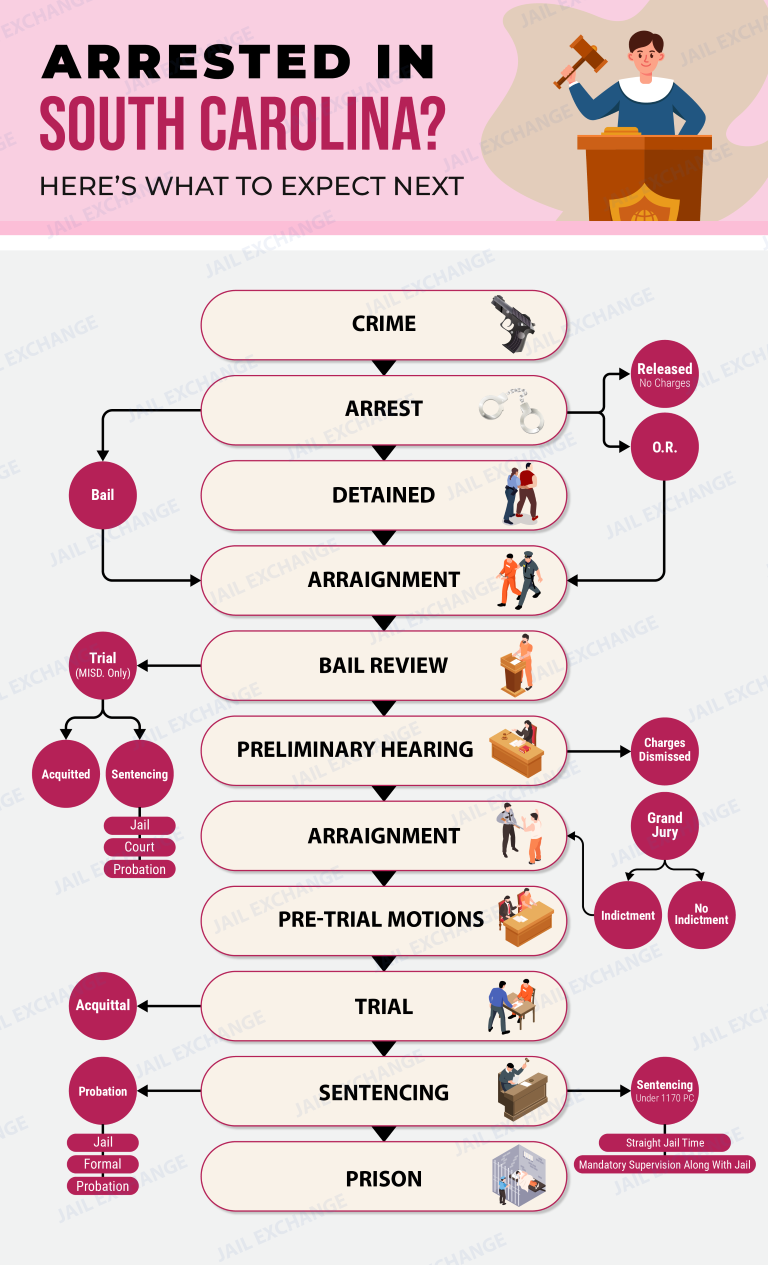
McDaniel Supply Company (operated online through the Jail Pack Store) allows family members and friends to purchase pre-approved commissary care packages, snack bundles, meats, personal hygiene kits, and apparel sent directly to an incarcerated loved one. Each package is packed to comply with individual detention center security standards, ensuring smooth intake and housing unit delivery.
Important: Package Deadlines and Delivery Windows Vary
Detention centers do not manage care package deliveries under identical schedules. While some facilities allow weekly orders, others restrict deliveries to bi-weekly or monthly distribution windows, and spending limits vary from jail to jail. You should verify the facility's active cutoff schedule and order allowances by calling them directly. If an order is submitted after the weekly processing deadline, delivery will be held until the following cycle, leaving your loved one waiting an extra cycle for fresh snacks, thermal wear, or personal care supplies.
Step-by-Step Instructions to Place a Commissary Package Order
- Confirm the inmate's legal first and last name, date of birth, and assigned booking or inmate ID number.
- Navigate to www.jailpackstore.com or mcdanielsupplyco.net.
- Select your state and detention center to open the jail's authorized merchandise catalog.
- Search for the inmate to link the purchase directly to their active housing record.
- Select allowable snack foods, candies, personal care goods, and clothing items up to the facility's allowed spending limit.
- Proceed to checkout, enter your debit or credit card billing details, and submit payment.
- Save your digital receipt and confirmation tracking number for your records.
What the Inmate Needs to Do
The inmate does not need an internet account to receive care packages. McDaniel Supply Company prepares the order in secure, tamper-evident packaging and delivers it directly to the jail commissary department. Facility staff inspect the shipment and deliver the items during regular housing unit commissary rounds, where the inmate signs for receipt.
Official Providers: Jail Pack Store | McDaniel Supply Company
Customer Service Telephone: 1-800-822-9388 or 1-912-427-9022
Support Hours: Monday – Friday, 8:00 AM – 5:00 PM EST
Supported Languages: English and Spanish
Other Services Provided by McDaniel Supply Company
In addition to Commissary Care Packages, McDaniel Supply provides trust deposit services at participating facilities:
- Inmate Trust Money Deposits: Send money directly into an inmate's jail trust account for independent canteen shopping.
• Learn more on our website: Inmate Trust Deposits Guide | • Visit official vendor page: Jail Pack Store Deposits
Buy Commissary for an Inmate in the Marion County Detention Center
Marion County Detention Center Inmate Commissary - Sending Money or Purchasing Commissary for an Inmate
Marion County Detention Center allows inmates to purchase commissary. This can be snacks, hygiene products, stamps, stationary, clothing and even electronics.
You can buy commissary for an inmate using an online service called McDaniel Supply Company / jailpackstore.com.

There is a monthly limit of $200-300 on how much inmates can spend on commissary items.
This amount is subject to change so call the facility at 843-423-0121 in order to confirm the amount that cannot be exceeded.
Inmates have access to both an in-house commissary store, and commissary packages that can be purchased and shipped to the inmate by friends and family.
Scroll down for information on the Marion County Detention Center's service they use for you being able to purchase commissary items online and have them shipped directly to the inmate.
You can also go to our Inmate Money page for information on how to send money to an inmate.
McDaniel Supply Inmate Trust Deposits allow friends and family members to transfer money directly into an incarcerated person's jail trust and canteen account using a credit or debit card online. Deposited funds give your loved one the financial balance needed to buy personal care goods, over-the-counter medical supplies, stationery, and snacks from the facility commissary.
Important: Facility Banking Policies Vary Across Jails
Once a person is booked and moved to a housing unit, facilities do not always allow cash drop-offs or phone payments directly to the jail window. Some might and you should confirm this by calling the facility and asking. But if you do not register online and fund your loved one's trust account immediately, they may be forced to wait days or weeks for standard paper processing, leaving them without essential soap, clean undergarments, basic medical sundries or snacks.
Step-by-Step Instructions to Register and Deposit Funds
- Confirm the inmate's legal first and last name, date of birth, and assigned booking or inmate ID number.
- Navigate to www.jailpackstore.com on your computer or mobile device.
- Click on Secure Inmate Deposit or Make a Deposit.
- Select the state and facility where the inmate is currently detained.
- Search for the inmate to confirm their active housing record matches the facility ledger.
- Enter your deposit dollar amount, review convenience fees, and enter your debit or credit card billing details.
- Submit payment and save the digital confirmation receipt for your financial records.
What the Inmate Needs to Do
The inmate does not need an internet account to receive funds. Once the electronic transaction clears, the balance posts directly to their jail trust ledger according to facility accounting schedules. The inmate can review their updated balance at a dayroom kiosk terminal or on their weekly trust statement and place orders on their regular commissary day.
Official Providers: Jail Pack Store | McDaniel Supply Company
Customer Service Telephone: 1-800-822-9388 or 1-912-427-9022
Support Hours: Monday – Friday, 8:00 AM – 5:00 PM EST
Supported Languages: English and Spanish
Other Services Provided by McDaniel Supply Company
In addition to Trust Money Deposits, McDaniel Supply provides direct care package delivery:
- Commissary & Care Packages: Order pre-approved snack boxes, food packages, and clothing directly to the jail.
• Learn more on our website: Commissary Orders Guide | • Visit official vendor page: Jail Pack Store Commissary
Deposit Money for an Inmate in the Marion County Detention Center
The U.S. mail is closed to money at the Marion County Detention Center, 2715 E. Highway 76, Suite D, in Mullins. Cash, checks and postal money orders sent that way are refused. Everything runs through one company instead, either online or at the jail's lobby kiosk.
From a computer or phone
Sign in or sign up at Jail Pack Store, search by the person's name or account number, and pay. The service fee rises or falls with the amount, and an email confirmation arrives afterward. That same account also lets you buy commissary items for the person outright rather than sending money.
At the lobby kiosk
Cash carries a $3.00 fee. A credit or debit card carries the same fee you would pay online.
How commissary runs
Orders are processed once a week and arrive on Fridays. Snack packs can be ordered any day. Someone with an empty account can still get hygiene items and writing kits.
The Marion County Detention Center in Mullins sends all personal mail to an off-site mail-scanning service. Each letter that meets the rules is scanned within 24 hours, staff review it, and the inmate reads it on a tablet. The paper is then destroyed, so never mail an original photo, document or anything you can't replace. Scanning keeps out paper soaked in drugs and dried. Legal mail and publications go to the jail in Mullins.
Personal mail (scanned):
Inmate's Full Name & Inmate ID number
Marion County Detention Center
Facility ID#: 5118
PO Box 18247
Greensboro, NC 27419
Legal mail and publications (to the jail):
Inmate's Full Name & Inmate ID number
Marion County Detention Center
2715 East Highway 76, Ste D
Mullins, SC 29574
- Required on every envelope: The facility name, the state, the inmate's name and their inmate ID number, or the mail is not processed. Find the ID number on the current inmates list or by calling 843-423-8216. Add your first and last name and full return address.
- What you can send: Written or typed pages, photos, drawings and greeting cards, up to 10 pages per envelope, no larger than 8.5 x 11 inches. No Polaroids.
- Not allowed: Glitter, glue, tape, 3D pieces, cards with lights or music, nude or partly clothed photos, and anything about gangs, drugs, violence or sex. Don't send birth certificates, ID cards or other important originals.
- Postage: Marion refuses anything that shows up with postage due.
- No money by mail: The jail takes no cash, checks or postal money orders through the mail. Deposits are made online instead.
- Legal mail: Mark it "Legal Mail" and send it to the Mullins address. The inmate is the one who opens it, with an officer watching.
- Publications: One per shipment, new and in its original packaging, bought by family or friends from a publisher or national distributor, and no bigger than 8.5 x 11 inches (newspapers excepted).
- Books: Mailed books are no longer accepted, except the main religious book of the inmate's faith, such as a Bible or Quran. Tablets carry a free library of more than 30,000 e-books.
- Keeping things: An inmate may keep one personal book plus one magazine or newspaper, besides a religious book. Old issues are thrown out when swapped, and subscriptions that arrive after release or transfer are discarded.
After release, a former inmate can ask the Detention Center by email for digital copies of their scanned mail. Electronic messages on the tablets cost less than a stamp.
PayTel Communications provides telecommunications services that allow incarcerated individuals to place outbound calls from housing units to family and friends. Because correctional facilities do not accept incoming calls, establishing a PayTel prepaid account links calling funds directly to your 10-digit telephone number so calls connect without carrier restrictions.
Important: Mobile Phones Automatically Block Inmate Calls
Mobile cellular carriers automatically block collect calls originating from jail phone systems. While some residential landlines might allow direct monthly billing, mobile phones and internet-based lines require an active prepaid balance, which you can verify by checking with your provider. If you do not register online and fund your account right away, your loved one will receive an automated operator message stating that your number cannot accept calls.
Step-by-Step Instructions to Register and Fund a Phone Account
- Visit www.paytel.com or call PayTel customer service at 1-800-729-8355.
- Click Open an Account and register using your primary 10-digit telephone number and email address.
- Select the state and facility where the inmate is currently detained.
- Link the inmate to your profile using their full legal name and booking ID number.
- Select your deposit dollar amount and complete payment using a credit or debit card.
- Confirm that your mobile phone allows calls from automated or unknown correctional numbers.
What the Inmate Needs to Do
The inmate dials your 10-digit number from any dayroom phone and enters their assigned PIN. The automated system verifies that your phone number has an active prepaid balance and prompts you to accept the call. All non-privileged conversations are recorded and monitored by facility staff.
Official Provider: PayTel Official Website
Customer Service Telephone: 1-800-729-8355
Support Hours: Monday – Friday, 8:00 AM – 9:00 PM EST; Saturday, 9:00 AM – 6:00 PM EST
Supported Languages: English and Spanish
Other Services Provided by PayTel Communications
In addition to Prepaid Phone Calling Accounts, PayTel provides digital communications at participating facilities:
- Inmate Messaging & Digital Communications: Send electronic messages and photos directly to an inmate's terminal.
• Learn more on our website: Inmate Messaging Guide | • Visit official vendor page: PayTel Messaging
PayTel Inmate Messaging provides a two-way digital communication platform that allows families to exchange electronic text messages and digital photo attachments with an incarcerated loved one. Messages are delivered directly to the inmate's terminal or tablet screen within hours, bypassing long postal mail processing times.
Important: Digital Mail Screening Rules Vary by Facility
Inmates cannot receive incoming phone calls, and traditional postal mail rules differ across jurisdictions. While some detention centers still allow regular handwritten letters, many facilities now restrict physical paper mail or mandate electronic messaging, which you can verify by checking facility rules. If you do not register online and set up message credits immediately, your loved one may face lengthy periods without direct written contact from family.
Step-by-Step Instructions to Register and Send Messages
- Go to www.paytel.com or launch the PayTel mobile app.
- Register your account, complete identity verification, and link your incarcerated contact.
- Navigate to the Messaging section of your dashboard.
- Purchase messaging credits using a credit or debit card.
- Type your message and attach approved JPEG photos if permitted by facility guidelines.
- Send your message to the facility's screening queue.
What the Inmate Needs to Do
All electronic correspondence is screened by correctional staff before delivery. Once approved, messages appear in the inmate's inbox on their housing unit terminal or tablet. The inmate opens the message, reads your note, and types an electronic reply using available account credits.
Official Provider: PayTel Official Website
Customer Service Telephone: 1-800-729-8355
Support Hours: Monday – Friday, 8:00 AM – 9:00 PM EST; Saturday, 9:00 AM – 6:00 PM EST
Supported Languages: English and Spanish
Other Services Provided by PayTel Communications
In addition to Inmate Messaging, PayTel provides telephone calling accounts at participating facilities:
- Prepaid Phone Calling Accounts: Prepay for telephone calling minutes so your loved one can call your mobile phone directly.
• Learn more on our website: Prepaid Calling Accounts Guide | • Visit official vendor page: PayTel Prepaid Calling
PayTel Communications provides secure handheld wireless tablets designed specifically for correctional housing units. Operating over a private, encrypted facility network, these devices allow incarcerated individuals to make phone calls, exchange digital messages, access legal research materials, complete rehabilitative courses, stream approved media, and submit facility requests directly from their cells.
Important: Tablet Hardware Deployment and Rental Rules Vary
Detention centers do not manage tablet distribution identically. While some agencies issue individual personal tablets to every detainee at booking, others utilize shared pod docking stations or restrict tablet use to specific dayroom hours, which you should confirm with the facility directly. Although core educational and legal resources are generally provided free of charge, sending messages, listening to music, or making phone calls from the tablet requires an active balance funded by outside contacts.
Step-by-Step Instructions to Support and Fund PayTel Tablets
- Confirm that PayTel handheld tablets are active at your loved one's specific detention facility.
- Navigate to www.paytel.com or launch the PayTel mobile app.
- Sign into your verified user profile and link the inmate's legal name and booking ID number.
- Select Tablet Services / Messaging or Inmate PIN Debit to add funds.
- Specify your deposit dollar amount, review convenience fees, and enter your credit or debit card billing details.
- Submit payment, save your confirmation receipt, and notify your loved one that their device balance is available.
What the Inmate Needs to Do
The inmate unlocks their assigned tablet using their PIN. Their available balance appears on the screen, allowing them to download songs, read digital books, write messages, and place outbound telephone calls to approved contacts. Devices are docked during quiet hours and shift changes for secure recharging and data synchronization.
Official Provider: PayTel Official Website
Customer Service Telephone: 1-800-729-8355
Support Hours: Monday – Friday, 8:00 AM – 9:00 PM EST; Saturday, 9:00 AM – 6:00 PM EST
Supported Languages: English and Spanish
Other Services Provided by PayTel Communications
In addition to Tablet Services, PayTel provides calling and digital messaging options:
- Prepaid Phone Calling Accounts: Prepay for telephone calling minutes so your loved one can call your mobile phone directly.
• Learn more on our website: Prepaid Calling Accounts Guide | • Visit official vendor page: PayTel Prepaid Calling - Inmate Messaging & Digital Communications: Send electronic messages and photos directly to an inmate's terminal.
• Learn more on our website: Inmate Messaging Guide | • Visit official vendor page: PayTel Messaging
Nearby counties
- Jail (Main): 843-423-0121
- Sheriff: 843-423-8216
The Marion County Detention Center serves the following cities and towns of Marion County: Centenary, Gresham, Latta, Marion, Mullins, Rains and Sellers.