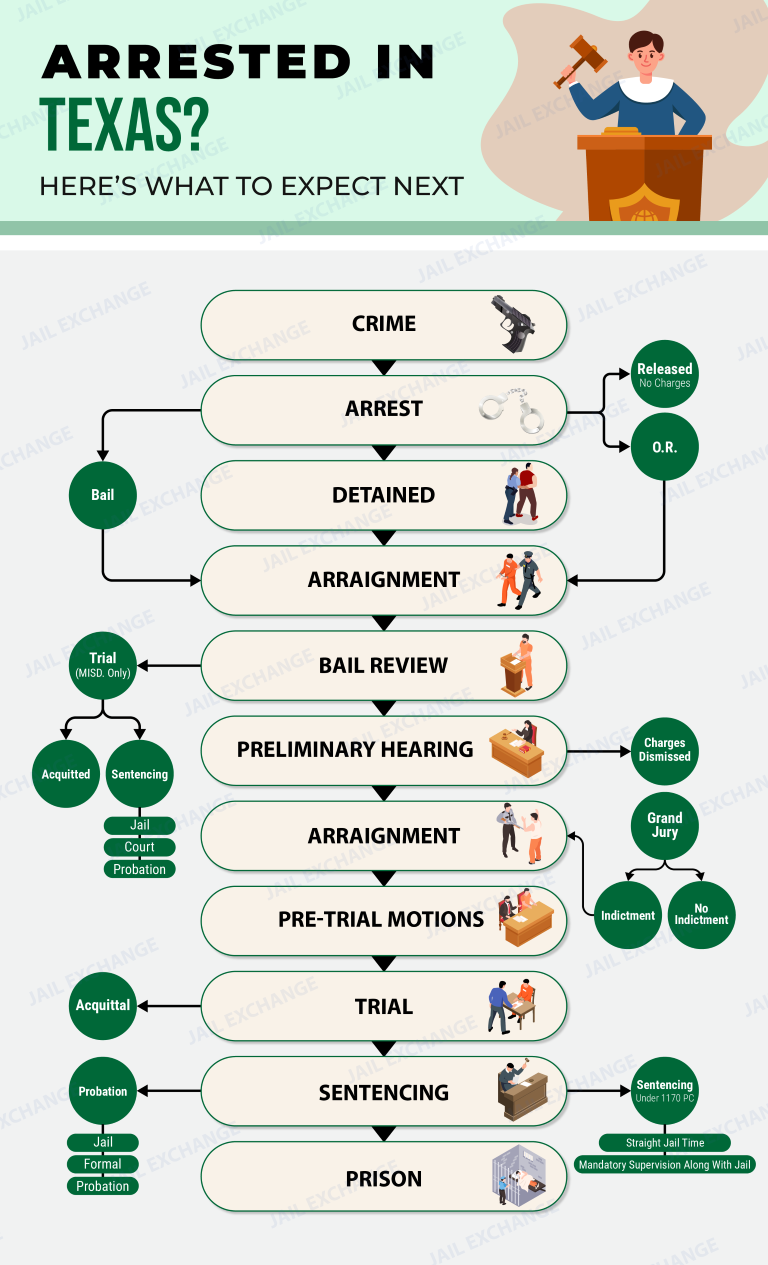
Allen City Jail Criminal Court Process
Criminal Court Process for Collin County Texas
Collin County Criminal Court Guide
Nearly every jailable charge from Plano, Frisco, Allen, Wylie, McKinney and the rest of the county is heard on the Bloomdale Road court campus, 2100 Bloomdale Road, McKinney, TX 75071. Adults are held in the Collin County Detention Facility, 4300 Community Avenue, McKinney, TX 75071, sometimes after a short stay in the Allen, Frisco, Plano, McKinney or Richardson city jail. Below you will find every local court, how cases move, who prosecutes and defends, warrant checks and date lookups.
To confirm the arrest, open the Sheriff's Current Inmate List, which shows charges and bond amounts. For the custody questions, our Jail Roster page helps with locating the person, new bookings, warrants, the charge sheet, mugshots, court-appointed counsel and property pickup.
Your first call depends on the charge level. The District Clerk handles felonies at 972-548-4320, while Class A and B files sit with the County Court at Law Clerks at 972-548-4185. Get the cause number, the court's name and the next setting date. If they are still in custody, our bail page explains each way out.
1. Which Collin County courts hear misdemeanors and felonies?
Which courtroom gets a case depends on its charge level. On the Collin docket:
- Felonies (state jail felony up to capital murder) go to the district courts. Their paperwork lives in the District Clerk's office on Bloomdale Road.
- Class A and B misdemeanors, the ones that can mean jail, go to the seven County Courts at Law. The County Clerk's County Court at Law Clerks keep those files.
- Class C misdemeanors, which carry a fine only, go to the four Justice of the Peace courts or to a city's municipal court.
- First hearings for people in jail happen in the Magistrate Court, which sets bond and decides probable cause but never guilt.
Appeals in criminal cases end at the Court of Criminal Appeals in Austin. A Texas Judicial Branch pamphlet maps every level.
↑ Back to the question list2. Where is the courthouse, and when are the clerks open?
Court business centers on the Russell A. Steindam Courts Building at 2100 Bloomdale Road, McKinney, TX 75071. The county's general line there is 972-548-4100.
- District Clerk, criminal, third floor of that building, 972-548-4320, Monday to Friday 8 a.m. to 4:30 p.m. It takes Visa, MasterCard and Discover for criminal filing fees, fines and costs. Copies of records from before 1988 take a written or in-person request, $5 per search and a day or two.
- County Court at Law Clerks, 2300 Bloomdale Road, Suite 2106, McKinney, TX 75071, 972-548-4185, and the Plano branch at 900 East Park Boulevard, Suite 140-A, Plano, TX 75074, 972-881-3025. Both are open weekdays 8 a.m. to 4 p.m. They do not take filings by fax.
- Magistrate Court, on the Bloomdale campus, 972-547-5485.
- Precinct 1 justice court in McKinney at 2300 Bloomdale Road, McKinney, TX 75071, 972-548-4125, weekdays 8:30 a.m. to 4 p.m.
- Precinct 2 justice court, 1025 South State Highway 78, Lavon, TX 75166, 972-547-1880, weekdays 8 a.m. to 4 p.m.
- Precinct 3 justice court, 920 East Park Boulevard, Plano, TX 75074, 972-881-3051, weekdays 8:30 a.m. to 4 p.m.
- Precinct 4 justice court, 8585 John Wesley Drive, Frisco, TX 75034, 972-731-7300, weekdays 8 a.m. to 4 p.m.
3. Which city and municipal courts handle tickets in Plano, Frisco and nearby towns?
Most cities in the county keep a municipal court, where fine-only tickets and city code cases are heard. The citation or bond paper names the right court. The state court office keeps a list of municipal courts by city with each court's contact details.
- Frisco's city jail, 7200 Stonebrook Parkway, Frisco, TX 75034, 972-292-6001, has a judge's arraignment room inside the police building.
- At the Richardson city jail, 200 North Greenville Avenue, Richardson, TX 75081, 972-744-4820, arraignment is usually held once a day, around 11 a.m.
- Outside city limits, Class C cases go to the justice court for the precinct. The county's precinct map shows which one covers an address.
Each justice court has an online citation payment option that adds a 5% fee. Juveniles must pay in person by debit or credit card. A payment made after hours on a case with an active warrant does not recall the warrant until the next business day.
↑ Back to the question list4. What happens at magistration after an arrest?
Magistration comes first for everyone booked at the McKinney jail. The Sheriff's Office says it runs twice daily, usually 8 to 11 a.m. and 2 to 5 p.m. Only the person's lawyer can attend, but family can watch on video in the jail lobby.
Under Texas law this hearing must happen within 48 hours of arrest (Code Crim. Proc. art. 14.06). Its warnings cover:
- the accusation, along with any sworn statement behind it;
- the right to retain counsel, plus how to ask for a free one;
- that they can stay silent, have a lawyer present for questioning and stop any interview;
- that they may ask for an examining trial;
- the fact that statements may be used as evidence (Code Crim. Proc. art. 15.17).
The magistrate then sets bond and any conditions. A ruling of no probable cause has to be backed by written findings inside 24 hours (Code Crim. Proc. art. 15.17(h)).
↑ Back to the question list5. How do DWI, theft and assault misdemeanors move through County Court at Law?
Jailable misdemeanors start when the prosecutor files a charging paper called an information in one of the seven County Courts at Law. From there a case usually runs through these stages:
- Arraignment. The court reads the accusation and asks the defendant to plead (Code Crim. Proc. art. 26.01).
- Pretrial settings. Discovery is shared, and the defense and the prosecutor may negotiate.
- Plea or trial. If the judge won't follow a plea deal, the person may take the plea back (Code Crim. Proc. art. 26.13).
Penalties under the Penal Code (chapter 12):
- Class A: county jail for one year or less and a fine capped at $4,000, either or both.
- Class B: up to 180 days in county jail and a fine capped at $2,000, either or both.
- Class C: a fine up to $500 and no jail.
Deferred adjudication can last up to two years on a misdemeanor, and the case is dismissed if every term is met (Code Crim. Proc. art. 42A.103). County Court at Law No. 7 runs a DWI/Drug Court, and County Court at Law No. 6 runs a Misdemeanor Veterans Court.
↑ Back to the question list6. How does a Collin County felony move toward trial?
Felony cases follow a longer path through the district courts on Bloomdale Road:
- Examining trial. Before indictment, the accused can ask a judge to test whether there is probable cause (Code Crim. Proc. art. 16.01).
- Grand jury. An indictment needs votes from nine or more grand jurors (Code Crim. Proc. art. 20A.301).
- Arraignment and pretrial hearings in the district court that gets the case.
- Plea or trial. A jury or the judge decides guilt, and then punishment.
- State jail felony: at least 180 days and at most two years of state jail time, plus a possible $10,000 fine.
- Prison ranges: third degree, 2 to 10 years; second degree, 2 to 20 years; first degree, 5 to 99 years or life. Judges or juries may also impose a fine of as much as $10,000 at each level.
- Capital felony: a death sentence or life without parole. A defendant under 18 at the time can receive only life.
Prior convictions can raise the level (Tex. Penal Code 12.42). Felony deferred adjudication and probation can each run up to 10 years. Adult probation, called Community Supervision, works from 2100 Bloomdale Road, Suite 12262, McKinney, TX 75071.
↑ Back to the question list7. Do assault, robbery or murder charges follow stricter rules?
Serious violent charges bring tighter bond rules and longer waits:
- Many violent charges bar release on a personal bond (Code Crim. Proc. art. 17.03).
- Proposition 3 passed on November 4, 2025. It covers murder, robbery and kidnapping in their worst forms, sexual assault, trafficking, child indecency and some assaults. If the prosecutor proves flight risk or danger at a hearing, bail "shall be denied" (Tex. Const. art. I, §11d).
- A 2025 statute, S.B. 9, lets the state appeal a bail it calls too low in those cases. The accused stays in custody until the ruling.
- Bond can be revoked and bail denied after a violation in family violence or child sex cases (Code Crim. Proc. arts. 17.152, 17.153).
- In a family violence case, the first hearing can end with an emergency protective order. It runs 61 to 91 days. With a deadly weapon, it runs 91 to 121 days (Code Crim. Proc. art. 17.292).
Capital cases can end in death or life without parole (Tex. Penal Code 12.31).
↑ Back to the question list8. Does Collin County offer mental health, veterans or drug courts?
Yes. A county news release from March 26, 2026 lists these treatment courts. Each takes only people who qualify, and a lawyer can ask about a referral:
- Adult Mental Health Court, 219th District Court with County Court at Law No. 3, for misdemeanor or felony charges tied to serious mental illness.
- Family Preservation Drug Court, 199th District Court.
- North Texas Regional Veterans Court, 296th District Court, which also serves Rockwall, Grayson, Kaufman and Fannin counties.
- Drug Court in the 416th District Court, for some felonies linked to substance use.
- Misdemeanor Veterans Court, County Court at Law No. 6. The Criminal District Attorney must approve entry.
- DWI/Drug Court Program, County Court at Law No. 7.
The state keeps a registry of specialty courts. Most programs run 12 to 24 months.
↑ Back to the question list9. Who are the prosecutors and appointed defense lawyers in Collin County?
The Criminal District Attorney's Office handles state charges, from misdemeanors in the County Courts at Law to felonies in district court. Its address is 2100 Bloomdale Road, Suite 200, McKinney, TX 75071. Reach it through the county's Metro line, 972-424-1460.
There is no public defender office here. Lawyers for people who can't pay are private attorneys picked from an approved roster.
- Indigent Defense, 2100 Bloomdale Road, McKinney, TX 75071, 214-491-4824, weekdays 8 a.m. to 4 p.m. with a noon hour off. Apply with the online Application for Court Appointed Counsel.
- Mental Health Managed Counsel Program, 2100 Bloomdale Road, Suite 20209, McKinney, TX 75071, 214-491-4805.
- The county's appointment rules are in its felony plan and misdemeanor plan.
Here, with a population past 250,000, the court gets one working day from receipt of the request to choose counsel (Code Crim. Proc. art. 1.051). The judge looks at income, debts and dependents, and may not deny a lawyer only because the person posted bond (Code Crim. Proc. art. 26.04). The state agency that checks county lawyer systems is the Texas Indigent Defense Commission, 209 West 14th Street, Room 202, Austin, TX 78701, 512-936-6994.
↑ Back to the question list10. Where can families search Collin court records and settings?
The county runs two free online tools. Start with either:
- Court Case Search, the county's main case lookup page.
- Judicial Online Search, for district and county court cases. The District Clerk says its online records reach back to 1988.
The statewide re:SearchTX site shows the court, case number and filed charges after a free sign-up, though hearing dates are left off. For a setting, call the clerk that holds the file: felonies at 972-548-4320, misdemeanors at 972-548-4185. The clerk will ask for a full name and birth date. For a Class C ticket, call the justice court or city court named on it.
For a paid statewide check of convictions, DPS offers its conviction database.
↑ Back to the question list11. Is there a Collin County warrant, and how is it resolved?
Warrants here are carried out by deputies, by the four precinct constables and by city officers. Check names on the county's active warrant search, and see the constables' warrant pages for Precinct 1 and Precinct 3. Statewide, see Texas 10 Most Wanted from DPS. Phone checks go to the Sheriff's Office, 972-547-5100, or to the Magistrate Court, which issues warrants, 972-547-5485. Before clearing it, get a defense attorney on the phone. Then either surrender at the jail, 4300 Community Avenue, McKinney, TX 75071, whose bonds window never closes, or have the issuing court reset the case. Felony warrant records are kept by the District Clerk, 2100 Bloomdale Road, McKinney, TX 75071, 972-548-4320.
↑ Back to the question list12. How does a federal prosecution from Plano or McKinney unfold?
A federal charge from the Collin area is filed in the Eastern District of Texas, Sherman Division. Its two courthouses:
- United States Courthouse, 7940 Preston Road, Room 101, Plano, TX 75024, 214-872-4800
- Paul Brown United States Courthouse, 101 East Pecan Street, Room 216, Sherman, TX 75090, 903-892-2921
- Prosecution comes from the U.S. Attorney's Plano office, 101 East Park Boulevard, Suite 500, Plano, TX 75074, 972-509-1201.
- A detention hearing, normally at the first court date, settles release or custody until trial (18 U.S.C. 3142).
- The U.S. Marshals keep anyone who is held. Their Plano office is at 214-705-9850.
- The Federal Public Defender's Frisco office, 7460 Warren Parkway, Room 270, Frisco, TX 75034, 469-362-8506, defends people who can't pay.
- For anyone given federal prison time, check the Federal Bureau of Prisons locator.
13. Will an immigration detainer stall or end the McKinney case?
No. Charges still move ahead in county or district court. A detainer only changes the moment of release:
- Federal immigration agents send the jail a Form I-247A.
- Bond, a dismissal or a served sentence would normally end custody. Instead the jail may hold the person up to 48 hours after they would otherwise be released (8 CFR 287.7(d)).
- State law (Code Crim. Proc. art. 2A.060) makes Texas jails follow detainers, with an exception for a person who proves lawful immigration status. State law since 2017 also forbids local policies that limit enforcement (Tex. Gov't Code 752.053).
- ICE's Dallas Field Office, 8101 North Stemmons Freeway, Dallas, TX 75247, 972-367-2200, then takes custody.
- Find the person through the ICE Online Detainee Locator.
A defense lawyer should weigh the immigration effects of any plea before it is entered. Separately, S.B. 8 (2025) set a December 1, 2026 deadline for every jail-running county to pursue a 287(g) partnership with ICE.
↑ Back to the question list14. Where is a Texas prison or state jail sentence served?
A state jail felony sentence is carried out in a state jail. Any felony of the third degree or higher means prison time with TDCJ (Tex. Penal Code 12.35). After sentencing in a district court on Bloomdale Road, the person returns to the county jail and waits for TDCJ transport. Intake staff then classify them and assign a unit.
- The TDCJ inmate search looks people up by TDCJ number, SID number, or exact surname with an initial.
- Our Texas state prison directory covers each unit's visits and mail.
15. What does Collin County juvenile court do with a 10 to 16 year old?
Juvenile court handles offenses by kids aged 10 to 16. By 17, Texas law counts a person as an adult (Tex. Family Code 51.02). A child arrested locally is taken to the county's John R. Roach Juvenile Detention Center, where an intake officer reaches a parent.
- A child held after intake sees the Juvenile Court at a detention hearing. The county holds these every business day, usually the day after arrest.
- Families who have not hired counsel get a court-approved lawyer for that first hearing. The county's juvenile appointment plan sets the rules.
- At 14 or 15 and older, depending on the charge, a judge can move a serious felony case to adult court after a hearing (Tex. Family Code 54.02).
- The 417th District Court runs the SOAR Drug Court and the GEMS and RISE Mental Health Court programs for youth.
Detention Intake: 972-547-5400, any hour. Juvenile Court Liaison: 972-547-5402. Juvenile Probation: 4690 Community Avenue, McKinney, TX 75071, 972-548-6470.
↑ Back to the question list16. Which rights and services protect victims of a crime here?
Texas law gives crime victims a list of rights (Code Crim. Proc. art. 56A.051). Among them:
- safety considered by the magistrate at the bail stage;
- to get notice of court hearings, if they ask;
- to give a victim impact statement before sentencing;
- to wait apart from the defendant before testifying.
Custody alerts on booking, release or transfer come from Texas IVSS-Counties. Register online or by phone at 866-268-8959 any time, in English or Spanish. Registration is free, and the inmate never learns who signed up. The Sheriff's Office runs a Victim Assistance Program. Medical bills, counseling and lost wages may be covered up to $50,000 by the Attorney General's victim compensation program. Phone 800-983-9933.
↑ Back to the question list