
Garland Detention Center
Garland Detention Center
Jail Phone Number
972-485-4890Garland posts no public roster for its jail. Call the Garland Detention Center at 972-485-4890, or walk up to jail staff in the lobby, and ask whether the person is in custody. Have their full name and date of birth ready. Someone answers around the clock, since the jail runs 24 hours a day, every day.
This is a holding jail run by the Garland Police Department, with room for 137 adults and a separate processing area for juveniles. The city says most prisoners stay less than 72 hours before they are released or moved. People charged with a Class B misdemeanor or anything more serious go to the Dallas County Jail once their case is ready to be filed with the Dallas County District Attorney. Juveniles are normally held no more than six hours before going home with a parent or guardian or to a Dallas County Juvenile Department facility. People serving a sentence on a Garland Municipal Court misdemeanor may stay longer.
Step by step: finding someone who left Garland
- Search the Dallas County Sheriff's Jail Lookup by name.
- Write down the book-in number. You will need it for letters and deposits.
- No result? Call Dallas County jail information at 214-761-9025.
- Read our Lew Sterrett Justice Center page for that jail's rules.
When is arraignment in Garland?
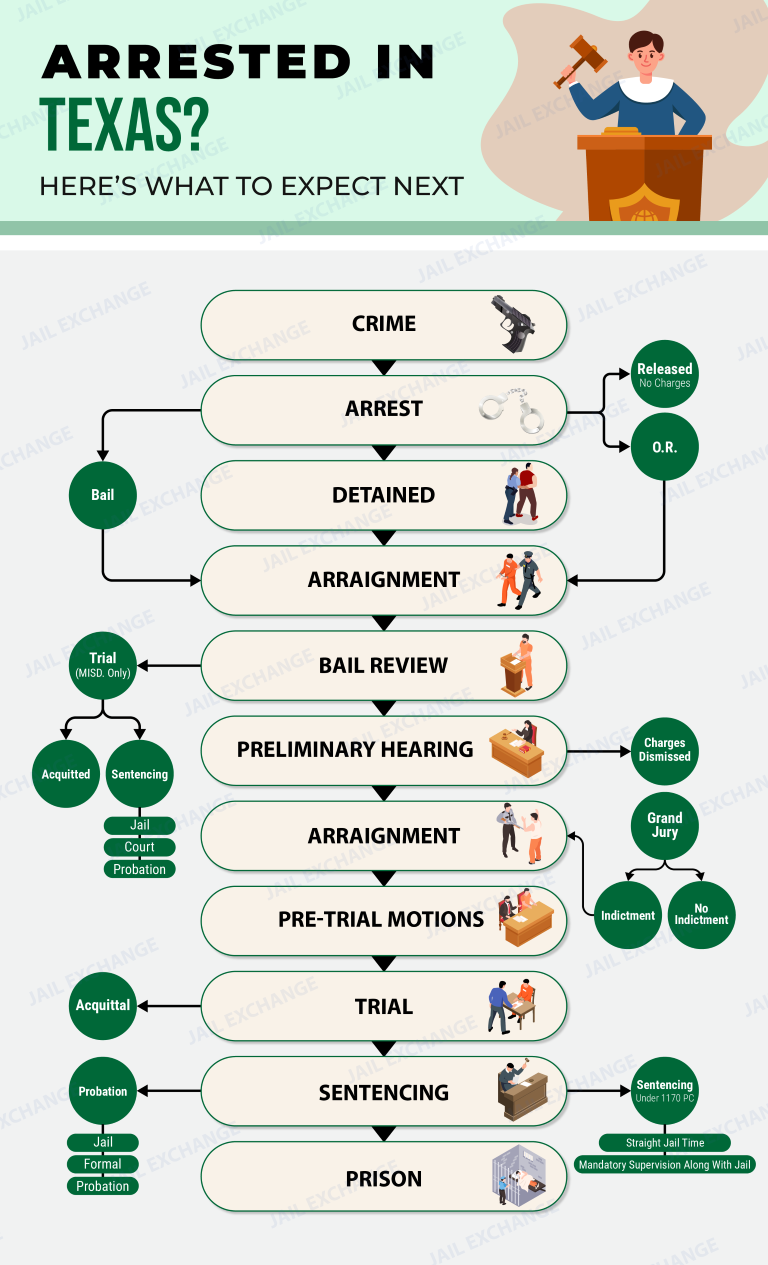
The city says prisoners are generally arraigned every day between 8 a.m. and 2:30 p.m. Under Texas law, as the Texas Indigent Defense Commission summarizes it, an arrested person must go before a magistrate within 48 hours.
Is there a warrant or a court case?
For Garland warrants, call Garland Municipal Court at 972-205-2330. For Dallas County warrants, call 214-761-9026. Dallas County court cases are searchable on the county's court portal.
Visits, calls and letters
Garland holds short in-person visits twice a week; times and rules are on our visiting page. Prisoners get a few free calls after booking and can place collect calls from the cell area, but they cannot take incoming calls; county jail phone accounts are on the phone calls page. Send letters only after the person reaches the county jail, using our mail instructions.
To get someone out of the Garland Detention Center, start by calling the jail at 972-485-4890. The judge sets bond at arraignment, which in Garland is generally held every day between 8 a.m. and 2:30 p.m. Ask the jail what bond was set and how it can be posted. Garland does not publish its accepted bond payments or bond hours for the jail, so that phone call is the only way to learn them. Bonds cannot be posted online.
Timing matters. Garland is a holding jail, and people charged with a Class B misdemeanor or higher are taken to the Dallas County Jail once the case is ready for the Dallas County District Attorney. After that move, the bond is posted with Dallas County, not Garland.
Garland ticket or county charge: what is the difference?
- Garland Class C case: Garland Municipal Court handles it. If the person is held in another city's jail on a Garland Class C ticket, someone must go to the Brad Neighbor Municipal Court during regular business hours to post the bond or pay the fine. Call the court at 972-205-2330 first.
- Class B, Class A or felony: a Dallas County case. The bond is paid to Dallas County.
How do I post bond at the Dallas County jail?
Go to the Bond Desk at the Lew Sterrett Justice Center, 111 West Commerce Street, Dallas, TX 75202. It is open all day and all night. Bring cash, a cashier's check or a money order payable to "Dallas County"; checks and money orders must come from a local DFW bank, and the clerk will want proof of purchase. Debit and credit cards are not accepted for cash bonds. To check the bond amount first, call 214-761-9025.
Should I use a bondsman?
A licensed bail bond company can post the bond for a fee. Do not pay anyone who asks for bond money by phone app; the Sheriff says those requests are scams. Pay a real bond company or the Bond Desk in person.
Refunds and missed court
The Sheriff does not refund cash bonds; the Dallas County Clerk or District Clerk handles that after the case. If the person skips a court date, the bond can be lost and a new warrant issued.
Visiting at Garland Detention Center
Call 972-485-4890 before going to the jail lobby at 1900 W. State Street, Garland. Confirm the person is still there and willing to see you. If they have been transferred, ask where they are held and contact that jail to arrange a visit.
- Sunday: 8–10 a.m.
- Wednesday: 7–9 p.m.
Bring state-issued photo ID and be ready to give the name of the person you want to visit. Visits usually last 10 minutes. The city requires visitors to be at least 17, accompanied by a qualifying parent, or able to show they are the person’s spouse. If this affects you, confirm what documents to bring when you call.
Texas criminal courtDallas County Criminal Court Guide
In Dallas County, felony and misdemeanor judges work in the Frank Crowley Courts Building, 133 N. Riverfront Boulevard, Dallas, TX 75207. People who aren't released stay at the Lew Sterrett Justice Center, 111 West Commerce Street, Dallas, TX 75202, in the North Tower (maximum security), West Tower (men; medical and mental health housing) or Suzanne Lee Kays Detention Facility (direct supervision). Suburban police use short-stay city jails. This guide maps the courts, each step of a case, lookups and warrants.
Not sure the person is still behind bars? Search the Sheriff's online jail lookup by name. Arrest and custody questions get answered on our Inmates in Custody section, which follows people held today, this week's bookings, warrant checks, filed charges, mugshots, public defenders and property pickup.
Which judge has the case? Phone a clerk. Felonies: the District Clerk's criminal section, 214-712-3088. Misdemeanors: the County Clerk's criminal courts office, 214-653-7099. Ask for the case number, court number and next setting. Bond help is on our Lew Sterrett bail page.
1. Which Dallas County judges handle felonies versus misdemeanors?
Texas assigns a case by its charge level. Here is the local layout:
- Felonies, from state jail felonies up to capital murder, belong to district courts. This county has seven Criminal District Courts (No. 1 to 7) plus the 194th, 195th, 203rd, 204th, 265th, 282nd, 283rd, 291st, 292nd and 363rd District Courts. There are also Auxiliary Courts 1, 6 and 8, where felony magistrates sit. The District Clerk keeps these files.
- Class A and B misdemeanors land in County Criminal Courts No. 1 through 11. Two County Criminal Courts of Appeals, No. 1 and No. 2, round out the county level. The County Clerk keeps these files.
- Class C offenses carry only a fine. Justice courts and city municipal courts hear them.
Every criminal courtroom listed above sits in the Frank Crowley Courts Building, 133 N. Riverfront Boulevard, Dallas, TX 75207. The last stop for any appeal is the Texas Court of Criminal Appeals. For felony records, call the District Clerk's criminal division at 214-653-5964.
↑ Back to the question list2. Where at Frank Crowley are the criminal clerks and offices?
Almost every criminal office is under one roof at the Frank Crowley Courts Building, 133 N. Riverfront Boulevard, Dallas, TX 75207. Clerk windows keep weekday hours, 8:00 a.m. to 4:30 p.m.
- District Clerk, felony section: 2nd floor. 214-712-3088; criminal records 214-653-5954.
- County Clerk, criminal courts: 2nd floor, Room A-1. 214-653-7099.
- Criminal District Attorney: mail box LB 19. 214-653-3600.
- Public Defender: 9th floor. 214-653-3550.
- Pretrial Services: Room A9 on the 1st and 2nd floors. 214-875-2302.
- Bail Bond Board: mail to LB-31. 214-653-2756.
Other buildings matter too. The jail is the Lew Sterrett Justice Center, 111 West Commerce Street, Dallas, TX 75202, with a 24-hour line at 214-761-9025. Youth cases are handled at the Henry Wade Juvenile Justice Center, 2600 Lone Star Drive, Dallas, TX 75212, 214-698-2200. The Public Defender's family division works in the George Allen Courts Building, 600 Commerce Street, Suite 465-G, Dallas, TX 75202, 214-653-6153. Federal cases are heard at 1100 Commerce Street, Dallas, TX 75242.
↑ Back to the question list3. Where do Class C tickets go: justice of the peace or city court?
Fine-only Class C cases, such as many traffic and public intoxication tickets, are handled close to home. The top fine is $500 and there is no jail time (Penal Code 12.23). The county has five justice precincts with two courts each:
- Precinct 1, Places 1 and 2: South Dallas Government Center, 8301 S. Polk Street, Dallas, TX 75232. Place 1 972-228-0280; Place 2 972-228-2272.
- Precinct 2, Place 1: 140 N. Garland Avenue, Garland, TX 75040, 214-643-4773.
- Precinct 2, Place 2: Mesquite Government Center, 500 S. Galloway Avenue, Suite P200, Mesquite, TX 75149, 972-285-5429.
- Precinct 3, Places 1 and 2: North Dallas Government Center, 6820 Lyndon B. Johnson Freeway, Dallas, TX 75240. Place 1 214-321-4106; Place 2 214-904-3042.
- Precinct 4, Places 1 and 2: Grand Prairie Government Center, 106 W. Church Street, Grand Prairie, TX 75050. Place 1 214-751-4040; Place 2 214-589-7000.
- Precinct 5, Place 1: moved from the closed St. Francis site to 9731 Lake June Road, Dallas, TX 75217, 214-943-6980.
- Precinct 5, Place 2: Oak Cliff Government Center, 702 E. Jefferson Boulevard, Suite 2100, Dallas, TX 75203, 214-943-5981.
Each city also has its own municipal court for tickets written inside city limits. Official addresses for some of them:
- Balch Springs: 3117 Hickory Tree Rd, Balch Springs, TX 75180
- Cedar Hill: 285 Uptown Blvd, #200, Cedar Hill, TX 75104
- Coppell: 130 Town Center Blvd., Coppell, TX 75019
- Farmers Branch: 3723 Valley View Ln, Farmers Branch, TX 75244
- Garland: 1791 Avenue B, Garland, TX 75042
- Lancaster: 220 W. Main St., Lancaster, TX 75146
- Mesquite: 211 Municipal Way, Mesquite, TX 75149
For any other city's court, check the state's municipal courts by city list or the phone number on the ticket. If paying is hard, the judge can allow installments, community service (credited at $150 per 8 hours) or a waiver. Jail for nonpayment comes only after a hearing (CCP art. 45A.252).
↑ Back to the question list4. What happens at the magistrate hearing and the first court setting?
Within 48 hours, the person sees a magistrate at Lew Sterrett (CCP art. 15.17). That official reads the accusation and lists the person's rights: silence, a lawyer, ending any interview, and an examining trial on a felony. The person also hears that their words may be used as evidence. Bail is set, and any request for a free lawyer is taken.
Next, the prosecutor decides what to file. The Criminal District Attorney's felony intake line is 214-653-3848. The misdemeanor division answers at 214-653-3700.
- On a felony, a person may ask for an examining trial, a probable cause hearing held before indictment (CCP art. 16.01). Use the request form on the felony courts' site.
- Arraignment is where the person's identity is confirmed and a plea is entered. It is required for felonies after indictment and for misdemeanors that carry jail time (CCP art. 26.01). A lawyer can waive it in writing.
- After that come pretrial settings. Lawyers trade evidence, file motions and may negotiate.
When a magistrate finds no probable cause, written findings must follow, and a 2025 law gives 24 hours for that (CCP art. 15.17(h)).
↑ Back to the question list5. How does a misdemeanor like DWI, theft or assault move through County Criminal Court?
A misdemeanor is filed by an "information," a charging paper from the prosecutor, and lands in one of the eleven County Criminal Courts. The usual path is arraignment, then one or more pretrial settings, then a plea or a trial. The level of the charge, not its name, sets the range:
- Class A (Penal Code 12.21): jail of up to a year, a fine of up to $4,000, or the two together.
- Class B (Penal Code 12.22): jail of up to 180 days, a fine of up to $2,000, or the two together.
- Class C (Penal Code 12.23): a fine capped at $500, with no jail.
Two outcomes avoid a conviction or jail. Deferred adjudication lets the judge hold off on a guilty finding for up to two years (CCP art. 42A.103). Finish it, and the judge dismisses the case (CCP art. 42A.111). Community supervision, often called probation, can also run up to two years (CCP art. 42A.053). The misdemeanor courts' probation line is 214-653-5370.
With a plea bargain, the judge must announce in open court whether to accept it. If the deal is rejected, the person may then take back the plea (CCP art. 26.13).
↑ Back to the question list6. How does a felony travel from grand jury to sentence?
A felony case here follows a set order:
- Magistrate and bail at Lew Sterrett.
- Examining trial, if the defense asks for one before indictment.
- Grand jury. Its work is secret. An indictment needs votes from at least nine grand jurors (CCP art. 20A.301).
- Arraignment, held by the assigned district court.
- Pretrial hearings on motions, evidence and any offer.
- Plea or trial, followed by sentencing.
Penalty ranges come from Penal Code chapter 12:
- State jail felony: 6 months to 2 years in a state jail facility.
- Third-degree felony: prison for 2 to 10 years.
- Second-degree felony: prison for 2 to 20 years.
- First-degree felony: prison for 5 to 99 years, or life.
- Capital felony: death or life without parole; a person under 18 at the time gets life.
- Each level except capital also allows a fine of up to $10,000.
Earlier convictions can push a case into a higher range (Penal Code 12.42). Some state jail felonies can be sentenced at the Class A level (Penal Code 12.44). Deferred adjudication and probation can each last up to ten years on a felony. Adult probation (the county's Community Supervision and Corrections Department) works from 1300 W. Mockingbird Lane, 3rd Floor, Dallas, TX 75247, 214-653-5300.
↑ Back to the question list7. Are the rules stricter for violent or high-level felonies?
Serious violent charges bring tighter rules at every stage:
- Bail. Most violent offenses make a personal bond impossible (CCP art. 17.03). Proposition 3 (2025) went further. It covers murder, several aggravated crimes, indecency with a child and trafficking. Once the prosecutor proves the need in such a case, a judge has to refuse bail (Tex. Const. art. I, sec. 11d).
- State appeal. The state may appeal a too-low bail in listed violent cases. A ruling is due within 20 days; meanwhile the defendant remains in custody (CCP art. 44.01).
- After a plea. A 2025 law keeps some people in custody from a guilty plea until sentencing on certain serious felonies (CCP art. 27.20).
- Deferred adjudication. It isn't available for most murder charges, some intoxication cases, certain trafficking cases and repeat sex offenses (CCP art. 42A.102).
- Family violence. A magistrate can sign an emergency protective order at the first appearance (CCP art. 17.292). It lasts 61 to 91 days. Cases with a weapon or serious injury get a longer order.
The Criminal District Attorney's family violence division takes calls at 214-653-3605.
↑ Back to the question list8. Which office prosecutes in Dallas County, and where are the public defenders?
The Criminal District Attorney handles felony and misdemeanor prosecutions alike. Its office is in the Frank Crowley Courts Building, LB 19, 133 N. Riverfront Boulevard, Dallas, TX 75207, 214-653-3600. Its juvenile section works from 2600 Lone Star Drive, 2nd Floor, Dallas, TX 75212, 214-698-2285.
For defense, the county Public Defender's Office gets priority when lawyers are appointed. It sits on the 9th floor at 133 N. Riverfront Boulevard, Dallas, TX 75207, 214-653-3550. Juvenile defenders are at 2600 Lone Star Drive, Suite A-132, Dallas, TX 75212, 214-698-4400.
- A free lawyer is requested at the magistrate hearing on a sworn money form (CCP art. 15.17).
- The felony plan covers people earning 150% of the poverty guideline or less who own $15,000 or less.
- It also covers anyone on SNAP, Medicaid, public housing, SSI or TANF.
- Someone already out on a felony can request a lawyer in Room A14 on the 5th floor of Frank Crowley, at the Criminal District Court Manager's Office.
- Once appointed, the lawyer must try to reach the client before the next working day ends (CCP art. 26.04).
The county's appointment rules are posted in the Texas Indigent Defense Commission plan library.
↑ Back to the question list9. Which online tools show a case, its charges and the next setting?
Three free tools cover most needs:
- County court portal. Search cases by name or number. Misdemeanor documents from 2011 forward can be viewed here.
- District Clerk case information. It shows the charge, the outcome and the case history.
- Criminal background search on the same portal.
The statewide re:SearchTX site needs a free account. It shows charging papers and judgments, but hearing dates come from the county. DPS also runs a paid conviction name search.
To confirm a date, call the clerk. Felony records: 214-653-5954. Misdemeanor courts: 214-653-7099. Spell out the name and birth date for the clerk.
↑ Back to the question list10. Could there be a Dallas County warrant, and what clears one?
Sheriff's deputies, the five constables' offices and city police all serve warrants. Call the Sheriff's warrant line at 214-761-9026 or the Warrants Section at 214-653-2700. Online, try the county's wanted person search, the city police warrant page (automated line 214-670-0109) and the DPS Texas 10 Most Wanted fugitive page. A defense attorney can set up a voluntary surrender with the judge who signed it; that court may also give a new date over the phone. Felony warrant records sit with the District Clerk: 2nd floor, 133 N. Riverfront Boulevard, Dallas, TX 75207, 214-712-3088.
↑ Back to the question list11. Who handles a federal arrest from Dallas County?
Federal prosecutions from here are filed in the Northern District of Texas, Dallas Division. The clerk works at 1100 Commerce Street, Room 1452, Dallas, TX 75242, in the Earle Cabell Federal Building, 214-753-2200.
- Prosecutor: the U.S. Attorney, 1100 Commerce Street, 3rd Floor, Dallas, TX 75242, 214-659-8600.
- Defense: the Federal Public Defender, 525 South Griffin Street, Suite 629, Dallas, TX 75202, 214-767-2746.
- Release: a detention hearing settles whether the defendant goes home before trial (18 U.S.C. 3142).
- Custody: the U.S. Marshals Service keeps federal prisoners before trial. Its office is Room 1657, 1100 Commerce Street, Dallas, TX 75242, 214-767-0836.
- After sentencing: the Federal Bureau of Prisons inmate locator shows where a sentenced person is.
↑ Back to the question list12. Does an ICE detainer affect bail, pleas or the state case?
Yes, in a few ways. First, the hold itself:
- ICE sends a detainer (Form I-247A).
- Lew Sterrett can keep the person up to 48 hours after they would otherwise be released (8 CFR 287.7(d)), even with the state bond paid.
- Texas makes the jail comply; showing proof of citizenship or lawful status is the way out (CCP art. 2A.060).
- ICE agents pick the person up. The Dallas ERO field office is at 8101 N. Stemmons Freeway, Dallas, TX 75247, 972-367-2200.
- To find someone afterward, use the ICE Online Detainee Locator.
Second, the court case. A non-citizen who pleads guilty or no contest first gets a deportation warning, both spoken and written (CCP art. 26.13). Talk to a defense lawyer about immigration effects before any plea. Certain appointed magistrates may not release someone with a detainer (CCP art. 17.027). In addition, local governments are barred from limiting immigration enforcement (Gov't Code 752.053). Every Texas county with a jail must, under a 2025 law, apply by December 1, 2026 for a 287(g) partnership with ICE. The Sheriff's Office can speak to local status.
↑ Back to the question list13. After a felony conviction, where does TDCJ send people?
County jail is where misdemeanor time is spent. Felony time belongs to the Texas Department of Criminal Justice, served either to a state jail or to prison, depending on the level.
After sentencing, the person usually waits at Lew Sterrett until TDCJ moves them to an intake unit. There they are assessed and then assigned to a unit suited to their custody level.
- The TDCJ inmate search finds people by last name plus a first initial, TDCJ number or SID number. Last names must match exactly, and results are a day old or more.
- Our Texas state prisons page describes each unit and its rules.
↑ Back to the question list14. How are 10- to 16-year-olds handled in juvenile court here?
Juvenile court in Texas covers children who were 10 through 16 when the offense happened. A person 17 or older at the time faces adult court instead (Family Code 51.02).
- Where they are held: the Dr. Jerome McNeil Jr. Detention Center inside the Henry Wade Juvenile Justice Center, 2600 Lone Star Drive, Dallas, TX 75212. Central Control: 214-698-4212.
- Detention hearing: the county holds it within 48 hours, after a lawyer is named. Family Code 54.01 allows up to two working days.
- Review: the judge must look at detention again at least every ten working days.
- Adult court: after a full hearing, a judge can send some cases to adult court. This applies at 14 for the gravest felonies and at 15 for other felonies (Family Code 54.02).
- Probation: the Juvenile Department intake screening line is 214-698-4313.
Both sides have juvenile teams on that campus. The prosecutor's juvenile section is on the 2nd floor, 2600 Lone Star Drive, Dallas, TX 75212, 214-698-2285. Juvenile public defenders are in Suite A-132 at the same address, 214-698-4400.
↑ Back to the question list15. Where can crime victims in Dallas County get support?
Texas gives victims a set of rights (CCP art. 56A.051). Victims can ask for notice of hearings and ask the magistrate to weigh their safety at bail. They may also give an impact statement that the judge considers.
- Victim/witness help at the Criminal District Attorney: 214-653-5895.
- Protective orders through the same office: 214-653-3528.
- Adult probation's victim services: 214-653-5330.
- Free 24-hour custody alerts come from Texas IVSS-Counties, 866-268-8959.
- Money for medical bills, counseling and lost wages, up to $50,000, from the Attorney General's Crime Victims' Compensation program, 800-983-9933.
The prosecutor's office is at LB 19, 133 N. Riverfront Boulevard, Dallas, TX 75207. Probation is at 1300 W. Mockingbird Lane, 3rd Floor, Dallas, TX 75247.
↑ Back to the question list16. Does Dallas County offer treatment courts or diversion programs?
Yes, several, mostly through adult probation. Felony programs include:
- AIM, for people ages 17 to 24;
- ATLAS, for people with mental illness;
- DIVERT, for first-time, nonviolent drug cases, with dismissal after completion;
- Felony DWI Court and a Felony Domestic Violence Court;
- a Veterans Treatment Court;
- other programs called DDCA, IIP, SAFPF 4C, SET, STAC and STAR.
Misdemeanor cases have a DWI Court and a Mental Health Court. Ask the defense lawyer whether the person fits. Program questions go to probation at 1300 W. Mockingbird Lane, 3rd Floor, Dallas, TX 75247, 214-653-5300.
The Criminal District Attorney also runs pretrial diversion through its Restorative Justice Division, 214-914-1228. Statewide, Texas lists its registered specialty courts; programs usually last 12 to 24 months.
↑ Back to the question list
Dallas County Criminal Court Guide
In Dallas County, felony and misdemeanor judges work in the Frank Crowley Courts Building, 133 N. Riverfront Boulevard, Dallas, TX 75207. People who aren't released stay at the Lew Sterrett Justice Center, 111 West Commerce Street, Dallas, TX 75202, in the North Tower (maximum security), West Tower (men; medical and mental health housing) or Suzanne Lee Kays Detention Facility (direct supervision). Suburban police use short-stay city jails. This guide maps the courts, each step of a case, lookups and warrants.
Not sure the person is still behind bars? Search the Sheriff's online jail lookup by name. Arrest and custody questions get answered on our Inmates in Custody section, which follows people held today, this week's bookings, warrant checks, filed charges, mugshots, public defenders and property pickup.
Which judge has the case? Phone a clerk. Felonies: the District Clerk's criminal section, 214-712-3088. Misdemeanors: the County Clerk's criminal courts office, 214-653-7099. Ask for the case number, court number and next setting. Bond help is on our Lew Sterrett bail page.
1. Which Dallas County judges handle felonies versus misdemeanors?
Texas assigns a case by its charge level. Here is the local layout:
- Felonies, from state jail felonies up to capital murder, belong to district courts. This county has seven Criminal District Courts (No. 1 to 7) plus the 194th, 195th, 203rd, 204th, 265th, 282nd, 283rd, 291st, 292nd and 363rd District Courts. There are also Auxiliary Courts 1, 6 and 8, where felony magistrates sit. The District Clerk keeps these files.
- Class A and B misdemeanors land in County Criminal Courts No. 1 through 11. Two County Criminal Courts of Appeals, No. 1 and No. 2, round out the county level. The County Clerk keeps these files.
- Class C offenses carry only a fine. Justice courts and city municipal courts hear them.
Every criminal courtroom listed above sits in the Frank Crowley Courts Building, 133 N. Riverfront Boulevard, Dallas, TX 75207. The last stop for any appeal is the Texas Court of Criminal Appeals. For felony records, call the District Clerk's criminal division at 214-653-5964.
↑ Back to the question list2. Where at Frank Crowley are the criminal clerks and offices?
Almost every criminal office is under one roof at the Frank Crowley Courts Building, 133 N. Riverfront Boulevard, Dallas, TX 75207. Clerk windows keep weekday hours, 8:00 a.m. to 4:30 p.m.
- District Clerk, felony section: 2nd floor. 214-712-3088; criminal records 214-653-5954.
- County Clerk, criminal courts: 2nd floor, Room A-1. 214-653-7099.
- Criminal District Attorney: mail box LB 19. 214-653-3600.
- Public Defender: 9th floor. 214-653-3550.
- Pretrial Services: Room A9 on the 1st and 2nd floors. 214-875-2302.
- Bail Bond Board: mail to LB-31. 214-653-2756.
Other buildings matter too. The jail is the Lew Sterrett Justice Center, 111 West Commerce Street, Dallas, TX 75202, with a 24-hour line at 214-761-9025. Youth cases are handled at the Henry Wade Juvenile Justice Center, 2600 Lone Star Drive, Dallas, TX 75212, 214-698-2200. The Public Defender's family division works in the George Allen Courts Building, 600 Commerce Street, Suite 465-G, Dallas, TX 75202, 214-653-6153. Federal cases are heard at 1100 Commerce Street, Dallas, TX 75242.
↑ Back to the question list3. Where do Class C tickets go: justice of the peace or city court?
Fine-only Class C cases, such as many traffic and public intoxication tickets, are handled close to home. The top fine is $500 and there is no jail time (Penal Code 12.23). The county has five justice precincts with two courts each:
- Precinct 1, Places 1 and 2: South Dallas Government Center, 8301 S. Polk Street, Dallas, TX 75232. Place 1 972-228-0280; Place 2 972-228-2272.
- Precinct 2, Place 1: 140 N. Garland Avenue, Garland, TX 75040, 214-643-4773.
- Precinct 2, Place 2: Mesquite Government Center, 500 S. Galloway Avenue, Suite P200, Mesquite, TX 75149, 972-285-5429.
- Precinct 3, Places 1 and 2: North Dallas Government Center, 6820 Lyndon B. Johnson Freeway, Dallas, TX 75240. Place 1 214-321-4106; Place 2 214-904-3042.
- Precinct 4, Places 1 and 2: Grand Prairie Government Center, 106 W. Church Street, Grand Prairie, TX 75050. Place 1 214-751-4040; Place 2 214-589-7000.
- Precinct 5, Place 1: moved from the closed St. Francis site to 9731 Lake June Road, Dallas, TX 75217, 214-943-6980.
- Precinct 5, Place 2: Oak Cliff Government Center, 702 E. Jefferson Boulevard, Suite 2100, Dallas, TX 75203, 214-943-5981.
Each city also has its own municipal court for tickets written inside city limits. Official addresses for some of them:
- Balch Springs: 3117 Hickory Tree Rd, Balch Springs, TX 75180
- Cedar Hill: 285 Uptown Blvd, #200, Cedar Hill, TX 75104
- Coppell: 130 Town Center Blvd., Coppell, TX 75019
- Farmers Branch: 3723 Valley View Ln, Farmers Branch, TX 75244
- Garland: 1791 Avenue B, Garland, TX 75042
- Lancaster: 220 W. Main St., Lancaster, TX 75146
- Mesquite: 211 Municipal Way, Mesquite, TX 75149
For any other city's court, check the state's municipal courts by city list or the phone number on the ticket. If paying is hard, the judge can allow installments, community service (credited at $150 per 8 hours) or a waiver. Jail for nonpayment comes only after a hearing (CCP art. 45A.252).
↑ Back to the question list4. What happens at the magistrate hearing and the first court setting?
Within 48 hours, the person sees a magistrate at Lew Sterrett (CCP art. 15.17). That official reads the accusation and lists the person's rights: silence, a lawyer, ending any interview, and an examining trial on a felony. The person also hears that their words may be used as evidence. Bail is set, and any request for a free lawyer is taken.
Next, the prosecutor decides what to file. The Criminal District Attorney's felony intake line is 214-653-3848. The misdemeanor division answers at 214-653-3700.
- On a felony, a person may ask for an examining trial, a probable cause hearing held before indictment (CCP art. 16.01). Use the request form on the felony courts' site.
- Arraignment is where the person's identity is confirmed and a plea is entered. It is required for felonies after indictment and for misdemeanors that carry jail time (CCP art. 26.01). A lawyer can waive it in writing.
- After that come pretrial settings. Lawyers trade evidence, file motions and may negotiate.
When a magistrate finds no probable cause, written findings must follow, and a 2025 law gives 24 hours for that (CCP art. 15.17(h)).
↑ Back to the question list5. How does a misdemeanor like DWI, theft or assault move through County Criminal Court?
A misdemeanor is filed by an "information," a charging paper from the prosecutor, and lands in one of the eleven County Criminal Courts. The usual path is arraignment, then one or more pretrial settings, then a plea or a trial. The level of the charge, not its name, sets the range:
- Class A (Penal Code 12.21): jail of up to a year, a fine of up to $4,000, or the two together.
- Class B (Penal Code 12.22): jail of up to 180 days, a fine of up to $2,000, or the two together.
- Class C (Penal Code 12.23): a fine capped at $500, with no jail.
Two outcomes avoid a conviction or jail. Deferred adjudication lets the judge hold off on a guilty finding for up to two years (CCP art. 42A.103). Finish it, and the judge dismisses the case (CCP art. 42A.111). Community supervision, often called probation, can also run up to two years (CCP art. 42A.053). The misdemeanor courts' probation line is 214-653-5370.
With a plea bargain, the judge must announce in open court whether to accept it. If the deal is rejected, the person may then take back the plea (CCP art. 26.13).
↑ Back to the question list6. How does a felony travel from grand jury to sentence?
A felony case here follows a set order:
- Magistrate and bail at Lew Sterrett.
- Examining trial, if the defense asks for one before indictment.
- Grand jury. Its work is secret. An indictment needs votes from at least nine grand jurors (CCP art. 20A.301).
- Arraignment, held by the assigned district court.
- Pretrial hearings on motions, evidence and any offer.
- Plea or trial, followed by sentencing.
Penalty ranges come from Penal Code chapter 12:
- State jail felony: 6 months to 2 years in a state jail facility.
- Third-degree felony: prison for 2 to 10 years.
- Second-degree felony: prison for 2 to 20 years.
- First-degree felony: prison for 5 to 99 years, or life.
- Capital felony: death or life without parole; a person under 18 at the time gets life.
- Each level except capital also allows a fine of up to $10,000.
Earlier convictions can push a case into a higher range (Penal Code 12.42). Some state jail felonies can be sentenced at the Class A level (Penal Code 12.44). Deferred adjudication and probation can each last up to ten years on a felony. Adult probation (the county's Community Supervision and Corrections Department) works from 1300 W. Mockingbird Lane, 3rd Floor, Dallas, TX 75247, 214-653-5300.
↑ Back to the question list7. Are the rules stricter for violent or high-level felonies?
Serious violent charges bring tighter rules at every stage:
- Bail. Most violent offenses make a personal bond impossible (CCP art. 17.03). Proposition 3 (2025) went further. It covers murder, several aggravated crimes, indecency with a child and trafficking. Once the prosecutor proves the need in such a case, a judge has to refuse bail (Tex. Const. art. I, sec. 11d).
- State appeal. The state may appeal a too-low bail in listed violent cases. A ruling is due within 20 days; meanwhile the defendant remains in custody (CCP art. 44.01).
- After a plea. A 2025 law keeps some people in custody from a guilty plea until sentencing on certain serious felonies (CCP art. 27.20).
- Deferred adjudication. It isn't available for most murder charges, some intoxication cases, certain trafficking cases and repeat sex offenses (CCP art. 42A.102).
- Family violence. A magistrate can sign an emergency protective order at the first appearance (CCP art. 17.292). It lasts 61 to 91 days. Cases with a weapon or serious injury get a longer order.
The Criminal District Attorney's family violence division takes calls at 214-653-3605.
↑ Back to the question list8. Which office prosecutes in Dallas County, and where are the public defenders?
The Criminal District Attorney handles felony and misdemeanor prosecutions alike. Its office is in the Frank Crowley Courts Building, LB 19, 133 N. Riverfront Boulevard, Dallas, TX 75207, 214-653-3600. Its juvenile section works from 2600 Lone Star Drive, 2nd Floor, Dallas, TX 75212, 214-698-2285.
For defense, the county Public Defender's Office gets priority when lawyers are appointed. It sits on the 9th floor at 133 N. Riverfront Boulevard, Dallas, TX 75207, 214-653-3550. Juvenile defenders are at 2600 Lone Star Drive, Suite A-132, Dallas, TX 75212, 214-698-4400.
- A free lawyer is requested at the magistrate hearing on a sworn money form (CCP art. 15.17).
- The felony plan covers people earning 150% of the poverty guideline or less who own $15,000 or less.
- It also covers anyone on SNAP, Medicaid, public housing, SSI or TANF.
- Someone already out on a felony can request a lawyer in Room A14 on the 5th floor of Frank Crowley, at the Criminal District Court Manager's Office.
- Once appointed, the lawyer must try to reach the client before the next working day ends (CCP art. 26.04).
The county's appointment rules are posted in the Texas Indigent Defense Commission plan library.
↑ Back to the question list9. Which online tools show a case, its charges and the next setting?
Three free tools cover most needs:
- County court portal. Search cases by name or number. Misdemeanor documents from 2011 forward can be viewed here.
- District Clerk case information. It shows the charge, the outcome and the case history.
- Criminal background search on the same portal.
The statewide re:SearchTX site needs a free account. It shows charging papers and judgments, but hearing dates come from the county. DPS also runs a paid conviction name search.
To confirm a date, call the clerk. Felony records: 214-653-5954. Misdemeanor courts: 214-653-7099. Spell out the name and birth date for the clerk.
↑ Back to the question list10. Could there be a Dallas County warrant, and what clears one?
Sheriff's deputies, the five constables' offices and city police all serve warrants. Call the Sheriff's warrant line at 214-761-9026 or the Warrants Section at 214-653-2700. Online, try the county's wanted person search, the city police warrant page (automated line 214-670-0109) and the DPS Texas 10 Most Wanted fugitive page. A defense attorney can set up a voluntary surrender with the judge who signed it; that court may also give a new date over the phone. Felony warrant records sit with the District Clerk: 2nd floor, 133 N. Riverfront Boulevard, Dallas, TX 75207, 214-712-3088.
↑ Back to the question list11. Who handles a federal arrest from Dallas County?
Federal prosecutions from here are filed in the Northern District of Texas, Dallas Division. The clerk works at 1100 Commerce Street, Room 1452, Dallas, TX 75242, in the Earle Cabell Federal Building, 214-753-2200.
- Prosecutor: the U.S. Attorney, 1100 Commerce Street, 3rd Floor, Dallas, TX 75242, 214-659-8600.
- Defense: the Federal Public Defender, 525 South Griffin Street, Suite 629, Dallas, TX 75202, 214-767-2746.
- Release: a detention hearing settles whether the defendant goes home before trial (18 U.S.C. 3142).
- Custody: the U.S. Marshals Service keeps federal prisoners before trial. Its office is Room 1657, 1100 Commerce Street, Dallas, TX 75242, 214-767-0836.
- After sentencing: the Federal Bureau of Prisons inmate locator shows where a sentenced person is.
12. Does an ICE detainer affect bail, pleas or the state case?
Yes, in a few ways. First, the hold itself:
- ICE sends a detainer (Form I-247A).
- Lew Sterrett can keep the person up to 48 hours after they would otherwise be released (8 CFR 287.7(d)), even with the state bond paid.
- Texas makes the jail comply; showing proof of citizenship or lawful status is the way out (CCP art. 2A.060).
- ICE agents pick the person up. The Dallas ERO field office is at 8101 N. Stemmons Freeway, Dallas, TX 75247, 972-367-2200.
- To find someone afterward, use the ICE Online Detainee Locator.
Second, the court case. A non-citizen who pleads guilty or no contest first gets a deportation warning, both spoken and written (CCP art. 26.13). Talk to a defense lawyer about immigration effects before any plea. Certain appointed magistrates may not release someone with a detainer (CCP art. 17.027). In addition, local governments are barred from limiting immigration enforcement (Gov't Code 752.053). Every Texas county with a jail must, under a 2025 law, apply by December 1, 2026 for a 287(g) partnership with ICE. The Sheriff's Office can speak to local status.
↑ Back to the question list13. After a felony conviction, where does TDCJ send people?
County jail is where misdemeanor time is spent. Felony time belongs to the Texas Department of Criminal Justice, served either to a state jail or to prison, depending on the level.
After sentencing, the person usually waits at Lew Sterrett until TDCJ moves them to an intake unit. There they are assessed and then assigned to a unit suited to their custody level.
- The TDCJ inmate search finds people by last name plus a first initial, TDCJ number or SID number. Last names must match exactly, and results are a day old or more.
- Our Texas state prisons page describes each unit and its rules.
14. How are 10- to 16-year-olds handled in juvenile court here?
Juvenile court in Texas covers children who were 10 through 16 when the offense happened. A person 17 or older at the time faces adult court instead (Family Code 51.02).
- Where they are held: the Dr. Jerome McNeil Jr. Detention Center inside the Henry Wade Juvenile Justice Center, 2600 Lone Star Drive, Dallas, TX 75212. Central Control: 214-698-4212.
- Detention hearing: the county holds it within 48 hours, after a lawyer is named. Family Code 54.01 allows up to two working days.
- Review: the judge must look at detention again at least every ten working days.
- Adult court: after a full hearing, a judge can send some cases to adult court. This applies at 14 for the gravest felonies and at 15 for other felonies (Family Code 54.02).
- Probation: the Juvenile Department intake screening line is 214-698-4313.
Both sides have juvenile teams on that campus. The prosecutor's juvenile section is on the 2nd floor, 2600 Lone Star Drive, Dallas, TX 75212, 214-698-2285. Juvenile public defenders are in Suite A-132 at the same address, 214-698-4400.
↑ Back to the question list15. Where can crime victims in Dallas County get support?
Texas gives victims a set of rights (CCP art. 56A.051). Victims can ask for notice of hearings and ask the magistrate to weigh their safety at bail. They may also give an impact statement that the judge considers.
- Victim/witness help at the Criminal District Attorney: 214-653-5895.
- Protective orders through the same office: 214-653-3528.
- Adult probation's victim services: 214-653-5330.
- Free 24-hour custody alerts come from Texas IVSS-Counties, 866-268-8959.
- Money for medical bills, counseling and lost wages, up to $50,000, from the Attorney General's Crime Victims' Compensation program, 800-983-9933.
The prosecutor's office is at LB 19, 133 N. Riverfront Boulevard, Dallas, TX 75207. Probation is at 1300 W. Mockingbird Lane, 3rd Floor, Dallas, TX 75247.
↑ Back to the question list16. Does Dallas County offer treatment courts or diversion programs?
Yes, several, mostly through adult probation. Felony programs include:
- AIM, for people ages 17 to 24;
- ATLAS, for people with mental illness;
- DIVERT, for first-time, nonviolent drug cases, with dismissal after completion;
- Felony DWI Court and a Felony Domestic Violence Court;
- a Veterans Treatment Court;
- other programs called DDCA, IIP, SAFPF 4C, SET, STAC and STAR.
Misdemeanor cases have a DWI Court and a Mental Health Court. Ask the defense lawyer whether the person fits. Program questions go to probation at 1300 W. Mockingbird Lane, 3rd Floor, Dallas, TX 75247, 214-653-5300.
The Criminal District Attorney also runs pretrial diversion through its Restorative Justice Division, 214-914-1228. Statewide, Texas lists its registered specialty courts; programs usually last 12 to 24 months.
↑ Back to the question listGarland's city court is the Garland Municipal Court (the Brad Neighbor Municipal Court building), 1791 W. Avenue B, Garland, TX 75042. Call 972-205-2330, Monday through Friday from 8:30 a.m. to 4:30 p.m., or email GarlandCourt@garlandtx.gov. A night drop box to the right of the front door takes papers 24 hours a day. It handles Garland Class C tickets and the misdemeanor cases that people serve jail time on at the Garland Detention Center. All hearings are in person; the court holds no virtual hearings.
For someone arrested in Garland, the first stop is arraignment at the jail, generally held daily between 8 a.m. and 2:30 p.m. The Texas Indigent Defense Commission explains that Texas law gives the state 48 hours to bring an arrested person before a magistrate, who must tell them about the right to a lawyer and how to request one.
Where are felonies and Class A and B cases tried?
In Dallas County courts. Once a Class B or higher case is ready for the Dallas County District Attorney, the person is moved to the Dallas County Jail. Felony cases are heard by the Criminal District Courts and Judicial District Courts in the Frank Crowley Courts Building, 133 N. Riverfront Boulevard, Dallas, TX 75207. Garland's official pages name only the Dallas County Jail as the place people are moved.
Where can I check case details?
- Dallas County felony and misdemeanor cases: the Dallas County courts portal.
- Garland warrants: the court's warrants page or a call to the court.
- Common questions: Garland court FAQs.
Is there a free lawyer?
For Dallas County cases, the Public Defender's Office tells defendants to say at their first court appearance that they cannot afford a lawyer. Its office is on the 9th floor of the Frank Crowley Courts Building, 214-653-3550. For a Garland city case, the court's attorney information page is the place to start.
What about an appeal of a Garland ticket?
Think before paying. Garland's court says that paying a fine waives any right to an appeal. Juvenile and family violence cases must appear at the first hearing before any payment.
Information for this service is currently unavailable.
Information for this service is currently unavailable.
Garland's jail gives no address for prisoner mail, and most people leave within about three days. Send nothing to the Garland Detention Center. Call 972-485-4890 first, with the person's full name and date of birth, to find out whether they are still in Garland or have been moved to the Dallas County Jail.
Mail for someone at the Dallas County Jail
The Sheriff's inmate mail page says to address letters like this:
Person's name and book-in number
c/o Mail Processing Center
PO Box 9226
Seminole, FL 33775-9226
- Get the book-in number from the Sheriff's Jail Lookup.
- Letters written front and back come back to you, so fill one side of the paper.
- Sign any greeting card, and keep cards and photos to 8x10 or smaller.
- No physical books: people there buy e-books for their tablets.
The Sheriff says mail sent to the Florida box is not confidential. A defense lawyer who needs privacy can write to PO Box 660334, Dallas, TX 75266.
Prisoners at the Garland Detention Center may make a limited number of free calls once booking ends, the city says, and can place collect calls from the cell area after that. They cannot receive incoming calls. Most people stay less than 72 hours, so a collect call to your number is the usual way you will hear from them. If no call comes, phone the Detention Center at 972-485-4890, give the full name and birth date, and ask whether they are still in Garland custody.
Calls once they reach Dallas County
Garland sends people it does not release to the Dallas County Jail at 111 Commerce Street. Phone time there depends on an inmate phone account set up by the family. The Sheriff's Office posts the setup steps on its How Do I page, and the Dallas County jail lookup shows whether the move has happened.
Information for this service is currently unavailable.
Information for this service is currently unavailable.
Dallas County County Jails
Dallas County City Jails
Dallas County Juvenile Facilities
Nearby counties
- Jail (Main): 972-485-4890
- 972-485-4890
- Adult Probation: 214-653-5300
- District Attorney - Juvenile: 214-698-4275
- Drug Court - Juvenile: 214-860-4324
- DWI Court: 214-653-5600
- Inmate Info: 214.761.9025
- Juvenile: 214-698-4212
- Juvenile Probation: 214-698-2200
- Police Tips: 214-671-4847
- Public Defender - Adults: 214-653.3550
- Public Defender - Juvenile: 214-698.4400
- Reentry Resources: 214-296-9258
- Sheriff: 214-653-3450
- Victims Help: 214-358-5173
The Garland Detention Center serves the following cities and towns of Dallas County: Addison, Balch Springs, Carrollton, Cedar Hill, Cockrell Hill, Combine, Coppell, Dallas, DeSoto, Duncanville, Farmers Branch, Ferris, Garland, Glenn Heights, Grand Prairie, Highland Park, Hutchins, Irving, Lancaster, Mesquite, Ovilla, Richardson, Rowlett, Sachse, Seagoville, Sunnyvale, University Park and Wilmer. At times this facility may also house inmates arrested in the following counties: Collin County.