
Webb County ICE Detention Center
Webb County ICE Detention Center
Jail Phone Number
956-729-4000How do you find someone who is in the Webb County ICE Detention Center?
The Webb County ICE Detention Center is a 570 bed privately managed ICE DETENTION FACILITY, in the city of Laredo, Webb County, Texas. You can call them 24 hours a day for inmate information at 956-729-4000.
It's always a good idea to find out and save the the Detainee's Registration number or booking number as you may need this for sending mail or other communication needs. If you can't locate it online, you can call the Webb County ICE Detention Center at 956-729-4000 to get it.
- Review the Jail Roster, or
- Call the Webb County ICE Detention Center at 956-729-4000
- Look up the offender's criminal charges
- Find out their bond, and
- View their public mugshot in the roster.
If you cannot find the mugshot of the offender that has been arrested, it is because Webb County or the state of Texas has recently changed their policy regarding publicly posting them in the jail roster. However, you can write the jail at the following address and request a copy of an inmate's mugshot be mailed or sent by email to you. Make sure to include your email address in all correspondence.
Mail to:
Webb County ICE Detention Center
9998 S. Zapata
(Highway 83)
Laredo, TX 78046
Attention: Media Relations - Inmate Mugshot Request
Mail, click on the link below, or call the facility at 956-729-4000 for the information you are looking for.
Webb County ICE Detention Center Inmate Search
How do I find out if someone was arrested in Webb County?
There are five ways to find out if someone was arrested in Webb County:
1. Look them up on the official jail inmate roster.
2. Look them up on vinelink.com, a national inmate tracking resource.
3. Call the jail at 956-729-4000. This is available 24 hours a day.
4. Write or visit the jail and request information.
You can reach them at:
Webb County ICE Detention Center
9998 S. Zapata
(Highway 83)
Laredo, TX 78046
5. Do a search online using this person’s name, the town or city you think they were arrested in, and the crime you think they were arrested for. Sometimes the local newspaper, police department or sheriff’s office will have a daily police blotter published on their website.
What information is included in jail booking records and the jail roster?
Jail booking records, also known as the jail roster, typically include the following information:
• Full name of the inmate
• Inmate's physical characteristics (age, sex, height, weight, etc.)
• Inmate’s mugshot(s)
• Booking number, Inmate ID#, Jacket #, etc.
• Booking date and time
• Charges or offense details – the applicable statute
• Bond or bail amount, if applicable
• Court date, if set, plus the court name and location
• Previous arrests in this jurisdiction, conviction details, and sentence
- Note that not all this information will be included. Most booking records and jail inmate rosters contain only the basic information such as name, date of arrest and the criminal charge.
- The amount and quality of the information depends on the state’s laws and the jail’s policies.
How often are jail booking records and rosters updated?
Most jails update their records at least once per day. Some booking information is updated as often as every 15 minutes in the roster. From the time a person is first arrested until when they are booked in the jail, it can be as short as a couple of hours, up to 24 hours, or even longer if they were arrested during a major event such as a protest or riot in which hundreds of people were arrested at the same time.
How do I find an inmate in the Webb County ICE Detention Center?
There are seven ways to find an inmate in Webb County or the Webb County ICE Detention Center:
1. Look them up on the official jail inmate roster.
2. Look them up on vinelink.com, a national inmate tracking resource.
3. Call the jail at 956-729-4000. This is available 24 hours a day.
4. Call local police departments in Webb County. Sometimes the local jails will hold recent arrestees for up to 72 hours before transporting them the Webb County ICE Detention Center.
5. Check with the jails in neighboring counties and look up their rosters. It is always possible they were arrested there instead of Webb County.
6. Write or visit the jail and request information.
Webb County ICE Detention Center
9998 S. Zapata
(Highway 83)
Laredo, TX 78046
7. Do a search online using this person’s name, the town or city you think they were arrested in, and the crime you think they were arrested for. Sometimes the local newspaper, police department or sheriff’s office will have a daily police blotter published on their website as well.
How do I find an inmate in a Texas state prison?
You can find an inmate in the Texas Department of Corrections by searching for them on the State Prison Locator, Vinelink.com (a nationwide inmate locator resource), or by calling the Department of Corrections.
How do I find an inmate in federal prison?
- The United States Bureau of Prisons maintains an up-to-date inmate locator where you can look up any inmate that has been in federal prison from 1982 to the present day.
- If they are currently in custody, you can see what institution they are in.
- If they are in transport, meaning they are being shuttled from one prison to another, that information will not be available. If they are no longer in custody, it will list their discharge date.
- Other information provided is their BOP Registry Number (inmate ID#), their race, age and release date.
- If they are in custody, there are links to how to visit them, send them money, communicating with them and sending the prison a concern you may have about them.
How do I find a detainee in an ICE facility?
- The US Immigration and Custom’s Enforcement maintains an up-to-date online detainee locator of all foreign detainees aged 18 and older that are in the custody of ICE.
- When searching by name, a detainee's first and last names are required and must be an exact match. When inputting a hyphenated last name into the Online Detainee Locator System, include the hyphen for the locator to find the individual (e.g., Doe-Smith).
- You can also search by using an A-number (Alien Registration Number) if you have it at the same link. The A-Number must be exactly nine digits long. If the A-Number has fewer than nine digits, add zeros at the beginning.
- You are also required to select the detainee's correct Country of Birth from the drop-down menu provided on the page.
NOTE: If an alien is arrested for a state crime, you will still be able to locate them in the police jail or the county jail where they were arrested. If it was a misdemeanor crime, they would do their time in the Webb County ICE Detention Center or the county jail where they were arrested and convicted.
If they were convicted of a Texas state felony and sent to state prison, and not deported, then you can locate them in the Texas state prison system.
How do I find an inmate in juvenile detention?
In the United States, a juvenile is a person under the age of 18. If a juvenile is arrested for a crime, it is unlikely that their name will be publicly listed on an inmate search page or detention center roster, or will be released to the public. Only the juvenile’s parents or legal guardians will be given that information.
If the crime is a serious felony such as Capital Murder, some states will release their name to the public, either when they are first arrested or after they are convicted. However, in general, it is unlikely that an inmate who is a juvenile will have their name released in any public way.
How can I see if someone is in jail or prison in Webb County or the state of Texas?
For online searches, if you want to see if someone is in jail in Webb County.
If you want a list of all the other county jail inmate searches in Texas.
If you want a list of all the county jails in the United States.
If you want to look up an inmate in any of the Texas state prisons. To look up the prisons in Texas.
How do I get information on someone in jail in Webb County?
If you want detailed information on a particular inmate in in jail in Webb County, and you can’t find it online in the jail inmate roster, your only other option is to either call the jail at 956-729-4000, go to the jail in person and ask, or write them at:
Webb County ICE Detention Center
9998 S. Zapata
(Highway 83)
Laredo, TX 78046
That said, most jails will limit the amount of information that they give to the public about an inmate in their roster because the offender is considered innocent until proven guilty, and thus is afforded a certain amount of privacy.
Once an offender is convicted, you are far more likely to find out information about them.
If you are good at using Google, you can dig into a person’s past and learn as much information about anyone as someone in the media can.
You can also search a website that has all the public records about people. One of the best online websites we found will cost you only $1.00.
Who can I call to find an inmate in Webb County?
To find an inmate in custody or ask about their roster in Webb County call 956-729-4000 24 hours a day.
Does the jail or prison have to keep the inmate in the county or state where they are charged or convicted?
No. Even though 99.9% of all pre-trial and convicted inmates are kept in the state where they were arrested and/or convicted, they can be kept in any US jail or prison that will have them. This is seen in circumstances where a jurisdiction is overcrowded, or an inmate is moved for their safety. That said, a person must stand trial where they were arrested unless the presiding judge or prosecuting attorney agrees to move the offender’s trial to a different jurisdiction if it is likely they will not get a fair trial.
What if I can’t find an inmate and I know they are in custody in Webb County?
If you know an inmate is in custody in Webb County, and you can’t find them, it can mean one of several things:
1. Either you or the jail has the spelling of the inmate’s name inputted incorrectly.
2. The jail has not yet updated their booking information or roster.
3. The inmate has already been released.
4. The inmate has either been arrested or is being housed in another jail.
5. The inmate is underage; therefore, it is illegal to post their information, or the inmate you are trying to find had their age incorrectly listed as someone under age 18.
I know the person was arrested and in jail, but my search in the roster comes back as “no record found.” What happened?
Same answer as that above. If you know an inmate is in custody in Webb County, but your search comes back in the roster as “no record found.”, it can mean one of several things:
1. Either you or the jail has the spelling of the inmate’s name wrong.
2. The jail has not yet updated their booking information or roster.
3. The inmate has already been released.
4. The inmate has either been arrested or is being housed in another jail.
5. The inmate is underage; therefore it is illegal to post their information, or the inmate you are trying to find had their age incorrectly listed as someone under age 18.
I was released from jail in Webb County, but my record still shows. When will it go away?
If your record of arrest and booking is still showing online, even though you were released, it is because some jails allow that information to remain public indefinitely. Unfortunately, even though the charges against you may have been dropped, many jails will not erase that information from their public records voluntarily.
In a situation like this your only option will be to get an attorney and request they petition the court to force the jail to remove this information. That said, if you were in fact found guilty of the crime you were arrested for, it is unlikely they will remove the information surrounding your arrest and conviction.
An inmate’s family member just died; how can I let them know right away?
The death of a family member is one of the few times, if not the only time, that a jail will take a message for an inmate. Because of the sensitivity of the tragic news, when a family member has died, the news will be transmitted by a member of the clergy, a counselor or someone who is very high ranking within the jail.
Jail management understands that a sudden death of a loved one could cause a violent emotional response that jeopardizes the safety of staff or other inmates.
An inmate’s family member just died; will they be allowed to attend the funeral?
The death of a family member is one of the few times, if not the only time, that a jail will allow an inmate, whether it pre-trial or post-conviction, to be allowed outside of the jail. Even if they are allowed outside the jail, they will have to have at least two armed escorts. An inmate attending a funeral is an extraordinary cost, use of staff and potential danger to the public. That is why it is rarely allowed.
This is not always the case though, and whether an inmate can attend a funeral depends on the inmate’s security classification, whether the jail has the staff to handle it, official jail policy, whether or not the inmate has an attorney that can push the right people, including the judge overseeing the inmate’s case, etc.
What determines whether an inmate is placed in low or high security facilities?
An inmate’s security classification depends on the following:
1. The inmate’s current crime.
2. The inmate previous crimes.
3. The inmate’s history for violence within the walls of the facility.
4. The inmate’s gang affiliation.
5. The jail's current distribution of inmates.
What information is available about an inmate?
The information that a jail or court releases publicly about an inmate depends on the laws in the state, the policy of the jail, and the sheriff’s or warden’s individual decision.
Jail booking records and rosters can include more or less, the following information:
• Full name of the inmate
• Inmate's physical characteristics (age, sex, height, weight, etc.)
• Inmate’s mugshot(s)
• Booking number, Inmate ID#, Jacket #, etc.
• Booking date and time
• Charges or offense details – the applicable statute
• Bond or bail amount, if applicable
• Court date, if set, plus the court name and location
• Previous arrests in this jurisdiction, conviction details, and sentence
What is vinelink.com?
Vinelink, which you will see referenced when discussing public information about offenders and inmates, is a national public roster that both allows the public to look up and see the person’s status, plus be able to track their movements, whether it involves being transferred from one facility to another or being released from custody.
The tracking feature is especially helpful for those who are victims of, or witnesses to, a crime and fear that the release of an offender may be dangerous to them or someone close to them.
Anyone can register with Vine to receive automated notifications via email, text or phone. It is available in 48 states and 2,900 jails and prisons.
Here is a short video explaining why it started and how it works.
How do I find old Webb County jail and inmate records from years ago?
To find jail records that go back many years really depends on how far you want to go back, however you would need to send a written request to the county sheriff as follows:
Webb County Sheriff
Att: Jail Records
9998 S. Zapata
(Highway 83)
Laredo, TX 78046
Let them know the inmate’s name, any aliases, date of birth, the date range that the inmate may have been incarcerated, the crime they were charged with/convicted of, and any other helpful information you can think of.
How can I have my jail record sealed?
To have your jail records sealed, you will have to have the crime you were convicted of expunged. You should know up front that not all crimes are eligible for expungement.
1. Hire a lawyer that specializes in expungement.
2. If your crime is eligible, they will contact the District Attorney's office in the judicial district where you were charged or convicted.
3. They will file a petition with the court where you were charged or convicted.
4. The entire process may take 1-2 years.
Where can I get Prison records from the state of Texas?
To get prison records from the state of Texas, you will need to send a written request to the state prison system in Texas.
Let them know the inmate’s name, any aliases, date of birth, the date range that the inmate may have been incarcerated, the crime they were charged with/convicted of, the name of the facility you believe they were incarcerated in, plus any other helpful information you can think of.
For inmate services and facility information such as:
- Directions
- Booking Process
- Visiting an Inmate
- Sending Money
- Mailing
- Emailing or Texting
- Receiving phone calls
- Bail Bond Information
- Court Information
Click the links above, or the button below.
ICE Detainees
This facility on Highway 83 south of Laredo is the Webb County Detention Facility, owned and run by CoreCivic, a private company, and ICE lists it as CoreCivic Webb County Detention Center. It is not the Webb County Sheriff's jail downtown. ICE classes it as a dedicated intergovernmental agreement site, meaning ICE generally has exclusive use of the beds, and CoreCivic names ICE as its government partner; its reporting notices also cover U.S. Marshals prisoners. Men and women are both held, by custody level. ICE detainees are found on the ICE Online Detainee Locator by A-Number and country of birth, or by exact name, birth country and birth date. U.S. citizens, Marshals prisoners and anyone under 18 are not on it. ICE answers detainee questions at (956) 615-9720, 8 a.m. to 4 p.m.; for an urgent message to someone inside, call 956-729-4000 with their full name, A-Number and your callback number, because detainees cannot take incoming calls.
What court decides the case?
The Laredo Immigration Court, 1406 Jacaman Road, Suite B, Laredo, TX 78041, (956) 523-6200. EOIR's control list names "Laredo Webb County Detention Center" under that court. Hearings may be in person in Laredo or by video; the hearing notice says which. Look up dates on EOIR's case information page or at 1-800-898-7180 with the A-Number.
Is there bond for people held on Highway 83?
Sometimes, though not for most people who entered without papers. ICE decides first and a Laredo immigration judge can review it on request, with $1,500 as the minimum. Because Texas is in the Fifth Circuit, which upheld ICE's 2025 no-bond policy for anyone who crossed without inspection, those detainees generally get no bond hearing, and federal habeas petitions have not helped here; the Supreme Court is expected to decide the issue. Lawfully admitted people who are not in mandatory detention can still ask. The bail section explains CeBONDS payment.
Burden of proof and finding a lawyer
Proof works differently for the two kinds of detainees on Highway 83. Someone who once held a visa or green card can be deported only when ICE's attorney convinces the judge with clear and convincing evidence. Someone who was never lawfully let in has to prove a right to stay, and anyone asking for asylum or any other relief must back that request up personally. No lawyer comes free with the case. Per ICE, CoreCivic posts a pro bono list in each housing unit and refreshes it quarterly, and EOIR publishes a nationwide free legal services list. Attorneys may come in person from 8 a.m. to 9 p.m., seven days a week, or book a virtual meeting. Treat this as general background, not legal advice.
From hearing to removal
A Laredo judge hears the case in two stages, a short master calendar appearance and then an individual hearing, and issues a decision; anyone wanting to appeal to the BIA must move within days, not weeks. After a final order, ICE gets a 90-day period for travel documents and the removal itself, which for Mexican citizens usually means a land return at a border port and for others a flight. Officers can deport without any judge through expedited removal or by reinstating an earlier order. For status updates, ICE's Detention Reporting and Information Line, 1-888-351-4024, has live operators weekdays 7 a.m. to 7 p.m. Central, and the Harlingen Field Office reads case questions sent to harlingen_outreach@ice.dhs.gov.
Prison and returning later
Sitting in ICE custody here is not a criminal sentence. A prison term would require federal prosecutors to file something new, most often illegal reentry under 8 U.S.C. 1326, which can mean 2, 10 or 20 years depending on the person's record; Webb County cases go to the Laredo Division of the U.S. District Court for the Southern District of Texas. Anyone already sentenced is on the BOP inmate locator. As for coming back after a deportation, the bars last 5, 10 or 20 years, or for life after an aggravated felony, with Form I-212 as the way to ask DHS for an earlier return.
Housing, interpreters and consulates
Classification sets housing by security level and sex, which is why visiting days are split into low/medium-low and medium-high/high groups; nationality is not used, so many countries share a unit. Medical care and interpreters are free under ICE standards. Consular calls are free; consular officials may visit any time after arranging it with ICE's supervisory officer, and some countries' consulates are notified automatically. No local average stay is published; ICE's national fiscal 2024 average was 46.9 days.
Contact with an ICE detainee here
Family visiting runs in two-hour windows, 9 to 11 a.m. or 1 to 3 p.m., by custody level, with Wednesdays for special visits. Detainees use the same phone calls, messages and tablets as everyone held here; ICE points families to GettingOut for non-confidential messages. Money for commissary can go by Western Union, ViaPath or postal money order. On mail, ICE asks for at least the last four digits of the A-Number and your return address.
Webb County Bail and Release
Deputies, Laredo officers, constables and troopers bring the adults they arrest to the Webb County Jail, a Sheriff's Office operation. Sheriff's headquarters: 1002 Farragut St., Laredo, TX 78040. Below: the magistrate hearing, the three bond types used here, where money is taken, bondsman licensing, and holds that may slow things down.
Step one is confirming the booking. Type a name into the county's jail and bond record search. Our Jail Roster page then tracks custody from start to finish: new arrests, warrant checks, mugshots, charges, property pickup and appointed counsel.
Next, call the Sheriff's Office on 956-523-4500. Three things to learn: did booking finish, has a magistrate named a bond yet, and what is the total. After release, the case itself is on our court page. Statewide release law lives on our Texas bail laws page.
1. After a Webb County arrest, who fixes bail, and how soon?
A magistrate does, meaning a judge or judicial officer who handles the very first step of a case. That first step must come within 48 hours of arrest (Code of Criminal Procedure art. 15.17; see also art. 14.06). Video hearings are allowed.
Local goals are faster. Under the county's plan for appointed lawyers, a felony arrest should reach a magistrate inside 48 hours, and a misdemeanor arrest inside 24. Certain people may go home sooner under the county bond schedule if they promise to come back before a magistrate the next business day.
During that short hearing, expect four things:
- the charge is read, along with the rights to remain silent and to counsel
- a question about wanting a court-paid lawyer, plus help filling out that request
- a probable cause finding, which asks whether police had solid grounds
- a bail amount and any release rules (art. 17.028)
The county calls these hearings central magistration, and Pre-Trial Services takes part. Its office: 1110 Victoria St., Suite 501, Laredo, TX 78040, 956-523-4988, weekdays 8 a.m. to 5 p.m. Staff there can say when the hearing is set.
↑ Back to the question list2. Which bond types do Laredo magistrates use?
Texas law names two families of bail: personal bonds and bail bonds (art. 17.01). In practice, families see three options:
- Paying cash yourself. The family covers the full figure. Most of it returns once the case closes with no broken rules (art. 17.02).
- Using a surety. A county-licensed bonding company signs for the full figure. Its fee, often called the premium, stays with the company.
- A personal bond. No money moves. The defendant signs to come back (art. 17.03). Pre-Trial Services interviews people in jail and helps arrange this kind of release.
Certain charges block a personal bond completely. They include violent offenses named in the statute, gun possession by a felon, terroristic threats charged as Class A or above and certain protective order breaches. Senate Bill 9 made that list longer in 2025 (art. 17.03). Any release may carry conditions too, such as GPS tracking, a substance abuse referral or a stay-away order.
↑ Back to the question list3. What bail figures do Webb County judges start from?
Local judges work from a shared bond schedule. The county's local criminal rules say the district and county court judges adopted it together, and the District Attorney may seek a different figure by giving reasons in writing. Read those local criminal rules on the county website.
The schedule is only where things begin. Each defendant still gets a personal decision inside 48 hours, using the lightest conditions that will work (art. 17.028). State law lists what counts (art. 17.15):
- how serious the offense was, and any violence
- the defendant's means, because bail can't be a tool of oppression
- whether victims, officers and neighbors stay safe
- criminal history, past no-shows and the public safety report
- citizenship
For one person's exact figure, ring Pre-Trial Services at 956-523-4988 or the Sheriff's Office at 956-523-4500.
↑ Back to the question list4. Posting a bond at the jail: what comes first?
All release paperwork meets at the jail. The local rules have a pretrial officer collect the signed bonds from the Sheriff each day and deliver them to the court clerk. Work through this list:
- Phone 956-523-4500 first. Find out which window takes bonds and its hours.
- Spell the legal name and give a date of birth. Get every charge, the bond on each, and any cause number.
- Ask whether another agency has a hold, like an out-of-county warrant.
- Pick a method: the whole amount from your own pocket, or a licensed bonding company.
- Bring a government ID and the exact amount. The receipt with your name is your proof, so keep it safe.
Felony releases have one extra check. The magistrate must confirm the defendant appeared and must weigh the public safety report first (art. 17.21).
↑ Back to the question list5. Do clerks or the municipal court accept bond payments?
That turns on the type of case.
- County and district cases. Bonds end up in the court clerks' files. Felonies belong to the District Clerk, 1110 Victoria St., Suite 203, Laredo, TX 78040, 956-523-4268. Class A and B cases belong to the County Clerk, 1110 Victoria St., Suite 201, Laredo, TX 78040, 956-523-4266. Each keeps weekday hours of 8 a.m. to 5 p.m. Phone ahead to ask whether that window accepts bond money.
- City warrants on fine-only tickets. When police pick someone up on this kind of city warrant, the municipal judge may take a cash bond, which tends to match the fine plus fees. Cash, cashier's checks and money orders work there, and the receipt lists the court date. The person may pay the fine outright instead. Laredo Municipal Court: 4610 Maher Ave., Laredo, TX 78041, 956-794-1680, open 7 a.m. to 6 p.m. on weekdays.
6. Will the bond window take a credit card?
Pre-Trial Services states that major credit and debit cards are accepted for bond releases, with a 3% service fee added. It will not take a card number by phone, so plan on paying in person.
- Before leaving home, ask the Sheriff's Office at 956-523-4500 if its window takes cash. Ask the same about cashier's checks and money orders.
- Pre-Trial Services, 956-523-4988, can say which counter runs the cards.
- For city fines, the municipal court runs a pay-by-phone line, 888-291-1852. City warrant bonds are paid in person.
Cash never goes in the mail. Always leave with a receipt naming whoever paid.
↑ Back to the question list7. How does the Webb County Bail Bond Board license sureties?
Texas makes large counties run a bail bond board (Occupations Code 1704.051), and this county has one. No surety company may bond out a person held here until the board licenses it. Find the board at 1110 Victoria St., 3rd Floor, Laredo, TX 78040, 956-523-4972, weekdays from 8 a.m. to 5 p.m.
- Compare any company against the board's approved bonding company list before signing.
- The board's local bail bond rules are online as well.
- No state limit exists on the premium. Expect a written receipt, and know that soliciting inside the jail is illegal (1704.304, 1704.305).
- Collateral, such as a car title, must be handed back within 30 days of a written demand made after the case closes (1704.301).
- A defense lawyer on the case may also act as surety. Locally, that lawyer then counts as the defendant's attorney, so a court-paid lawyer is not normally added.
To get off a bond, a surety must file an affidavit with the court and alert the defense lawyer (art. 17.19).
↑ Back to the question list8. Bond paid, still not home: which holds explain it?
Each bond covers one charge only. Before paying, ask the Sheriff's Office at 956-523-4500 to read off each hold. Common ones:
- Another Texas county's warrant. Bail can be taken here and the bond sent along to that county (art. 15.18).
- A parole violation warrant. The person can stay locked up until the violation hearing.
- Probation trouble. Adult probation, the CSCD, works from 1110 Victoria St., Suite 104, Laredo, TX 78040, 956-523-5373.
- Family violence cases. When a magistrate believes the violence could continue, release is delayed 4 hours past posting. By written order, the magistrate can make that delay as long as 48 hours (art. 17.291).
- An earlier felony bond. Release then depends on the court with that first case, or the court it picks (art. 17.027).
- An immigration detainer lodged by ICE.
9. When may a Texas judge refuse bail altogether?
The Texas Constitution leans toward release, so nearly all people may post bail. Capital charges with evident proof are the main exception (art. I, §11). In a few narrow situations, sections 11a, 11b and 11c allow a district judge to say no after a hearing. Examples: a new felony committed while free on felony bail, or a broken safety condition.
Proposition 3 went to voters on November 4, 2025. Its approval created section 11d. It covers murder and capital murder, trafficking, three aggravated crimes (kidnapping, robbery and sexual assault), some aggravated assault charges, and indecency with a child. Only the prosecutor can ask. Bail must be refused if the state proves danger by clear and convincing evidence, or flight risk by the lower preponderance standard. Should the judge grant bail anyway, written findings are required.
A felony bail set by a magistrate can also go to a district judge for review at the prosecutor's request (art. 17.029). Prosecutors in some violent cases named by law may take a bail they see as too small to the court of appeals, which rules within 20 days (art. 44.01). For the prosecutor's number, call the District Clerk at 956-523-4268.
↑ Back to the question list10. How can a lawyer ask the judge for lower bail?
Judges may change bail for good cause (art. 17.09). Here is the usual route:
- Line up a lawyer. Local rules aim to bring a jailed felony defendant before the assigned district judge or a magistrate by the third business day after booking.
- That lawyer files a motion for a bond reduction with the trial court.
- Gather pay stubs, bills, proof of work, a lease and family ties. The law says ability to pay counts.
- Propose safeguards, such as GPS tracking or Pre-Trial Services check-ins.
Slow prosecutions help too. A defendant held too long before the state says it is ready for trial is owed a personal bond or a smaller bail (art. 17.151). The limits:
- 5 days if the charge is fine-only
- 15 days for a misdemeanor carrying 180 days or less
- 30 days for a misdemeanor carrying more jail than that
- 90 days for any felony
Some defendants are excluded. Ask the District Clerk, 956-523-4268, for the next felony setting.
↑ Back to the question list11. How does a Webb County defendant get a court-paid lawyer?
A defendant who lacks money for a private attorney can request a court-paid one. The magistrate explains the process at the first hearing. The request uses two forms: an attorney request and a sworn affidavit about income. Pre-Trial Services hands them out and helps fill them in seven days a week, and the magistrate's assistant has them too.
- Once the paperwork reaches the court, a lawyer should be named before the next working day ends.
- Roughly half of felony and misdemeanor appointments go to the Public Defender's Office. A list of private lawyers covers the rest.
- Capital cases usually go to the regional public defender office for capital cases.
- If the only hold is another county's warrant, a lawyer is named when the person is still jailed here on the 11th day.
The Public Defender's Office sits on the Administrative Building's ground floor at 1110 Washington St., Suite 102, Laredo, TX 78040, 956-523-4101. Hours run weekdays 8 a.m. to 5 p.m., with a noon to 1 p.m. lunch closure. Staff include a mental health social worker, and the office gives immigration consultations. The Texas Indigent Defense Commission posts the county's appointment plan.
↑ Back to the question list12. Where are the Webb County criminal courts and clerks?
Most criminal judges and clerks are in one downtown building on Victoria Street. Phone a court to learn its courtroom.
- Felonies: the 49th District Court, 1110 Victoria St., Suite 304, Laredo, TX 78040, 956-523-4237. Also the 111th (956-523-4230), the 341st (956-523-4325) and the 406th (956-523-4954). Felony files stay with the District Clerk in Suite 203, 956-523-4268.
- Class A and B cases: County Court at Law No. 1 (956-523-4340) and No. 2 (956-523-4332), with records at the County Clerk in Suite 201, 956-523-4266.
- Fine-only cases: the city's Municipal Court, 4610 Maher Ave., Laredo, TX 78041, 956-794-1680, and six Justice of the Peace courts:
- Precinct 1, Place 1: 1110 Victoria St., Suite 106, Laredo, TX 78040, 956-523-4300
- Precinct 1, Place 2: 956-523-4303 (call for its office)
- Precinct 2, Place 1: 901 South Milmo, 1st Floor, Laredo, TX 78043, 956-523-5360
- Precinct 2, Place 2: 956-523-5330 (call for its office)
- Precinct 3: TX-359, Bruni, TX 78344, 956-523-4850
- Precinct 4: 8501 San Dario, Laredo, TX 78045, 956-523-4840
- Federal charges: the U.S. District Court, 1300 Victoria Street, Laredo, TX 78040, 956-723-3542.
The county courthouse itself is at 1000 Houston Street, Laredo, TX 78040, 956-523-4000.
↑ Back to the question list13. Cash deposit refunds and forfeitures: what are the rules?
When the case wraps up and all conditions were met, the cash is refunded to whoever the receipt lists (art. 17.02). Some money may be held back:
- A clerk's fee is possible: 5% of the deposit, $50 at most. It applies only after deferred adjudication or a conviction (Local Government Code 117.055).
- If the defendant owes fines or court costs, the deposit can pay them (art. 17.53).
- A bonding company's premium is never refunded.
Skip a court date and the bond may be lost. The judge starts with a judgment nisi, a conditional forfeiture order (art. 22.02). If the defendant is back behind bars by day 180 (misdemeanor) or day 270 (felony), the bonding company owes nothing (art. 22.13). Failing to appear on purpose is a separate offense, bail jumping (Penal Code 38.10).
The clerk on the case handles refunds: the District Clerk at 956-523-4268 for felonies, or the County Clerk at 956-523-4266 for misdemeanors.
↑ Back to the question list14. Jail account balance and belongings: how are they returned?
Raise this before the release, not after. Items taken at booking normally go back to the person on the way out. Reach the Sheriff's Office at 956-523-4500 and ask for property or records staff. Good questions to ask:
- How does the jail return the balance on a jail account, and how soon?
- May a relative collect items, and does the person have to sign a release?
- When and where are belongings handed over?
A photo ID will be needed. For general tips on deposits and payouts, our jail money guide can help.
↑ Back to the question list15. Federal arrest near the border: who decides on release?
Federal cases started anywhere in the county land in the federal Southern District's Laredo Division, seated in the George P. Kazen Federal Building and U.S. Courthouse, 1300 Victoria Street, Laredo, TX 78040, 956-723-3542.
- A U.S. magistrate judge decides between custody and release at a detention hearing (18 U.S.C. 3142). Commercial bondsmen play no part.
- Until trial or release, federal defendants stay under U.S. Marshals Service control: 1300 Victoria Street, Suite 1197, Laredo, TX 78040, 956-794-1060. That office can say which facility is holding the defendant.
- Low-income federal defendants can be represented by the local Federal Public Defender office, 1202 Houston Street, Room 100, Laredo, TX 78040, 956-753-5313.
- Once sentenced, a person can be tracked with the BOP inmate locator.
16. Paid bond, but ICE has a detainer: what next?
Posting the state bond has no effect on an ICE hold. The steps usually run in this order:
- ICE officers lodge an immigration detainer (Form I-247A) at the jail.
- Jail staff then may hold the person for up to 48 hours after they would otherwise be released (8 CFR 287.7(d)).
- State law (art. 2A.060) orders the jail to honor the detainer and to let the person know about it. Proving U.S. citizenship, or a lawful right to be here, lifts that duty.
- A 2017 law, Government Code 752.053, says no Texas city or county may have a policy that gets in the way when its officers help enforce immigration law.
- Each Texas county that keeps a jail was told by a 2025 law to sign a 287(g) deal with ICE. That law's deadline falls on December 1, 2026. Has this county signed? Ask the Sheriff's Office.
- This county falls under ICE's Harlingen Field Office, 1717 Zoy Street, Harlingen, TX 78552, 956-389-7800. A nearby ICE facility is the Rio Grande Processing Center, 1001 San Rio Blvd, Laredo, TX 78046, 956-718-4700.
- Type an A-number into the ICE Online Detainee Locator, or a full name plus the birth country.
17. Which state agency houses someone after a long sentence?
A state jail felony sentence is served inside a state jail, not a prison. Prison terms for third-degree felonies and up are handled by TDCJ, the Texas prison agency. Most people wait in the county jail until TDCJ picks them up. TDCJ first runs each new arrival through intake, where staff look at health, risk and needs, then assigns a unit.
- Our Texas state prisons page has visit and mail tips for each unit.
- Search TDCJ's online inmate lookup with a last name or a TDCJ number. Results are refreshed on working days.
18. Where is a child under 17 taken after arrest?
Juvenile court in Texas is for kids who had turned 10 but were still under 17 on the offense date (Family Code 51.02). Seventeen-year-olds are tried in adult court. Officers bring a child to a place the juvenile board approved, such as a processing office or detention, and must contact a parent quickly (52.02).
- Detained youths stay at the Solomon Casseb Jr. Webb County Youth Village, 111 Camino Nuevo Road, Laredo, TX 78043. Its detention intake line, 956-523-5673, is staffed around the clock.
- The detention hearing, where a judge decides if the youth stays in, comes by the second working day. An appointed lawyer must be in place before it (54.01).
- The center belongs to the Juvenile Probation Department. Call its office at 956-523-5600, weekdays 8 a.m. to 5 p.m.
ICE Detainees
Webb County bail and an ICE bond are unrelated. A Laredo bondsman or a deposit at a county court only resolves a criminal charge. ICE has the main use of this CoreCivic facility on Highway 83, and an immigration hold is released only through ICE's own bond process, or not at all. If your relative is also facing a criminal case with an ICE detainer, posting criminal bail typically leads to ICE custody rather than going home. Before spending anything, ask the jail holding your relative which holds are on file; the jail on this page answers at 956-729-4000.
Setting the amount
ICE's deportation officers set the first figure or decline release. A detainee who disagrees can ask the Laredo Immigration Court for a custody redetermination; there is no fee, and a written request should list the name, A-Number, the ICE amount and the facility holding them, such as the CoreCivic Webb County Detention Center on Highway 83. No bond can be under $1,500. The judge focuses on danger and flight risk, and a dependable sponsor with a stable home address weighs in the detainee's favor. Either side may appeal the bond ruling to the Board of Immigration Appeals.
Who is shut out right now
Laredo falls under the Fifth Circuit. ICE's July 2025 guidance says anyone who entered without inspection must stay detained without bond; the BIA said immigration judges lack authority to change that; and the Fifth Circuit endorsed ICE's view in February 2026. Result: for people who crossed without papers, a bond hearing is generally unavailable in Texas today, and federal habeas has not been a workaround here. The Supreme Court took up the conflict among the circuits and should rule in 2027. Bond remains possible for lawful entrants, such as visa overstays and permanent residents, unless they are subject to mandatory detention for certain crimes or, since the Laken Riley Act of 2025, for an undocumented person's charge or arrest for theft, burglary, shoplifting, assault on an officer, or a crime causing death or serious bodily injury.
Paying and recovering a bond
- Who pays: an obligor who is a U.S. citizen or lawful permanent resident and is in the U.S.
- How: ICE's CeBONDS online system, full amount, by Fedwire or ACH bank transfer only.
- When: weekdays 9 a.m. to 3 p.m. Central, except federal holidays; later requests roll to the next business day. Instructions are on ICE's bond page.
- Release: usually the same day once ICE approves Form I-352, which needs the obligor's SSN, ITIN or EIN.
- Refund: ICE cancels the bond after the case ends with every appearance kept and returns the deposit plus interest. A no-show forfeits it.
General information only, not legal advice. EOIR lists free legal providers.
Webb County ICE Detention Center ON-SITE (at the jail) VIDEO VISITATION SCHEDULE
9998 S. Zapata
(Highway 83)
Laredo, TX 78046
956-729-4000
Schedule Video Visits online with gettingout

- On-site Visits are free.
- Visits are 60 minutes.
- Visitation schedule subject to change.
- Inmates are allowed two visits per week
- Only two (2) adults and two (2) children (ages seventeen 17 or under) will be allowed to visit at a time, as space permits and is limited.
- Adult visitors must present a valid, verifiable government issued (state/federal) identification to enter the visitation area of the facility. No foreign credentials accepted.
- Minors who are visiting the facility must be accompanied by an adult guardian (18 or older). Minors (seventeen 17 or under) must not be left unaccompanied in the waiting area, visiting room, or any other area. Any behavior issues will be addressed, and may lead to postponement or cancellation of visit.
- Extended or Special visits requests can be submitted by the detainee through a written request form to the Chief of Security for prior approval/review.
- Attorneys and/or paralegals may visit detainees seven (7) a week from 8:00AM to 9:00PM, including weekends.
- Clergy may visit detainees at any time, but must make prior arrangements with the facility Chaplain. I.C.E. approval is required.
LOW AND MEDIUM LOW CLASSIFICATION INMATES - Male & Female
| DAY | TIME |
| MONDAY | 1:00PM - 3:00PM |
| TUESDAY | 9:00AM - 11:00AM |
| WEDNESDAY | Special Visits 8:00 AM - 4:00PM |
| THURSDAY | 1:00PM - 3:00PM |
| FRIDAY | 9:00AM - 11:00AM |
| SATURDAY | 1:00PM - 3:00PM |
| SUNDAY | 9:00AM - 11:00AM |
MEDIUM HIGH AND HIGH CLASSIFICATION INMATES - Male & Female
| DAY | TIME |
| MONDAY | 9:00AM - 11:00AM |
| TUESDAY | 1:00PM - 3:00PM |
| WEDNESDAY | Special Visits 8:00 AM - 4:00PM |
| THURSDAY | 9:00AM - 11:00AM |
| FRIDAY | 1:00PM - 3:00PM |
| SATURDAY | 9:00AM - 11:00AM |
| SUNDAY | 1:00PM - 3:00PM |
GettingOut / ViaPath Remote Video Visits
Provider: GettingOut (Telmate) • Rebranding as ViaPath Technologies (myViaPath Visits)

GettingOut Video Visitation allows friends and family members to conduct live, face-to-face video visits with incarcerated loved ones using a personal computer, laptop webcam, or the mobile application. Telmate and GTL operate under ViaPath Technologies, and the visiting service is transitioning from GettingOut Visits to myViaPath Visits; users may encounter either brand name depending on whether their county jail has completed the platform update.
Important: Advance Background Clearance Required
Detention centers do not permit unapproved drop-in video visitation. All visitors must submit valid government photo identification and pass administrative screening before an appointment can be booked, a review that can take up to 48 hours depending on facility staffing. You should verify your visitor approval status with the facility in advance. If you do not register ahead of time, you will miss your loved one's scheduled visiting slots for the week.
Step-by-Step Instructions to Schedule a Video Visit
- Open the GettingOut / myViaPath Visits app or go to www.gettingout.com / my.viapath.com.
- Register your profile and upload clear photographs of your government ID and a verification photo.
- Wait for the facility to issue visitor approval (you will receive an email confirmation).
- Select Schedule Visit, pick your detention facility, and select the inmate.
- Choose an available 25- or 30-minute time slot from the calendar and pay the visitation fee using a credit or debit card.
- Sign into the app or website 10 minutes prior to the start time on a device with a functioning camera, microphone, and stable internet connection.
What the Inmate Needs to Do
The inmate receives a schedule alert on their housing unit video kiosk or personal tablet. At the appointed time, they log in with their PIN and sit in front of the terminal. Inmates must follow institutional dress and conduct rules; corrections staff actively monitor sessions and will terminate any call immediately if rules are broken.
Official Providers: GettingOut Visits | myViaPath Visits
Customer Service Telephone: 1-866-516-0115 (GettingOut) • 1-877-650-4249 (ViaPath)
Support Hours: Monday – Friday, 7:00 AM – 11:00 PM CST; Saturday – Sunday, 8:00 AM – 7:00 PM CST
Supported Languages: English and Spanish
Other Services Provided by GettingOut / ViaPath
In addition to Remote Video Visits, GettingOut and ViaPath provide several other communication and financial options:
- Two-Way Text Messaging: Send electronic messages and photos straight to the inmate's screen.
• Learn more on our website: Two-Way Text Messaging Guide | • Visit official vendor page: GettingOut Messaging - Inmate Tablet Rentals & Content: Provide funds for educational modules, music streaming, and news.
• Learn more on our website: Tablet Rentals & Content Guide | • Visit official vendor page: GettingOut Tablets - AdvancePay Phone Calling: Keep a funded prepaid balance to receive calls directly on your phone.
• Learn more on our website: AdvancePay Phone Calling Guide | • Visit official vendor page: ViaPath ConnectNetwork Calling - Inmate Trust Deposits: Transfer money directly into their jail trust account for canteen goods.
• Learn more on our website: Inmate Trust Deposits Guide | • Visit official vendor page: ViaPath Trust Deposits
Webb County Criminal Court Guide
The criminal docket in this border county is split among four district courts, two county-level courts at law, six justice courts and one municipal court. Anyone who can't make bond waits in the Webb County Jail, a Sheriff's Office facility (headquarters: 1002 Farragut St., Laredo, TX 78040). This guide sorts charges by court, follows a case from hearing to sentence, and names the prosecutors and defenders.
Locate your person first with the Sheriff's jail and bond record search. The arrest side, from booking status and charge details to warrants, mugshots, public defenders and getting belongings returned, is on our Inmates in Custody page.
Next, phone a clerk. Felony charges: District Clerk, 956-523-4268. Class A or B charges: County Clerk, 956-523-4266. Write down what they tell you: cause number, which court, and the next hearing. Release money and bondsmen are explained on our bail page.
1. Felony or misdemeanor: which Webb County court gets it?
Texas matches each charge to a court by its top penalty:
- Class C offenses are fine-only. A justice court hears them, or the municipal court when the ticket came from inside city limits.
- Jailable misdemeanors (Class A and B) are tried in a County Court at Law (there are two, No. 1 and No. 2), and the County Clerk files them.
- Felony cases belong to district court. Here that means the 49th, 111th, 341st or 406th, and the District Clerk holds the records.
Every felony here starts with a magistrate at the jail. It reaches a district courtroom after grand jurors return an indictment.
↑ Back to the question list2. Where do the Webb County criminal judges sit?
The building at 1110 Victoria St. holds most of the criminal courts and both clerks. Clerk windows open 8 a.m. to 5 p.m. on weekdays. A quick call tells you which courtroom to walk to.
- District Clerk, for felony records: 1110 Victoria St., Suite 203, Laredo, TX 78040, 956-523-4268.
- 49th District Court: 1110 Victoria St., Suite 304, Laredo, TX 78040, 956-523-4237, open 8 a.m. to noon and 1 to 5 p.m. Its judge also holds court in Zapata County at 201 East 6th Ave., Zapata, TX 78076.
- 111th District Court: 956-523-4230.
- 341st District Court: 956-523-4325.
- 406th District Court: 956-523-4954.
- County Clerk, for Class A and B records: 1110 Victoria St., Suite 201, Laredo, TX 78040, 956-523-4266.
- County Court at Law No. 1: 956-523-4340. County Court at Law No. 2: 956-523-4332.
- Webb County Courthouse: 1000 Houston Street, Laredo, TX 78040, 956-523-4000.
Stuck on paperwork? The county's Self-Help Center takes calls at 956-523-4759.
↑ Back to the question list3. Class C tickets: which justice or city court hears them?
The location and the agency that wrote a fine-only ticket decide the court. Look at the ticket itself, since it prints the court's name.
- Justice of the Peace, Pct. 1, Place 1: 1110 Victoria St., Suite 106, Laredo, TX 78040, 956-523-4300. Hours run Monday through Thursday 8 a.m. to 5 p.m., Friday 8 a.m. to 2 p.m., and night court is available on request.
- Pct. 1, Place 2: 956-523-4303. Ask staff where the office sits.
- Pct. 2, Place 1: 901 South Milmo, 1st Floor, Laredo, TX 78043, 956-523-5360, weekdays 8 a.m. to 5 p.m. Use its Zoom request form to appear by video.
- Pct. 2, Place 2: 956-523-5330. Ask staff where the office sits.
- Pct. 3: TX-359, Bruni, TX 78344, 956-523-4850, open Monday through Thursday 7:30 a.m. to 6 p.m.
- Pct. 4: 8501 San Dario, Laredo, TX 78045, 956-523-4840. Card payments carry a 3% charge.
- Laredo Municipal Court: 4610 Maher Ave., Laredo, TX 78041, 956-794-1680, weekdays 7 a.m. to 6 p.m., for city tickets and ordinance cases.
Got a ticket in El Cenizo or Rio Bravo? The County Clerk, 956-523-4266, can point you to the right court.
↑ Back to the question list4. At magistration, what will the magistrate cover?
Everyone booked meets a magistrate within 48 hours (Code of Criminal Procedure art. 15.17), and the local target for misdemeanors is 24. The county's name for this is central magistration. Pre-Trial Services, 1110 Victoria St., Suite 501, Laredo, TX 78040, 956-523-4988, helps run it. Expect the magistrate to cover:
- what the person is accused of
- the rights to stay silent, to hire counsel, to have counsel in the room during questioning and to end an interview
- in felony cases, the option of an examining trial
- a reminder that what the person says can come up at trial
- whether the person wants an appointed lawyer, with help on the forms
- the bail amount and its conditions
Pre-Trial staff assist with the lawyer forms seven days a week. After an arrest made without a warrant, art. 17.033 forces release if probable cause isn't decided in time.
↑ Back to the question list5. How does a shoplifting or DWI misdemeanor play out?
Picture a shoplifting or first-time DWI arrest charged as Class A or B. The prosecutor charges it on paper, through an information, and the case is assigned to a County Court at Law. From there:
- The defendant is out on bond, or waits in jail while the case runs.
- At arraignment, the defendant hears the formal charge and answers it with a plea (art. 26.01).
- Pretrial settings let both lawyers trade evidence and discuss a plea offer.
- Most cases close with a plea bargain, and some go to trial. A judge who turns down a plea bargain must let the defendant pull the plea back (art. 26.13).
The Penal Code sets these ranges:
- Class C: fine up to $500, never jail (12.23)
- Class B: 180 days or less in jail, a fine of $2,000 or less, or both (12.22)
- Class A: a year or less in jail, a fine of $4,000 or less, or both (12.21)
Deferred adjudication is a common ending. There is no guilty finding. The supervision period for a misdemeanor tops out at two years. Completing it leads to dismissal (art. 42A.103). For dates, phone the County Clerk at 956-523-4266.
↑ Back to the question list6. How does a Webb County felony reach trial?
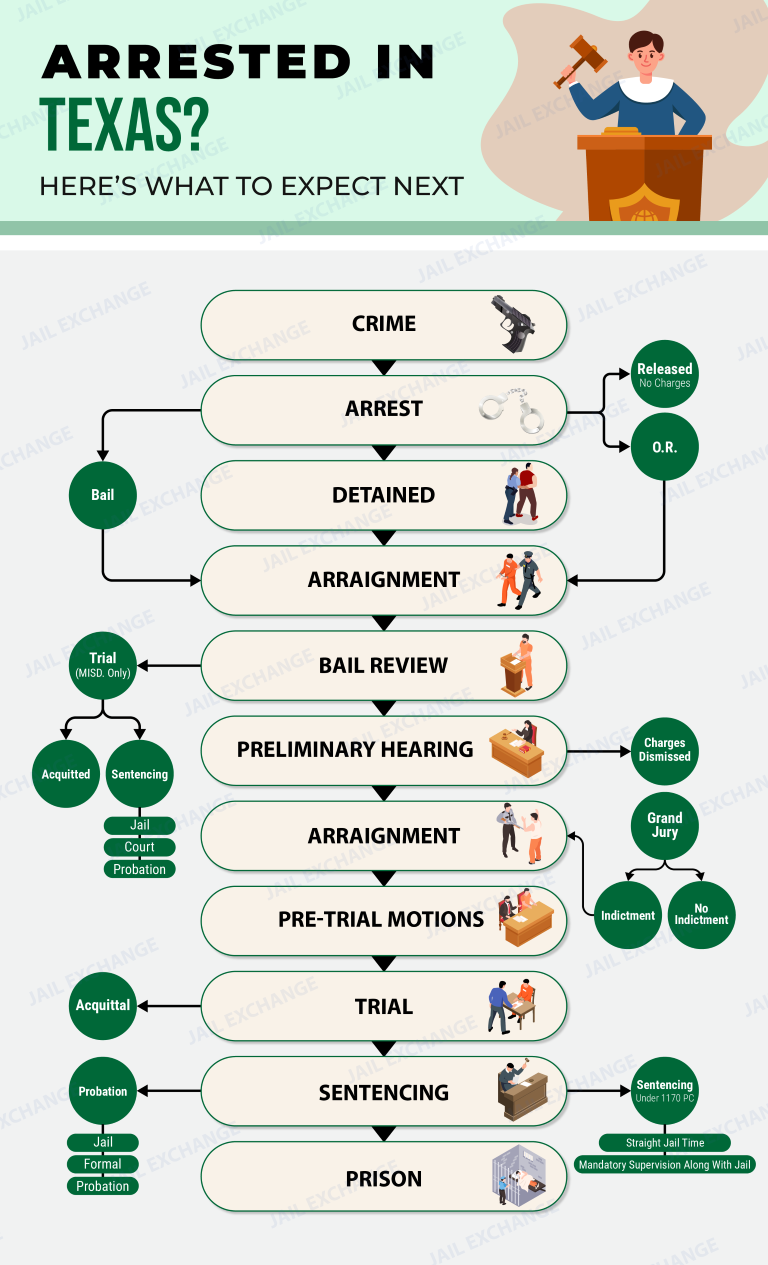
A felony moves from the jail magistrate up to one of four district courts. In order:
- Examining trial. This optional hearing tests probable cause, and the defense must ask for it before indictment (art. 16.01).
- Grand jury. The grand jurors review the evidence privately, and at least nine must vote to indict (art. 20A.301).
- Plea in district court. At arraignment, the district judge takes a plea.
- Pretrial work. Motions, evidence and plea talks.
- The end of the case. A plea, or a trial with 12 jurors, and then a sentence.
Sentence ranges from Penal Code chapter 12, with fines as high as $10,000 at every level:
- state jail felony, served in a state jail: at least 180 days, at most 2 years (12.35)
- third degree: a prison term between 2 and 10 years (12.34)
- second degree: a prison term between 2 and 20 years (12.33)
- first degree: a prison term between 5 and 99 years, or life (12.32)
Earlier convictions can raise the level (12.42). Felony community supervision, often called probation, generally goes up to 10 years (art. 42A.053). Call the District Clerk at 956-523-4268 for the court and the setting.
↑ Back to the question list7. Are violent felonies treated differently in Laredo courts?
Yes, from bail through sentencing:
- Bail can be refused. Proposition 3, approved in November 2025, reaches murder, aggravated robbery and a short list of other violent charges. Bail is denied once the prosecutor, at a hearing, proves danger or a risk of flight (Tex. Const. art. I, §11d).
- No signature bond. Violent offenses on the statute's list can't get a personal bond (art. 17.03).
- State appeals. Since 2025, the state may challenge a bail amount in the court of appeals when it believes the figure is too small for a listed violent charge. Meanwhile, a jailed defendant stays put (art. 44.01).
- Family violence. Release waits 4 hours after bond if the violence may continue. A magistrate's emergency order to protect the victim lasts 61 to 91 days (arts. 17.291, 17.292).
- Capital murder. A conviction brings one of two sentences: death, or life in prison without parole. If the defendant was younger than 18, the sentence is plain life (12.31). Capital defense usually goes to the regional capital public defender office.
8. Who prosecutes Webb County cases, and who defends people for free?
The local criminal rules name the District Attorney's office as part of criminal cases here, including bond decisions. To reach that office, or to find out which prosecutor has a misdemeanor, ask the District Clerk at 956-523-4268.
Juvenile, child welfare and mental health matters go to the County Attorney, 110 Washington St., Suite 301, Laredo, TX 78040, 956-523-4044.
The Public Defender's Office defends adults who can't afford counsel on misdemeanor and felony charges, plus youths in juvenile court. Find it at 1110 Washington St., Suite 102, Laredo, TX 78040, 956-523-4101, weekdays 8 a.m. to 5 p.m. with a noon hour closure. A mental health social worker is on staff, and immigration consultations are offered.
- Request counsel at magistration, or through Pre-Trial Services at 956-523-4988.
- Under the county plan, appointment follows within one working day once the court has the paperwork.
- The Public Defender takes about half the appointments, and listed private lawyers take the others.
9. Does Webb County have drug, veterans or DWI courts?
It does. Each one swaps a regular court track for treatment, frequent check-ins and closer watching by a judge. The Public Defender's Office names four:
- Adult Drug Court, program line 956-523-4797
- Veterans Treatment Court, reached through the 406th District Court's veterans program at 956-523-4969
- Mental Health Court
- DWI Court, part of County Court at Law No. 2, 956-523-4332
Referrals usually come through the defense lawyer. Adult probation, known as the CSCD, supervises many participants. Its main office: 1110 Victoria St., Suite 104, Laredo, TX 78040, 956-523-5373, open Monday through Thursday 7:30 a.m. to 5:30 p.m. and Friday 8 a.m. to 3 p.m.
↑ Back to the question list10. Which online search shows a cause number?
A free court records search covers district, county and justice court cases. Type a name or cause number, then open the case to read its settings.
- The statewide re:SearchTX system needs a free sign-up and shows charges and judgments. Hearing dates aren't included.
- Felony questions: District Clerk, 956-523-4268, or the criminal deputy clerk for a specific court: 49th, 956-523-4279; 111th, 956-523-4269; 341st, 956-523-4277; 406th, 956-523-4283.
- Class A or B questions: County Clerk, 956-523-4266.
- City ticket questions: the municipal court, 956-794-1680.
Have a birth date and cause number ready to speed up the search.
↑ Back to the question list11. Warrant check and surrender: what are the steps here?
Deputies handle county warrants, constables cover four precincts, and city police handle city warrants. Phone the Sheriff's Office at 956-523-4500, city police at 956-795-2800, or a constable: Precinct 1, 956-523-4316; Precinct 2, 956-523-4780; Precinct 3, 956-523-4860; Precinct 4, 956-523-5100. Pending cases appear in the county court records search. DPS keeps a Texas 10 Most Wanted fugitives list. City cases have their own warrants page from the municipal court, and a warrant docket meets each weekday at 10 a.m. For a county warrant, a lawyer can set up surrender to the court that issued it. The District Clerk is at 1110 Victoria St., Suite 203, Laredo, TX 78040, 956-523-4268.
↑ Back to the question list12. Charged federally: what happens in the Laredo Division?
The federal court for the Southern District of Texas hears this county's federal cases at its courthouse on 1300 Victoria Street, Laredo, TX 78040, 956-723-3542.
- The defendant first sees a U.S. magistrate judge. The government can ask to keep the defendant locked up, and then a detention hearing decides release or jail until trial (18 U.S.C. 3142).
- The U.S. Attorney's local branch brings the charges. Mail goes to P.O. Box 1179, Laredo, TX 78042-1179, and the phone is 956-723-6523.
- Defendants who qualify get the Federal Public Defender, 1202 Houston Street, Room 100, Laredo, TX 78040, 956-753-5313.
- Ask the U.S. Marshals Service which facility is housing a federal defendant before trial: 1300 Victoria Street, Suite 1197, Laredo, TX 78040, 956-794-1060.
- Once there is a sentence, the BOP inmate locator can find the person by register number or by name.
13. Will an ICE detainer affect the Texas charge?
The Texas case keeps its normal path. Where an ICE hold bites is release day. In order:
- ICE's detainer arrives at the jail on an I-247A form.
- Jail staff are then allowed to hold the person up to 48 hours after they would otherwise be released (8 CFR 287.7(d)).
- Under art. 2A.060, Texas jails must comply and must notify the person. Proving citizenship or lawful status means no hold on the detainer. Government Code 752.053 also blocks local policies against immigration enforcement.
- Counties with jails must have a 287(g) agreement with ICE by a December 1, 2026 deadline under a 2025 state law. The Sheriff's Office, 956-523-4500, can explain this county's position.
- Pickups in the county are handled by ICE's Harlingen Field Office: 1717 Zoy Street, Harlingen, TX 78552, 956-389-7800. A person picked up may be taken to the Rio Grande Processing Center, 1001 San Rio Blvd, Laredo, TX 78046. Its detainee information line is 956-615-9720.
- The ICE Online Detainee Locator shows where a detainee is.
Pleading guilty may carry immigration consequences, so ask about them before any plea. The Public Defender's Office offers immigration consultations.
↑ Back to the question list14. Which agency takes custody after a prison sentence?
A state jail felony sentence means time in a state jail facility. Longer sentences for third-degree up through capital felonies go to TDCJ, the state prison system. Most sentenced people remain at the county jail for a while. TDCJ then moves them to an intake unit, and later to a unit matched to their risk and needs.
- Find someone with the TDCJ inmate search, using a name, TDCJ number or SID number. Updates come on working days, so new moves may take a day to appear.
- For visits, letters and deposits at state units, open our Texas state prisons page.
15. How are juvenile cases in Webb County handled?
A youth who was 10 or older but under 17 at the time of the act goes to juvenile court. Anyone who was 17 faces adult court (Family Code 51.02). Juvenile court deals with "delinquent conduct" instead of crimes, and its records are kept private.
- Youths who are held stay at the county's Youth Village, named for Solomon Casseb Jr., at 111 Camino Nuevo Road, Laredo, TX 78043. Its detention intake desk never closes: 956-523-5673. Juvenile Probation's office number is 956-523-5600.
- Timing of the detention hearing: by the second working day after custody, but by the first working day for a Friday or Saturday pickup. Before it starts, the youth must have an appointed lawyer (54.01).
- Prosecution belongs to the County Attorney's Juvenile Division. The Public Defender often represents the youth.
- A youth aged 14 or more charged with a capital, first-degree or aggravated drug felony may be moved to adult court through certification. Other felonies allow it from age 15 (54.02).
16. Which protections and alerts can victims get?
State law lists victims' rights (art. 56A.051). Among them:
- the magistrate weighing their safety in the bail decision
- hearing notices, if requested, including reschedulings
- an impact statement the judge considers before accepting a plea or imposing a sentence
For a phone or online alert when someone is booked or let out, sign up with Texas IVSS-Counties, 866-268-8959. The service is free and confidential, in English or Spanish. Victims may also apply to the Attorney General's compensation program, which can cover up to $50,000 for medical care, counseling and lost income. Call 800-983-9933. Peace bond questions go to Justice of the Peace Pct. 1, Place 1 at 956-523-4300.
↑ Back to the question listICE Detainees
The district and county courts described above handle criminal charges only. Immigration cases for people held at the CoreCivic facility on Highway 83 belong to the Laredo Immigration Court, run by the Justice Department's Executive Office for Immigration Review (EOIR). These are civil cases: an immigration judge decides whether a person may stay, and ICE's lawyers argue the government's side.
The Laredo Immigration Court
1406 Jacaman Road, Suite B, Laredo, TX 78041; (956) 523-6200. EOIR's administrative control list places "Laredo Webb County Detention Center" under this court, which keeps the records and takes the filings. Detained hearings can be held in the courtroom or by video, and the hearing notice tells you which. Check the next date any time through EOIR's case portal or by calling 1-800-898-7180 with the A-Number, in English or Spanish.
How a case moves
Expect at least two kinds of hearings. The first, called a master calendar, often lasts minutes: identity is confirmed, rights and charges are explained, the detainee admits or denies the allegations, and the judge asks which defense or relief is coming, whether asylum, withholding, protection under the torture convention, cancellation, or voluntary departure. Disputed requests then get a full individual hearing with witnesses. Interpreters come from the court at no cost.
Who carries the burden turns on lawful admission. If your loved one came in on a visa or holds a green card, ICE has to prove the deportation charge with clear and convincing evidence. Without any lawful admission, the detainee must prove a clear right to be admitted or a prior legal entry, and whoever seeks relief proves eligibility. No lawyer is appointed. EOIR's pro bono provider list and the quarterly list ICE says is posted in each housing unit are good first calls. Watch for "stipulated removal" paperwork: signing it is agreeing to deportation with no hearing, so talk to a lawyer before any signature.
Appeals and removal
Losing at the Laredo court leaves one main option, an appeal to the Board of Immigration Appeals, which must actually arrive by the deadline. That deadline is short already, and EOIR's new rule trims it from 30 days to 10 beginning in mid-December 2026. When the order becomes final, the 90-day removal period begins for ICE. A deportation officer can also skip the court for some people, through expedited removal or by reinstating an old order.
Federal court and return
Returning without permission after a deportation can be charged as illegal reentry (8 U.S.C. 1326) in federal court, here the Laredo Division of the U.S. District Court for the Southern District of Texas, with prison terms up to 2, 10 or 20 years depending on past convictions. A legal return usually means waiting out the bar: 5, 10 or 20 years, or permanently after an aggravated felony, unless DHS says yes earlier on Form I-212. This is general information, not legal advice.
Information for this service is currently unavailable.
Detainees at the Webb County ICE Detention Center, 9998 S. Highway 83 in Laredo, are held on immigration matters. For their accounts, ICE gives two options.
The first is Western Union: send online, or phone Western Union at 1-800-225-5227.
The second is a U.S. Postal Service money order showing the detainee's name, addressed to:
Webb County Detention Facility
9998 S. Highway 83
Laredo, TX 78046
Mailed money is taken to processing and credited to the account, and the detainee receives a receipt. Cash should never be mailed.
ICE answers questions about a detainee at 956-615-9720 from 8 a.m. to 4 p.m. For urgent messages, the number is 956-729-4000.
The Webb County ICE Detention Center, listed by U.S. Immigration and Customs Enforcement as the Webb County Detention Center, is a privately run immigration detention center on Highway 83 south of Laredo, Webb County, Texas. It is not the Webb County Jail run by the Sheriff downtown. Mail for a detainee goes to the detention center, and staff open it to check for contraband but do not read it.
Letters, legal mail and money orders for a detainee:
Inmate's Full Name & A-Number
Webb County Detention Center
9998 S. Highway 83
Laredo, TX 78046
- A-Number: Put the detainee's full name and at least the last four digits of their A-Number (alien registration number) on the envelope. You can find someone with the ICE detainee locator.
- Your name and address: Every envelope must show the sender's name and address.
- Money: Mail a U.S. Postal Service money order to the center with the detainee's name on it. ICE warns families not to mail cash to a detainee.
- Lawyers: Attorneys can also fax legal papers to the center's legal fax line, marked as confidential attorney-client mail with a cover sheet giving the detainee's name and A-Number.
- Items for release: Clothes or other things needed for travel or release are taken only with the deportation officer's approval ahead of time. Nothing is accepted at visits.
- Writing back: Detainees can send as many letters as they can pay for, and those without money get postage.
- Urgent messages: Detainees cannot take incoming calls, but you can leave an urgent message at 956-729-4000. For case questions, ICE's detainee information line is 956-615-9720, 8 a.m. to 4 p.m.
Short messages can also go through the center's tablet messaging service.
GettingOut / ViaPath Inmate Phone Calling
Provider: GettingOut (Telmate) • Rebranding as ViaPath Technologies (myViaPath)GettingOut telephone services (operated under Global Tel*Link / Telmate and transitioning to ViaPath Technologies / myViaPath) allow incarcerated individuals to place outbound voice calls from housing-unit telephones and handheld tablets directly to approved family contacts. Funding a prepaid phone balance ensures calls connect to cellular devices and residential lines without carrier collect call blocks.
Important: Cell Carriers Automatically Block Jail Collect Calls
Inmate phone networks do not permit incoming calls, and wireless cell providers do not support traditional collect billing. While some residential landlines might allow direct carrier billing, mobile numbers require a funded prepaid account or inmate PIN debit balance, which you can verify with your phone provider. If you do not register online and add calling funds promptly, your loved one will receive an automated disconnect announcement when dialing your line.
Step-by-Step Instructions to Set Up and Fund Calling
- Visit www.gettingout.com or the updated my.viapath.com portal.
- Register your account using the primary 10-digit telephone number where you want to receive calls.
- Search for the facility and add the inmate using their full legal name or facility booking ID.
- Select Phone Deposits or AdvancePay from your dashboard.
- Select your deposit dollar amount and enter your debit or credit card billing details.
- Authorize payment, save your confirmation receipt, and confirm that your mobile phone allows calls from automated or unknown correctional numbers.
What the Inmate Needs to Do
The inmate approaches any housing-unit telephone or opens the phone application on their handheld tablet, enters their assigned PIN, and dials your 10-digit number. The system verifies that your account has an active prepaid balance and connects the call once you accept the automated prompt. All non-privileged conversations are recorded and monitored by the facility.
Official Providers: GettingOut Website | myViaPath Portal
Customer Service Telephone: 1-866-516-0115 (GettingOut) • 1-877-650-4249 (ViaPath)
Support Hours: Monday – Friday, 7:00 AM – 11:00 PM CST; Saturday – Sunday, 8:00 AM – 7:00 PM CST
Supported Languages: English and Spanish
Other Services Provided by GettingOut / ViaPath
In addition to Phone Calling, GettingOut and ViaPath provide several communication, financial, and visitation services:
- Two-Way Text Messaging: Send digital text messages and photos directly to an inmate's tablet or kiosk.
• Learn more on our website: Digital Messaging Guide | • Visit official vendor page: GettingOut Messaging - Remote Video Visits: Schedule and join live video visits from home using your computer or smartphone.
• Learn more on our website: Video Visitation Guide | • Visit official vendor page: GettingOut Video Visits - Inmate Tablets & Media: Fund tablet entertainment, music streaming, games, and news modules.
• Learn more on our website: Tablet Rentals & Content Guide | • Visit official vendor page: GettingOut Tablets - Inmate Trust & Commissary Deposits: Transfer funds directly into their jail trust ledger for commissary store purchases.
• Learn more on our website: Inmate Trust Deposits Guide | • Visit official vendor page: ViaPath Trust Deposits
GettingOut / ViaPath Inmate Messaging
Provider: GettingOut (Telmate) • Rebranding as ViaPath Technologies (myViaPath)GettingOut (a service of Global Tel*Link / Telmate) provides an instant two-way digital messaging and photo-sharing platform connecting families with incarcerated individuals via housing-unit kiosks and handheld tablets. The provider is actively rebranding as ViaPath Technologies (under the myViaPath platform); depending on the facility contract, local booking sheets and tablets may still refer to the service as GettingOut, GTL, or ViaPath, but both brand portals grant access to the same centralized messaging balance.
Important: Contact Authorization and Digital Mail Rules Vary
Inmate digital messaging rules are not uniform across all county detention centers. While some jails allow immediate two-way messaging upon registration, others require initial contact invitations or administrative ID verification, which you should verify directly with the facility. If you delay setting up an online profile and funding your Friends & Family messaging account, your loved one may face lengthy periods without direct family communication.
Step-by-Step Instructions to Register and Message an Inmate
- Visit www.gettingout.com or the newly branded my.viapath.com portal, or install the GettingOut / myViaPath mobile app.
- Create a user profile using your primary email address and 10-digit mobile phone number.
- Complete identity verification by uploading a clear photo of your government-issued driver's license or state ID and taking a verification selfie if requested.
- Search for the inmate by selecting the state, correctional facility, and their legal name or booking ID.
- Send an outside contact connection request to link your account to their tablet profile.
- Deposit funds into your 'Friends & Family Account' using a debit or credit card to cover message and photo-sharing costs.
- Compose your text message in the chat box, attach approved photos, and submit it for jail screening.
What the Inmate Needs to Do
The inmate powers on their assigned pod tablet or approaches a housing-unit kiosk and logs into the messaging application with their PIN. They accept your incoming contact invitation on the screen. Once approved by institutional monitors, incoming messages appear in their inbox, and the inmate types a reply directly on the screen.
Official Providers: GettingOut Website | myViaPath Portal
Customer Service Telephone: 1-866-516-0115 (GettingOut Support) • 1-877-650-4249 (ViaPath Support)
Support Hours: Monday – Friday, 7:00 AM – 11:00 PM CST; Saturday – Sunday, 8:00 AM – 7:00 PM CST
Supported Languages: English and Spanish
Other Services Provided by GettingOut / ViaPath
In addition to Two-Way Text Messaging, GettingOut and ViaPath provide several other communications and visitation options:
- Remote Video Visits: Schedule and join live web-based video visits from your computer or smartphone.
• Learn more on our website: Video Visitation Guide | • Visit official vendor page: GettingOut Video Visits - Inmate Tablet Rentals & Media: Fund tablet entertainment, music streaming, games, and news modules.
• Learn more on our website: Tablet Rentals & Content Guide | • Visit official vendor page: GettingOut Tablets - AdvancePay Phone Calling: Prepay for telephone calls so your loved one can dial your mobile phone directly.
• Learn more on our website: AdvancePay Phone Calling Guide | • Visit official vendor page: ViaPath ConnectNetwork Calling - Inmate Trust Deposits: Transfer funds directly into their jail trust account for commissary store purchases.
• Learn more on our website: Inmate Trust Deposits Guide | • Visit official vendor page: ViaPath Trust Deposits
GettingOut / ViaPath Inmate Tablets & Media
Provider: GettingOut (Telmate) • Rebranding as ViaPath Technologies (myViaPath)GettingOut provides specialized, secure handheld tablets for county jail inmates, offering access to messaging apps, telephone calling, legal research tools, eBooks, vocational training, and premium entertainment rentals. As part of GTL and Telmate's transition to ViaPath Technologies, tablet firmware and management platforms are moving to the myViaPath system.
Important: Tablet Feature Availability Varies by Facility
Jails manage tablet distribution according to individual facility contracts. While basic educational and legal materials are often provided without cost, access to music streaming, games, podcasts, and premium movies requires an active funded account. You should confirm the tablet rules with the facility directly. Registering and funding their media balance right away ensures your loved one has productive resources and recreation during their stay.
Step-by-Step Instructions to Fund Inmate Tablet Services
- Confirm that GettingOut / ViaPath handheld tablets are active at your loved one's specific detention facility.
- Navigate to www.gettingout.com or my.viapath.com.
- Sign into your verified user profile and link the inmate's legal name and booking ID number.
- Select Make a Deposit and choose either your Friends & Family Account (for messaging) or the inmate's personal Inmate Account (for entertainment and song rentals).
- Choose your deposit amount, review convenience fees, and complete payment with a credit or debit card.
- Notify your loved one that their tablet account balance has been funded.
What the Inmate Needs to Do
The inmate unlocks their assigned tablet or signs one out from the pod charging station using their biometric verification or PIN. Once logged in, their available balance appears on the screen, allowing them to download songs, stream educational content, and communicate with approved family members.
Official Providers: GettingOut Website | myViaPath Portal
Customer Service Telephone: 1-866-516-0115 (GettingOut) • 1-877-650-4249 (ViaPath)
Support Hours: Monday – Friday, 7:00 AM – 11:00 PM CST; Saturday – Sunday, 8:00 AM – 7:00 PM CST
Supported Languages: English and Spanish
Other Services Provided by GettingOut / ViaPath
In addition to Tablet Media & Rentals, GettingOut and ViaPath provide several other communication and account services:
- Two-Way Text Messaging: Send electronic letters and photos straight to the inmate's screen.
• Learn more on our website: Two-Way Text Messaging Guide | • Visit official vendor page: GettingOut Messaging - Remote Video Visits: Meet face-to-face over secure live video from home.
• Learn more on our website: Video Visitation Guide | • Visit official vendor page: GettingOut Video Visits - AdvancePay Phone Calling: Prepay for phone calling credits so your loved one can call your telephone directly.
• Learn more on our website: AdvancePay Phone Calling Guide | • Visit official vendor page: ViaPath ConnectNetwork Calling - Inmate Trust Deposits: Transfer cash directly into an inmate's jail ledger for commissary purchases.
• Learn more on our website: Inmate Trust Deposits Guide | • Visit official vendor page: ViaPath Trust Deposits
Webb County County Jails
Webb County Juvenile Facilities
- Jail (Main): 956-729-4000
- Inmate Accounts: 956-723-1985
The Webb County ICE Detention Center serves the following cities and towns of Webb County: El Cenizo, Laredo and Rio Bravo.