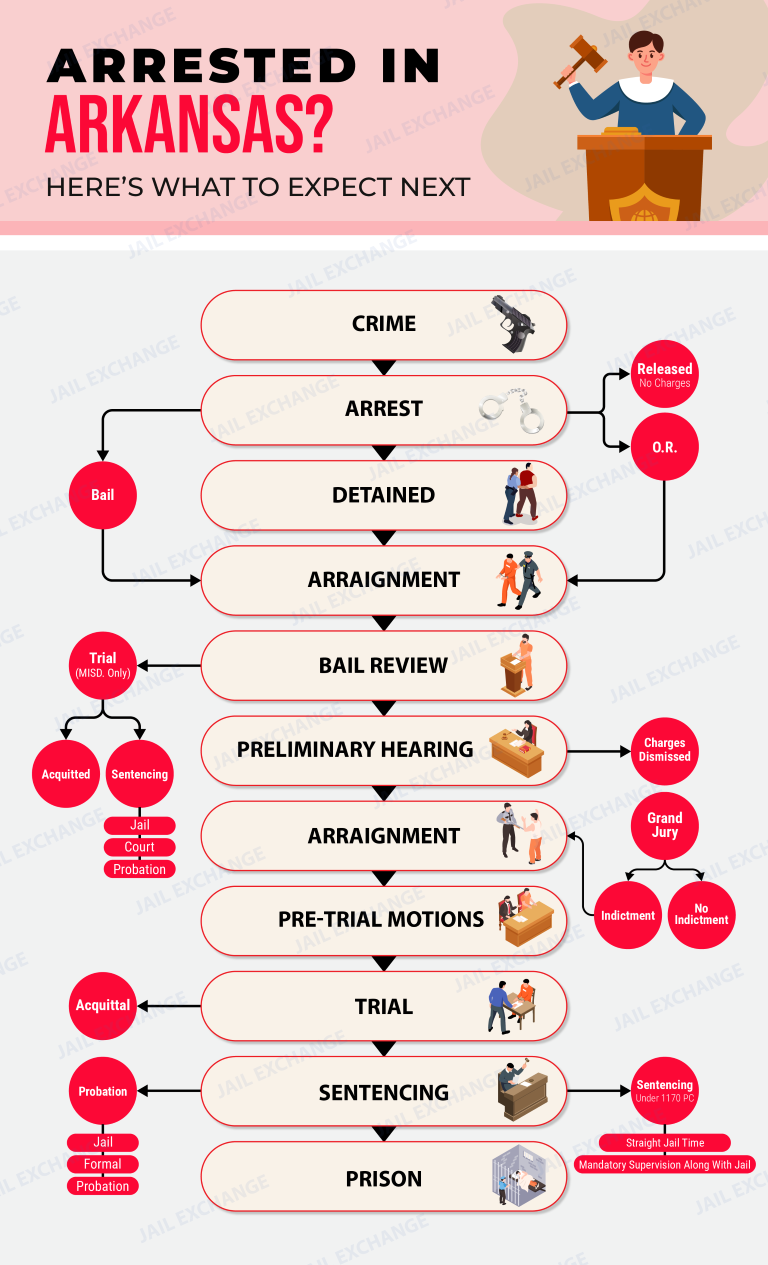
Arkansas County Juvenile Detention Criminal Court Process
Criminal Court Process for Arkansas County Arkansas
The Criminal Court Process in Arkansas County
Arkansas County still keeps two county seats, so its courts are split between a Northern District in Stuttgart and a Southern District in DeWitt. The Arkansas County Circuit Court tries all felony cases, and its juvenile division sits there too, at 302 S. College Street, Stuttgart, AR 72160 and 101 Court Square, DeWitt, AR 72042. Adults arrested anywhere in the county are held at the Arkansas County Jail in DeWitt.
Anyone still held between hearings shows up in the Sheriff's official inmate search. Our Arkansas County Inmate Search page covers the rest of an arrest: who is in custody, warrants, charges, mugshots and property. Arkansas County makes up the entire 11th Judicial Circuit–East by itself, so it has its own circuit judge and its own elected Prosecuting Attorney.
To reach the circuit clerk, call 870-659-2098 for Stuttgart cases or 870-659-2099 for DeWitt cases, and ask for the next hearing date and courtroom. Lower-level cases go to the Arkansas County District Court. Posting bond is covered on our bail and bond page.
1. Misdemeanor cases: theft under the felony line, first DWI, battery, trespass
An arrest by Stuttgart or DeWitt police, a sheriff’s deputy or a state trooper for a lesser offense lands in the district court department closest to where it happened. Plenty of people are simply cited and released with a court date. Rule 8.1 of the Arkansas Rules of Criminal Procedure says a jailed person goes before a judge quickly. For most small charges the judge lets the person sign a written pledge to come back, or sets a low bond.
Arkansas misdemeanors come in three classes. A Class A conviction can cost a year behind bars and a $2,500 maximum fine, a Class B conviction three months and $1,000, and a Class C conviction a month and $500. Taking goods worth $1,000 or under counts as a Class A misdemeanor. Third-degree battery sits in that same class. Criminal trespass is usually Class C, or Class B when the place entered is an occupied building. A first DWI is set out in its own statute and carries 24 hours up to one year behind bars, plus $150 to $1,000 in fines, and a suspended license or an ignition interlock device.
District court cases are heard by a judge with no jury. Someone who loses can appeal to circuit court inside 30 days. A fresh trial follows there, with a jury if the defendant wants one. If jail time is possible and money is short, the defendant may request a court-paid lawyer; judges in Arkansas can assess a public defender user fee based on income and may waive it. Most cases here end in a plea, a fine, probation or a suspended sentence within a few months.
For someone under 18, a misdemeanor is ordinarily a delinquency matter for the juvenile division of the Arkansas County Circuit Court, not district court. The prosecutor or juvenile intake staff may offer a diversion agreement for a first offense, that might call for counseling, repaying the victim or unpaid work, after which no formal adjudication follows. Traffic tickets, curfew violations and some game-and-fish or tobacco offenses by teens can be handled in district court instead.
↑ Back to the question list2. Felony cases: burglary, felony theft, drug delivery, felony DWI
After a felony arrest, the first hearing usually takes place in district court in Stuttgart or DeWitt. After an arrest made with no warrant, a judge must review the grounds inside 48 hours. The Arkansas Constitution, Article 2, Section 8, guarantees bail in every case except capital offenses where the proof is evident or the presumption great, and judges set conditions using the factors in Rule 9. Families often hire a bondsman. Each one must hold a license from the Professional Bail Bond Company and Professional Bail Bondsman Licensing Board. Anyone found too poor to hire counsel gets a public defender for the 11th Judicial District–East.
Arkansas rarely uses grand juries. The Prosecuting Attorney instead files a felony information directly in circuit court, and the defendant then answers guilty or not guilty at arraignment. Rule 28.1 sets a speedy-trial limit of 12 months, though delays requested by the defense and other excluded periods stop the clock. Trials take place before a 12-person jury, and in Arkansas the jury usually fixes the sentence within the legal range if it convicts.
Felonies are graded as Class Y (10 to 40 years or life), Class A (6 to 30 years), Class B (5 to 20 years), Class C (3 to 10 years) and Class D (up to 6 years), with fines up to $15,000 for Class A and B and $10,000 for Class C and D. Residential burglary is a Class B felony and commercial burglary a Class C. Theft climbs from Class D for property worth more than $1,000 to Class B at $25,000 or more. Drug delivery charges are graded by drug and weight, and a fourth DWI within the look-back period becomes a felony. Most felonies here end in a plea within six months to a year.
A teenager accused of a felony usually stays in the juvenile division, and a held youth gets a hearing inside 72 hours. For a 16- or 17-year-old, though, Ark. Code 9-27-318 lets the prosecutor file any felony in the adult criminal division, and either side can ask for a transfer hearing. If the judge keeps the case in juvenile court, the outcome may be probation, residential treatment or commitment to the state Division of Youth Services, and serious cases can be designated for extended juvenile jurisdiction, which lets the court keep supervising the youth into early adulthood.
↑ Back to the question list3. Violent felonies: capital murder and murder, rape, aggravated robbery
A violent charge also starts in district court and into circuit court, but bail is much harder to obtain, and in a capital case the judge can refuse release altogether when the evidence is strong. A capital murder conviction can bring death, or else a life term where parole is never possible. First-degree murder, rape and aggravated robbery are all Class Y felonies carrying at least 10 years. When the state seeks death, the Public Defender Commission must supply two attorneys qualified to try capital cases.
The 2023 Protect Arkansas Act changed how much of a sentence is actually served for crimes committed from January 1, 2025, onward. People convicted of capital murder, rape, aggravated robbery and several other offenses now serve 100% of the term, and a second group, including second-degree murder and manslaughter, must serve at least 85%. Arkansas held 23 men on death row as of April 2026. Its most recent execution was in 2017, and since 2025 state law has allowed nitrogen hypoxia as well as lethal injection.
Victims have rights under the Arkansas Code, such as being told about hearings, speaking with the prosecutor before any plea deal, addressing the judge at sentencing, and being repaid for losses. The prosecutor’s victim-witness coordinator helps with those steps, and the Attorney General’s Crime Victims Reparations program can cover some costs. Homicide and rape cases often run a year or two.
A 14- or 15-year-old accused of capital murder, first-degree murder, rape, aggravated robbery, kidnapping or a few other listed crimes can be charged directly in the criminal division, and older teens can be charged there for any felony. When the youth is held in detention, the transfer hearing must take place within 30 days, and moving the case requires clear and convincing evidence. A person who was under 18 at the time of the crime cannot be sentenced to death, and the Fair Sentencing of Minors Act of 2017 gives such a person a chance at parole even after a capital murder conviction.
↑ Back to the question list4. Courthouses in Arkansas County: addresses and phone numbers
Cases are split between Stuttgart in the north and DeWitt in the south. Each town has its own circuit and district courtroom:
- Arkansas County Circuit Court, Northern District: 302 South College Street, Stuttgart, AR 72160, clerk 870-659-2098
- Arkansas County Circuit Court, Southern District: 101 Court Square, DeWitt, AR 72042, clerk 870-659-2099
- Arkansas County District Court, Stuttgart: 304 South Maple Street, Stuttgart, AR 72160, 870-673-7951
- Arkansas County District Court, DeWitt: 120 Court Square, DeWitt, AR 72042, 870-946-2503
Circuit court takes felonies and juvenile cases. District court handles misdemeanors, traffic tickets and most first hearings on felony arrests. Small sessions for Gillett and St. Charles are run by the district court, so ask the DeWitt clerk where they sit.
The district court decides misdemeanors and traffic cases and is usually where a person charged with a felony first sees a judge. Felony defense for people who can’t pay a lawyer comes through the Arkansas Public Defender Commission, the state agency that funds public defenders in each judicial district.
This summary of criminal cases in Arkansas County gives the basics only and cannot stand in for a lawyer. Anyone charged here can hire defense counsel or phone the Arkansas County Circuit Clerk at (870) 659-2098 for help with a public defender request.
Before a hearing, phone the circuit clerk at 870-659-2098 for Stuttgart cases or 870-659-2099 for DeWitt cases to confirm the date and room. Call the district court in Stuttgart at 870-673-7951 or in DeWitt at 870-946-2503 for misdemeanor dockets.
↑ Back to the question list5. How do I check for a warrant in Arkansas County and clear it?
The sheriff's office in DeWitt handles arrest warrants, and a deputy can tell you whether one is active if you call 870-659-2060. For a wider view, the free statewide case search at Search ARCourts shows filings from circuit and many district courts across the state. Clearing a warrant usually starts with a lawyer who can ask the judge to set bond, or with turning yourself in at the jail on Ricebelt Avenue during a weekday. Felony paperwork sits with the Circuit Clerk in Stuttgart, reachable at 870-659-2098, extension 1.
↑ Back to the question list6. When a case is federal
Federal prosecutions arising in Arkansas County belong to the Delta Division of the U.S. District Court for the Eastern District of Arkansas. That division’s courthouse is the federal building at 617 Walnut Street, Helena, AR 72342, but the Helena office has no clerk staff, so questions go to the Little Rock clerk at (501) 604-5351. What separates the two systems is which government wrote the law. An offense against the Arkansas Code, such as a burglary in Stuttgart or a bar fight in DeWitt, is a state case handled by the local prosecuting attorney in circuit or district court. A federal case involves a statute passed by Congress or a federal interest: large drug-distribution conspiracies that cross state lines, a gun held by a person barred by an old felony, fraud against a federally insured bank or a federal farm program, or offenses on land the U.S. owns, like the Arkansas Post National Memorial near Gillett or the White River National Wildlife Refuge.
Some crimes break a law passed by Congress. Examples are moving drugs across state lines, a gun found with someone who has a felony record, or fraud tied to a farm loan program. Those cases go to the U.S. District Court for the Eastern District of Arkansas. Its Delta Division covers this county and meets at the federal courthouse in Helena, 617 Walnut Street, Helena, AR 72342 (clerk questions go to Little Rock), 501-604-5351.
- The person sees a magistrate judge soon after arrest, often the next business day.
- Pretrial Services writes a short report on the person's background.
- Prosecutors may ask for detention. The defense may then ask for a hearing, which is usually held within about five days.
- A grand jury must return an indictment for felony charges to go forward.
- The U.S. Marshals hold anyone kept in custody. Their office for this district is U.S. Marshals Service, 600 West Capitol Avenue, Little Rock, AR 72201, 501-324-6256.
One incident can lead to both a state case and a federal case, and each runs on its own track.
↑ Back to the question list7. Looking up someone in jail or prison
- Arkansas County Jail: Arkansas County Inmate Search. Search the last name and look at the booking date and charges.
- VINE: VINELink (https://vinelink.vineapps.com/). Pick Arkansas and enter the name. Results name the holding facility, and you can ask for alerts too.
- Federal Bureau of Prisons: Federal Bureau of Prisons Inmate Locator (https://www.bop.gov/inmateloc/). Use a register number or a full name. The result shows the federal facility.
- Arkansas Division of Correction: Arkansas Division of Correction Inmate Search (https://apps.ark.org/inmate_info/). Enter a name or ADC number to see the state unit and key dates.
8. Immigration detainers and where ICE sends people
ICE may ask the DeWitt jail to keep a person up to 48 hours past the normal release time, with weekends and holidays counted. That request is called a detainer. It does not change the county case, and the person still owes the court every hearing.
Arkansas is handled by the ICE New Orleans Field Office, 181 James Drive W, St. Rose, LA 70087, 504-318-2360. Detainees from here are often taken to Louisiana:
- LaSalle ICE Processing Center: 830 Pinehill Road, Jena, LA 71342 · 318-992-1600
- Pine Prairie ICE Processing Center: 1133 Hampton Dupre Road, Pine Prairie, LA 70576 · 337-599-2400
Families can search the ICE Online Detainee Locator System (https://locator.ice.gov/odls/) with an A-number or a full name and country of birth.
↑ Back to the question list