Akron is the county seat of Summit County and the center of its criminal court system. Three municipal courts, in Akron, Barberton and Stow, divide the county's misdemeanor, OVI and traffic cases and also take the first hearings in felony cases, while seven cities and villages keep mayor's courts for local tickets. Felony cases are tried in the Summit County Court of Common Pleas on South High Street once a grand jury indicts. The Summit County Prosecutor's Office handles felonies and juvenile cases; misdemeanors are prosecuted by city law directors in Akron, Barberton, Stow, Cuyahoga Falls and the other municipalities. Adults who are not released after arrest are held at the Summit County Jail on East Crosier Street in Akron.
- Summit County Court of Common Pleas, General Division, 209 S. High Street, Akron, OH 44308, (330) 643-2270
- Summit County Clerk of Courts, Criminal Division, Summit County Courthouse, 205 S. High Street, 1st Floor, Akron, OH 44308, (330) 643-2282
- Akron Municipal Court, 172 S. Broadway Street, Akron, OH 44308, (330) 375-2120; clerk (330) 375-2570
- Barberton Municipal Court, Municipal Building, 576 W. Park Avenue, Barberton, OH 44203, (330) 753-2261
- Stow Municipal Court, 4400 Courthouse Drive, Stow, OH 44224, (330) 564-4200
- Summit County Juvenile Court, 650 Dan Street, Akron, OH 44310, (330) 643-2900
- Summit County Prosecutor's Office, 53 University Avenue, Akron, OH 44308
- Legal Defender Office of Summit County (Summit Legal Defenders, the county's public defender), downtown Akron, (330) 434-3461
- Summit County Jail (Summit County Sheriff's Office), 205 E. Crosier Street, Akron, OH 44311
Which court hears your case. Summit County has no county court. Misdemeanors, OVI and traffic cases are filed in whichever municipal court has territory over the place of the offense: Akron Municipal Court for Akron, Fairlawn, Lakemore, Richfield and Bath, Richfield and Springfield townships, plus the Summit part of Mogadore; Barberton Municipal Court for Barberton, Green, Norton, New Franklin, Clinton and Copley and Coventry townships; and Stow Municipal Court for Stow, Cuyahoga Falls, Hudson, Tallmadge, Twinsburg, Macedonia and the rest of northern Summit County. In Boston Heights, Cuyahoga Falls, Fairlawn, Macedonia, Munroe Falls, Peninsula and Richfield, ordinance and traffic citations may instead go to a mayor's court, where there is no jury and the defendant can request a transfer to the municipal court. A Summit felony starts out in that same municipal court, which handles the first appearance, the bond decision and any preliminary hearing; the case then moves to the Court of Common Pleas, General Division, after an indictment or a bill of information. Appeals go to the Ninth District Court of Appeals in Akron.
Where pretrial detainees are held. The Summit County Sheriff runs the county jail at 205 E. Crosier Street, just south of downtown Akron. Arrestees from the Akron Police Department, the Sheriff's Office, suburban departments and the Highway Patrol are booked there, and people who cannot post bond wait there for their municipal court or Common Pleas hearings. The Clerk of Courts' Criminal Division, (330) 643-2282, can help with Common Pleas case and bond information; the Sheriff's Office handles questions about custody and visits.
- Local courts in Summit County (municipal, county and mayor's courts)
- Summit County courthouses at a glance
- From booking to first appearance in Summit County
- The Summit County Jail on Crosier Street
- Public defense through Summit Legal Defenders
- The Prosecutor's Office, city law directors and diversion
- Summit County specialty and treatment courts
- Misdemeanor (for example, petty theft, a first OVI, assault, criminal trespass)
- Felony (for example, burglary, felony theft, drug trafficking, felonious assault)
- Violent felony (for example, murder, rape, aggravated robbery)
- Juveniles (under 18) arrested in Summit County
- Federal cases (U.S. District Court) from Summit County
Local courts in Summit County (municipal, county and mayor's courts)
Summit's lower courts are organized by territory. The three municipal courts split the county roughly into central, southwestern and northern sections, and the seven mayor's courts each serve a single city or village.
Municipal courts
- Akron Municipal Court — 172 S. Broadway Street, Akron, OH 44308, (330) 375-2120. Territory: Akron and Fairlawn; the villages of Lakemore and Richfield; Bath, Richfield and Springfield townships; and the Summit County portion of Mogadore.
- Barberton Municipal Court — Municipal Building, 576 W. Park Avenue, Barberton, OH 44203, (330) 753-2261. Territory: Barberton, Green, Norton, New Franklin and Clinton, plus Copley and Coventry townships.
- Stow Municipal Court — 4400 Courthouse Drive, Stow, OH 44224, (330) 564-4200. Territory: Stow, Cuyahoga Falls, Hudson, Tallmadge, Twinsburg, Macedonia, Munroe Falls, Boston Heights, Northfield, Peninsula, Reminderville and Silver Lake, along with Boston, Northfield Center, Sagamore Hills and Twinsburg townships. (This court was formerly known as the Cuyahoga Falls Municipal Court.)
County courts
None. The municipal courts' combined territory takes in all of Summit County.
Mayor's courts
- Boston Heights Mayor's Court — Village Hall, 45 E. Boston Mills Road, Hudson, OH 44236
- Cuyahoga Falls Mayor's Court — City Hall, 2310 Second Street, Cuyahoga Falls, OH 44221
- Fairlawn Mayor's Court — City Hall, 3487 S. Smith Road, Fairlawn, OH 44333
- Macedonia Mayor's Court — City Hall, 9691 Valley View Road, Macedonia, OH 44056
- Munroe Falls Mayor's Court — City Hall, 43 Munroe Falls Avenue, Munroe Falls, OH 44262
- Peninsula Mayor's Court — P.O. Box 83, Peninsula, OH 44264, (330) 657-2151
- Richfield Mayor's Court — 4410 W. Streetsboro Road, Richfield, OH 44286, (330) 659-9201
A mayor's court handles only that municipality's ordinance and traffic violations, holds no jury trials and has limited sentencing power. The court date on a citation shows which court has the case; a defendant who prefers a municipal judge, or who wants a jury, can ask for transfer.
Summit County courthouses at a glance
- South High Street, downtown Akron. The Common Pleas General Division is at 209 S. High Street, next to the historic Summit County Courthouse at 205 S. High Street, where the Clerk of Courts' Legal Division has its first-floor office. Felony arraignments, pretrials, pleas, trials and sentencings take place in the General Division courtrooms.
- Akron Municipal Court building, 172 S. Broadway Street. Opened in late 2023 a block from the old Stubbs Justice Center, this is where the Akron Municipal Court handles a large daily volume of arraignments, OVI cases and felony preliminary hearings for the central part of the county.
- Barberton and Stow. The Barberton Municipal Court is in Barberton's Municipal Building on West Park Avenue; the Stow Municipal Court has its own building on Courthouse Drive in Stow.
- Dan Street. The Summit County Juvenile Court and its detention center are on a separate campus at 650 Dan Street in north Akron.
Every building has security screening, so arrive early. A person with cases in more than one court, for example an Akron Municipal Court misdemeanor and a Common Pleas felony, needs to keep both sets of dates; missing either can produce a warrant.
From booking to first appearance in Summit County
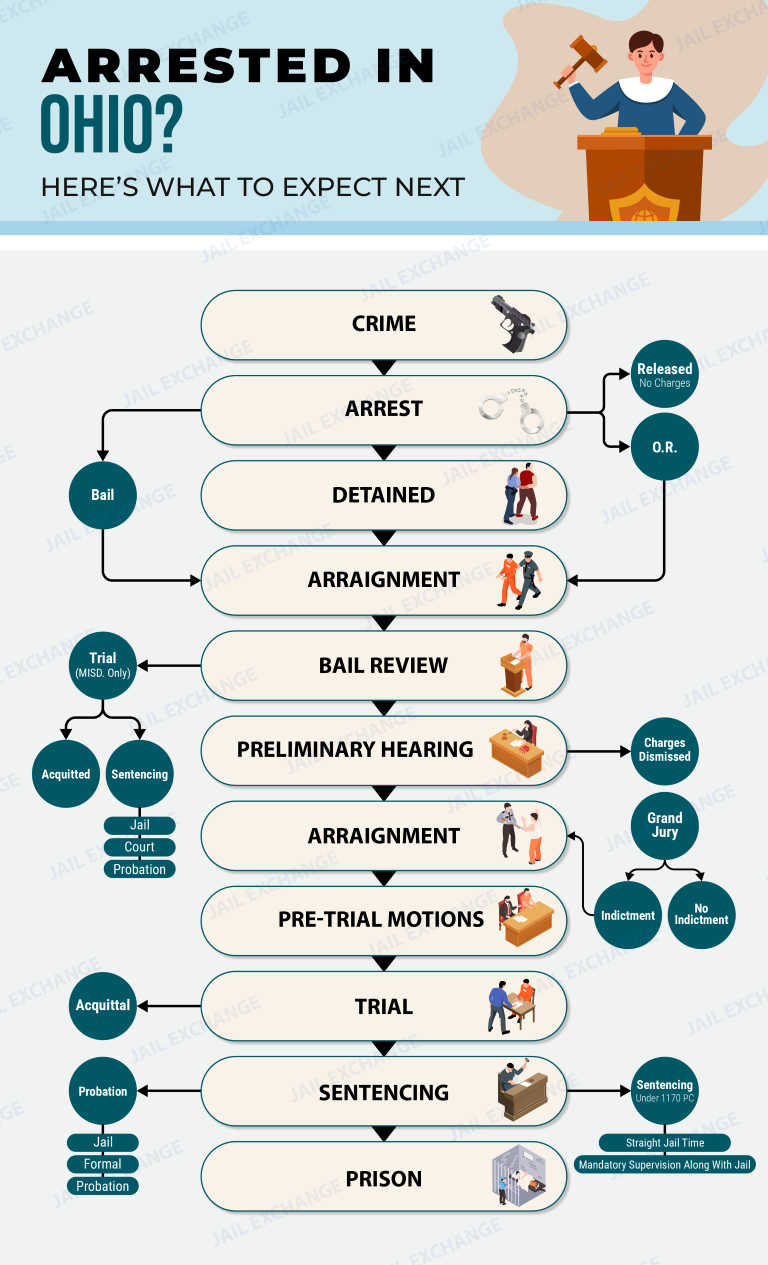
Booking. Arresting officers bring adults to the Crosier Street jail, where staff record identifying information and property, take photographs and fingerprints, and check for outstanding warrants. Some suburban departments hold a person briefly at their own station first.
Bond schedule versus a judge. Lower-level misdemeanors often carry a scheduled bond that can be posted right away at the jail. Charges like domestic violence, repeat OVI and most felonies wait for a judge.
The first hearing. The person is taken before a judge or magistrate of the municipal court for the area, usually the next weekday and often by video link from the jail. In fixing a dollar amount, an Akron, Barberton or Stow judge works from the 2022 bail amendment to Ohio's Constitution, which names four considerations: risk to the public, the person's prior record, the gravity of the charge, and whether the person will come back to court. A Summit judge may release on recognizance, require a 10% deposit, demand cash, or accept a surety bond through a commercial bail company, and conditions such as electronic monitoring, alcohol testing or a protection order are common.
Counsel. This is also the moment to ask for appointed counsel if the person cannot afford one.
Next deadlines. In a felony case, a preliminary hearing must follow within 10 consecutive days for someone in custody or 15 for someone released, unless the Prosecutor's Office indicts first.
The Summit County Jail on Crosier Street
The Summit County Jail, 205 E. Crosier Street, Akron, OH 44311, is operated by the Summit County Sheriff's Office and is the main adult detention facility for every police agency in the county. Its population includes people held before trial in all three municipal courts and in Common Pleas, people serving local sentences, and people held for other jurisdictions.
Friends and family generally can look up whether a person is in custody and the bond amount through the Sheriff's Office. Visitation, phone and video accounts, commissary deposits and mail are all subject to jail rules that change from time to time, so check current policies before sending anything. Victims can sign up for release notifications through Ohio's VINE system.
A person sentenced to prison leaves the jail for the Ohio Department of Rehabilitation and Correction's reception center. People with shorter local sentences may serve them at the jail or through alternatives the sentencing court orders, such as electronic monitoring or a community-based correctional program.
Public defense through Summit Legal Defenders
Summit County's public defender is a nonprofit, the Legal Defender Office of Summit County (Summit Legal Defenders), which works under contract with the county's Public Defender Commission. Its main line is (330) 434-3461. The office has been based at One Cascade Plaza in downtown Akron, and the county approved funding in 2024 for a move to new space on South Summit Street, so call before visiting.
The office represents eligible adults in misdemeanor cases and children in delinquency cases, among other matters. In felony cases, and whenever the office has a conflict, the Common Pleas Court appoints private lawyers from its approved list. Either way, eligibility is decided from a sworn financial affidavit, and a small application fee may be charged. Ask for counsel at the very first hearing.
The Prosecutor's Office, city law directors and diversion
The elected Summit County Prosecutor, whose office is at 53 University Avenue in Akron, takes felony cases to the grand jury, handles them through trial or plea in Common Pleas, and files the county's juvenile delinquency complaints. In the municipal courts, the city law director's prosecutors handle misdemeanors: Akron's prosecutors handle cases in the Akron court, and Barberton, Stow, Cuyahoga Falls and the other municipalities prosecute their own cases, often also covering nearby townships under agreements.
Both levels offer ways for some defendants to avoid a conviction. Pre-trial diversion programs typically require a clean record, an admission of responsibility, and completion of conditions such as classes, restitution, community service or treatment, after which the charge is dismissed. A judge can also grant intervention in lieu of conviction (ILC), putting a defendant whose offense was driven by addiction or a qualifying mental health condition on court-monitored treatment instead of entering a conviction. Eligibility depends on the offense and history, and the prosecutor's position carries weight.
Crime victims can ask the Prosecutor's Office victim services staff for case updates and help exercising their rights at each stage.
Summit County specialty and treatment courts
Summit County has long been one of Ohio's leaders in specialized dockets, which are certified by the Supreme Court of Ohio. These courts trade a standard sentence for a structured program of treatment, frequent judicial review hearings, drug and alcohol testing and graduated incentives and sanctions.
- Drug and recovery courts in the Common Pleas Court and municipal courts, for defendants whose crimes stem from addiction.
- Mental health courts connecting defendants with serious mental illness to treatment.
- OVI courts for repeat impaired drivers.
- Veterans treatment courts that link veterans with VA services and volunteer mentors.
- Human trafficking and reentry dockets, of the kind Franklin County pioneered with its CATCH Court, which some Ohio courts use for people whose charges grew out of exploitation or who are coming home from prison.
- Juvenile and family treatment dockets at the Juvenile Court.
Admission usually requires a referral, a clinical assessment and agreement by the prosecutor and the judge, and the lineup of dockets in each court changes over time. Defense counsel can say which programs are available for a given charge.
Misdemeanor (for example, petty theft, a first OVI, assault, criminal trespass)
Summit County's municipal courts see a steady flow of shoplifting cases from Fairlawn and Stow retail corridors, bar fights in the Merriman Valley and along Front Street in Cuyahoga Falls, and trespass complaints on vacant property. Many of these cases begin with a summons or a citation listing an arraignment date, not an overnight stay on Crosier Street.
The arraignment and what follows
On the first court date the judge or magistrate explains the charge and its maximum penalty and takes a plea of guilty, no contest or not guilty. For a jailable offense, a defendant who cannot pay a lawyer can complete an affidavit and be assigned Summit Legal Defenders or appointed counsel. After a not-guilty plea, defense counsel and the city prosecutor exchange evidence, including dash-camera and body-camera video, and meet at a pretrial to talk about a plea, diversion or dismissal.
Summit municipal judges decide misdemeanor trials themselves unless the defense files a jury demand in writing on time; a demanded jury has eight members and needs a unanimous verdict. The speedy-trial statute gives city prosecutors 90 days on first- and second-degree charges and 45 on third- and fourth-degree ones, with triple credit for any time on Crosier Street held only on that case.
How Ohio grades misdemeanors
- First degree: a jail term of no more than 180 days and a fine of no more than $1,000. Petty theft, under $1,000 in value, and assault are first-degree offenses.
- Second degree: 90 days and $750 maximum.
- Third degree: 60 days and $500 maximum.
- Fourth degree: 30 days and $250 maximum. Basic criminal trespass is a fourth-degree offense; aggravated trespass is first-degree.
- Minor misdemeanor: fine only, capped at $150.
A first OVI in Akron, Barberton or Stow
First-offense OVI is graded as an M1. The minimum is three consecutive days, which a Summit judge can satisfy with a 72-hour driver intervention program instead of jail; a .17-or-higher result or some refusal situations double it to six. Fines are set between $375 and $1,075. Failing or refusing the test brings an immediate administrative suspension, and a conviction adds a court suspension that lasts somewhere between one and three years. Limited privileges for work, school or medical needs are often granted, and in some cases an ignition interlock allows unrestricted driving.
Summit misdemeanor cases commonly close through dismissal, a finished diversion program, ILC, fines, community control or jail time, and a sealing application can often be filed down the road. Most of these cases close within one to four months.
Felony (for example, burglary, felony theft, drug trafficking, felonious assault)
A Summit County felony begins in the municipal court for the area where the crime happened and, if it is not reduced or dismissed, ends in the Common Pleas General Division at 209 S. High Street.
In the municipal court
The judge at the initial appearance confirms the charge, appoints counsel if needed and sets bond. The court then schedules a preliminary hearing to test whether probable cause exists. Summit prosecutors often bypass it by taking the case straight to the grand jury, and once an indictment is returned the municipal court's role ends. Someone negotiating an early plea may skip the grand jury entirely by agreeing to a bill of information.
In the Court of Common Pleas
The case is assigned to one of the General Division judges, and the defendant is arraigned on the indictment, usually entering a not-guilty plea while bond is reviewed. The next months involve discovery, suppression or other motions, and pretrial conferences where most cases are settled by plea. If trial is necessary, 12 jurors must agree unanimously. The state's speedy-trial deadline for a felony is 270 days from arrest, and a defendant jailed on nothing but that case accrues three days of credit per day. After a plea or verdict, the Adult Probation Department generally prepares a presentence investigation before sentencing.
What each felony degree carries
- F5: 6 to 12 months; theft of $1,000 up to $7,500. A first-time F4 or F5 offender without violence is usually presumed to receive community control.
- F4: 6 to 18 months; theft of $7,500 up to $150,000.
- F3: 9 to 36 months for most offenses and 12 to 60 months for certain others; includes some burglaries.
- F2: 2 to 8 years; includes felonious assault and burglary of an occupied structure where someone is likely present.
- F1: 3 to 11 years; includes aggravated burglary and the largest drug trafficking cases.
Summit judges sentence first- and second-degree felonies dated March 22, 2019 or later as indefinite Reagan Tokes terms, with a top end up to 50% beyond the minimum chosen. Trafficking cases move from F5 up to F1 with the type and quantity of drug, and firearm specifications attach mandatory prison time that is served before the base sentence. Intervention in lieu of conviction and the county's drug court are alternatives in some cases. A Summit County felony usually takes four months to a year.
Violent felony (for example, murder, rape, aggravated robbery)
In Akron and the rest of Summit County, homicide, rape and aggravated robbery cases are generally indicted directly, often within days of the arrest, and assigned to experienced trial prosecutors. Judges frequently set very high bonds or, after a hearing, deny bail, so many defendants stay at the county jail until the case ends.
Sentences
- Aggravated murder: the one crime eligible for the death penalty in Ohio; the alternative is life in prison, either never parole-eligible or eligible after 20, 25 or 30 years. Executions in Ohio have been on hold under governor's reprieves, and none has been carried out since 2018.
- Murder: 15 years to life.
- Rape: an F1 with an indefinite Reagan Tokes term; the law permits life imprisonment in certain cases involving a victim under 13, particularly with force.
- Aggravated robbery: an F1, commonly with a gun specification adding mandatory years.
Repeat violent offender findings can increase the prison term further. Victims' rights under Marsy's Law, written into the Ohio Constitution in 2017, include advance notice, a seat in the courtroom and a chance to address the judge on bail, a plea bargain and the sentence. Expect a year or two, sometimes more, before a Summit violent felony is resolved, since DNA, phone and video evidence and expert witnesses take time.
Juveniles (under 18) arrested in Summit County
Delinquency charges against Summit County youths under 18 belong to the Summit County Juvenile Court, a division of Common Pleas with its own campus at 650 Dan Street, Akron, OH 44310, (330) 643-2900. The municipal courts do not hear delinquency cases.
Complaints, intake and diversion
The Summit County Prosecutor's Office files delinquency complaints. Officers may hand a youth over to a parent and forward the report, or for a serious offense drive the youth to Dan Street. The court's intake staff screen referrals and steer many first or low-level cases into diversion or an unofficial case, using tools like community service, restitution, counseling or classes; finishing the program typically ends the matter without a formal adjudication.
Detention
Youths who are detained are held at the Summit County Juvenile Detention Center on the court's Dan Street campus; the detention center's administrative line is (330) 643-2909. Whether a detained youth stays is decided at a hearing that cannot wait more than 72 hours from admission, or past the next court day.
If the youth is found delinquent
The judge or magistrate can order probation, electronic monitoring, community service, restitution, treatment or placement. The most serious felony cases can result in commitment to the Ohio Department of Youth Services.
Adult court and SYO
Ohio's mandatory bindover rules send certain older teens, those 16 or 17 at the time of an alleged homicide or similarly grave offense, to the General Division, and reach younger teens of 14 or 15 only in narrower cases. A youth 14 or older can also be bound over at the judge's discretion after an amenability hearing. Between those options sits the serious youthful offender (SYO) case: the youth receives juvenile sanctions, and an adult prison sentence is imposed but suspended, to be used only if the youth fails.
Juvenile records are generally confidential and can often be sealed or expunged. Summit Legal Defenders, (330) 434-3461, represents many youths in delinquency cases.
Federal cases (U.S. District Court) from Summit County
Summit County has a federal courthouse of its own, one of the Northern District of Ohio's courthouse cities. The county is in the Eastern Division, and its cases are generally heard right in downtown Akron.
Where to go. John F. Seiberling Federal Building and U.S. Courthouse, 2 South Main Street, Akron, OH 44308; clerk's office (330) 252-6000. The U.S. Marshals Service is in Room 314 of the same building, (330) 375-5800. The U.S. Attorney's Office and the Federal Public Defender for the Northern District each keep a branch office in Akron; the U.S. Attorney's main office is at 801 West Superior Avenue, Suite 400, Cleveland, OH 44113, (216) 622-3600, and the Federal Public Defender's main office is also in Cleveland.
What gets charged federally. Federal charges arise when a Summit County case involves a violation of U.S. law and the investigating agency (often the FBI, DEA, ATF, HSI, IRS Criminal Investigation or the postal inspectors) brings it to federal prosecutors. Common examples include drug trafficking organizations, gun crimes by people with felony records, carjackings and commercial robberies, child exploitation, bank, health-care and tax fraud, and public corruption. Akron police and Summit County deputies often work on joint federal task forces, so the decision whether to file in state or federal court is made case by case.
Initial hearings. A federal arrestee is taken to a magistrate judge at the Seiberling building for an initial appearance; those unable to hire a lawyer are assigned one from the Federal Public Defender's Akron office or the court's CJA panel. A detention hearing, if the government asks for one, is normally held within three court days. The magistrate applies the Bail Reform Act and either sets conditions of release, supervised by U.S. Pretrial Services, or orders detention. Bail bond companies have no role.
Indictment to verdict. When the case began with a complaint, the grand jury has 30 days from arrest to indict. Once the indictment is filed, federal law expects trial within 70 days, a deadline that excluded delays routinely push back. Most Akron federal cases end in plea agreements, and a trial verdict requires the agreement of all 12 jurors.
Sentencing. U.S. Probation's presentence report helps the judge calculate the advisory Sentencing Guidelines; statutory mandatory minimums, which are common in drug and firearm cases, are binding. Without parole in the federal system, a Bureau of Prisons term is cut only by good-conduct credit, so about 85% is served before supervised release starts. Appeals go to the Sixth Circuit.
Custody. Detained federal defendants are in U.S. Marshals custody and are housed in jails and other facilities under contract with the Marshals Service; the Federal Bureau of Prisons inmate locator lets loved ones in Summit County look up an Akron resident by register number or name. A Summit County defendant held pretrial in a contract jail may turn up on that jail's list. Federal cases against juveniles are rare.
The Summit County information on this page is a general overview, not legal advice, and courts, programs and phone numbers can change. If you or someone close to you is charged in Akron, Barberton, Stow, a mayor's court or the Common Pleas Court, consult a criminal defense attorney or call Summit Legal Defenders at (330) 434-3461 to ask about appointed representation.