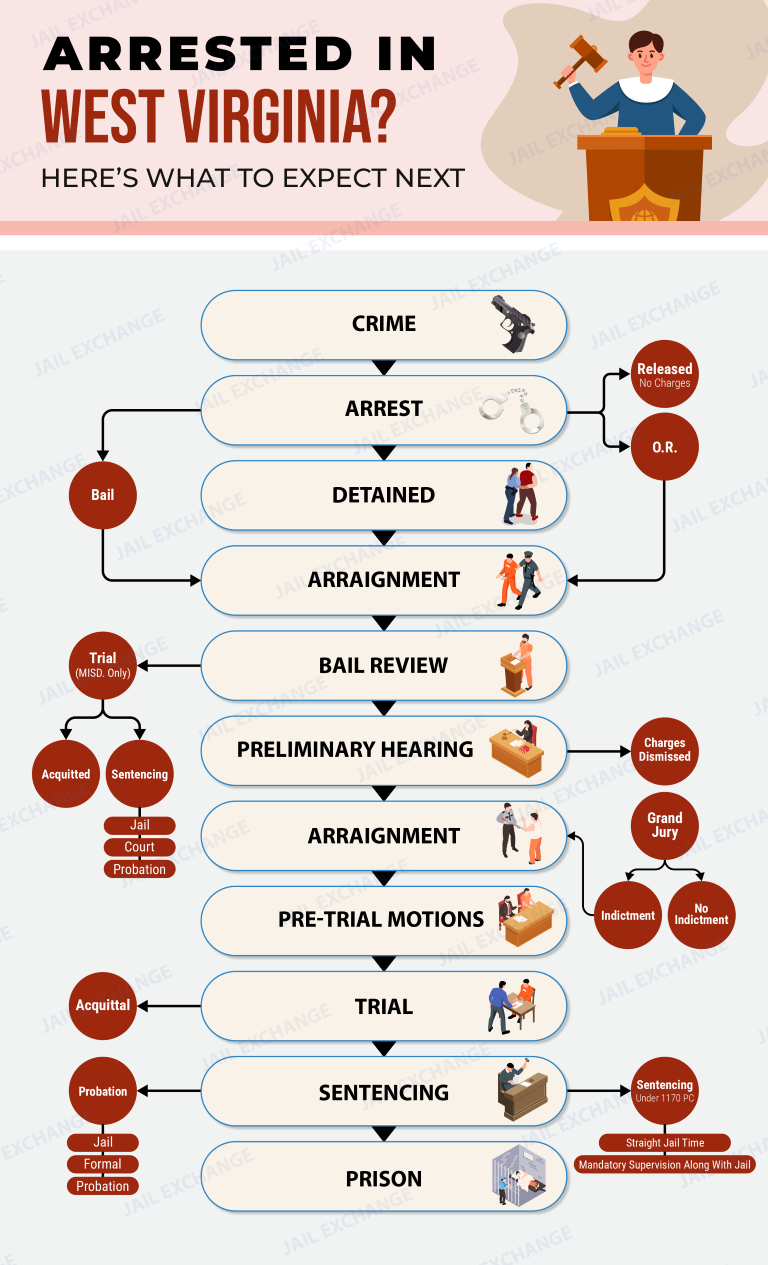
An arrest in Doddridge County can place a family in two different systems at once: the courts remain in the county, while detention is handled through a shared state regional jail. This guide identifies the local Magistrate Court, the Circuit Court when a verified contact is available, and the North Central Regional Jail and Correctional Facility serving this area. The questions explain bail, lawyers, misdemeanor hearings, felony trials, youth proceedings, actual sentencing limits and federal cases.
- Which courts hear criminal cases and where are they?
- What happens after arrest and which regional jail receives detainees?
- How can the family arrange bail or bond?
- How do misdemeanor cases proceed and what can they cost?
- What happens after someone is charged with a felony?
- How do serious violent crime cases proceed?
- What happens when the person arrested is younger than 18?
- What are the actual fines and possible jail or prison sentences?
- How does someone qualify for a public defender?
- What about municipal court violations and other local charges?
- How are federal crimes prosecuted and how can federal inmates be found?
Which courts hear criminal cases and where are they?
Doddridge County criminal cases begin in the county Magistrate Court for many misdemeanor matters and preliminary felony proceedings. Felony trials are within Circuit Court jurisdiction. These are separate from the facility holding the person.
- Doddridge County Circuit Court: Circuit felony hearings take place through the county court system; the Doddridge County Magistrate Court contact below handles initial criminal hearings.
- Doddridge County Magistrate Court / Magistrate Clerk: 118 East Court Street, West Union, WV 26456, 304-873-2694
Magistrate Court is the first point of contact for many arrests; the Circuit Clerk maintains Circuit Court felony records.
What happens after arrest and which regional jail receives detainees?
At the initial appearance, a county magistrate deals with the accusation and the question of pretrial release. Court dates and charges belong to the county record even when the jail building is located outside Doddridge County.
Regional detention facility serving Doddridge County: North Central Regional Jail and Correctional Facility, 1 Lois Lane, Greenwood, WV 26415. Telephone 304-873-1384. This regional jail serves multiple West Virginia counties. The county sheriff does not operate a separate ordinary county jail for these bookings.
Booking may involve identification, a photograph, fingerprints, inventory of property and a medical screening. A jail assignment is not a conviction.
How can the family arrange bail or bond?
For a Doddridge County charge, a magistrate commonly considers whether the person may be released on a personal-recognizance promise, a secured bond, a surety bond or other lawful conditions. Bond amounts belong to the court case; staff at North Central Regional Jail and Correctional Facility can help identify the custody record and payment arrangements.
For information about this facility’s bonding desk and inmate release, use the verified North Central Regional Jail and Correctional Facility facility page.
Have the person’s full legal name and booking information ready. A licensed bonding company charges a fee, which is separate from any refundable deposit made with a court.
How do misdemeanor cases proceed and what can they cost?
A misdemeanor typically remains in Magistrate Court, although some cases can reach Circuit Court on appeal or through specific procedures. Many charges are resolved after a court date, a plea discussion or trial. The accused can ask for legal representation when incarceration is possible.
Actual misdemeanor penalty examples
- Petit larceny: Theft of property worth less than $1,000 may bring up to one year in jail, a fine up to $2,500, or both (WV Code §61-3-13).
- First ordinary DUI under §17C-5-2(e): Up to six months in jail and a fine of $100–$500, plus driver license consequences.
- DUI with a blood-alcohol level of 0.15% or above under §17C-5-2(f): Two days to six months and a $200–$1,000 fine, with a minimum actual confinement requirement.
There is no single fine that applies to every West Virginia misdemeanor; the offense’s own statute determines the range.
What happens after someone is charged with a felony?
For a felony allegation in Doddridge County, the first appearance and any preliminary hearing are generally handled in Magistrate Court. A grand jury indictment sends the case to Circuit Court, where arraignment, evidence exchange, motions, a possible plea agreement and any felony trial take place. The prosecution must prove guilt beyond a reasonable doubt.
A person charged with a felony can apply for appointed counsel if unable to pay an attorney. A conviction does not automatically mean the statutory maximum sentence; the charge, mandatory provisions, criminal history and sentencing decisions matter.
How do serious violent crime cases proceed?
Murder and other serious violence allegations proceed in Circuit Court, with close attention to forensic evidence, victim testimony and release decisions. Detention may continue during the case if the legal requirements for holding the accused are satisfied.
West Virginia’s penalty for first-degree murder can be life imprisonment, while second-degree murder is also punishable by substantial imprisonment. Whether parole is possible depends on the offense and the judgment. Certain repeat serious felonies can trigger enhanced punishment under §61-11-18; those enhancements require the legal findings specified by the statute.
What happens when the person arrested is younger than 18?
A person under 18 ordinarily goes through the juvenile provisions of West Virginia’s court system rather than the adult regional jail. The Circuit Court has juvenile jurisdiction, and the judge may order diversion, supervision, treatment or a lawful placement after considering the youth’s circumstances.
Juvenile detention facilities are separate from North Central Regional Jail and Correctional Facility. A parent or guardian should ask the court for the child’s hearing details and request appointed counsel when eligible. Some grave allegations involving older teenagers can be transferred under specific statutory procedures.
What are the actual fines and possible jail or prison sentences?
West Virginia does not use one universal Class A/B/C felony sentencing chart. A person’s exposure depends on the offense statute and any applicable enhancement. The following are concrete examples:
- Petit larceny, below $1,000: up to 12 months in jail and/or $2,500 (§61-3-13(b)).
- Grand larceny, $1,000 or more: generally 1–10 years in a state correctional facility, or a discretionary jail alternative of up to one year and fine up to $2,500 (§61-3-13(a)).
- First ordinary DUI: up to six months in jail and $100–$500 (§17C-5-2(e)).
- Third DUI under §17C-5-2(m): 2–5 years in a state correctional facility, with a discretionary $3,000–$5,000 fine and license penalties.
- Impaired driving causing death under §17C-5-2(b)(2): 3–15 years and $1,000–$3,000, subject to the statute’s details.
Probation, suspension of sentences, restitution, mandatory minimums and repeat-offender laws can change the outcome. A listed range is not a prediction of the sentence in a particular case.
How does someone qualify for a public defender?
Someone without enough money to hire a lawyer should ask the magistrate or Circuit Court about appointed counsel at the earliest appearance. Eligibility depends on financial circumstances and the nature of the case. The Doddridge County court can take an application for appointed defense counsel; West Virginia Public Defender Services administers publicly funded representation.
An attorney can examine charging papers, request discovery, challenge an unlawful detention, advise on a plea offer and present information at sentencing. Family members can gather court papers and accurate contact information for counsel.
What about municipal court violations and other local charges?
Some city ordinance citations and local traffic matters are handled in municipal courts where the municipality maintains one. A county criminal charge is different: its hearings follow the county Magistrate or Circuit Court. Read the citation or court notice to identify which court actually issued it.
The Doddridge County Magistrate Clerk can be reached at 304-873-2694 at 118 East Court Street, West Union.
How are federal crimes prosecuted and how can federal inmates be found?
Federal prosecutions involve violations of federal law, such as certain interstate fraud, federal firearms offenses, federal drug trafficking or crimes on federal property. They do not automatically go to Doddridge County Circuit Court.
U.S. District Court, Northern District of West Virginia: principal courthouse 500 West Pike Street, Clarksburg, WV 26301, telephone 304-622-8513. Another division courthouse may be assigned to the particular federal case.
Federal defendants may be detained in local or contracted custody before trial. People serving federal prison sentences are placed within the federal prison system as designated by the Bureau of Prisons. To search for a federal inmate, use the Bureau of Prisons Inmate Locator.
This is general information about criminal procedure in Doddridge County, not legal advice. Anyone accused of a crime should seek individualized legal guidance.