
Scottsdale City Jail
Scottsdale City Jail
Physical Address
3700 North 75th StreetScottsdale, AZ 85251
Jail Phone Number
480-312-2503Arrested in Phoenix or anywhere in Maricopa County: a family guide
Maricopa County holds more than half of Arizona's people, from Phoenix and Mesa out to Buckeye, Wickenburg and Gila Bend. Almost every adult arrested here on a state charge ends up in the sheriff's jail system, which books close to 100,000 people a year and usually holds about 6,000 at once. Search Maricopa County Inmate Search or phone the sheriff's jail information line, 602-876-0322 (3250 West Lower Buckeye Road, Phoenix, AZ 85009). Our court guide explains what comes next.
Read inmate search answers
 Read inmate search answers
1. Where do people arrested in Maricopa County get booked?
Booking for the whole county now happens at the Intake, Transfer and Release Facility, often called ITR, at 2670 South 28th Drive, Phoenix, AZ 85009, near 28th Avenue and Durango Street. It took over the intake work that used to be done inside the 4th Avenue Jail (201 South 4th Avenue, Phoenix, AZ 85003, 602-876-0322) downtown. City officers from Phoenix, Mesa, Glendale and the rest drive their arrestees there. Every release from county custody also goes out through this building.
↑ Back to the questions2. Which Maricopa County jail houses them now?
After booking, the sheriff moves people to one of several housing jails. The roster shows which one. The 4th Avenue Jail, 201 South 4th Avenue, Phoenix, AZ 85003, sits downtown and also holds the bond and fine room. The Lower Buckeye Jail (3250 West Lower Buckeye Road, Phoenix, AZ 85009) in the west part of the city has the main medical and mental health units. The Towers Jail (3127 West Gibson Lane, Phoenix, AZ 85009) and Estrella Jail (2939 West Durango Street, Phoenix, AZ 85009) share the Durango campus. The Watkins Jail (2680 South 28th Drive, Phoenix, AZ 85009) and the 512 Facility (2670 South 28th Drive, Phoenix, AZ 85009) round out the list; the latter is a short-stay unit attached to intake.
Units open and close as the head count changes, so the roster is the best guide on any given day. Every one of them uses the same information line, 602-876-0322.
↑ Back to the questions3. Using the sheriff's Maricopa lookup
Open Maricopa County Inmate Search. The sheriff's tool asks for the last name, first name and the exact date of birth, or a booking number. A wrong birth date gives zero results, so double-check it. Once you find the person, copy the booking number. You'll need it for bonds, deposits, mail and visits.
↑ Back to the questions4. Why can't I find them online yet?
Getting from the street into the system can take 2 to 15 hours. The officer may first take the person to a city holding cell, such as the ones at Mesa, Chandler, Scottsdale, Glendale or Tempe police (120 East 5th Street, Tempe, AZ 85281, 480-350-8311) stations, for questioning or paperwork. Then comes the drive to 28th Drive, a medical check, fingerprints and photos. Phone 602-876-0322 (3250 West Lower Buckeye Road, Phoenix, AZ 85009) with the legal name and birthday. If the sheriff shows nothing, phone the city police listed above.
↑ Back to the questions5. Did a city officer hold them at a police station first?
Some Valley cities keep a small holding area. Chandler, Mesa, Glendale, Scottsdale and Tempe all have one. People stay there only for hours before they are released or taken to county intake. Mesa's holding facility answers at 480-644-2323, and Glendale's city jail at 623-930-3020. A person in one of these cells usually appears on the county roster only after the transfer.
↑ Back to the questions6. Could they have been given a citation and let go?
Arizona law lets an officer skip booking on a misdemeanor or petty offense and hand over a written court notice. Shoplifting, trespass and many traffic crimes are often handled that way in Phoenix and its suburbs. The court date on the ticket is usually in that city's municipal court. Domestic violence arrests are the big exception: state law keeps those cases out of the citation process, so expect a booking.
↑ Back to the questions7. How fast does a judge see someone after a Maricopa arrest?
Arizona's rules give 24 hours from the arrest. If that deadline passes without a hearing, the person must be let go. Maricopa County runs its Initial Appearance court inside the intake building on 28th Drive, with sessions about every three hours. The City of Phoenix holds its own initial appearance sessions there too, at 10 a.m. and 4 p.m., for some Phoenix city charges. Some people see a judge in as little as two hours after booking.
↑ Back to the questions8. What happens at the Initial Appearance hearing?
The charges are read, the judge checks if counsel is affordable, and bond conditions get set. Then the next court date is set, often in a justice court or Superior Court (175 West Madison Street, Phoenix, AZ 85003, 602-372-5375). Families can sit in on the hearing. The charges at this stage are not final. Prosecutors may later file different ones or none at all. If no complaint is filed within 48 hours of the hearing, the jail has to let the person go.
↑ Back to the questions9. How is release decided in Maricopa County?
Arizona starts from the idea that people who are charged should go home on their own promise to return. A judge adds conditions only when needed for court or for safety. Those can include a cash bond, a secured bond posted through a bail agent, pretrial supervision, a GPS bracelet, or a stay-away order. Some charges may be denied release after a hearing, including capital cases and dangerous felonies where no conditions would keep people safe. Read our Maricopa bail guide before you pay anyone.
↑ Back to the questions10. Where do I pay a Maricopa County bond?
Bonds and fines are paid at the bond and fine room on the northwest corner of the 4th Avenue Jail (201 South 4th Avenue, Phoenix, AZ 85003). Bring the exact amount: the sheriff accepts U.S. cash, a cashier's check, a postal or store-bought money order, or a card with a processing fee. Card payments must stay under 10,000 dollars. Payments over that require a Social Security number for tax reporting. Call 602-876-0322 (3250 West Lower Buckeye Road, Phoenix, AZ 85009) before paying. A bond will not free someone who has an immigration hold or a hold from another agency. Paid bonds are not refunded.
↑ Back to the questions11. Once bond is posted, how long until Maricopa lets them out?
Expect as long as 24 hours. All releases go out through the intake building on 28th Drive. Pick-up is at the public lot at Gibson Lane and 28th Drive, not at the front doors. The person can make a collect call when release is near.
↑ Back to the questions12. Which court will handle the case?
Felonies end up in Maricopa County Superior Court (175 West Madison Street, Phoenix, AZ 85003, 602-372-5375), with downtown Phoenix as its main site and other court centers in Mesa and Surprise. Misdemeanors from unincorporated areas go to one of the county's many justice courts. City misdemeanors go to that city's court, such as Phoenix Municipal Court (300 West Washington Street, Phoenix, AZ 85003, 602-262-6421). You can check case dates on the Arizona Judicial Branch's public case lookup. See the Maricopa court steps for the path from charge to trial.
↑ Back to the questions13. Can the family get a public defender?
At the Initial Appearance, the judge asks about money. If the person qualifies, the county appoints a lawyer from its Office of Public Defense Services. Make sure your loved one tells the judge plainly when they lack the funds for a lawyer. Jail calls are recorded, so tell them to save case details for the lawyer.
↑ Back to the questions14. Could someone in a Maricopa County jail have other warrants?
Outside holds are very common here. Start with the sheriff's online warrant lookup, then ask about detainers at 602-876-1000. The DPS warrant search adds a statewide sweep; the Public Access lookup finds other Arizona cases. A defense attorney can have bond set together. For superior court (175 West Madison Street, Phoenix, AZ 85003) cases, the clerk answers at 602-372-5375 (201 West Jefferson Street, Phoenix, AZ 85003). Planned turn-ins go to the sheriff's intake center, 2670 South 28th Drive, Phoenix, AZ 85009 (602-876-0322); once the bond is posted, release follows from that same building.
↑ Back to the questions15. Learning the charges and court dates
Ask the information line, 602-876-0322 (3250 West Lower Buckeye Road, Phoenix, AZ 85009), for the charges listed at booking. Later, the case number shows on the state's online case search and on the lookup run by the Superior Court (175 West Madison Street, Phoenix, AZ 85003, 602-372-5375). Police reports are public records under Arizona law, but agencies hold back open investigations. Request them from the arresting city's records unit.
↑ Back to the questions16. How do visits work at the Maricopa jails?
The sheriff mainly uses video visits. They can be done remotely from home on a computer or phone, or on screens in a jail lobby. Visitors must sign up and get approved before the first visit. Schedules shift with jail moves and lockdowns, so check online or call the jail before you plan (all MCSO jails, for example Lower Buckeye Jail at 3250 West Lower Buckeye Road, Phoenix, AZ 85009, answer at 602-876-0322). See Maricopa visitation and video visits from home.
↑ Back to the questions17. Calls, deposits and commissary in the Maricopa jails
The jail phone system lets people make outgoing calls, and every call starts from inside the jail. A prepaid phone account lets you accept those calls. Money for snacks and hygiene goes into the person's account, through lobby kiosks at the jails or online. Some housing units allow messages and tablets. Our guides: Maricopa jail calls, messages and texts, tablets, putting money on the books, Maricopa commissary.
↑ Back to the questions18. How do I send mail to a Maricopa inmate?
Use the person's full name and booking number on each envelope, plus your own name and return address. Personal mail must be free of cash, stickers and anything sticky. The jail mail rules change, so confirm the current address at Maricopa inmate mail before you send.
↑ Back to the questions19. What if they need medicine or medical care?
Use the sheriff's online form to report a health condition, or call 602-876-0322 (201 South 4th Avenue, Phoenix, AZ 85003) and ask for medical. Give the medicine names, the doctor and the pharmacy. Correctional health staff decide care inside. Lower Buckeye Jail (3250 West Lower Buckeye Road, Phoenix, AZ 85009) has the main medical and mental health units. Mention any risk of suicide right away.
↑ Back to the questions20. Where are kids under 18 held?
Juvenile Court runs its own detention centers, one on Durango Street in Phoenix and one in Mesa. They are separate from the sheriff's jails, and minors stay off the adult roster. A judge reviews detention within 24 hours. Call the juvenile court's detention line or our juvenile detention page (3131 West Durango Street, Phoenix, AZ 85009, 602-506-4280) for help.
↑ Back to the questions21. Does a reservation arrest change things in Maricopa?
The Salt River Pima-Maricopa Indian Community, the Gila River Indian Community, the Fort McDowell Yavapai Nation and the Tohono O'odham Nation's lands near Gila Bend each have their own police and courts. Tribal jails are separate from the county system, and their inmates stay off the sheriff's search. Salt River's detention center answers at 480-362-7200 and Gila River's at 520-562-7061. A non-Native person arrested on tribal land is often turned over to county or federal officers.
↑ Back to the questions22. How do I check for a warrant in Maricopa County?
MCSO keeps a public warrant search by name, and its main line, 602-876-1000, can say whether a listed warrant is active. For holds issued by other agencies, run the DPS statewide warrant search, then open the Arizona courts case lookup for the case number and issuing court. The superior court clerk, 201 West Jefferson Street, Phoenix, AZ 85003 (602-372-5375), explains what a felony warrant requires. To clear one, surrender at the Intake, Transfer and Release facility, 2670 South 28th Drive, Phoenix, AZ 85009 (602-876-0322), using the door marked Self-Surrender, then post the bond set on the warrant.
↑ Back to the questions23. How do I spot a bail scam?
Genuine bonds get paid at the 4th Avenue bond room, at a court, or through a licensed bail agent you chose. Calls demanding gift cards, crypto or wires for a release are fraud. Hang up and call 602-876-0322 (3250 West Lower Buckeye Road, Phoenix, AZ 85009) yourself.
↑ Back to the questions24. What should I confirm by phone before driving to a Maricopa jail?
Call the sheriff's jail information line at 602-876-0322 (3250 West Lower Buckeye Road, Phoenix, AZ 85009) to confirm which building holds the person, the booking number and the exact bond. For street patrol or general questions, the sheriff's main line is 602-876-1000.
↑ Back to the questions25. What if federal agents arrested them?
It often starts after officers from the U.S. Marshals or the DEA make the arrest. Cases out of this area are heard in the District of Arizona's Phoenix Division, sitting in Phoenix: 401 West Washington Street, Phoenix, AZ 85003. For case questions, reach the clerk at 602-322-7200. Soon after booking, they appear before a U.S. magistrate judge for a first hearing. There will be an interview with a pretrial officer; the judge sees the answers. In U.S. court, release is decided case by case. Under federal bail law, the magistrate runs a short hearing to decide release or detention.
Search the local inmate list; there a Marshals hold might appear. Many federal detainees stay in a private jail rented by the Marshals. Phoning the Marshals on 602-382-8768 may confirm their location. Its address is 401 West Washington Street, Suite 270, Phoenix, AZ 85003. Once there is a federal sentence, they transfer to BOP (320 First Street NW, Washington, DC 20534, 202-307-3198) custody when a bed opens. Find the person through the federal inmate locator by full name.
↑ Back to the questions26. How will an ICE detainer work in this county?
- Right after arrest, the person's prints are checked by federal agencies. ICE may then place a detainer.
- Making the bond does not remove the detainer.
- Through a detainer, ICE requests that the sheriff keep the person up to 48 hours after they would otherwise be released.
- Immigration officers may take custody within those 48 hours. Without an ICE pickup, that means the person goes free.
- Look them up at the locator after the move; enter the A-number and birth country. Without the A-number? Enter the person's legal name, date of birth and native country instead.
- The agency decides the next facility, and it can change.
- Status questions can go to the Phoenix ICE office: 2035 North Central Avenue, Phoenix, AZ 85004, 602-257-5900.
27. Sentenced to state prison: what happens now
If the court orders prison time, the person is now an ADCRR (701 East Jefferson Street, Phoenix, AZ 85034, 602-542-5497) inmate in the care of the state corrections department. Before that, most people wait in the Phoenix jail until the ADCRR finds a bed. Their first ADCRR stop is an intake or reception unit where staff process them. At intake, the ADCRR checks custody score, health and mental health needs, and gang connections. Finally, the ADCRR sends them to a unit that fits that rating.
The ADCRR inmate search shows the current unit after intake. For visits and mail, read our Arizona prison guide.
↑ Back to the questions28. Are there Maricopa County mugshots I can look up?
Yes. Open a name in the Maricopa County roster and Maricopa mugshots load with it. Some Maricopa entries load the photo slowly.
To get an immigration mugshot, submit ICE's online FOIA request; ICE must sign off. If a jail photo hasn't been posted, media questions go through the sheriff's office at 602-876-1000. A federal mugshot is not released, even to reporters. The U.S. Marshals Service (401 West Washington Street, Suite 270, Phoenix, AZ 85003, 602-382-8768), which takes federal mugshots, releases one only in a few cases: for a fugitive or escaped inmate, to help the search or to alert the public or if there's an urgent safety need.
↑ Back to the questions29. Which Valley police department arrested them?
Each city runs its own police force. These are their non-emergency lines:
Phoenix Police keep their station at 100 West Washington Street, Phoenix, AZ 85003; the desk line is 602-262-6151. Mesa Police work from 130 North Robson, Mesa, AZ 85201 (480-644-2211). Chandler Police sit at 250 East Chicago Street, Chandler, AZ 85225; call 480-782-4130. Glendale Police answer 623-930-3000 at 6835 North 57th Drive, Glendale, AZ 85301. Scottsdale Police operate from 8401 East Indian School Road, Scottsdale, AZ 85251, reachable at 480-312-5000. Gilbert Police work from 75 East Civic Center Drive, Gilbert, AZ 85296 (480-503-6500). Tempe Police sit at 120 East 5th Street, Tempe, AZ 85281; call 480-350-8311. Peoria Police answer 623-773-8311 at 8351 West Cinnabar Avenue, Peoria, AZ 85345. Surprise Police have their headquarters at 14250 West Statler Plaza, Suite 103, Surprise, AZ 85374 and answer 623-222-4000. Goodyear Police work from 11 North 145th Avenue, Goodyear, AZ 85338 (623-932-1220). Avondale Police sit at 11485 West Civic Center Drive, Avondale, AZ 85323; call 623-333-7001. Buckeye Police answer 623-386-4421 at 21699 West Yuma Road, Suite 104, Buckeye, AZ 85326. Queen Creek Police can be found at 20727 East Civic Parkway, Queen Creek, AZ 85142, with a front desk on 480-358-3500. El Mirage Police work from 12401 West Cinnabar Avenue, El Mirage, AZ 85335 (623-500-3000). Tolleson Police sit at 8350 West Van Buren Street, Tolleson, AZ 85353; call 623-936-7186. Paradise Valley Police answer 480-948-7410 at 6433 East Lincoln Drive, Paradise Valley, AZ 85253. Wickenburg Police answer non-emergency calls on 928-684-5411 at 1980 West Wickenburg Way, Wickenburg, AZ 85390. Sheriff's deputies operate out of the Maricopa County Sheriff's Office headquarters, 550 West Jackson Street, Phoenix, AZ 85003, main line 602-876-1000.
Towns such as Fountain Hills, Cave Creek, Anthem, Sun City and Gila Bend are patrolled by sheriff's deputies, so start with the sheriff. Arizona state troopers on the freeways and campus police at the state university also bring people to intake.
↑ Back to the questionsMaricopa County contacts
- Roster: Maricopa County Inmate Search
- Intake and release: Intake, Transfer and Release Facility (2670 South 28th Drive, Phoenix, AZ 85009), 602-876-0322
- Jail information: 602-876-0322 (3250 West Lower Buckeye Road, Phoenix, AZ 85009)
- Sheriff main line: 602-876-1000
- Phoenix police (100 West Washington Street, Phoenix, AZ 85003): 602-262-6151
- Mesa police (130 North Robson, Mesa, AZ 85201): 480-644-2211
- Salt River detention: 480-362-7200
Phone numbers and housing units change often in the Valley. Always call first. Read this as Maricopa background for families only, and get advice from a lawyer.
Information for this service is currently unavailable.
Navigating a Criminal Case in the Maricopa County Courts
With more than four and a half million residents, Maricopa County runs one of the largest trial court systems in the country, and a criminal charge here can land in any of dozens of courtrooms depending on where the arrest occurred and how serious it is. Felonies and all juvenile cases are handled by the Superior Court of Arizona in Maricopa County. Its criminal departments sit in downtown Phoenix at the Central Court Building, 201 W. Jefferson Street, Phoenix, AZ 85003, and the South Court Tower, 175 W. Madison Street, Phoenix, AZ 85003; the court’s information center is (602) 506-3204. Juvenile cases are heard at the Durango Juvenile Court Center, 3131 W. Durango Street, Phoenix, AZ 85009, and the Southeast Juvenile Court Center, 1810 S. Lewis Street, Mesa, AZ 85210, each with a detention facility on site. More is in our bond guide. Before driving to the courthouse, check current bookings on Maricopa County Inmate Search.
Misdemeanors are divided between two other kinds of courts:
- Justice courts: more than two dozen county precincts, grouped into regional justice court centers, hear misdemeanors filed by the Maricopa County Attorney, usually from arrests by the Sheriff’s Office, the Department of Public Safety or police in towns without their own court.
- City and town courts: about two dozen municipalities, including Phoenix, Mesa, Glendale, Scottsdale, Tempe and Chandler, run their own courts with city prosecutors. The largest is Phoenix Municipal Court, 300 W. Washington Street, Phoenix, AZ 85003, (602) 262-6421.
Because the list is long, the azcourts.gov court finder is the fastest way to confirm which justice or city court has a particular case. Felonies are prosecuted by the Maricopa County Attorney’s Office, headquartered at 225 W. Madison Street, Phoenix, AZ 85003.
Federal crimes from Maricopa County are tried a few blocks away at the Phoenix federal courthouse, 401 West Washington Street, Phoenix, AZ 85003, the headquarters of the U.S. District Court for the District of Arizona; clerk (602) 322-7200. The dividing line is the source of the law. Offenses defined by Arizona statutes, which make up the vast majority of arrests, are charged by the County Attorney or a city prosecutor in the courts above. The U.S. Attorney prosecutes violations of federal law: large-scale drug and human smuggling networks that run through Phoenix, illegal reentry and other immigration offenses, bank robbery, federal firearms and child-exploitation crimes, cheating U.S. benefit programs, and acts on federal ground such as Luke Air Force Base or the Tonto National Forest. Tribal land sits inside or along the county too: the Salt River Pima-Maricopa Indian Community, the Fort McDowell Yavapai Nation, part of the Gila River Indian Community, and the Tohono O’odham Nation’s San Lucy District near Gila Bend. Under the Major Crimes Act, serious felonies such as murder, kidnapping and sexual abuse committed by Native Americans on those lands go to federal court, and tribal courts take up many smaller cases. Select a category below.
1. Misdemeanors in Phoenix and the suburbs (DUI, shoplifting, family-violence assault, property damage)
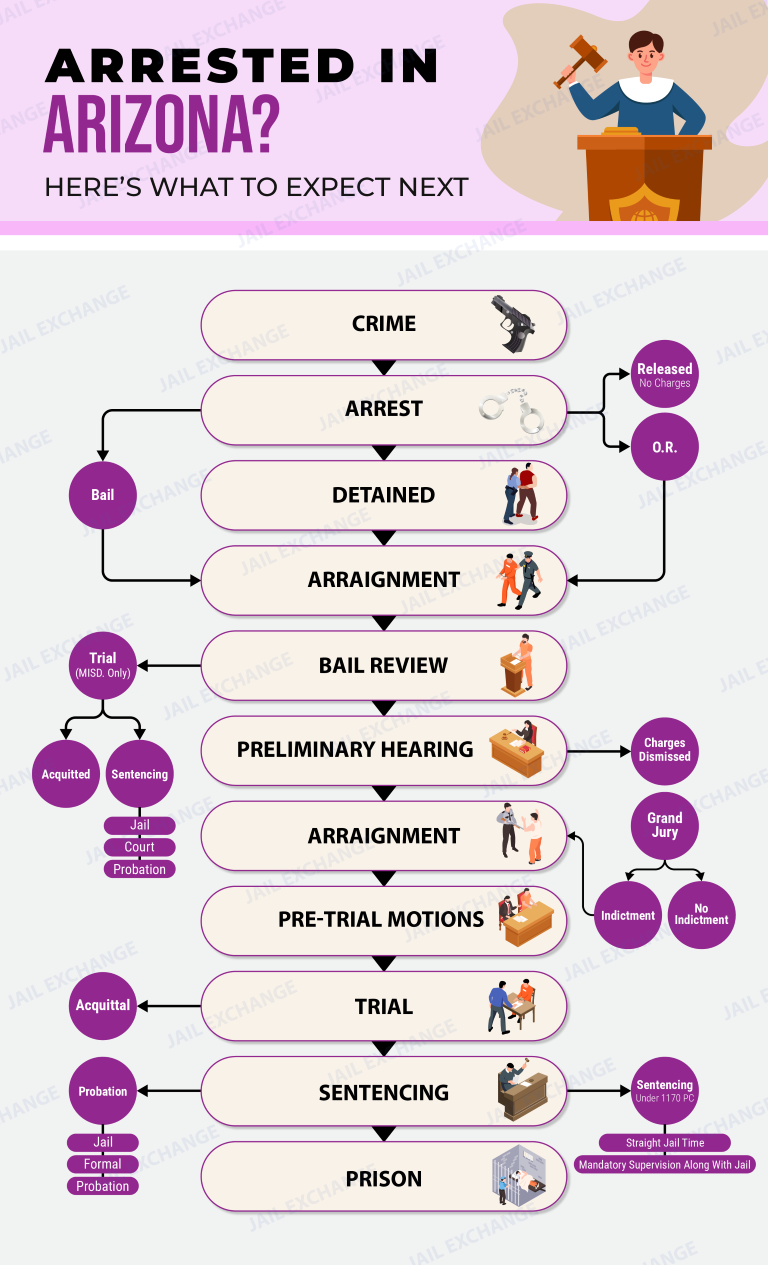
In the Valley, the badge on the arresting officer decides the courtroom. A Phoenix police (100 West Washington Street, Phoenix, AZ 85003, 602-262-6151) citation goes to Phoenix Municipal Court (300 West Washington Street, Phoenix, AZ 85003, 602-262-6421) and is prosecuted by the city prosecutor; a Mesa or Tempe ticket goes to that city’s court; a deputy or trooper stop on a freeway or in county land outside cities usually lands in the precinct's justice court. Most people are cited and released. Those who are booked, as often happens after a domestic-violence call, are brought to the Initial Appearance Court at Intake, Transfer and Release (2670 South 28th Drive, Phoenix, AZ 85009, 602-876-0322) within 24 hours, where a commissioner sets release terms. Arizona law presumes release on recognizance unless the judge finds a reason to require more.
How much punishment is possible turns on the misdemeanor’s class. Class 1, where a first DUI, most family-violence assaults and shoplifting fall, can bring six months behind bars and a $2,500 fine. Class 2 reaches four months and $750. Class 3 reaches 30 days and $500. Surcharges can nearly double the base fine. If jail is possible and cash is short, the person may request appointed counsel; most city courts contract with private defense firms, and in the justice courts the Maricopa County Public Defender (620 West Jackson Street, Suite 4015, Phoenix, AZ 85003, 602-506-7711) or contract counsel takes the case.
Many cities offer diversion for first-time shoplifting, minor drug possession or domestic-violence offenses, ending in dismissal after classes or counseling. Cases that do not settle are usually tried to the judge; a six-person jury is reserved mainly for DUI and offenses with a historical jury-trial right. A jailed person should get a trial within 150 days of arraignment, and a free person within 180. Most Valley misdemeanors are done in under four months.
Under 18: Juvenile misdemeanors are filed in the Superior Court’s Juvenile Department at the Durango or Southeast center, depending on where the youth lives. Juvenile Probation (3125 West Durango Street, Phoenix, AZ 85009, 602-506-4011) reviews each referral, and a large share of first-time offenders are offered diversion with community service, education programs or a teen court rather than a formal petition. Certain minor violations, including underage drinking, tobacco and vaping, curfew and traffic tickets, may go to a justice or city court instead. A youth taken into detention at Durango or Southeast receives a detention hearing within 24 hours once a petition is on file, and the Public Defender represents eligible juveniles. Juvenile jurisdiction ends at 18, except that the state may extend it to 19 for a 17-year-old by filing a notice before adjudication (A.R.S. 8-202).
↑ Back to the questions2. Felony charges (burglary, drug sales, aggravated DUI, fraud schemes)
Almost every felony arrest in the county funnels through the Initial Appearance courtroom inside the 28th Drive intake center (2670 South 28th Drive, Phoenix, AZ 85009, 602-876-0322), where judges sit 365 days a year so nobody waits past 24 hours. The judicial officer reviews probable cause for the arrest, sets release conditions or bond, and determines whether the person qualifies for appointed counsel. Maricopa County splits indigent defense among several agencies: the Public Defender, the Legal Defender, the Legal Advocate and private attorneys assigned through the Office of Public Defense Services, which allows conflict-free representation for co-defendants.
The County Attorney must then obtain a grand jury indictment or win a preliminary hearing, which Rule 5.1 requires within 10 days for jailed defendants and 20 days for those released. Maricopa relies heavily on its standing grand juries, so many defendants skip the preliminary hearing. Next comes a not-guilty arraignment, often by video for jailed defendants, then an Initial Pretrial Conference where police reports and other evidence change hands and the court picks a trial date, and a Pretrial Management Conference about four weeks before trial. Plea offers are frequently made early and can expire if not accepted. The deadline for trial is 150 days after arraignment when jailed or 180 days when not, with an eight-person jury in most felony trials.
Murder aside, which is class 1, Arizona grades felonies on a scale running from class 2 down to class 6. First offenders in non-dangerous cases are often eligible for probation; presumptive prison terms run from one year (class 6) to five years (class 2), and prior convictions raise the ranges significantly under A.R.S. 13-703. A first or second conviction for having drugs for personal use must get probation under Prop 200, and class 6 felonies may become misdemeanors under A.R.S. 13-604. Anyone sent to prison serves at least 85% of the sentence. A typical felony case in Maricopa County takes six months to a year.
Under 18: A 14- to 17-year-old charged with a non-violent felony usually faces a delinquency petition in Juvenile Court, with possible outcomes ranging from probation and treatment to commitment with the Arizona Department of Juvenile Corrections. The County Attorney has the option under A.R.S. 13-501(B) to file in adult court instead when the youth is at least 14 and the charge is a class 1 or 2 felony, an enumerated class 3 felony, a dangerous offense, or any felony by a chronic felony offender. The county’s Juvenile Department works out of the Durango and Southeast court centers in Phoenix and Mesa.
↑ Back to the questions3. Violent and serious felonies (murder, sexual assault, armed robbery)
Violent felony files in Maricopa County use those felony steps too, yet pretrial release is much rarer. The Arizona Constitution (art. 2, § 22) allows a no-bail hold in capital and sexual assault cases with strong proof, and prosecutors may also push for a dangerousness hearing to keep the person jailed. Defendants held without bail typically stay at Lower Buckeye (3250 West Lower Buckeye Road, Phoenix, AZ 85009, 602-876-0322) or another Sheriff’s jail for the duration.
Offenses involving a deadly weapon or serious physical injury are “dangerous” under A.R.S. 13-704, eliminating probation. First-offense ranges include:
- First-degree murder: death, natural life, or life with release possible after 25 years. The Maricopa County Attorney has historically sought death more often than any other Arizona prosecutor; capital cases require a 12-person jury and two qualified defense lawyers, often from the Public Defender’s capital unit. Executions in Arizona resumed in 2022.
- Second-degree murder: 10 to 25 years, 16 presumptive.
- Armed robbery: 7 to 21 years, presumptive 10.5.
- Sexual assault: 5.25 to 14 years with no early release, plus lifetime registration.
Victims are guaranteed participation rights under the Arizona Victims’ Bill of Rights, Article 2, Section 2.1: they are told about each key hearing, may refuse to talk to the defense, get a turn at the microphone before bail, plea and punishment rulings, and should be repaid quickly. The County Attorney’s victim services advocates help navigate these. Homicide and sexual-assault cases in Maricopa County routinely take two years or more, and capital cases often last four or five.
Under 18: A.R.S. 13-501(A) sends teens aged 15 through 17 straight to adult court for first- or second-degree murder, forcible sexual assault, armed robbery or another violent felony offense, or when a chronic felony offender commits any felony. Those teens are often held in juvenile detention (3131 West Durango Street, Phoenix, AZ 85009, 602-506-4280) while their cases proceed in the adult criminal courts downtown. For a 14-year-old accused of violence, adult court is the prosecutor's choice. The death penalty is off the table for youths, and sentencing courts must weigh age when considering life terms.
↑ Back to the questions4. Maricopa County Superior Court buildings
Criminal courtrooms are in downtown Phoenix, with regional centers in Mesa, Surprise and north Phoenix:
- Central Court Building (information center): 201 West Jefferson Street, Phoenix, AZ 85003 · 602-506-3204
- South Court Tower (criminal courtrooms): 175 West Madison Street, Phoenix, AZ 85003 · 602-372-5375
- Southeast regional court center: 222 East Javelina Avenue, Mesa, AZ 85210 · 602-372-5375
- Northwest regional court center: 14264 West Tierra Buena Lane, Surprise, AZ 85374 · 602-372-5375
- Northeast regional court center: 18380 North 40th Street, Suite 120, Phoenix, AZ 85032 · 602-372-5375
- Durango juvenile court center: 3131 West Durango Street, Phoenix, AZ 85009 · 602-506-4280
- Southeast juvenile court center: 1810 South Lewis Street, Mesa, AZ 85210 · 602-506-4280
5. How do I check for and clear a warrant in Maricopa County?
The sheriff's office offers an online warrant lookup; its switchboard is 602-876-1000. DPS has a free statewide warrant search, and the Public Access case lookup covers many courts. Clear a warrant with the issuing justice, city or superior court (175 West Madison Street, Phoenix, AZ 85003), or through an attorney. The Superior Court clerk (201 West Jefferson Street, Phoenix, AZ 85003) answers at 602-372-5375. Callers demanding payment to cancel a warrant are a scam. Turn yourself in at Intake, Transfer and Release, 2670 South 28th Drive, Phoenix, AZ 85009, 602-876-0322, and post the warrant's bond once booked.
↑ Back to the questions6. Federal cases from Maricopa County
The U.S. District Court for the District of Arizona hears federal cases in downtown Phoenix:
- First appearance at Phoenix federal courthouse, 401 West Washington Street, Phoenix, AZ 85003 (clerk 602-322-7200).
- A pretrial officer meets the defendant and writes up a release recommendation.
- Prosecutors may push for a detention hearing, usually within a few days.
- Anyone kept in custody is housed by the Marshals, sometimes outside the Valley.
Questions about where a federal prisoner sits go to U.S. Marshals Service, 401 West Washington Street, Suite 270, Phoenix, AZ 85003, 602-382-8768.
↑ Back to the questions7. Searching for someone after a Maricopa arrest
- Maricopa County Inmate Search: covers the Fourth Avenue, Lower Buckeye (3250 West Lower Buckeye Road, Phoenix, AZ 85009, 602-876-0322) and other sheriff's jails. Type the last and first name.
- VINELink (https://vinelink.vineapps.com/): pick Arizona and enter the name to see custody status in any county jail or state prison.
- Federal Bureau of Prisons Inmate Locator (320 First Street NW, Washington, DC 20534, 202-307-3198) (https://www.bop.gov/inmateloc/): search a register number or name; call 602-382-8768 (401 West Washington Street, Suite 270, Phoenix, AZ 85003) for someone awaiting federal trial.
- ADCRR Inmate Data Search (701 East Jefferson Street, Phoenix, AZ 85034, 602-542-5497) (https://inmatedatasearch.azcorrections.gov/): name or ADCRR number for state prison placement.
- ICE Online Detainee Locator System (https://locator.ice.gov/odls/): A-number plus birth country; if nothing comes back, call 602-257-5900 (2035 North Central Avenue, Phoenix, AZ 85004).
8. ICE detainers in Maricopa County
The sheriff's office tells ICE when a person with a detainer will be released, but doesn't hold anyone past release. A detainer asks the sheriff to keep the person up to 48 hours after they would otherwise be released. A.R.S. 11-1051 bars county limits on enforcement.
Removal matters for this area are handled by ICE Phoenix Field Office, 2035 North Central Avenue, Phoenix, AZ 85004, 602-257-5900. Detention sites:
- Eloy Detention Center: 1705 East Hanna Road, Eloy, AZ 85131 · 520-464-3000
- Florence Service Processing Center: 3250 North Pinal Parkway, Florence, AZ 85132 · 520-868-5862
- Central Arizona Florence Correctional Center: 1155 North Pinal Parkway, Florence, AZ 85132 · 520-868-9095
Take this as a guide to the usual path, not legal advice for a specific case. A person charged in the Valley should hire private counsel or ring the Maricopa County Public Defender, 620 West Jackson Street, Suite 4015, Phoenix, AZ 85003, at (602) 506-7711.
Call the criminal information desk at 602-506-3204 to confirm the courtroom before your hearing.
Information for this service is currently unavailable.
Information for this service is currently unavailable.
Information for this service is currently unavailable.
Information for this service is currently unavailable.
Information for this service is currently unavailable.
Information for this service is currently unavailable.
Maricopa County County Jails
Maricopa County City Jails
Maricopa County Juvenile Facilities
Nearby counties
- Maricopa County Jails Info: 602-876-0322
- Administration: 602-876-1801
- Adult Probation: 602-372-5900
- Bail: 602-876-0322
- Booking: 602-876-0322
- Court: 602-506-8575
- Dispatch: 602-876-1011
- District Attorney: 602-506-3411
- Inmate Info: 602-876-1070
- Juvenile: 602-506-4280
- Juvenile Court: 602-506-4041
- Juvenile Court (other): 602-506-2850
- Juvenile Detention (other): 602-506-2669
- Juvenile Probation: 602-506-4011
- Phoenix Police: 602-262-6151
- Police Tips: 800-343-8477
- Public Defender: 602-506-7711
- Sheriff: 602-876-1000
The Scottsdale City Jail serves the following cities and towns of Maricopa County: Avondale, Buckeye, Carefree, Cave Creek, Chandler, El Mirage, Fountain Hills, Gilbert, Glendale, Goodyear, Guadalupe, Litchfield Park, Mesa, Paradise Valley, Peoria, Phoenix, Queen Creek, Scottsdale, Surprise, Tempe, Tolleson, Wickenburg and Youngtown.